Notes of XI Physics SG, Physics Mech. Prop. of Fluids.pdf - Study Material
Page 1 :
Mechanical Properties of Fluids, (5 marks)
Page 2 :
Fluids – liquids or gases, When an object is submerged in a fluid at rest, the fluid, exerts a normal force on its surface., , Why normal force?, If there was a component of force parallel to the surface,, the object would also exert a force on the fluid parallel to, it; as a consequence of Newton’s third law. This force will, cause the fluid to flow parallel to the surface. Since the, fluid is at rest, this cannot happen. Hence, only the, normal component acts on the surface of the object., , The force exerted by the liquid in the, beaker on the submerged object or, on the walls is normal(perpendicular), to the surface at all points.
Page 3 :
The average pressure is the ratio of force to area., Pav= F/A, Where P = Pressure, F = Force, A = Area on which the force acts, It is a scalar quantity., Its dimensions are [ML-1T-2]., The SI unit of pressure is Nm-2 or pascal(Pa)., A common unit of pressure is the atmosphere(atm), i.e. the, pressure exerted by the atmosphere at sea level., So, 1 atm = 1.013× 10⁵ Pa, Where F = magnitude of the normal force, A = Area of the piston, P = Pressure, , Smaller the area on which the force acts, greater is the impact., Eg: A sharp needle pressed on a soap bar makes a hole on it. If the, same bar is pressed with a blunt object like a spoon there is very, little impact. This is because needle has a smaller contact area, whereas spoon has a wider contact area.
Page 4 :
Where m = mass of fluid, V = volume of fluid, ρ = density of fluid, , • It is a positive scalar quantity., • Its dimensions are [ML-3]., • Its SI unit is kgm-3., • Densities of liquids are nearly constant whereas those of gases are, variable with pressure., • The density of water is 1.0 × 10³ kg m-3 at 4°C (277 K)., • Relative density – The ratio of the density of the substance to the density, of water at 4°C.
Page 5 :
Densities of some common fluids at STP(Standard, temperature (0°C) and 1 atm pressure), Fluid, , Density (kg m-3), , Water, , 1.00 × 10³, , Sea water, , 1.03 × 10³, , Mercury, , 13.6 × 10³, , Ethyl alcohol, , 0.806 × 10³, , Whole blood, , 1.06 × 10³, , Air, , 1.29, , Oxygen, , 1.43, , Hydrogen, , 9.0 × 10 -2, , Interstellar space, , ≈ 10 -20
Page 6 :
Pascal’s Law, The pressure in a fluid at rest is same at all, points which are at the same height., • Consider an element ABC-DEF which is in the form of a right-angled, prism., • This element is actually very small so that every part of it can be, considered at the same depth from the liquid surface and therefore, the effect of gravity is same at all these points., • The forces exerted on it by the rest of the fluid are normal to its, surfaces., • If areas BEFC=Aa, ADFC=Ab and ADEB=Ac and if Pa, Pb and Pc are the, pressures exerted by the fluid on the element then,, Fb sinθ = Fc , Fb cosθ = Fa (by equilibrium), Ab sinθ = Ac , Ab cosθ = Aa (by geometry), Thus, Fb/Ab = Fc/Ac = Fa/Aa, , Pb = Pc = Pa, I.e. Pressure exerted is same in all directions in a fluid at rest., • The force against any area within a fluid at rest and under pressure is, normal to the area, regardless of the orientation of the area.
Page 7 :
• Now we consider a rectangular bar as a fluid element of uniform crosssection., • The bar is in equilibrium. The horizontal forces exerted at its two ends must, be balanced or the pressure at the two ends should be equal., • This proves that for a liquid in equilibrium the pressure is same at all points, in a horizontal plane., • What if the pressure isn’t equal in different parts of the fluid?, As the force is not balanced, there will be a net force in a particular direction, giving rise to a flow., • In the absence of flow the pressure in the fluid must be same everywhere.
Page 8 :
Variation of Pressure with depth - Fluid under gravity, • Consider a cylindrical element in a fluid at rest in a container having base, area A and height h., • Point 1 is at height h above a point 2., • The pressures at points 1 and 2 are P1 and P2 respectively., • As the fluid is at rest the resultant horizontal forces should be zero and the, resultant vertical forces should balance the weight of the element., • The top vertical force acting downward is P1A and the bottom vertical, force acting upward is P2A., • So, (P2 −P1) A = mg, (1), • m = ρV= ρhA, (2), • Therefore, P2 − P1 = ρgh, (3), • Where m = mass of fluid, ρ = mass density of the fluid, V = volume of cylindrical element, A = base area of cylindrical element, g = acceleration due to gravity
Page 9 :
• Pressure difference depends on h between the points (1 and 2), ρ and, g and not on the base area or the shape of the container., • If the point 1 is shifted to the top of the fluid, which is open to the, atmosphere, P1 may be replaced by atmospheric pressure (Pa) and P2, by P., • Then, P = Pa + ρgh, (4), • Thus, the pressure P, at depth below the surface of a liquid open to the, atmosphere is greater than atmospheric pressure by an amount ρgh., • P − Pa = ρgh is called a gauge pressure at depth h., • Thus, the liquid pressure is the same at all points at the same, horizontal level (same depth)
Page 10 :
• Consider three vessels A, B and C of different, shapes, connected at the bottom by a, horizontal pipe., • On filling with water, the level in the three, vessels is the same, though they hold different, amounts of water., • This is so because water has the same pressure, below each section of the vessel., , • Hydrostatic paradox -The pressure at a certain horizontal level in the fluid is, proportional to the vertical distance to the surface of the fluid.
Page 11 :
Mercury Barometer, •, •, •, , Used for measuring atmospheric pressure., Consists of a long glass tube closed at one end and filled with mercury., It is inverted into a trough of mercury., , •, , Pressure P of mercury vapour in the space above the mercury column is so, small that it may be neglected., Pressure at A = Pressure at B ( Pascal’s law), Pressure at B = Pa, So equation (4) for this case is written as, , •, •, •, , Pa = ρgh, Where ρ = density of mercury, h = height of mercury column, , 1 mm of Hg = 1 torr, 1 torr = 133 Pa, 1 bar = 105 Pa
Page 12 :
Open tube manometer, • Used for measuring pressure differences., • It consists of a U-tube containing a suitable, liquid i.e., a low density liquid (such as oil) for, measuring small pressure differences and a, high density liquid (such as mercury) for large, pressure differences., • One end of the tube is open to the atmosphere, and the other end is connected to the system, whose pressure we want to measure., , • Pressure at A = Pressure at B = P, • So we get P – Pa = ρgh
Page 13 :
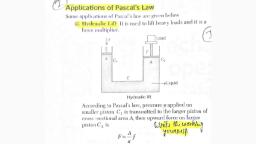
Hydraulic machines, • Hydraulic lift, , A change in pressure applied to an enclosed fluid, is transmitted undiminished to every point of the, fluid and the walls of the containing vessel, (another form of Pascal’s law)., • Two pistons are separated by the space filled with a liquid., • A piston of small cross-section A1 is used to exert a force,, F1 = P × A1 directly on the liquid., • The pressure transmitted throughout the liquid to the larger, cylinder attached with a larger piston of area A2 is, P =F1 /A1., • This pressure results in an upward force,, F2 = P × A2 = (F1 × A2) / A1, • Therefore, the piston is capable of supporting a large weight of, any heavy object., • The factor A2 / A1 is the mechanical advantage of the device.
Page 14 :
• Hydraulic brakes, , • When we apply a little force on the pedal with our foot the, master piston moves inside the master cylinder., • The pressure caused is transmitted through the brake oil to act, on a piston of larger area., • A large force acts on the piston and is pushed down expanding, the brake shoes against brake lining., • In this way, a small force on the pedal produces a large retarding, force on the wheel., • An important advantage of the system is that the pressure set up, by pressing pedal is transmitted equally to all cylinders attached, to the four wheels so that the braking effort is equal on all, wheels.
Page 15 :
Streamline flow, , (a) A typical trajectory of a fluid particle., (b) A region of streamline flow., , • The flow of the fluid is said to be steady if at any given point, the, velocity of each passing fluid particle remains constant in time., • That is, every other particle which passes the second point, behaves exactly as the previous particle that has just passed that, point., • Each particle follows a smooth path, and the paths of the particles, do not cross each other., • The path taken by a fluid particle under a steady flow is a, streamline and is defined as a curve whose tangent at any point is, in the direction of the fluid velocity at that point., • The curve PQ indicates how the fluid streams. Hence, in steady, flow, the map of flow is stationary in time.
Page 16 :
• Consider planes P, R and Q perpendicular to the direction of fluid flow The number of fluid particles crossing the surfaces, as indicated at P, R and Q is the same., • Then, ∆mP = ρPAPvP∆t , ∆mR = ρRARvR∆t and ∆mQ = ρQAQvQ∆t, (1) where ∆mP , ∆mQ , ∆mR are masses of fluids at P, Q, R, • The mass of liquid flowing out equals the mass flowing in, holds in all cases., • Therefore, ρPAPvP∆t = ρRARvR∆t = ρQAQvQ∆t, • For flow of incompressible fluids ρP = ρR = ρQ, , (2), (3), , • Equation (2) reduces to APvP = ARvR = AQvQ which is called the equation of continuity., • In general Av = constant, , (4), , • Thus, at narrower portions where the streamlines are closely spaced, velocity increases and its vice versa., , • Beyond a limiting value, called critical, speed, the steady flow loses its steadiness, and becomes turbulent., • In a laminar flow, the velocities at, different points in the fluid may have, different magnitudes but their directions, are parallel.
Page 17 :
Bernoulli’s Principle, • Consider a fluid moving steadily in a pipe of varying cross-sectional area., • Consider the flow at two regions 1 (i.e., BC) and 2 (i.e., DE)., • The fluid initially lying between B and D moves a distance v1∆t and v2∆t, respectively in an infinitesimal time interval ∆t, that is B moves to C and D, moves to E., Where v1= the speed at B, v2= the speed at D, •, , The work done on the fluid at left end (BC) is, W1 = P1A1(v1∆t) = P1∆V, , •, , The work done on the fluid at right end (DE) is, W2 = –P2A2(v2∆t) = –P2∆V, , •, , So the total work done on the fluid is., W1– W2 = (P1−P2) ∆V, Where P1 = pressure at A1, P2 = pressure at A2
Page 20 :
Venturi - meter, • The Venturi-meter is a device to measure the flow speed, of incompressible fluid., • It consists of a tube with a broad diameter and a small, constriction at the middle and a manometer in the form, of a U-tube is attached to it, with one arm at the broad, neck point of the tube and the other at constriction., • From equation of continuity,, v1A= v2a, , v2= (A/a)v1, , • Using Bernoulli’s equation,, P1 + (1/2)ρv12 = P2 + (1/2)ρv12 (A/a)2, • Therefore, (P1−P2) = (1/2)ρv12[(A/a)2 − 1], • This pressure difference causes the fluid in the U-tube, connected at the narrow neck to rise in comparison to the, other arm., •
Page 21 :
Dynamic Lift - The force that acts on a body, such as airplane, wing, a hydrofoil or a spinning ball, by virtue of its motion, through a fluid., , • For a ball moving without spin, there is symmetry of streamlines, so the velocity of fluid (air), above and below the ball at corresponding points is the same resulting in zero pressure, difference. The air therefore, exerts no upward or downward force on the ball., • For a ball moving with spin, the streamlines are crowded above the ball and rarified below it., This is because the ball drags air along with it resulting in larger velocity above the ball and, smaller below it. This in turn results in pressure difference and there is net upward force on the, ball. This dynamic lift due to spinning is called Magnus effect.
Page 22 :
• When an aerofoil moves against the wind, the orientation of the wing relative to flow, direction causes the streamlines to crowd together above the wing more than those, below it., • The flow speed on top of the areofoil is higher than that below it., • There is an upward force resulting in a dynamic lift of the wings and this balances the, weight of the plane.
Page 23 :
Viscosity, • The internal friction or resistance offered by most fluids to its motion due to relative, motion between its layers is called viscosity., • Honey is more viscous than oil., Suppose we consider oil and honey enclosed between two glass plates of which the, bottom plate is fixed while the top plate is moved with a constant velocity v relative to the, fixed plate. A greater force is required to move the plate enclosing honey with the same, velocity. The fluid in contact with a surface has the same velocity as that of the surfaces., Hence, the layer of the liquid in contact with top surface moves with a velocity v and the, layer of the liquid in contact with the fixed surface is stationary. The velocities of layers, increase uniformly from bottom (zero velocity) to the top layer (velocity v). For any layer, of liquid, its upper layer pulls it forward while lower layer pulls it backward. This results in, force between the layers. This type of flow is known as laminar., The coefficient of viscosity is given as,, η = (F/A)/(v/l) = Fl/vA ,where (F/A)= shearing stress , (v/l)= strain rate, • The SI unit of viscosity is poiseiulle (Pl). Its other units are N s m-2 or Pa s.
Page 24 :
• Thin liquids like water, alcohol, etc., are less viscous than thick liquids, like coal, tar, blood, glycerine, etc., • The viscosity of liquids decreases with temperature, while it increases in the, case of gases.
Page 25 :
Stokes’ Law, • When a body falls through a fluid it drags the layer of the fluid in, contact with it. As a result of relative motion between the different, layers of the fluid, the body experiences a retarding force., • Thus, viscous force is proportional to the velocity of the object,, viscosity η of the fluid and radius a of the sphere and is opposite to, the direction of motion., F =6 π η av , this is known as Stokes’ law., • A raindrop descends with a constant velocity known as terminal, velocity when it is in equilibrium and it is given by,, vt = 2a2(ρ-σ)g / (9η), So the terminal velocity vt depends on the square of the radius of the, drop and inversely on the viscosity of the medium.
Page 26 :
Reynolds number, •, •, •, •, •, , A dimensionless number which gives an approximate idea whether a flow is turbulent., Re = ρvd/η, Re= ρv2/(ηv/d) = ρAv2/(ηAv/d) = inertial force/ force of viscosity, If Re<1000 , flow is streamline or laminar, If Re>2000 , flow is turbulent., , Surface Energy and Surface Tension
Page 27 :
• For a molecule well inside a liquid, the inter-molecular attraction results in a negative potential, energy for the molecule., • To disperse the molecules far away from each other in order to evaporate or vaporise, the heat of, evaporation required is quite large., • For a molecule near the surface of liquid, only lower half of it is surrounded by liquid molecules, resulting in less negative potential energy., • Thus, molecules on a liquid surface have some extra energy also known as surface tension in, comparison to molecules in the interior., • Surface tension is equal to the surface energy per unit area of the liquid interface and is also, equal to the force per unit length exerted by the fluid., , S=Fd/2dl = F/2l
Page 28 :
Angle of contact, • The angle between tangent to the liquid surface at the point of contact and solid, surface inside the liquid is termed as angle of contact and is denoted by θ., • Consider the three interfacial tensions at three interfaces, liquid-air, solid-air and, solid-liquid denoted by Sla, Ssa and Ssl., • At the line of contact, the surface forces between the three media must be in, equilibrium., Sla cos θ + Ssl = Ssa, • The angle of contact is an obtuse angle if Ssl > Sla as in the case of waterleaf interface while it is an acute angle if Ssl < Sla as in the case of waterplastic interface., • When θ is an obtuse angle then molecules of liquids are attracted, strongly to themselves and weakly to those of solid., • On the other hand, when θ is an acute angle then the molecules of the, liquid are strongly attracted to those of solid.
Page 29 :
Drops and bubbles, Consequences of surface tension, • Spherical shape of free liquid drops and, bubbles., • More pressure inside a spherical drop, than outside., • For a liquid drop,, , (Pi– Po) = (2 Sla/ r), • For a bubble,, (Pi– Po) = (4 Sla/ r)
Page 30 :
Capillary rise, •, •, •, •, •, •, , •, •, •, , A consequence of the pressure difference across a curved liquid-air, interface is the effect that water rises up in a narrow tube in spite of, gravity., If we consider a vertical capillary tube of circular cross section (radius a), inserted into an open vessel of water, the contact angle between water, and glass is acute., Thus the surface of water in the capillary is concave., So the pressure difference between the two sides of the top surface is, given by, (Pi– Po)=(2S/r) = 2S/(a sec θ ) = (2S/a) cos θ, Thus the pressure of the water inside the tube, just at the meniscus (airwater interface) is less than the atmospheric pressure., Points A and B must be at the same pressure., P0 + h ρ g = Pi = PA, where ρ = the density of water, h = capillary rise, Using both the above equations we have,, h ρ g = (Pi– P0) = (2S cos θ )/a, If cos θ is negative then, it is clear that the liquid will be lower in the, capillary.
Page 31 :
Detergents and surface tension, • Washing clothes with water does not remove grease or oil stains. This is because, water does not wet greasy dirt; i.e., there is very little area of contact between, them., • To remove the grease detergents are used. The molecules of detergents are, hairpin shaped, with one end attracted to water and the other to molecules of, grease, thus tending to form water-oil interfaces., • Addition of detergents drastically reduces the surface tension( water-oil) and, thereby helps in removing stains.



 Learn better on this topic