Notes of Class11, Maths Chemistry & Physic 3 VECTORS PH6SICS NOTES .PDF.pdf - Study Material
Page 1 :
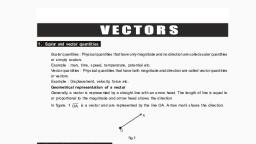
Vectors, , 1, , y, ˆj, , x, , k̂, , î, , z, , Fig. 0.1, , Chapter, , 0, , Vectors, Introduction of Vector, Physical quantities having magnitude, direction and obeying laws of, vector algebra are called vectors., Example : Displacement, velocity, acceleration, momentum, force,, impulse, weight, thrust, torque, angular momentum, angular velocity etc., If a physical quantity has magnitude and direction both, then it does, not always imply that it is a vector. For it to be a vector the third condition, of obeying laws of vector algebra has to be satisfied., Example : The physical quantity current has both magnitude and, direction but is still a scalar as it disobeys the laws of vector algebra., , Types of Vector, (1) Equal vectors : Two vectors A and B are said to be equal when they, have equal magnitudes and same direction., , (7) Orthogonal unit vectors ˆi , ˆj and kˆ are called orthogonal unit, vectors. These vectors must form a Right Handed Triad (It is a coordinate, system such that when we Curl the fingers of right hand from x to y then, we must get the direction of z along thumb). The, ˆi x , ˆj y , kˆ z, y, x, z, , x xˆi , y yˆj , z zkˆ, (8) Polar vectors : These have starting point or point of application ., Example displacement and force etc., (9) Axial Vectors : These represent rotational effects and are always, along the axis of rotation in accordance with right hand screw rule. Angular, velocity, torque and angular momentum, etc., are example of physical, quantities of this type., Axial vector, , (2) Parallel vector : Two vectors A and B are said to be parallel, , Axis of rotation, , when, (i) Both have same direction., (ii) One vector is scalar (positive) non-zero multiple of another, vector., , Anticlock wise rotation, , (3) Anti-parallel vectors : Two vectors A and B are said to be, anti-parallel when, (i) Both have opposite direction., (ii) One vector is scalar non-zero negative multiple of another, vector., (4) Collinear vectors : When the vectors under consideration can, share the same support or have a common support then the considered, vectors are collinear., (5) Zero vector (0 ) : A vector having zero magnitude and arbitrary, direction (not known to us) is a zero vector., (6) Unit vector : A vector divided by its magnitude is a unit vector. Unit, ˆ (read as A cap or A hat)., vector for A is A, , Axis of rotation, , Clock wise rotation, , Axial vector, , Fig. 0.2, , (10) Coplanar vector : Three (or more) vectors are called, coplanar vector if they lie in the same plane. Two (free) vectors are always, coplanar., , Triangle Law of Vector Addition of Two Vectors, If two non zero vectors are represented by the two sides of a, triangle taken in same order then, B, the resultant is given by the, closing side of triangle in opposite, R AB, order. i.e. R A B, B, , OB OA AB, , A, , O, A, , ˆ ., ˆ A A AA, Since, A, A, Thus, we can say that unit vector gives us the direction., , Fig. 0.3, , (1) Magnitude of resultant, vector, , JOIN TELEGRAM ➭@NOTESFORYOU12TH
Page 2 :
2 Vectors, , sin , , BN, B, , (2) Direction, , AN, AN B cos, B, , In ABN , cos , , tan , , BN B sin, , CN, B sin, , ON, A B cos, , Polygon Law of Vector Addition, , In OBN , we have OB ON BN, 2, , 2, , If a number of non zero vectors are represented by the, (n – 1), sides of an n-sided polygon then the resultant is given by the closing side or, the n side of the polygon taken in opposite order. So,, , 2, , B, , th, , R, , B sin, , B, , A, , O, , R ABCD E, , , A, , OA AB BC CD DE OE, , N, B cos, , 2Fig. 0.4, , D, , D, , C, , R ( A B cos ) (B sin ), 2, , 2, , C, , E, , R 2 A 2 B 2 cos 2 2 AB cos B 2 sin2 , R 2 A 2 B 2 (cos 2 sin2 ) 2 AB cos , , E, , B, , R 2 A 2 B 2 2 AB cos , R, , R, , A 2 B 2 2 AB cos, , (2) Direction of resultant vectors : If is angle between A and, B, then, | A B| , , tan , , B sin, A B cos, , Note, , Resultant of three non co- planar vectors can not be, zero., , If R makes an angle with A, then in OBN ,, BN, BN, , ON OA AN, , A, A, : Resultant, two unequal vectors can not be zero., Fig.of0.6, O, , Resultant of three co-planar vectors may or may not be, zero, , A 2 B 2 2 AB cos, , tan , , B, , Subtraction of vectors, Since, A B A ( B) and, | A B | A 2 B 2 2 AB cos, , Parallelogram Law of Vector Addition, If two non zero vectors are represented by the two adjacent sides of, a parallelogram then the resultant is given by the diagonal of the, parallelogram passing through the point of intersection of the two vectors., (1) Magnitude, , A 2 B 2 2 AB cos (180 o ), , | A B| , , Since, cos (180 ) cos, | A B | A 2 B 2 2 AB cos , , Since, R 2 ON 2 CN 2, R 2 (OA AN )2 CN 2, , R sum A B, , R 2 A 2 B 2 2 AB cos , , , , R | R | | A B | , B, , R AB, , B sin, , , , , O, , B cos, , Special cases : R A B when = 0, , o, , R diff A ( B ), , B sin, tan 1 , A B cos, , o, , A 2 B 2 when = 90, , and tan 2 , o, , A, , 180 – , , N, , Fig. 0.5, , R A B when = 180, , B, , 1, 2, , B, , A, , A, , R, , , , C, , B, , , , B, , A 2 B 2 2 AB cos , , Fig. 0.7, , B sin(180 ), A B cos (180 )
Page 3 :
Vectors, But sin(180 ) sin and cos(180 ) cos, , cos , , Ry, , cos , , Rz, , R, , B sin, tan 2 , A B cos, , Resolution of Vector Into Components, Consider a vector R in X-Y plane as, shown in fig. If we draw orthogonal vectors, , Y, , Now as for any vector A A nˆ, , Ry, , R, , Fig. 0.8, , so R ˆi R x ˆjRy, , …(i), , But from figure R x R cos , , …(ii), , and R y R sin, , …(iii), , Since R and are usually known, Equation (ii) and (iii) give the, Here it is worthy to note once a vector is resolved into its, components, the components themselves can be used to specify the vector, as, (1) The magnitude of the vector R is obtained by squaring and, adding equation (ii) and (iii), i.e., R, , , , R y2 R z2, Rz, , R x2, , R y2 R z2, , m, , n, , :, , R x2 R y2 R z2, R x2 R y2 R z2, , 1, , When a point P have coordinate (x, y, z), , then its position vector OP xˆi yˆj zkˆ, , , When a particle moves from point (x , y , z ) to (x , y ,, 1, , 1, , 1, , 2, , 2, , z ) then its displacement vector, 2, , magnitude of the components of R along x and y-axes respectively., , R x2, , Note, , X, , Rx, , R x ˆi R x and R y ˆjR y, , R x2, , l 2 m 2 n 2 cos 2 cos 2 cos 2 , , , , so,, , Ry, , , , Where l, m, n are called Direction Cosines of the vector R and, , R x and R y along x and y axes respectively,, by law of vector addition, R R x R y, , R, , 3, , R y2, , (2) The direction of the vector R is obtained by dividing equation, (iii) by (ii), i.e., tan (Ry / R x ) or tan 1 (Ry / R x ), , , , r (x 2 x 1 )ˆi (y 2 y1 )ˆj (z 2 z1 )kˆ, , Scalar Product of Two Vectors, (1) Definition : The scalar product (or dot product) of two vectors is, defined as the product of the magnitude of two vectors with cosine of angle, between them., Thus if there are two vectors A and B having angle between, them, then their scalar product written as A . B is defined as A . B, AB cos , , (2) Properties : (i) It is always a scalar, which is positive if angle between the vectors is, acute (i.e., < 90°) and negative if angle between, them is obtuse (i.e. 90°< < 180°)., , R R x R y R z q or R R x ˆi R y ˆj R z kˆ, , , , (ii) It is commutative, i.e. A . B B . A, (iii), , Rectangular Components of 3-D Vector, , B, , It, , is, , distributive,, , i.e., , A, Fig. 0.10, , A . (B C) A . B A . C, , (iv) As by definition A . B AB cos , A. B , The angle between the vectors cos 1 , , AB , , Y, , (v) Scalar product of two vectors will be maximum when, Ry, , R, , cos max 1, i.e. 0 o , i.e., vectors are parallel, , Rx, , X, , Rz, , (vi) Scalar product of two vectors will be minimum when, , Z, , | cos | min 0, i.e. 90 o, , Fig. 0.9, , If R makes an angle with x axis, with y axis and with z axis,, then, cos , , ( A . B)max AB, , Rx, , R, , Rx, R x2 R y2 R z2, , l, , ( A . B)min 0, , i.e. if the scalar product of two nonzero vectors vanishes the vectors, are orthogonal., (vii) The scalar product of a vector by itself is termed as self dot, product and is given by ( A)2 A . A AA cos A 2
Page 4 :
4 Vectors, i.e. A A . A, (viii) In case of unit vector n̂, nˆ . nˆ 1 1 cos 0 1 so nˆ . nˆ ˆi .ˆi ˆj . ˆj kˆ . kˆ 1, , (ix) In case, , ˆi , ˆj, , of orthogonal unit vectors, , kˆ ,, , and, , ˆi . ˆj ˆj . kˆ kˆ . ˆi 1 1 cos 90 0, , Fig. 0.12, , The direction of A B, i.e. C is perpendicular to the plane, , (x) In terms of components, A . B (iAx jAy k Az ). (iBx jBy k Bz ) [ Ax Bx Ay By AZ Bz ], , containing vectors A and B and in the sense of advance of a right, , (3) Example : (i) Work W : In physics for constant force work is, defined as, W Fs cos , …(i), , handed screw rotated from A (first vector) to B (second vector) through, the smaller angle between them. Thus, if a right handed screw whose axis is, , But by definition of scalar product of two vectors, F. s Fs cos , …(ii), So from eq (i) and (ii) W F.s i.e. work is the scalar product of, force with displacement., n, , (ii) Power P :, As W F . s or, , dW, ds, F., dt, dt, , or P F . v, , i.e., power is the scalar product of force with, , [As F is constant], , , ds, , , B, , (iii) Magnetic Flux :, Magnetic flux through an area is, given by d B ds cos, …(i), by, , definition, , product B . d s Bds cos, , of, , scalar, , , O, , ...(ii), Fig. 0.11, , So from eq (i) and (ii) we have, n, , d B . d s or , , , , of the screw gives the direction of A B i.e. C, (2) Properties, (i) Vector product of any two vectors is always a vector, perpendicular to the plane containing these two vectors, i.e., orthogonal to, both the vectors A and B, though the vectors A and B may or may, not be orthogonal., (ii) Vector product of two vectors is not commutative, i.e.,, A B B A [but B A], , dW, , ds, velocity. As, P and, v, dt, dt, , , , But, , perpendicular to the plane framed by A and B is rotated from A to B, through the smaller angle between them, then the direction of advancement, , Here it is worthy to note that, | A B | | B A | AB sin, , i.e. in case of vector A B and B A magnitudes are equal but, directions are opposite., (iii) The vector product is distributive when the order of the vectors, is strictly maintained, i.e., A (B C) A B A C, , (iv) The vector product of two vectors will be maximum when, B.ds, , (iv) Potential energy of a dipole U : If an electric dipole of moment, p is situated in an electric field E or a magnetic dipole of moment M, , in a field of induction B, the potential energy of the dipole is given by :, U E p . E and U B M . B, , Vector Product of Two Vectors, (1) Definition : The vector product or cross product of two vectors, is defined as a vector having a magnitude equal to the product of the, magnitudes of two vectors with the sine of angle between them, and, direction perpendicular to the plane containing the two vectors in, accordance with right hand screw rule., C AB, , Thus, if A and B are two vectors, then their vector product, written as A B is a vector C defined by, C A B AB sin nˆ, , sin max 1, i.e., 90 o, , [ A B]max AB nˆ, , i.e. vector product is maximum if the vectors are orthogonal., (v) The vector product of two non- zero vectors will be minimum when, | sin | minimum = 0, i.e., 0 o or 180 o, , [ A B]min 0, , i.e. if the vector product of two non-zero vectors vanishes, the, vectors are collinear., (vi) The self cross product, i.e., product of a vector by itself, vanishes, i.e., is null vector A A AA sin 0 o nˆ 0, (vii), In, case, of, ˆi ˆi ˆj ˆj kˆ kˆ 0, , unit, , vector, , nˆ nˆ 0 so, , that, , (viii) In case of orthogonal unit vectors, ˆi , ˆj, kˆ in accordance with, right hand screw rule :
Page 5 :
Vectors, a b c, , ˆj, , ˆj, , 5, …(ii), , Pre-multiplying both sides by a, a (a b) a c 0 a b a c, , k̂, , î, , î, , ab ca, k̂, , Pre-multiplying both sides of (ii) by b, , Fig. 0.13, , ˆi ˆj kˆ , ˆj kˆ ˆi and kˆ ˆi ˆj, , b (a b) b c, , And as cross product is not commutative,, , (x) In terms of components, , …(iv), , From (iii) and (iv), we get a b b c c a, , kˆ, Az, Bz, , ˆj, Ay, By, , b a b b b c, , a b b c a b b c, , ˆj ˆi kˆ , kˆ ˆj ˆi and ˆi kˆ ˆj, , ˆi, A B Ax, Bx, , …(iii), , Taking magnitude, we get | a b | | b c | | c a |, ab sin(180 ) bc sin(180 ) ca sin(180 ), ab sin bc sin ca sin , , ˆi ( Ay Bz Az By ) ˆj( A z B x A x B z ) kˆ ( A x B y A y B x ), , (3) Example : Since vector product of two vectors is a vector, vector, physical quantities (particularly representing rotational effects) like torque,, angular momentum, velocity and force on a moving charge in a magnetic field, and can be expressed as the vector product of two vectors. It is well –, established in physics that :, , Dividing through out by abc, we have, , , sin sin sin, , , a, b, c, , Relative Velocity, (1) Introduction : When we consider the motion of a particle, we, assume a fixed point relative to which the given particle is in motion. For, example, if we say that water is flowing or wind is blowing or a person is, running with a speed v, we mean that these all are relative to the earth, (which we have assumed to be fixed)., , (i) Torque r F, (ii) Angular momentum L r p, (iii) Velocity v r, , Y, , Y, , (iv) Force on a charged particle q moving with velocity v in a, , P, , magnetic field B is given by F q(v B), , r, , (v) Torque on a dipole in a field E p E and B M B, , r, , PS ', , PS, , X, , S, , Lami's Theorem, , rS ' S, , X, , S, , In any A B C with sides a, b, c, , Fig. 0.15, , Now to find the velocity of a moving object relative to another, moving object, consider a particle P whose position relative to frame S is, , sin sin sin, , , a, b, c, , , , , , rPS while relative to S is rPS ., , 180 – , , , , If the position of frames S relative to S at any time is r, , , , , , c, , , 180 – , , , , , , , , from figure, rPS rPS rS S, , b, , Differentiating this equation with respect to time, , 180 – , , , , a, , i.e. for any triangle the ratioFig.of0.14, the sine of the angle containing the, side to the length of the side is a constant., , , , , , , , , , , , , , , , or v PS v PS v S S, , For a triangle whose three sides are in the same order we establish, the Lami's theorem in the following manner. For the triangle shown, a b c 0 [All three sides are taken in order], , , , drPS drPS drS S, , , dt, dt, dt, , …(i), , or v PS v PS v S S, , , , , , [as v d r /dt ], , S S, , then
Page 6 :
6 Vectors, (2) General Formula : The relative velocity of a particle P moving, , (5) Relative velocity of swimmer : If a man can swim relative to, , 1, , , , , , with velocity v1 with respect to another particle P moving with velocity, , water with velocity v and water is flowing relative to ground with velocity, , 2, , , , , , , , , , , , , , v R velocity of man relative to ground v M will be given by:, , v 2 is given by, v r1 2 = v1 – v 2, , , , , , , , v2, , P1, , Fig. 0.16, , r12 1 – 2, , (6) Crossing the river : Suppose, the river is flowing with velocity, , r . A man can swim in still water with velocity m . He is standing on one, , , (ii) If the two particles are moving in the opposite direction, then :, , bank of the river and wants to cross the river, two cases arise., , r12 1 2, (iii) If the two particles are moving in the mutually perpendicular, directions, then:, , (i) To cross the river over shortest distance : That is to cross the, river straight, the man should swim making angle with the upstream as, shown., , r12 12 22, the, , , , vr, , A, , , , , angle, , , , between, , r12 12 22 – 21 2 cos , , , , 1/2, , 1 and, , 2, , be, , ,, , then, w, , ., , , , , , plane with velocity v s and a point on the surface of earth with v e, relative to the centre of earth, the velocity of satellite relative to the surface, of earth, , , , , , v, , , , vm, , vr, , , , O, , Upstream, , Downstream, , Fig. 0.18, , , , , , , , , , Here OAB is the triangle of vectors, in which OA vm , AB r ., , , , , B, , , , (3) Relative velocity of satellite : If a satellite is moving in equatorial, , , , , , And if the swimming is opposite to the flow of water, v M v v R, , (i) If both the particles are moving in the same direction then :, , If, , , , So if the swimming is in the direction of flow of water,, vM v vR, , P2, , (iv), , , , v v M v R , i.e., v M v v R, , v1, , , , Their resultant is given by OB . The direction of swimming makes, , vse v s v e, , angle with upstream. From the triangle OBA, we find,, , So if the satellite moves form west to east (in the direction of, rotation of earth on its axis) its velocity relative to earth's surface will be, v se v s ve, , cos , , r, , Also sin r, m, m, , Where is the angle made by the direction of swimming with the, shortest distance (OB) across the river., , And if the satellite moves from east to west, i.e., opposite to the, motion of earth, v se v s (ve ) v s ve, (4) Relative velocity of rain : If rain is falling vertically with a, , Time taken to cross the river : If w be the width of the river, then, time taken to cross the river will be given by, , , , , , velocity v R and an observer is moving horizontally with speed v M, , , , , , , velocity of rain relative to observer will be v RM v R v M, , the, , t1 , , w, , , , , , w, , m2, , – r2, , (ii) To cross the river in shortest possible time : The man should, swim perpendicular to the bank., , which by law of vector addition has magnitude, 2, v RM v R2 v M, , The time taken to cross the river will be:, , direction tan 1 (v M / v R ) with the vertical as shown in fig., , t2 , , w, , m, A, , , vM, , , vR, , – vM, , , , vR, , Fig. 0.17, , , vM, , , vR, , w, , Upstream, , , , vr, , B, , , , , vm, , vr, , O, Fig. 0.19, , Downstream
Page 7 :
Vectors, , In this case, the man will touch the opposite bank at a distance AB, down stream. This distance will be given by:, AB r t 2 r, , w, , or, , m, , AB , , 7, , , , , Because A A A and A A is collinear with A, , Multiplication of a vector with –1 reverses its direction., , ˆ B, ˆ ., If A B , then A = B and A, , ˆ B, ˆ ., If A B 0 , then A = B but A, , r, w, m, , Minimum number of collinear vectors whose resultant can be zero, is two., , Minimum number of coplaner vectors whose resultant is zero is, three., , All physical quantities having direction are not vectors. For, example, the electric current possesses direction but it is a scalar, quantity because it can not be added or multiplied according to the rules, of vector algebra., , Minimum number of non coplaner vectors whose resultant is zero, is four., , , Two vectors are perpendicular to each other if A.B 0 ., , , , , A vector can have only two rectangular components in plane and, , Two vectors are parallel to each other if A B 0., , only three rectangular components in space., , Displacement, velocity, linear momentum and force are polar, , A vector can have any number, even infinite components., , vectors., , (minimum 2 components), , Angular velocity, angular acceleration, torque and angular, , Following quantities are neither vectors nor scalars : Relative, , momentum are axial vectors., , density, density, viscosity, frequency, pressure, stress, strain, modulus of, elasticity, poisson’s ratio, moment of inertia, specific heat, latent heat,, spring constant loudness, resistance, conductance, reactance, impedance,, permittivity, dielectric constant, permeability, susceptibility, refractive, index, focal length, power of lens, Boltzman constant, Stefan’s constant,, Gas constant, Gravitational constant, Rydberg constant, Planck’s constant, etc., , Division with a vector is not defined because it is not possible to, , Distance covered is a scalar quantity., , The rectangular components cannot have magnitude greater than, , divide with a direction., , Distance covered is always positive quantity., The components of a vectors can have magnitude than that of the, vector itself., that of the vector itself., , The displacement is a vector quantity., , When we multiply a vector with 0 the product becomes a null, , Scalars are added, subtracted or divided algebraically., , vector., , Vectors are added and subtracted geometrically., , The resultant of two vectors of unequal magnitude can never be a, , Division of vectors is not allowed as directions cannot be divided., , null vector., , Unit vector gives the direction of vector., , Three vectors not lying in a plane can never add up to give a null, vector., , Magnitude of unit vector is 1., Unit vector has no unit. For example, velocity of an object is 5 ms, , –1, , due East., , i.e. v 5ms 1 due east., , v, 5 ms 1 (East), vˆ , East, | v|, 5 ms 1, , A quantity having magnitude and direction is not necessarily a, vector. For example, time and electric current. These quantities have, magnitude and direction but they are scalar. This is because they do not, obey the laws of vector addition., , A physical quantity which has different values in different, , So unit vector v̂ has no unit as East is not a physical quantity., , directions is called a tensor. For example : Moment of inertia has, different values in different directions. Hence moment of inertia is a, tensor. Other examples of tensor are refractive index, stress, strain,, density etc., , Unit vector has no dimensions., , The magnitude of rectangular components of a vector is always less, , ˆi . ˆi ˆj . ˆj kˆ . kˆ 1, , than the magnitude of the vector, , If A B , then Ax Bx , Ay By and Az Bz ., , , , ˆi ˆi ˆj ˆj kˆ kˆ 0, ˆi ˆj kˆ , ˆj kˆ ˆi, kˆ ˆi ˆj, , , , ˆi . ˆj ˆj . kˆ kˆ . ˆi 0, , , , A A 0 . Also A A 0 But A A A A, , , , , , , , , , , , , , , , , , , , If A B C . Or if A B C 0 , then A, B and C lie in, one plane., , , If A B C , then C is perpendicular to, , , If | A B | | A B | , then angle between, , , , A as well as B ., , , A and B is 90°., , Resultant of two vectors will be maximum when = 0° i.e. vectors
Page 8 :
8 Vectors, are parallel., Rmax P 2 Q 2 2 PQ cos 0 | P Q |, , JOIN TELEGRAM @NEET_JEE_CHANNEL, , Resultant of two vectors will be minimum when = 180° i.e., vectors are anti-parallel., Rmin P 2 Q 2 2 PQ cos 180 | P Q |, Thus, minimum value of the resultant of two vectors is equal to the, difference of their magnitude., Thus, maximum value of the resultant of two vectors is equal to, the sum of their magnitude., When the magnitudes of two vectors are unequal, then, Rmin P Q 0, , , [| P | | Q |], , , Thus, two vectors P and Q having different magnitudes can never be, combined to give zero resultant. From here, we conclude that the, minimum number of vectors of unequal magnitude whose resultant can, be zero is three. On the other hand, the minimum number of vectors of, equal magnitude whose resultant can be zero is two., , , Angle between two vectors A and B is given by, , A.B, cos , | A| | B|, , , Projection of a vector A in the direction of vector B, , A. B, , | B|, , , Projection of a vector B in the direction of vector A, , A. B, , | A|, , , If vectors A, B and C are represented by three sides ab, bc and, ca respectively taken in a order, then, , , , | A| | B| | C|, , , ab, bc, ca, The vectors ˆi ˆj kˆ is equally inclined to the coordinate axes at, , an angle of 54.74 degrees., , , If A B C , then A . B C 0 ., , , , If A . B C 0 , then A . B and C are coplanar., , , If angle between A and B is 45°,, , , then A . B | A B |, , , , , , If A1 A2 A3 ...... An 0 and A1 A2 A3 ...... An, then the adjacent vector are inclined to each other at angle 2 / n ., , , If A B C and A 2 B 2 C 2 , then the angle between A, , and B is 90°. Also A, B and C can have the following values., (i) A = 3, B = 4, C = 5, (ii) A = 5, B = 12, C = 13, (iii) A = 8, B = 15, C = 17., , JOIN TELEGRAM ➭@MHT_CET_GROUP, JOIN TELEGRAM ➭ @NEET_JEE_CET_QUIZ, , JOIN TELEGRAM ➭@NOTESFORYOU12TH



 Learn better on this topic