Notes of Class 11, Education Unit-1.pdf - Study Material
Page 1 :
UNIT 1 EDUCATION: ITS MEANING, CONCEPT, AIMS AND, PHILOSOPY, Structure, 1.0, , Objectives, , 1.i, , Introduction, , 1.2, , Overview: Definitions and Meaning of Education, , 1.3, , Forms of Education, , 1.4 Educational Process, , ducati ion, , 1.5, , Agencies of, , 1.6, , Aims of Education, 1.6.1 Factors Determining Educational Aims, 1.6.2 Aims of Education and their Relevance to Indian Context, 1.6.3 Aims Suggested by National Education Policy, 1.6.4 Aims of Nursing Education, , 1.7 Philosophy of Education, 1.7.1, 1.7.2, 1.7.3, 1.7.4, , Definition and Meaning, hportant Philosophies of Education, Eclectic Philosophy, Relationship between Philosophy and Education, , 1.7.5 Philosophy and Nursing Education, 1.8, , Let Us Sum Up, , 1.9 Key Words, 1.10 Answers to Check Your Progress, , 1.0, , OBJECTIVES, , After studying this unit, you should be able to:, define education;, explain the meaning of education;, differentiate between education as a bipolar and tripolar process;, list the three forms of education;, name the agencies of education;, mention the factors detennining the aims of education;, describe the aims of education in general;, identify the aims of education in Independent .India;, explain the aims of nursing education;, define philosophy;
Page 2 :
lntroduetlon to Nursing, , explain the relationship between philosophy and education;, , Education, , describe important philosophies of education;, explain the contributions of these philosophies to education; and, identify the relationship between philosophy and Nursing Education,, , You come across the term education very frequently in your day to day dealings., But have you given a thought as to what does education mean? Education is, derived fkom two Latin words viz,, 'e' and 'duco'; 'e' means: out of and 'duco', means: I lead. Education thus means leading out or drawing out, In other words, education helps to develop the inherent capacities already in an individual and as, Swami Vivekananda has said "Education is the manifestation of perfection 7'-?ady, in man." He also said that "Education is not the amount of information tht is pelt, into your brain and runs riot there undigested all your life.", , ., , In this unit, you are going to learn-the definition, meaning, forms and the process c ', education. You will also be learning the aims of education in general, aims of, education in Independent India and the aims of ~ursing'Education., , 1.2, , OVERVIEW: DEFINITIONS AND MEANING, OF EDUCATION, , As you know, man gets culbred and civilized through education. The word, "education" has: a very wide meaning and it is vew difficult to give a precise, .definition. DifPerent people meant different things at diflerant times, when they, tried to define education. Some of the definitions are stated here:, , Swami Vlvekonando as stated above, has defined Education as, "Manifestation of perfection already in man.", Arlststle defined education aa ''Creation of a ~ o u n dmind in a sound body"., , Bestalozzl said "Education is a natural, harmenious and progressive, development of man's innate powers.", According to aha at mi Gandhl education is "an all round drawing out of the, beat in child and man = body, mind and epirit,", , John Dewey, an eminent American educationist eaw "education as the power, by whish mm is able to control hie environment a d fblfill his poesibilities,", Frobel eaid thrrt "education is ar process by which the child develops its inner, potential8 in a manner so BS to participate meaningfully in the external, environmeat." He has said that "the purpose sf education is; "to expand the life of, the individual in order to participate in thie all pervading epirit which mmifests and, realizes itself in and though the whole univene.", Redden and &an have given a very comprehensive definition "Education is the, deliberate and syatem~ticinfluence exerted by the mature peraon upon the, immature through instruction, discipline and h@rmoniousdevelopment of all the, powen of the human being physical, social, intellectual, aesthetic and epiritual,, According to their es8ential hierarchy, by and fbr their individual and eocial use8, and directed towwd the union of the educ~tionwith hie Creator as the final end,"
Page 3 :
From the above definitions we can see that the ,education meant different things for, different people; yet all definitions explain the existence of innate or natural or, inborn capabilities in a child which can be developed through education to interact, meaningfully with the environment., Activity 1, , Read various definitions of education and develop the definition of nursing, education in your own words after critically analysing the definitions given in the, text., Meaning of Education, , We have already seen that education has different meanings. Now let us look into, the etymological meaning of education, i.e., the meaning with regard to the origin, of the word. The word "Education" has originated from the Latin word, "Educatum" the meaning of which is "to lead out" or "to bring ideas out of the, mind", Hence education is a process or an activity, which leads ideas or emotions, out of the mind. Synonyms of education are: "Pedagogy", "Shiksha", "Vidya"., Now, Let us see the wider meaning s f education. The wider or broad meaning of, education is that it is a life long process of modification of behaviour through, every experience of life. In this sense, education is imparted by every person to, anybody, at any time, at any place and any way, it aims at the total development of, the person., In the strict (narrow) sense, education means the training that is given within the, four wallq of an educational institution during a particular periad of time to attain, prescribed purposes and objectives., , 1.3 FORMS OF EDUCATION, Though there are no elear-cut form6 of education, we can ddi~euweabout three typesHomal, Jnfomal and Non-formal. Let u8 wee saeh in detail,, a, , Formal Eclucatlon, , It w, i pre-planned direct, organized and given in specific sducsrtionrrl institutions, such as schoole wud, l colleges. It ie limited to a specific periad and it has, well-defined curriculum. Jt is given by qualified and trained teachers, Formal, edueaatisn observeg strict diweipline, Formal edueatian e m be primary, middle,, twcandmy, higher secondary levole in the aCh~0land undergraduate, gradu~teand, post graduate level in the colleges and univenitier which can be in Art, Science,, Technical and Brofepieional area&., , Education: It,8 Meaning,, Concepts, Alnrs and, Philosc~phy
Page 4 :
Ii~troductionto Nursing, Education, , b), , Informal Education, , Informal education is not pre-planned or deliberate. It has the following, characteristics:, , -, , it is not pre-planned, , -, , it is indirect, incidental and spontaneous, , -, , no specific agencies or institutions are there like schools to impart this type of, education, , -, , no formal ends or goals or objectives are there, , -, , takes place from the day to day activities, experiences and living in the family, or community or even in the school and colleges incidentally either through, informal interaction or by observation of various things., , -, , no prescribed time-table or curriculum is there, , -, , no qualified or trained teachers are there, , -, , no examinations or awarding of certificates take place, , -, , is provided by informal agencies such as home or family or community., , c), , Non-Formal Education, , It falls within the formal and informal types of education. It is a flexible system., The characteristics are:, it is intentional, incidental and given outside the formal system, i.e., school., it is consciously and deliberately planned, organized and systematically, implemented., it is an open system of education without rigid rules, regulations and fixed, stages or time schedule., it is a life-long process, integrated with life and work. It is life oriented and, environment based., it is intended for all ages., it is programmed to serve the needs of identified groups of different categories, if and when they need., it necessitates flexibility in designing the cumculum and the scheme of, evaluation., 0, , social or adult education, distance education are the examples of rionformal education., , All these three types of education - formal, informal and non-formal, have their, due place in the modern system of education. Each has its own merits and demerits., There is need to integrate the three forms and make education holistic and, comprehensive., Lct us now proceed to discuss education as a process in the next section.
Page 5 :
Education: Its Meaning,, Concepts, Aims a ~ l d, Philosophy, , 1.4 EDUCATIONAL PROCESS, Modern educators consider education as a process. Some view it as a bipolar, process and others as a tripolar process., Bipolar Process means that education is the result of interaction between two, persons, i.e., educator and the educant (teacher and student). Education is a, conscious and deliberate process in which one personality acts upon another, i.e.,, teacher's personality acts upon the personality of the student. Education becomes a, shared activity., , Fig. 1.1: Bipolar process of education, , Tripolar Process involves the interaction between the pupil, the teacher and the, social environment, i.e., it is not only the interaction between the teacher and the, student but also with other students or any one else in the environment. It is a three, dimensional process. According to the modern concept, education is more of a, tripolar process thar. a bipolar process.
Page 6 :
Introduction to Nursing, Education, , Fig. 1.2: Tripolar process of education, , In the next section, we shall discuss the agencies of education. Agencies of, education as you will find are those which exert educational influence on the child., , 1.5 AGENCIES OF EDUCATION, Agencies of education are those factors which exercise an educational influence on, the child. Specialized institutions of education are also known as agencies of, education. Educational agencies can be classified as Formal and Informal, Active, and Passive and other types of agencies., Formal Agencies of education are those which have a pre-determined location,, time, aim, plan and other programmes. They are set up by the society. They have, their specific, pre-determined objectives, rules and regulations., , Examples: Schools, religious institutions, library, museum, recreational centers etc., Informal Agencies have no formal organization or pre-determined objectives or, activities, no formal rules or regulations. They perform educational functions, incidentally, indirectly and unconsciously., , Examples: Home, family, play groups, gangs etc., Active Agencies are those agencies that work through human interactions. For, them, education is a two way process. These agencies are family, school, religious, organizations, society, state, youth groups etc., Passive Agencies see education as a one way process. Examples of such agencies, are: Cinema, Radio, Television, newspapers, magazines, etc. By and large these, agencies do not work through interactions. Informations flow in one direction from, sender to the recipient. But the various methods are adapted to have interactions by, having question answer session, panel discussion, seeking feedback, giving replies, etc., 4, , A third classification is by F.J. Brown. brown classifies educational agencies as, formal, group, commercial and non-commercial agencies., t, , f
Page 7 :
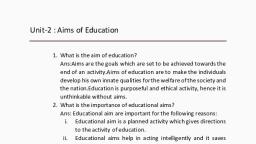
Formal institutions are set up by the society. They are: sdhools, churches,, museums, art galleries etd., Group organizations are family, play groups, communities etc., Commercial agencies are mostly profit making agencies. Examples are: press,, cinema, radio, television, theatre etc., Non-commercial agencies are mostly social service institutions. Examples are:, youth clubs, social welfare centres, sports clubs, scouts, adult education centers, etc. In conclusion, we can say that education is the joint responsibility of a, number of agencies. The educational role is complementary as well as, supplementary. Every agency has its own unique contribution to make towards, education of the child. Family and school play very important role for the, development, of the child in the early years., We hope by now you have grasped the meaning, forms and agencies of education., Let us now see what are the aims of education., Activity 2, Identify the various agencies of education in your locality and classify them, according to Brown., , 1.6 AIMS OF EDUCATION, Education is mostly a planned and purposeful activity. It must have clear aims and, objectives, in view. An aim is a pre-determined goal which inspires the individual, to attain it through appropriate activities. Educational aims are necessary in giving, direction to educational activity. Educational aims are determined by certain, factors. These are as follow:, , 1.6.1, , Factors Determining Educational Aims, , The factors that contribute for the determination of educational aims are philosophy, of life, views about human nature, religious factors, political ideologies, socioeconomic problems, cultural factors and exploration of knowledge. These are presented, in Fig. 1.3. A brief description of these is given as under., i), , Philosophy: Philosophy of life and educational aims are closely related. In, fact, philosophy determines the aims of education. Education is the best, means for propagation of philosophy. Philosophy and education are the two, sides of a coin., , iii), , Elements of human nature: These elements are always considered for the, determination of educational aims. For example, Idealists regard unfolding, of the divine in man as the aim of education., , ii), , Religious factors: Religious factors exert their influence on educational, aims. In ancient India, Buddhism emphasized the inculcation of the ideals of, that religion such as Ahimsa and Truth into the prevailing educational, system., , iii), , Political Ideologies: Political ideologies certainly have a say in the determination, of educational aims. The educational aims of a democratic political system can, be quite different from that of an autocratic political set up., , "I, , iv) \ Socio-economic factors and problems: These factors and problems of a, country definitely have a say in deciding the educational aims of that country., v), , Cultural factors and problems: Socio-cultural heritage of a country have a, great influence on the aims of education. Education has to preserve anc!, transmit the cultural heritage and traditions from one generation to another., , Education: I& Meaning,, Concepts, Aims and, Philosophy
Page 8 :
Introduction to Nursing, Education, , vi), , Exploration of knowledge: Education today is science oriented and, technology based: It has to aim at exploring new information. Education must, represent these factors and be related to the realities and problems and issues, of life. Aims of education is also related to time and space. Therefore, they, can change from time to time and place to place. All the same, there can be, some common elements in the educational aims of different places., , n, \, , Exploration of, , Knowledge, , ), , Religkus, Factors, , Fig. 1.3: Factors determining educational aims
Page 9 :
1.6.2 Aims of Education and their Relevance io Indian Context, The following are the aims of education in general:, i), , Vocational: Education should prepare the child to earn his livelihood and, make him self-sufficient and efficient economically and socially. Vocational, efficiency must be an important aim of education., , ii), , Knowledge: Knowledge is as essential for intellectual growth as food is, essential for physical growth. Knowledge is a must for good interpersonal, relationship, healthy adjustment in life, modification of behaviour, selfawareness and for social growth, it is also a source of happiness. Above all, knowledge is power. Because of all these, attainment of knowledge should be, an important aim of education., , iii) Complete Living: Education should acquaint a person with the activities of, complete living. They are bearing and rearing of children, self-preservation,, activities related to social and political duties and activities related to the, beneficial utilization of leisure time., iv) Total Development: The educ&ion aims at total development of individual, which include physical, mental, emotional, social and spiritual developments., v), , Harmonious Development: It means the harmonious cultivation of the, physical, intellectual, aesthetic and moral aspects of human nature. The aim of, education is to produce a well balanced personality. All the powers and, abilities of the child should be developed in a harmonious manner. Mahatma, Gandhi emphasized this aim of education very much when he said "By, education, we mean an all round drawing out of the best in child and manbody, mind and spirit.", , vi) Moral Development: Herbert Spencer, an eminent English educationist, gave, much importance to this aim of education. He believed that education must, enable the child to cultivate moral values and virtues such as truthfulness,, goodness, purity, courage, reverence and honesty., vii) Character Development: Some educational lists consider this as the supreme, aim of education. It is said that education consists of cultivation of certain, human values and development of attitudes and habits which constitute the, character of a person. Our great leaders like Mahatma Gandhi and Swami, Vivekananda also emphasized character formation as the primary aim of, education. John Dewey also agreed character formation as the overall aim of, education. You will also agree that character building is an essential aim of, education., viii) Self-realization: Some educationists think thi3 aim as the most important aim, of education. Education should help a person to become what he has to, become according to hisher individual potentials., ix) Cultural Development: Every individual has to become cultured and, civilized through education. The basic difference between knowledge and, culture aims is that in the former "knowledge is sought for its own sake" as, against the later where: it is sought for its conventional value". Cultural, development if attained truly gives refinement, aesthetic sense and a concern, and respect for others and others' culture. ., , x), , Citizenship: The child has to be educated to become a good citizen of his, country. Education should enable him to cultivate such qualities that are, beneficial to the society. As a member of the society, he should have, knowledge about his duties, functions, and obligations towards society. In a, democratic set up, this aim is very important. As a democratic citizen, the, , Education: Its Meaning,, Concepts, Aims and, Philosophy
Page 10 :
Introduction to Nursing, Education, , child needs to be trained to develop abilities for clear thinking, receptivity to, new ideas, clarity in speech and writing and true patriotism., xi) Individual and Social Aim: Some educationists are of the opinion that full, growth and development of the individual is the most important aim of, education whereas others consider social development as the primary aim of, education., Man is a social being and as such he needs his society. He has a debt to the, society which he must repay. He has to work for the good of the society., Individual needs his society and society needs individuals. Social contacts and, relationships are essential for individual development. Education should help, to create and foster a sense of obligation and loyalty to the community and its, needs. Social progress and welfare should be the aim of each and every, citizen. There should be balance between the individual and social aims of, education. They should be complementary to each other. No need for any, conflict to be there between the two. The true aim of education is the highest, development of the .individual as a member of the society. Social control and, individual initiative should supplement each other. Individual and society, should develop simultaneously., xii) Education for Leisure: Leisure is that time which is utilized for enjoyment, and recreation. Leisure is also part of human life. It is needed to keep up rest, and regain energy. Leisure time should be utilized in such activities that are, beneficial to the individual as well as society. Leisure, if wisely used,' gives, ., birth to physical and mental balance. Artistic, moral and aesthetic, developments can be inspired through the beneficial use of leisure time., Children should be educated to use their leisure time usefully and creatively., , Fig. 1.4: General aims of education
Page 11 :
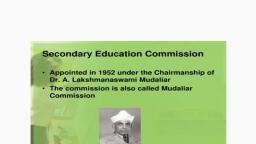
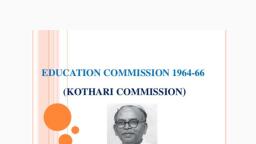
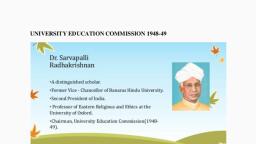
So far we have discussed the aims of education in general. Now we shall examine, the relevance of these aims to education in India after Independence. Since, Independence, India has become a secular and democratic country. When India, became free there was need for re-orientation and restructuring of all our existing, social, political and educational systems, in order to meet the socio-economic,, political and educational needs of the country., Some of the important aims of Independent India were preparation for democratic, citizenship, increased productivity, national integration, personality and leadership, development. The total educational system had to be reoriented and restructured, to facilitate the achievement of the above mentioned goals., Since Independence, various committees and commissions were appointed to lay, down the aims and objectives of education in India. Some of those committees, and commissions were:, -, , University Education Commission of 1948. Dr. S. Radhakrishnan was the, Chairman of this commission., , -, , Secondary Education Coim~issionof 1952-53. Dr. Murlidhar was the Chairman., , -, , National Education Committee under the Chairmanship of Dr. S. Radhakrishnan., , -, , Kothari Education Commission of 1964-66. Chairman was Dr. A.S. Kothari., , These committees, considering the existing situations, purposes and goals of, democratic set up of the country, suggested Aims of Education which were and, are appropriate to Indian context though more or less similar to general aims of, education. The aims which have been scggested include:, Democratic citizenship by developing abilities in clear thinking, receptivity, to new ideas, clarity in speech and writing etc., Development of personality by overall development through art, music,, dance, craft, cultural and literary subjects in the curriculum., Vocational efficiency and increased productivity by equipping youth with, appropriate scientific knowledge and technical abilities in variety of, vocational znd professional areas., Development of leadership abilities to assume leadership responsibilities in, social, political, industrial and cultural fields., ., , Social and National integration through some kind of public education, system and some form of obligatory national services., Art of living together in harmonious relationship with each other by, developing interpersonal skills and adjustment abilities., Development of social, moral and spiritual values by including such subjects, and by facilitating environment to practice these values., Keeping pace with the modem world by preparing intellectually efficient and, technically competent person by giving sound basic education and higher, education in accordance with scientific and technological advancement., , 1.6.3, , Aims Suggested by National Education Policy, , The National Educational Policy (NEP) was formulated in 1986 on the basis of, the findings of periodic comprehensive appraisal of the existing educational, scenario in our country. The NEP 1986 specified the following aims and, objectives of our education :, , Its Meaning,, Concepts, Aims and, Philosophy, , Education:
Page 12 :
Introduction to Nursing, Education, , All round matekal and spiritual development of all people, Cultural Orientations and development of interest in Indian Culture, Scientific temper, National cohesion, Independence of mind and spirit, Furthering the goals of socialism, secularism and democracy, Man-power development for different levels of economy, Fostering research in all areas of development, Education for equality, Education is a unique investment in the present and future. The nation as a whole is, striving to attain the above-mentioned educational goals of our country. Each, individual has to contribute hisher own mite for the good of the country., , 1.6.4 Aims of Nursing Education, Nursing education is the professional education for the preparation of nurses to, enable them to render professional nursing care to people of all ages, in all phases, of health and illness, in a variety of settings. Need for nursing care is universal., Well qualified professional nurses are needed to take care of the nursing needs of, people in any society. Nursing care is an important and integral aspect of health, care. Nurses have an important role to play in identifying and meetingholving the, health and nursing needslproblems of people of all ages, in a variety of settings, such as hospital, family, and community. S h e should teach principles of healthful, living to people around and above all s h e has to be a model of health. The purpose, of nursing education is therefore to produce well qualified and competent, professional nurses to meet the nursing needs of the country., Nursing education has its aims in common with the aims of education in general as, well as its specific aims. The aims of nursing education are determined by such
Page 13 :
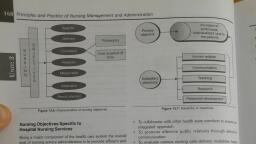
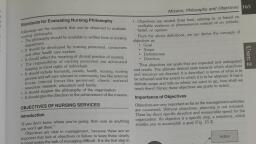
factors as health needs of the people in the society, needs of the student,, philosophy of nursing, current trends in general education as well as professional, education, current trends in nursing, needs of the time, advances in science and, technology and so on. Some of the specific aims of nursing education are the, following:, i), , Knowledge Aim: Nursing education should impart scientific and up-to-date, knowledge in the area of biological, behavioural, social, medical and nursing, sciences. Nursing education at the same time should aim at inculcating the, appropriate nursing skills and the right attitude in the students. Theoretical, and practical knowledge is essential for rendering intelligent and efficient, nursing services. Professional nursing practice is based on scientific and, nursing principles. Any nursing education curriculum should have sufficient, theory content and practical experience., , ii), , Leadership Aim: Nursing education should aim at the preparation of nurses, as good Eaders. Nurses are responsible for the quantity and quality of nursing, care. They have to assess and monitor the quality of care. They have to, participate in decision-making and policy-making with regard to health, matters and allocation of resources of health development. They have to plan,, organize and manage health care programmes in the community. They have to, evaluate the quality and structure of health care services. They are to, collaborate and coordinate the health care functions of the members of the, health team. The nurse leaders are also responsible for effective nursing, education, nursing education should, therefore, aim at identifying potential, nursing leaders and facilitating their development., , Education: Its Meaning,, Concepts, Aims and, Philosophy, , iii) Professional Development Aim: Nursing education should aim at the, professional development of each individual nurse. She should be trained to, keep up the ethics and standards of her profession. Each individual nurse, should be educated in a manner so as to enable her to develop the appropriate, skills and attitude essential for professional practice of her vocation. She, should also in turn contribute for the growth and development of her, profession., iv) Personality Development Aim: This is also an important aim of nursing, education. Nursing education should contribute for the all round development, of the individual in all aspects. It should mould her character and help for the, individual is personal as well as professional development. Slhe should grow, and develop as a person of self-awareness, self-direction and self-motivation., v), , Research Orientation: Ongoing research is essential for the growth of the, profession. Nursing education should prepare nurses who have inquisitive, mind and approach and who can add to the body of nursing knowledge, through participation in scientific investigations., , vi) Democratic Citizenship: Nursing education should inculcate democratic, values such as respect to individuality, equality, toleration, co-operative, living and faith in change through persuasion. The nurse also has to be a, responsible and contributing citizen of the country., , Knowledge, Development, , Professional, Development, , Orientation, , Fig. 1.5: Aims of nursing education, , 17
Page 14 :
I, , I, I, , Introduction to Nursing, Education, , 1.7 PHILOSOPHY OF EDUCATION, So far, you have learnt the meaning, process, forms and aims of education in, general and aims of nursing education in particular. In this section you will learn, about the various philosophtes of education and role of philosophy in nursing, education., , 1.7.1 Defrnition and Meaning, Ever since the beginning of the world, efforts have been made to understand man as, he is. Sometime or the other it must have come to your mind questions like "Who, and what am I?"'Where is my origin?" "Where am I going? and questions of this, sort. The hardest task of man is to know himself. It is through philosophy, a, systematic enquiry about man and the realities of life have been made. It is, philosophy that has interpreted man and his life. Philosophy is the science of all, sciences. The term philosophy has been derived from two Greek words-"Philos", and "Sophia". Philos means love and Sophia means wisdom. So the word, "philosophy" means love of wisdom. In this sense, philosophy is search for, wisdom and truth. V ~ o u definitions, s, of philosophy have been made by different, philosophers and educationalists. Some of these are stated below., Fitche says "Philosophy is the science of knowledge"., Coleridge sees "philosophy as the science of sciences"., Cicero has called it as the "mother of all arts"., , In the words of Henderson mentions "Philosophy as a search for a, comprehensive view of name, an attempt at a universal explanation of nature, of things"., According to Raymond "Philosophy is an unceasing effort to discern the, general truth that lies behind the particular facts, to discern also the reality that, lies behind appearances"., 18, , In the light of the above definitions, we can say that philosophy is a living force, a, way of life, an attitude towards life, and a search for truth and reality. The
Page 15 :
generally accepted meaning of philosophy is that it is a point of view, a belief, construct, a speculatio~labout the nature and value of things. Tt is a particular way, of looking at things, it is a search for deeper and finer values of life. Let us now, understand some of the important philosophies of education as presented in the, following section., , 1.7.2 Important Philosophies of Education, There are many philosophies of education, some of the important philosophies of, education are - Idealism, Naturalism, Pragmatism, Existentialism, Experimentation, and Theistic Realism. We shall discuss in detail Idealism, Naturalism and, Pragmatism., 1), , Idealism, , i), , Meaning, , The word "idealism" has been derived from "Ideal" or "Ideas". Idealism is a very, old philosophical thought originated by the Greek Philosopher-Plato. He, conceived the 'ideas' as the basis of his philosophy. Idealism is a philosophical, position according to which nothing exists except an idea in the mind of inan., Idealism idolizes "Mind and Self'. Idealism explains man and the universe in, terms of "Spirit" or "Mind. It is infact, spiritualism. Man's spiritual naturc is, considered to be the very essence of his being. idealists thus, cinphasize higher, values of life and prescribe the study of religion, ethics, logic, literature, art and, humanities., The chief exponents of this philosophy are - Plato, Kant, Hegel, Berkley, Guru, Nanak, Tagore and Mahatma Gandhi., ii), , Chief Assertions of Idealism, , a), , Idealism believes in the "Universal Mind". Besides the material or physical, universe there is a spiritual universe which is permeated by the "Universal, Mind" or God. He is the creator and everything else is created by him. The, "Universal Mind" is the source of all human values. The goal of all human, activities is the realization of this "Universal Mind" in his own self., , b), , Idealism regards man as a spiritual being superior to animals. Reality is found, in the mind of man and in the external world., , c), , The world of ideas or values are important than the'world of matter. Values, are absolute. Idealism believes in spiritual or eternal values. The primary aim, of human life is to achieve spiritual values. The outstanding spiritual values, are - Truth, Beauty and Goodness. These values are absolute, undying and, permanent. In pursuit of these values, man rises higher and higher in the,, moral plane till he becomes one with the "Universal Mind., , d), , Real knowledge is perceived in mind. God is the source of all knowledge., According to idealists, knowledge gained through mind is rnore importatlt, than knowledge gained through the senses., , ducation: Its Meanirrg,, Concepts, K i ~ and, s, Pllilosophy
Page 16 :
introduction to Nursing, Education, , 2), , Naturalism, , i), , Meaning, , Contrary to Idealism, Naturalism is a philosophy with the belief that natur dl01 e, represents the entire reality. There is nothing behind; beyond or other than naturc, Naturalism is a doctrine that separates nature &om God, subordinates spirit to, matter and sets up unchangeable laws as supreme. According to naturalists human, life is a part of nature; it is a self sufficient entity having its own natural matter,, natural force and natural laws. Its emphasis is on matter and the physical world. It, does not believe in spirituality and Supernaturalism. The chief exponents of, Naturalism are: Bacon, Comenius, Herbert Spencer, Huxely, Bernard Shaw and, Rousseau., ii), , Naturalism and Education, , Naturalism was a revolt against traditional system of education which gave very, little freedom to the child. Naturalism gives maximum freedom and central position, to the child. Its watch words are: "follow nature", "back to nature", "maximum, happiness" and "utmost freedom to children". Naturalism believes that education, should be according to the nature of the child. Text books, curriculum and even, teachers are not so important as the child. It advocates creation of conditions in, which the development of the child can take place in a natural way., 3), , Pragmatism, , i), , Meaning, , The word "Pragmatism" is derived from the Greek word 'Pragmatism' this means, practice or action. Pragmatism is a typical American philosophy. For pragmatists, the key word is 'Utility'. For them whatever useful is good and whatever good is, useful. A pragmatist lives in a world of facts not in a world of ideas or ideals., William James is the founder and father of this philosophy. John Dewey, W.H., i(ilpatrick,'Margaret H, Mead is some of the exponents of this philosophy., ii), , Pragmatism and Education, , Pragmatism stands for progressive trends in education. It has influenced modern, education to a great extent. According to pragmatism activity lies at the center of all, educative process. Also education is a continuous process which is progressive and, flexible. It stands for freedom and worth of fie individual. It works on the principle, of democracy and education is a social necessity., Education should help to solve human problems of everyday life, meet human, needs and enable the pupil to lead a better and happy life. Pragmatists believe that, philosophy is the product of educational practice. Pragmatism has its effects on the, various aspects--of education., -
Page 17 :
1.7.3 Eclectic Philosophy, So far, we have discussed three important philosophies of education. Though there, are many more philosophies of education. Remember each of the philosophies, have its contributions and limitations. No one philosophy is complete in itself., Also, no one philosophy can be applied successfully in all situations because the, world and its values are continuously changing. The educational system also, changes from time to time., Education has to be Flexible and Dynamic: It is not safe and advisable to stick to, one kind of philosophy only. The best way is to familiarize with different, philosophies, draw the best and essential points from all of them and make into, one harmonious whole and build ones own philosophy of education. This resulting, philosophy is eclectic philosophy., , Definition: Eclectic philosophy in education is the synthesis or harmonious blend, of the diverse philosophies of education. It is the process of pulling out and putting, together of the useful and essential aspects of various philosophies of education., All the philosophies are philosophies of life. The difference is in the way each one, views life. Some give importance to spiritual and mental aspects of life while, others give emphasis to the physical and social aspects. There should be a happy, and harmonious blending of the various aspects because man is a complex being, with physical, mental, psychological, spiritual and social aspects of life. A holistic, philosophy of education which would help for the total development of the, individual is useful. Let us now try to understand the relationship between, philosophy and education., , 1.7.4, , Relationship between Philosophy and Education, , The relationship between philosophy and education is very close. Philosophy sets, the goals and education tells the means to achieve them. Philosophy is the theory, while education is the practice. Philosophy is the contemplative side and education, is the active side. Education is applied philosophy. Philosophy deals with the, abstract while education deals with the concrete. Education and philosophy are the, two sides of a coin. All great philosophers were also great educators., Examples: Thales in Greece, Confucius in China, Sree Budha, Swaini, Vivekananda and Mahatma Gandhi in India. They reflect their philosophical views, in their educational schemes. The truths and principles established by philosophy, are applied in education. Fitche said "The arch of education will never attain, complete clearness. without philosophy". All educational programmes are based on, certain philosophy. All the aspects of education such as aims, objectives,, curriculum, methods of teaching, teacher, text books and discipline are influenced, by philosophy. There is a direct bearing between philosophy and aims of education,, curriculum, methods, of teaching and teachers, text books and discipline. Let us, pyamine parh nf thpcp h ~ l n w, , Educaqon: Its Meaning,, Concepts, Aims and, Philosophy
Page 18 :
Introduction to Nursing, Education, , Philosophy and Aims of Education, , The aims of education are determined by the prevailing philosophy of education., Different philosophies of education prescribe different aims of education. For, example, Idealism believes in self-enhancement whereas Naturalism prefers selfpreservation as the aim of education. Aims of education can be different at, different periods in different places according to the existing philosophy. Countries, believing in delrlocracy produce democrats. In short philosophy is the determining, force in laying down the aims of education., Philosophy and Curriculum, , Curriculum is the sum total of all the activities and the experiences provided by the, school to its pupils to achieve the aims of education. Nowhere is the dependence of, education on philosophy more marked than in the question of curriculum. It is, philosophy that determines the content of the curriculum. The content of the, curriculum varies according to the philosophy it follows., Idealists emphasize higher values of life and prescribe the study of religion e h c s ,, logic, literature, arts and humanities., Pragmatists advocate the study of fi~nctionalsubjects and social sciences., Pragmatists include such subjects as Language, Social Studies, General Science,, Practical Arithmetic, Arts and Crafts in their curriculum. These subjects have utility, value., The Naturalists are mainly concerncd with physical sciences and direct, experiences. The Naturalistic school or philosophy wishes that the present, experiences, interests and activities of the child should determine his subjects of, instruction. The subjects are selected according to the aptitude and ability of the, child. So we see how philosophy determines the contents of the curriculum., Philosophy and Methods of Teaching, , There is a close relationship between philosophy and methods of teaching., Philosophy is a way of thinking and a way of working. Method of teaching is the, process of establishing and maintaining contact between the pupil and the subject, matter. Every system of education has its own methods of teaching based on its, philosophical background. Idealism advocates question answer, lecture and, discussion methods. Naturalists emphasize child-centered methods of education., They recommend learning by doing and direct experience. Pragmatists are for, project methods, problem-solving methods, and socialized techniques., Philosophy and Teacher, , The teacher is the back-bone of the educative process. A teacher needs the study of, philosophy as a person and as a teacher. Philosophy has great influence on the, teacher, both in the area of thinking as well as teaching. A teacher is also a, philosopher having his or her own ideas and beliefs. A teacher influences the, personality of the child and instills in him a new outlook and a new life. An, idealistic teacher is a person of high ideals, ethics and morals. He has to be a model, for the pupils. Naturalism sees the teacher as the stage-setter and s/he works behind, the screen. According to Pragmatism teacher is a friend and guide of the pupil,, facilitating the process of growth of the individual., Philosophy and Text Books, , A text book sets up the norms of knowledge which the children are expected to, know. Text-books have to conform to the accepted ideals of the society and the, ~revailineohiloso~hvof education and the nation.
Page 19 :
Philosophy and Discipline, I, , 1, , Philosophy determines the nature and forms of discipline. Discipline is nothing but, the conduct of the pupil. Social, political, economic and philosophical thinking of a, country always determines the nature of discipline. Internal discipline concerned, with the inner code of conducts of the individuals sustains a nation. Idealists favour, strict discipline of mind and body. Naturalists believe in a discipline of natural, consequences: Pragmatists stress social discipline, self-discipline and fiee, discipline. Modem concept of discipline is in tune with the principles of democracy, and social philosophy, where political integrity and environmental stability is vital., In conclusion, we can say that philosophy and education are inseparably linked., Philosoplly has its influence on all the aspects of education such as aims, curriculum,, and methods of teaching, teacher and discipline. Philosophy and education exist, together. Philosophy leads and education follows the path shown by philosophy. We, shall now deal with philosophy and nursing education in the following sub-section., , 1.7.5 Philosophy and Nursing Education, You have already read that there is a close relationship between philosophy and, education. All the important aspects of education such as aims, objectives,, curriculum, methods of teaching etc., is determined by the philosophy of education., It is the same for nursing education too., Philosophy of Nursing Education, A philosophy of nursing education includes beliefs and values with regard to the man, in general and specifically man as the learner, the teacher, the nurse and the consumer., It also includes beliefs about health, illness, society, nursing, learning etc., Traditionally Nursing and Nursing Education had adopted a Christian philosophy, which was based on super-naturalism. A Christian philosophy has a belief in a, personal God, who is the creator, redeemer and provider of man and universe., "Love of G o d and "Love of neighbour" are the maxims of Christian philosophy., According to Christian nurse who would believe in God and who would take care, of the sick fellow-beings after the example of Christ. During the course of time,, changes have taken place in the field of education, health care, socio-cultural, aspects, science and technology. There was a need for change in the existing value, systems and beliefs. Changes had taken place in the field of nursing practice and, nursing education also. It was not advisable to adhere to only one type of, philosophy. So it became inevitable for nursing too, to follow the path of, eclecticism, i.e., to draw the best and useful aspects from various educational, philosophies and make one's own philosophy., In her book "Curriculum Building in Nursing'' dl,ivia Em Bevls discussed some, modern philosophical points with regard to nursing and nursing education. These, philosophical points are:, , Education: Its Meaning,, Concepts, Aims and, Philosophy
Page 20 :
Introduction to Nursing, Education, , 1), , The Individual has Intrinsic Value and there is Worth Inherent in Human, Life: Each human life has inherent worth and nursing is a service to individuals,, to people, without any distinction between caste or creed, sex or colour, age or, religion and rich or poor. It is concerned with human welfare. It acknowledges, the uniqueness of each individual. It considers health as a human right. The aim, of nursing education is to produce a professional nurse with such a philosophical, outlook., , 2), , Nursing is a Rational Activity: Nursing functions require the exercise of, critical thinking, logic and judgement. Nursing is a problem-solving and, decision-malung process. The nurse is a legally and morally accountable, person., , A nursing education curriculum should include such learning experiences that, would equip the learner with skills in problem-solving, decision-malung and, critical thinking., , 3), , ', , Nursing's Uniqueness is in the Way the basic, Social andBiologica1, Sciences are Synthesized in Functions that Promote Health: Nursing, actions are based on scientific principles which are drawn from the biopsycho-social sciences. Any nursing education curriculum should include, subjects like physics, chemistry, biology, anatomy, physiology, microbiology,, psychology, sociology and other relevant subjects., , 4), , The Individual Nurse-Citizen has Some Control Over and Responsibility, for the Political and Sbcial Milieu in which Slhe Lives: The nurse is also a, member of the society and a true citizen of the country. As such, he/she has, to have some active voice in the social, political and legal aspects of the, community, especially with regard to health care matters. The nurse is a, change agent as well as a consumers' advocate and protector. She has to take, active part in effecting social changes and she has to speak for the people., One of the important aims of nursing education is democratic citizenship., , 5), , Nursing is a Process with a Central Subjective Purpose, an Inherent, Organization or System and Dynamic Creativity: It is an agreed upon, belief that nursing is a process to attain an end. A process is a series of actions, or operations to attain an end. Processes have three characteristics. They are:, inherent purpose, internal organization and infinite creativity., , The inherent purpose of nursing is the optimum level of wellness of, health for the individual., In the case of nursing process, internal organization means the series of, actions to attain the aim of optimum health of the individual/community., Infinite creativity in nursing process means the dynamics of evolving, uniquely more effective and efficient nursing activities for the, achievement of the goal of optimum health., 6), , Nursing Functions are Independent, Inter-dependent and, Collaborative; Nursing is a crucial component of multi-disciplinary health, care system. The nursing education curriculum should reflect the, independent, dependent and collaborative positions of the nurse involving, these respective functions., , 7), , Nursing is a Profession and Nursing Practice Must Reflect, Professionalism: This is a much debated issue. One of the aims of nursing, education is professional development of the pupil nurse. In order to, accomplish this aim curriculum should include courses like ethics and, standards of profession, professional adjustments and research:
Page 21 :
8), , 9), , I, , I, , Nursing Roles in the Order of Priority are: Educative (promotive,, preventive, rehabilitative), therapeutic and supportive. The priority of roles, as specified in philosophy dictates the order of priority in curriculum content., The Democratic Mode of Operation and the Implications of that, Democratic Mode are a Key Stone of Nursing Roles, Organization and, Structure: Democratic processes like authority by mutual consent, individual, accountability for group activities and the ability of each group member to, contribute to hisher potential are essential to the optimal functioning of the, nursing group. A democratic organizational set up has to be preferred in the, present day situation when democratic development leadership is considered, as the best., , In conclusion, philosophy of nursing education should contain guidelines for, nursing practice as well as nursing education. It is developed by the faculty of each, individual school of nursing together with the nurse leaders and nurse, administrators. It should be clearly stated and directly related to the aims,, objectives curriculum and other aspects of nursing education., Activity 3, Write your own beliefs with regard to nursing practice and nursing education., , I, , 1.8 LET US SUM UP, , I, , In this unit, the meaning, process, agencies, aims and philosophy of education is, discussed. You have read the aims of education in general as well as the aims of, nursing education. Education is an ongoing process. Every country or profession, develops its own system of education to express and promote its unique,, socio-cultural or professional identity and also to meet the challenges of time. The, meaning of philosophy and its role in education is also elaborated., Some of the important philosophies of education are - Idealism, Naturalism,, Supernaturalism and Pragmatism. No one philosophy is complete in itself. Each, has its own merits and demerits. Hence it is always good to follow the path of, eclecticism by which the good aspects of every philosophy is accepted and, synthesized into one's own philosophy of education. We have also discussed the, close relationship between philosophy and education. Philosophy determines the, aims, curriculum, and methods of teaching, role of the teacher and other important, aspects of education. In fact, education is the means for the propagation of, philosophical ideas.. The important aspects of nursing education are also, determined by a sound philosophy of nursing education and nursing practice., , KEY WORDS, I, , Aim, , : Direction toward a particular target, purpose, , I, , Agency, , : An organization that provides some services, , Assertion, , : Insistence or strong declaration, , Bipolar, , : Having two poles, , Collaboration, , : Working together with others, , Critical, , : Art of making judgement or opinion, , Culture, , : The sum total of the ways built up by a group of human, , I, , beings and transmitted from one generation to another., Discipline, , : Training of mind and character., , Education: Its Meaning,, , Concepts, Aims and, Philosophy
Page 22 :
lntroduction to Nursing, Education, , Dynamics, , : Power of force that produce motion, , Eclecticism, , : Borrowing freely from various sources, , Ethics, , : Science of morals, moral principles or rules of conduct, , Etymology, , : The study of historical linguistic change, especially as, , applied to individual words, , Exponent, , : person or thing that explains or interprets, a representative, of example, , Harmonious, , : Forming a pleasantly consistent whole, , Milieu, , : Environment of surroundings, , Objective, , : Something that one's efforts are intended to attain or, accomplish, , Pedagogy, , : It is a Greek word, meaning "to lead the boy". It is a science, , of instruction or teaching for the purpose of leading the, children, , Personality, , : The sum total of the physical, mental, emotional and social, , characteristics of an individual, , Process, , : Systematic series of actions, directed to some end, , Shiksha, , : Instruction, Teaching or Discipline, , Supernaturalism, , : Belief in personal God who is the creator of man and the, , universe, , Synthesis, , : Combination of separate parts or elements or substances, into a whole., , Trend, , : Prevailing tendency, , Tripolar, , : Having three poles, , Value, , : Regard highly, worth of something, , Vidhya, , : Sanskrit word meaning knowledge, , Vocation, , : A particular occupation or profession, , Check Your Progress 1, The broad or wider meaning of education is that education is a life-long process of, modification of behaviour through every experience of life. All the experiences of, life from any source, at any time and place contribute towards learning. In strict, sense, education is that training given in specific educational institutions for a, particular period of time., , Check Your Progress 2, 1), , The three forms of education are:, i), , Formal, , ii), , Informal, , iii) NonzTorn~al
Page 23 :
2), , Six charactenstics of formal education are:, Pre-planned and well organized, Imparted in specific educational institutions, Limited to a specific period of time, Has well-defined curriculum, Given by well qualified teachers, Observes strict discipline, , Check Your Progress 3, Education is a tripolar process which means education is the result of interaction, between pupil, teacher and the social environment. It is a three dimensional, process., Check Your Progress 4, Factors determining educational aims are:, Philosophy of life, Elements of human nature, Religious factors, Political ideologies, Socio-economic factors, Cultural factors, Exploration of knowledge, Check Your Progress 5, 1), , Ten general aims of education are:, i), , Vocational aim, , ii), , Knowledge aim, , iii) Complete and Harmonious living, iv) Mental, emotional and physical development, v), , Moral development, , vi) Character development, vii) Cultural development, , viii) Self-realization, ix) Citizenship, , x), 2), , Individual and social aim, , Democratic citizenship is one of the aims of education in Independent India., India being a democratic country, she wants her citizens to be educated with, the ideals of democracy and secularism. The ideals of democracy are respect, for individuality, equality, toleration, cooperative living and faith in change, through persuasion., , Education: Its Meaning,, Concepts, Aims and, , Philosophy
Page 24 :
Introduction to Nursing, Education, , Check Your Progress 6, 1), , The purpose of nursing education is nursing man-power development., , 2), , The aims of nursing education are:, a, , Knowledge, , a, , Leadership, , a, , Professional development, , a, , Personality development, , a, , Nursing Research Orientations, , Check Your Progress 7, , ., , ., , 1), , Philosophy is a point of view, a belief construct, a speculation about the, nature and the value of things., , 2), , Chief Assertions of Idealism are:, Idealism believes in Universal Mind or God, who is the creator of man, and everything else. God is the source of all human values., Idealism regards man as a spiritual being. Reality is found in the mind of, man and in the external world., The world of ideas or values are important than the material world., Idealism believes in spiritual or eternal values. The outstanding spiritual, values are - Truth, Beauty and Goodness., Real knowledge is perceived in mind. God is the source of all, knowledge., , Knowledge gained through mind is more important than knowledge gained, through senses., , Check Your Progress 8, Eclectic philosophy in education means selecting the good aspects from the, various philosophies of education and synthesizing them to make one's own, philosophy of education., , Check Your Progress 9, Philosophy and Education are closely related. Philosophy affects all the important, aspects of education such as aims, curriculum, methods of teaching, teacher and, discipline. The aims of education are determined by the philosophy. For example,, if super-naturalisti? philosophy is accepted in a school, one of its educational aims, will be to attain knowledge about God. Again, the curriculum content and all the, learning experiences depend upon the philosophy of education. Idealists, emphasize higher values in life and they include religion, ethics, logic, literature,, arts and humanities in the cumculum. Every system of education has its own, methods of teaching based on its philosophical.background. For example,, pragmatists advocate 'learning by doing'. Hence they recommend experimental, method. Based on the philosophy, the teacher has hisher place in education., Idealism sees the teacher as a model where as Naturalism sees the teacher's role, only as a stage setter. Philosophy also determines the nature and form of discipline.



 Learn better on this topic