Notes of XI A Economics, Economics Chapter 3.pdf - Study Material
Page 1 :
CHAPTER NO. 3, , PARTITION VALUES
Page 2 :
Introduction, • You have already studied about the measures of central tendency i.e., averages such as Arithmetic Mean, Median and Mode., , •, •, •, , Median is the value of the middlemost observation in the data when the, observations are arranged in increasing or decreasing order of values., 'Median', is a special type of partition value because there are equal number of, observations above as well as below it., Like Median, Quartiles, Deciles and Percentiles are also partition values. since they, divide the given set of observations into equal number of parts. In general, they are, referred to as 'fractiles'.
Page 3 :
Introduction, • The procedure of dividing the data into equal parts, is called 'partitioning'., • Values dividing the data into a required number of, equal parts are called 'Partition Values'.
Page 4 :
Need for Partition Values, • The data consists of extreme values on the lower, side and also on the higher side in magnitude. Such, values are known as 'outliers'. The average used for, such data often misinterprets its representative, value. To overcome this misinterpretation, generally, partition values like median, quartiles, deciles and, percentiles are used., , • Q2 = D5 = P50 = Median
Page 5 :
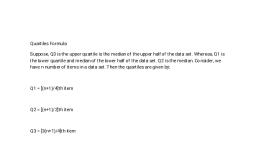
Quartiles, • 'Quartiles' are values of data which divide the, whole set of observations into four equal parts., , • There are three Quartiles which divide the data into, 4 equal parts., • They are known as Q1, Q2 and Q3, • Second quartile is nothing but the median.
Page 6 :
• To find out quartiles, generally the data is arranged, in ascending order., • for individual and ungrouped data we get the, formula for Q1, Q2 and Q3 as given below :, , • For grouped data or continuous data :
Page 7 :
• Where :
Page 8 :
Calculation of Quartiles (Individual Data), • Calculate Q1 and Q3 of the first semester examination marks, scored by the students as given : 40, 85, 84, 83, 82, 69, 68, 65,, 64, 55, 45, • Solution : Arrange the series in ascending order., • 40, 45, 55, 64, 65, 68, 69, 82, 83, 84, 85, , Q1 = 55, Q2 = 68, Q3 = 83
Page 9 :
Calculation of Quartiles Discrete Data, • Find out Q1 and Q3 from the following data., , Solution : Arrange the data in ascending order and, find out the cumulative frequency
Page 10 :
Find out Q2 from the above data
Page 11 :
Calculation of Quartiles Continuous data, • Steps for calculation of Quartiles for continuous, data, 1) Arrange the data in ascending or descending order, 2) Write respective frequencies of the class., 3) Find out cumulative frequency (cf), 4) Determine the quartile class.
Page 13 :
• Example Text book Page 17, , • Write frequencies of the class
Page 14 :
• Step 1
Page 15 :
• Step II
Page 16 :
Exercise Q4 : Calculate Q1 from the following data, 18, 24, 45, 29, 4, 7, 28, 49, 16, 26, 25, 12, 10, 9, 8, Arrange the data in ascending or descending order., 4, 7, 8, 9, 10, 12, 18, 16, 24, 25, 26, 28, 29, 45, 49, (calculate Q2 & Q3)
Page 17 :
• Exercise Q4 (2) Calculate Q3, , • Arrange the data in ascending order & calculate frequency
Page 18 :
Calculate Q 1 from the above data
Page 19 :
• Continuous data, • Text book exercise Q 4 (4)



 Learn better on this topic