Notes of Class 11, Botany IMG-20220111-063100.jpeg - Study Material
Page 1 :
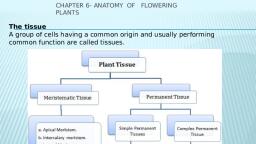
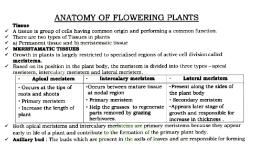
r ‘Tissues may be defined as a group of similar type of cells having same function, ‘origin. Plant tissues are of two types on the basis of stages of development ‘, , 1._.a. Meristematic tissue, b, Permanent tissues., 2 — divisit, , Meristems are the group of young undifferentiated cells, having the capacity for active cell, division, Meristems occur in all the growing regions of the plant body such as root apex and shoot, , apex Characteristic features, , They are living cells with thin cell wall, They are isodiamatic in shape and arranged compactly without any intercellular spaces., , The cells contain dense cytoplasm and prominent nucleus., They are capable of active cell division and production of new cells., , Cells do not contain reserve food materials., , Vacuoles may be absent when present, they are few in number and small in size,, , 3. Classification of meristems, , 1. Meristens are classified in to different types based on different criteria. Based on origin meristems, , are classified in to two, .a. Primary. Meristems:- These are the meristems which are directly derived from the embryonic, meristems.€g- apical meristems, fascicular cambium., , b. Secondary Meristems:- It is meristamatic tissue derived from the permanent tissues at the time of, secondary growth . eg- interfascicular cambium and cork cambium of stem., , 2. Classification of meristems based_on position., , According to their position in the plant body, meristems are classified in to, , , , "ep a9cp, , a. Apical meristems- these are found at the apices of stem and root. Growth in length at the plant, , axis is due to the activity of apical meristems., Intercalary meristems- these are meristems seen in between permanent tissues. They are parts, , of apical meristems separated from the apex due to the development of permanent tissues in, , between. It is usually seen at the leaf bases and intemodal regions at certain monocots like wheat., , c. Lateral meristems — these meristems are found on the lateral sides of the stem and root. The cells, of the lateral meristems shows only periclinal divisions. They are responsible for growth in, , thickness of the plant body., 4. Permanent tissues, , Permanent tissues originate from the meristamatic tissues. Permanent tissues are composed of, matured cells that have lost the power of division and have attained definite form and size. They may be, living or non-living, thin walled or thick walled., , b.