Page 1 :
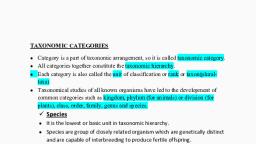
3. Classification: It is the grouping of organisms into convenient categories, (taxa) based on characters., TAXONOMIC CATEGORIES, • Classification involves hierarchy of steps in which each step represents a, taxonomic category (rank)., • All categories together constitute a taxonomic hierarchy., • A group of organisms occupying a particular category is called a taxon, (pl. taxa). E.g. Class Mammalia., • Each category or taxon represents a unit of classification., , 1. Species:, • It is a group of closely related organisms capable of interbreeding to, produce fertile offspring., • It is the lowest category. E.g.
Page 2 :
2. Genus:, It is the aggregates of closely related species. E.g.• Potato, tomato & brinjal are species of genus Solanum., • Lion, leopard & tiger are species of genus Panthera. This genus, differs from genus Felis (genus of cats)., 3. Family:, It is a group of closely related genera. E.g., • Family Solanaceae includes Genus Solanum, Genus Petunia, and Genus Datura., • Family Felidae includes Genus Panthera and Genus Felis., 4. Order:, It is the assemblage of related families. E.g., • Order Polymoniales includes Family Convolvulaceae and Family, Solanaceae., • Order Carnivora includes Family Felidae & Family Canidae., 5. Class:, • It is the assemblage of related orders., • E.g. Order Primata, Carnivora etc. is placed in class Mammalia., 6. Phylum (Division in case of plants):, • It is the assemblage of related classes., • E.g. Classes Amphibia, Reptilia, Aves, Mammalia etc. come, under phylum Chordata., 7. Kingdom:, • The assemblage of related phyla., • It is the highest category., E.g. Kingdom Plantae, Kingdom Animalia etc.