Notes of 11th Bio, Biology Ch-13-Photosynthesis-in-Higher-Plants-Part-1 - Study Material
Page 1 :
10/25/2018----Biology Class 11 NCERT Solutions: Chapter 13 Photosynthesis in Higher Plants Part 1- Translation in Hindi, Kannada, Malayalam,, Marathi, Punjabi, Sindhi, Sindhi, Tamil, Telgu - FlexiPrep----Downloaded from flexiprep.com, Visit examrace.com for free study material, doorsteptutor.com for questions with detailed explanations, and "Examrace" YouTube channel for free, videos lectures, , Flexiprep, ▶, , Examrace 339K, , Biology Class 11 NCERT Solutions: Chapter 13 Photosynthesis in, Higher Plants Part 1, Q: 1. By looking at a plant externally can you tell whether a plant is, , ? Why and how?, , Answer, One cannot distinguish whether a plant is, or, by observing its leaves and other,, morphological features externally. Unlike, plants, the leaves of, plants have a special, anatomy called Kranz anatomy and this difference can only be observed at the cellular level. For, example, although wheat and maize are grasses, wheat is a, plant, while maize is a, plant., , Image Shows the C3 and C4 Plant, , Q: 2. By looking at which internal structure of a plant can you tell whether a plant is, Explain., , or, , ?, , Answer, The leaves of, plants have a special anatomy called Kranz anatomy. This makes them different, from, plants. Special cells, known as bundle-sheath cells, surround the vascular bundles., 1 of 4
Page 2 :
10/25/2018----Biology Class 11 NCERT Solutions: Chapter 13 Photosynthesis in Higher Plants Part 1- Translation in Hindi, Kannada, Malayalam,, Marathi, Punjabi, Sindhi, Sindhi, Tamil, Telgu - FlexiPrep----Downloaded from flexiprep.com, Visit examrace.com for free study material, doorsteptutor.com for questions with detailed explanations, and "Examrace" YouTube channel for free, videos lectures, , These cells have a large number of chloroplasts. They are thick-walled and have no intercellular, spaces. They are also impervious to gaseous exchange. All these anatomical features help prevent, photorespiration in, plants, thereby increasing their ability to photosynthesise., , Image of the Internal Structure of c3 and c4 Plant, , Q: 3. Even though a very few cells in a, plant carry out the biosynthetic - Calvin pathway, yet, they are highly productive. Can you discuss why?, Answer, The productivity of a plant is measured by the rate at which it photosynthesises. The amount of, carbon dioxide present in a plant is directly proportional to the rate of photosynthesis., plants, have a mechanism for increasing the concentration of carbon dioxide. In, plants, the Calvin, cycle occurs in the bundle-sheath cells. The, compound (malic acid) from the mesophyll cells, is broken down in the bundle-sheath cells. As a result,, is released. The increase in, ensures that the enzyme, does not act as an oxygenase, but as a carboxylase. This, prevents photorespiration and increases the rate of photosynthesis. Thus,, plants are highly, productive., Q: 4., , is an enzyme that acts both as a carboxylase and oxygenase. Why do you think, carries out more carboxylation in, plants?, , Answer:, The enzyme, is absent from the mesophyll cells of, plants. It is present in the bundlesheath cells surrounding the vascular bundles. In, plants, the Calvin cycle occurs in the, bundle-sheath cells. The primary, acceptor in the mesophyll cells is phosphoenol pyruvate a three-carbon compound. It is converted into the four-carbon compound oxaloacetic acid, 2 of 4
Page 3 :
10/25/2018----Biology Class 11 NCERT Solutions: Chapter 13 Photosynthesis in Higher Plants Part 1- Translation in Hindi, Kannada, Malayalam,, Marathi, Punjabi, Sindhi, Sindhi, Tamil, Telgu - FlexiPrep----Downloaded from flexiprep.com, Visit examrace.com for free study material, doorsteptutor.com for questions with detailed explanations, and "Examrace" YouTube channel for free, videos lectures, , is further converted into malic acid. Malic acid is transported to the bundle-sheath, cells, where it undergoes decarboxylation and, fixation occurs by the Calvin cycle. This, prevents the enzyme, from acting as an oxygenase., , Image of the Calvin Cycle, , Q: 5. Suppose there were plants that had a high concentration of Chlorophyll-b, but lacked, chlorophyll-a, would it carry out photosynthesis? Then why do plants have chlorophyll-b and, other accessory pigments?, Answer, Chlorophyll-a molecules act as antenna molecules. They get excited by absorbing light and emit, electrons during cyclic and non-cyclic photophosphorylations. They form the reaction centres for, both photosystems I and II. Chlorophyll-b and other photosynthetic pigments such as, carotenoids and xanthophylls act as accessory pigments. Their role is to absorb energy and, transfer it to chlorophyll-a. Carotenoids and xanthophylls also protect the chlorophyll molecule, from photo-oxidation. Therefore, chlorophyll-a is essential for photosynthesis., If any plant were to lack chlorophyll-a and contain a high concentration of chlorophyll-b, then, this plant would not undergo photosynthesis., Q: 6. Why is the colour of a leaf kept in the dark frequently yellow, or pale green? Which pigment, do you think is more stable?, , 3 of 4
Page 4 :
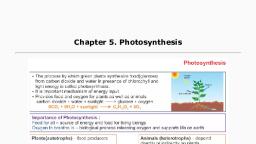
10/25/2018----Biology Class 11 NCERT Solutions: Chapter 13 Photosynthesis in Higher Plants Part 1- Translation in Hindi, Kannada, Malayalam,, Marathi, Punjabi, Sindhi, Sindhi, Tamil, Telgu - FlexiPrep----Downloaded from flexiprep.com, Visit examrace.com for free study material, doorsteptutor.com for questions with detailed explanations, and "Examrace" YouTube channel for free, videos lectures, , Answer, Since leaves require light to perform photosynthesis, the colour of a leaf kept in the dark changes, from a darker to a lighter shade of green. Sometimes, it also turns yellow. The production of the, chlorophyll pigment essential for photosynthesis is directly proportional to the amount of light, available. In the absence of light, the production of chlorophyll-a molecules stops and they get, broken slowly. This changes the colour of the leaf gradually to light green. During this process,, the xanthophyll and carotenoid pigments become predominant, causing the leaf to become, yellow. These pigments are more stable as light is not essential for their production. They are, always present in plants., Q: 7. Look at leaves of the same plant on the shady side and compare it with the leaves on the, sunny side. Or, compare the potted plants kept in the sunlight with those in the shade. Which of, them has leaves that are darker green? Why?, Answer, Light is a limiting factor for photosynthesis. Leaves get lesser light for photosynthesis when they, are in shade. Therefore, the leaves or plants in shade perform lesser photosynthesis as compared, to the leaves or plants kept in sunlight., In order to increase the rate of photosynthesis, the leaves present in shade have more, chlorophyll pigments. This increase in chlorophyll content increases the amount of light, absorbed by the leaves, which in turn increases the rate of photosynthesis. Therefore, the leaves, or plants in shade are greener than the leaves or plants kept in the sun., , Image of the Process of Photosynthesis, , 4 of 4