Notes of 11, Biology Cell Cycle - Study Material
Page 1 :
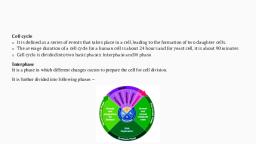
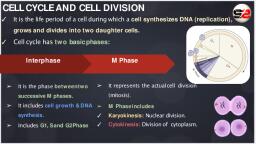
(4) INTRODUCTION, ividing into two, with each parental, Is reproduce by dividing in iW at, at ab two daughter cells each time they divide., Growth and reproduction are characteristics of cells,, . indeed ofall living organisms., , = Such cycles of growth and division allows single cell to form, - astructure consisting of millions of cells., , , , , , , , (2) CELL CYCLE, , it is sequence of events by which a cell duplicates its, genome, synthesises the other constituents of the cell and, eventually divides into two daughter cells., , Cell growth results in disturbing the ratio between the, nucleus and cytoplasm. It therefore becomes essential for, the cell to divide to restore the nucleo-cytoplasmic ratio., , , , , , , , , , ©, , Cell growth (in terms of cytoplasmic increase) is a continous, process, , » Duration of cell cycle can vary from organism to organism, and also from cell type to cell type., , €.9., Yeast- cell cycle duration - 90 minutes,, , Human cell cycle duration - 24 hours but cell division proper, lasts for only about an hour., , , , , , , , (@) PHASES OF CELL CYCLE, , , , , , , , Interphase M-phase, > Called resting phase >» Actual cell division phase, > Farce hy acon ° Starts with nuclear, oth cell division (karyokinesis), ew DNA replication and usually ends with, orderly manner. division of cytoplasm, 3 Itlasts more than 95% of the (cytokinesis), of call cycle, Nit, , Divided further into three phases, (i) G, phase (Gap 1), , (ii) S phase (Synthesis), , (iii) G, phase (Gap 2), , In animal cells mitotic division is ont, , diploid cells., , , , () INTERPHASE, , Some cells do not divide further, exit G, phase to enter an, inactive stage called quiescent stage (G,) of the cell cycle., , Cells in this stage remain metabolically active but no longer, proliferate unless called on to do so depending on the, requirement of the organism. eg Heart cells, , Interval between mitosis and initiation of DNAreplication., , Cell is metabolically active and continuously grows but does not, replicate its DNA., , Most of the cell organelles duplicate, , This phase marks the phase of DNA replication and, chromosome duplication., , Amount of DNA per cell doubles but there is no increase in initial, chromosome number, , In animal cells, centriole duplicates in cytoplasm., DNA replication begins in nucleus., , >» Proteins are synthesised in preparation for mitosis while cell, growth continues, , ly seen in diploid somatic cells. Plant cells show mitotic division in both haploid and, , thse etree eet ermine eben yom lt et Sg uirged “Siten ee ection esrinetavinlninane