Notes of 11 th, Biology Animal Tissue.pdf - Study Material
Page 1 :
Study Materials, • JEE Main & Advanced – Free Study Material, • NEET UG – Free Study Material, • NCERT Solutions for Class 1 to 12, • NCERT Books PDF for Class 1 to 12, • ICSE & ISC Free Study Material, • Free Study Material for Kids Learning (Grade 1 to 5), • Olympiad Free Study Material, • Reference Books (RS Aggarwal, RD Sharma, HC Verma, Lakhmir, Singh, Exemplar and More), • Previous Year Question Paper CBSE & State Boards, • Sample Papers, • Access All Free Study Material Here, , Vedantu Innovations Pvt. Ltd., Score high with a personal teacher, Learn LIVE Online!, www.vedantu.com
Page 2 :
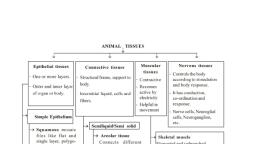
Revision Notes, Class 11 Biology, Chapter 7 Structural Organisation in Animals, , • Multicellular organisms' cells are organized into tissues to perform various, functions., • Tissue: A collection of similar cells and intercellular substances that work, together to perform a specific function., • All complex animals are made up of just four basic tissue types., • Organ: A collection of similar and dissimilar tissues in a living organism that, have been organized and adapted to perform a common specific function, such as, the heart, lung, kidney, or stomach., • Organ System: A collection of organs that work together to perform a single, function. Each has a specific function in the body and is made up of specific, tissues., , 7.1 Animal Tissues, , Class XI Biology, , www.vedantu.com, , 1
Page 3 :
7.1.1: Epithelial Tissues:, • They are densely packed cells with little intercellular matrix and one surface of, this tissue is exposed to air or internal fluid., • It covers the surface of the body and lines the internal organs and cavities; it acts, as a barrier against mechanical injury, pathogens, and dehydration; and it provides, a surface for molecule absorption, excretion, and transport., , It is classified into two types: simple epithelium and stratified epithelium., • Simple epithelium: A single layer of cells arranged end to end. It is most, commonly found as a lining for body cavities, ducts, and tubes., • Stratified or Compound Epithelium: The compound epithelium is made up of, two or more cell layers and serves as a protective layer in our skin., , • Simple epithelium is classified into three types based on their structure:, squamous, cuboidal and columnar., 1. Squamous epithelium: Flattened cells with irregular boundaries arranged to, form a thin layer, which appears polygonal in surface view., , , They are also known as pavement epithelium due to their compact structure,, which resembles floor tiles., , , , It forms the delicate lining of cavities such as the mouth, esophagus, nose,, pericardium, alveoli, and so on, as well as the lining of blood vessels., , , , They are involved in functions such as the formation of a diffusion boundary, and the formation of the covering of the tongue and skin., , , , Squamous epithelium is arranged in many layers in skin to prevent wear and, tear., , Class XI Biology, , www.vedantu.com, , 2
Page 4 :
2., Cuboidal Epithelium: A layer of cube-like cells that appear as squares in, sections but hexagonal on the free surface., , , It can be found in the kidney tubules, thyroid vesicles, and glands., , , , It is responsible for the formation of the germinal epithelium in the gonads., , , , It is involved in absorption, excretion, and secretion, as well as mechanical, support., , , , The proximal convoluted tubule epithelium of a kidney's nephron has, microvilli. On the surface of epithelial cells, microvilli are finger-like, projections. They aid in the absorption process., , • Columnar Epithelium:, , , A slender layer of tall, slender cells., , , , The nuclei are found at the bottom., , , , Microvilli may be present on the free surface., , , , They are found in the lining of the stomach and intestines and aid in, secretion and absorption., , • Ciliated Epithelium:, , , Cuboidal or columnar epithelium with fine, hair-like protoplasmic, outgrowths on the surface., , , , It is found in the nephrons, trachea, and fallopian tubes., , , , The cilia propel particles or mucus across the epithelium in a specific, direction., , • Glandular Epithelium:, , Class XI Biology, , www.vedantu.com, , 3
Page 5 :
, , Cells that have been modified to secrete. They can be columnar or cuboidal, in shape., , , , Unicellular: They are single, isolated glandular cells, similar to goblet cells, in the alimentary canal., , , , Multicellular: They are a group of glandular cells, similar to the salivary, gland., , , , Exocrine glands secrete substances through ducts or tubes. Saliva, mucus,, earwax, oil, milk, digestive enzymes, and other cell products are secreted by, these glands., , , , Endocrine: They are devoid of ducts (ductless glands). Their byproducts are, known as hormones, and they are directly secreted into the fluid that, surrounds the gland., , • Stratified or Compound Epithelium:, , , They are multi-layered, consisting of more than one layer of cells, and play a, limited role in secretion and absorption., , , , They primarily serve to protect against mechanical and chemical stresses., , , , They can be found on the dry surface of the skin, the pharynx, the moist, surface of the buccal cavity, the inner lining of salivary gland ducts, and, pancreatic ducts., , Junctions: They are specialized structures that connect individual cells structurally, and functionally., • They are classified as tight, adhering, and gap junctions., 1. Tight junctions: These are the specialized structures that prevent substances, from leaking across a tissue., 2. Adhering junctions: A specialized structure that connects neighboring cells., , Class XI Biology, , www.vedantu.com, , 4
Page 6 :
3. Gap Junctions: These are the specialized structures that allow cells to, communicate with one another. They connect the cytoplasm of neighboring, cells, allowing for the rapid transfer of ions, small molecules, and large, molecules., , 7.1.2: Connective Tissue:, • The various types of connective tissue are the most abundant of all tissues in the, bodies of complex animals. They are also the most widely available., • They are so-called because they play a specific role in the linking and supporting, of body tissues/organs., • They come in a variety of forms, ranging from soft to specialized., • Connective tissue is made up of cells that are widely spaced and embedded in a, matrix., • The matrix's nature determines the tissue's function., • Cells in all connective tissues, except blood, secrete structural proteins called, collagen or elastin, which provide strength, elasticity, and flexibility to the tissue., • The matrix or ground substance is formed as a result of the accumulation of, modified polysaccharides secreted by the cells., • Loose connective tissue, dense connective tissue, and specialized connective, tissue are the three major types of connective tissue., • Connective tissue is also subdivided into three types: connective tissue proper,, skeletal tissue, and vascular or fluid tissue., , Class XI Biology, , www.vedantu.com, , 5
Page 7 :
Loose Connective Tissue:, • Areolar, adipose, and reticular tissue are loosely arranged cells and fibers in a, semi-fluid ground substance., • Areolar Tissue:, , , This is the most common type of connective tissue in the body., , , , This tissue is found inside organs, between skin and organs, around blood, vessels, nerves, and in bone marrow., , , , It is frequently used as a support framework for epithelium., , , , It is made up of fibroblasts, macrophages, and mast cells., , , , Fibroblasts make and secrete two kinds of fibers: inelastic white fibers and, elastic yellow fibers., , , , It holds various tissues in an organ together., , , , It aids in the repair of body tissues following injury., , , , Mast cells are concern of allergy., , Class XI Biology, , www.vedantu.com, , 6
Page 8 :
• Adipose Tissue:, , , This tissue is mostly found beneath the skin., , , , The cells are designed to store fat., , , , It is made up of adipocytes, which are oval and round cells filled with fat, globules., , , , It acts as insulation by preventing heat loss from the body., , , , It aids in the storage of extra energy in the form of fats., , , , It forms a cushion-like shock absorber around vital organs such as the heart,, kidneys, and eyeballs., , • Reticular Tissue:, , , This tissue's cells are star-shaped and form a network-like structure., , , , The fibers are composed of reticulin protein., , , , It is found in the spleen, lymph nodes, tonsils, and other organs., , , , It is responsible for the formation of lymphoid tissues in the body., , , , The formation of blood cells is aided by reticular tissue in the bone marrow., , Dense Connective Tissue:, • Cells, fibers, and fibroblasts are arranged in a compact manner with little matrix., • Tissue orientation can be regular or irregular, giving rise to the terms dense, regular and dense irregular tissues., • Regular connective tissues that are dense: The collagen fibers are contained in, between many parallel bundles of fibers. Rows of collagen fibers can be seen., Tendons and ligaments are the examples., , Class XI Biology, , www.vedantu.com, , 7
Page 9 :
• Tendons: These are white fibrous tissues. The fibroblasts are almost continuously, arranged. It's stiff and inelastic. It is a ligament that connects a skeletal muscle to a, bone., • Ligaments: Ligaments are made of yellow elastic tissue. The fibroblasts are, strewn about. It is a tough but pliable tissue. It connects one bone to another., • Dense, erratic connective tissues: The fibroblasts and fibers (primarily collagen), are oriented differently in this. These are the tissues that make up the skin., , Specialised Connective Tissue:, , , Specializing connective tissue refers to connective tissue that has been, trained to perform a specific function., , , , It consists of bone, cartilage, and lymph., , , , Bone: A type of skeletal tissue., , Class XI Biology, , www.vedantu.com, , 8
Page 10 :
, , It serves as the body's structural support., , , , It is made up of a hard, non-pliable matrix of calcium phosphate, calcium, carbonate, and a protein (ossein) in addition to collagen., , , , The matrix is made up of longitudinal canals known as Haversian canals., , , , The matrix exists in the form of layers known as lamellae. Around, Haversian canals, the lamellae appear as crescentic rings., , , , Lacunae are fluid-filled spaces that exist within the ring-shaped lamellae., , , , The lacunae contain bone cells, also known as osteocytes., , , , Softer tissues and organs are supported and protected by bones., , , , Limb bones, such as the long bones of the legs, support the body's weight., They also interact with the skeletal muscles that are attached to them to, produce movement., , , , The bone marrow in some bones is the site of blood cell production., , • Cartilage:, , , It is a type of skeletal tissue as well., , , , This tissue is strong and elastic, but it is softer than bone., , , , The matrix is solid and pliable, and it can withstand compression., , , , Cartilage cells, also known as chondrocytes, are encased in small cavities, within the matrix that they secrete., , , , The presence of protein chondrin accounts for the elasticity., , , , Cells are widely separated, and the matrix is reinforced with fibers., , , , It is responsible for the embryonic skeleton of vertebrates. The majority of, the cartilage is eventually replaced by bones., , Class XI Biology, , www.vedantu.com, , 9
Page 11 :
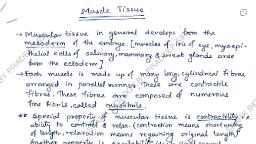
, , Cartilage can be found in areas such as the tip of the nose, limbs and hands, in adults, outer ear joints, and so on. It can also be found between adjacent, bones in the vertebral column., , • Blood:, , , It is a fluid connective tissue made up of plasma and blood cells that serves, as the main circulating fluid and aids in the transport of various substances., , , , It is the most delicate connective tissue., , , , Plasma is the fluid component that is nearly 90% water. The remaining 10%, consists of proteins, salts, hormones, and other materials used to transport, digested food, gases, excretory products, and so on., , , , Red blood cells (RBCs), white blood cells (WBCs), and platelets are, examples of blood cells., , 7.1.3: Muscle Tissue:, • Muscular tissue is unique in its ability to contract and relax, allowing it to, perform mechanical work., • Muscles are made up of many long cylindrical fibers that are arranged in parallel, arrays., • The fibers are made up of numerous fine fibrils known as myofibrils., • Muscle fibers contract when they are stimulated. They then relax and return to, their original uncontracted state in a coordinated fashion., • Their action causes the body or parts of the body to move in order to adjust to, changes in the environment and maintain the positions of the various body parts., • Muscle cells are classified into three types: skeletal, smooth, and cardiac., • Skeletal Muscle:, , , It is tightly connected to the skeletal bones., , Class XI Biology, , www.vedantu.com, , 10
Page 12 :
, , They are striated and bundled together in a parallel pattern., , , , Several bundles of muscle fibers are encased in a tough connective tissue, sheath., , , , They are also known as voluntary muscles because they are under conscious, control., , , , Cells have multiple nuclei and are unbranched., , , , Smooth muscle has cells that taper at both ends to form a spindle or fusiform, shape., , , , They aren't striated., , , , Cell junctions hold them together, and they are encased in a connective, tissue sheath., , , , Cells are devoid of nuclei., , , , They are also known as involuntary muscles because their function is not, controlled by the conscious mind., , • Cardiac Muscle:, , , It is a type of contractile muscle tissue found only in the heart., , , , Cell junctions connect the plasma membranes of cardiac muscle cells,, causing them to stick together., , , , Junctions of communication, , , , Cells can contract as a unit because of intercalated discs at some fusion, points. This means that when one cell receives a signal, the cells around it, are stimulated to contract as well., , , , They are uncontrollable muscles., , , , They are branched and uninucleate., , , , Rhythmic contraction and relaxation of these muscles occurs throughout, life., , Class XI Biology, , www.vedantu.com, , 11
Page 13 :
7.1.4: Neural Tissue, • Neural tissue is specialized for nerve impulse conduction and is made up of, densely packed cells known as neurons., • Neurons are distributed throughout the brain, spinal cord, and nerves., • Neuroglial cells guard and support neurons., • Neuroglia account for more than half of the volume of neural tissue in our bodies., • The neuron is made up of three parts: the cyton, the dendrites, and the axon., • Cyton: The cell body, which contains a central nucleus and cytoplasm with, distinctive deeply stained particles known as Nissl's granules., • Dendrites: A single or a group of short, branched cytoplasmic processes. They, receive impulses from receptors or other neurons and send them to the cyton., • Axon: A single long process that conducts impulses from one neuron to another. •, Nerve fibers can be myelinated or not., • When a neuron is stimulated, an electrical impulse is produced that rapidly, travels along the plasma membrane. When this impulse reaches the neuron's ends,, it sets off events that stimulate or inhibit neighboring neurons., , 7.2: Organ and Organ System, • The body's basic tissue types organise in various ways to form organs. In, multicellular organisms, a group of such organs will then associate with one, another to form organ systems., • The organization of the body into tissues, organs, and organ systems is necessary, for the body to function more efficiently. It also aids in the better coordination of, the activities of the millions of cells that comprise an organism. Every organ in our, bodies is made up of one or more types of tissues. For example, our heart is made, up of all four types of tissues: epithelial, connective, muscular, and neural. • The, complexity of organs and organ systems exhibits a discernible trend, which is, referred to as evolutionary trend., , Class XI Biology, , www.vedantu.com, , 12
Page 14 :
7.3: Earthworm, • It is a terrestrial invertebrate that is reddish brown in color and lives in the upper, layer of moist sand., • They can be identified by their faecal deposits known as worm casting., , 7.3.1: Morphology:, • The body of an earthworm is long and cylindrical. The body is divided into over a, hundred short segments known as metamers, which are similar to one another, (metameres about 100-120 in number)., • The dorsal blood vessel is represented on the body's dorsal surface by a dark, median mid-dorsal line., • The ventral surface is distinguished by the presence of genital openings (pores)., • The mouth and the prostomium are located at the anterior end. Prostomium is a, lobe that serves as a mouth cover., • The prostomium has a sensory function and is used as a wedge to force open, cracks in the soil into which the earthworm can crawl., • The prostomium serves a sensory function., • The mouth is located in the first segment of the body, which is known as the, peristomium (buccal cavity)., • In a mature worm, the segments 14-16 are covered by a prominent dark band of, glandular tissue called the clitellum., • The body is split into three sections: preclitellar, clitellar, and postclitellar., • There are four pairs of spermathecal apertures on the ventro-lateral sides of the, intersegmental grooves. That is, they are present between the 5th and 9th segments., • A single female genital pore can be found in the 14th segment's mid-ventral line., • A pair of male genital pores can be found on the ventro-lateral sides of the 18th, segment., , Class XI Biology, , www.vedantu.com, , 13
Page 15 :
• Numerous tiny and minute pores known as nephridiopores open on the body's, surface., • Nephridiopores: A nephridiopore is an excretory organ found in many organisms,, including flatworms and annelids., • Each body segment has rows of S-shaped setae. Setae are absent from the body's, first, last, and clitellum segments. They can be found embedded in the epidermal, pits in the center of each segment. Setae have the ability to be extended or, retracted. Their primary function is locomotion., , 7.3.2: Anatomy, • The earthworm's body wall is protected from the outside by a thin non-cellular, cuticle, which is followed by the epidermis, two muscle layers (circular and, longitudinal), and an innermost coelomic epithelium., • Digestive System:, , , The alimentary canal is a straight tube that runs from the beginning to the, end of the body., , , , A mouth at the end of the tube opens into the buccal cavity (1-3 segments)., , , , This is followed by muscular pharynx. Between the 5th and 7th segments,, there is a small oesophagus. It progresses into a muscular gizzard (8-9, segments)., , , , The stomach is located between segments 9 and 14. The earthworm eats, decaying leaves and organic matter that has been mixed with soil. The, stomach contains calciferous glands. They act to neutralize the humic acid, found in humus., , , , The intestine starts at the 15th segment and ends at the final segment. On the, 26th segment, a pair of short and conical intestinal caecae protrude from the, intestine., , , , The presence of an internal median fold of the dorsal wall, known as, typhlosole, is a distinguishing feature of the intestine after the 26th segment, (except for the last 23rd-25th segments). This expands the effective, absorption area in the intestine., , Class XI Biology, , www.vedantu.com, , 14
Page 16 :
, , The alimentary canal is accessible to the outside world via a small rounded, aperture known as the anus. Organic matter abounds in the ingested soil. It, makes its way through the digestive tract., , , , Digestive enzymes break down complex food into smaller absorbable units, in the digestive tract. These simpler molecules are absorbed and used, through intestinal membranes., , • Circulatory System:, , , Pheretima has a closed blood vascular system composed of blood vessels,, capillaries, and the heart., , , , It demonstrates a closed circulatory system, implying that blood is confined, to the heart and blood vessels., , , , Contractions keep blood flowing in only one direction., , , , Smaller blood vessels carry oxygen and nutrients to the gut, nerve cord, and, body wall., , , , Blood glands can be found on the fourth, fifth, and sixth segments. They are, responsible for the production of blood cells and hemoglobin. Blood plasma, contains haemoglobin, which is dissolved., , , , Blood cells are naturally phagocytic., , , , Earthworms do not have specialized breathing apparatus. Respiratory, exchange takes place through the moist body surface. Gases are exchanged, directly into the bloodstream through the moist skin., , • Excretory System:, , , The excretory organs of earthworms are known as nephridia (sing.:, nephridium). They are segmentally arranged coiled tubules. They. Septal, nehridia, integumentary nephridia, and pharyngeal nephridia are the three, types of nephridia., , Class XI Biology, , www.vedantu.com, , 15
Page 17 :
, , Septal nephridia: These are found at the last intersegmental septa on segment, 15. They can be found on both sides. They allow access to the intestine., , , , Integumentary nephridia: These are attached to the lining of the body wall, from segment 3 to the last segment that opens on the body surface., , , , Pharyngeal nephridia: These appear as three paired tufts in the fourth, fifth,, and sixth segments., , , , The structure of these various types of nephridia is essentially the same., , , , Nephridia regulate and modulate the volume and composition of bodily, fluids., , , , A nephridium starts out as a funnel. It removes extra fluid from the coelomic, chamber. The funnel connects to a tubular component. This transports, wastes into the digestive tube., , • Nervous system:, , , It is made up of ganglia that are arranged in segments on the ventral paired, nerve cord. The nerve cord splits in the anterior region (3rd and 4th, segments). It then wraps around the pharynx. Finally, it connects the dorsal, cerebral ganglia to form a nerve ring., , , , The cerebral ganglia, along with the other nerves in the nerve ring, integrate, sensory input. They also control the body's muscular responses., , , , The sensory system includes organs that are sensitive to light and touch., They exist as receptor cells. They distinguish between light intensities and, aid in the perception of ground vibrations. There are no eyes., , , , Worms have specialized chemoreceptors (taste receptors) in the anterior, portion of the worm that respond to chemical stimuli., , • Reproduction:, , , The earthworm is hermaphrodite (bisexual), which means that both the testes, and the ovaries are present in the same individual., , Class XI Biology, , www.vedantu.com, , 16
Page 18 :
, , In the tenth and eleventh segments, there are two pairs of testes. Their vasa, deferentia extend up to the 18th segment, where they connect with the, prostatic duct., , , , The accessory glands are divided into two groups. They can be found in the, 17th and 19th segments., , , , The common prostate and spermatic duct is the vasa deferentia. It is, connected to the outside world via a pair of male genital pores. These pores, can be found on the ventro-lateral side of the 18th segment., , , , There are four pairs of spermathecae. They can be found in segments 6, through 9. Each segment contains one pair of spermatheca. During, copulation, they receive and store spermatozoa., , , , Spermathecae: A sac or receptacle found in female or hermaphrodite, animals. The mate's sperm is stored in this sac until the eggs are ready to be, fertilized., , , , A pair of ovaries can be found at the inter-segmental septum between the, 12th and 13th segments., , , , The ovaries open into ovarian funnels located beneath the ovaries. The, ovarian funnels connect to the oviduct. They later fuse and open on the, ventral side to form a single median female genital pore on the 14th, segment., , , , There is a mutual exchange of sperm between two worms during mating., , , , One worm discovers another. Mating occurs when the worms' gonadal, openings are opposite each other. Spermatophores are the name given to, these gonadal openings. They are used to exchange sperm packets., , , , Clitellum glands generate cocoons. Mature sperm and egg cells, as well as, nutritive fluid, are deposited into these cocoons., , , , Inside the cocoons, fertilization and ova development take place. After that,, the cocoons are released into the soil. The fertilized ova then falls off, along, with the worm's cocoon. The cocoon is where the worm embryos develop., , , , Each cocoon produces two to twenty baby worms after about three weeks., On average, four are produced., , Class XI Biology, , www.vedantu.com, , 17
Page 19 :
, , Earthworms develop directly without the formation of larvae., , , , Earthworms are also known as "farmer's friends." This is due to the fact that, they dig burrows in the soil, which makes it porous. This allows developing, plant roots to penetrate and breathe., , , , Vermicomposting is accomplished through the use of earthworms., Earthworms are used in this method to break down organic matter and soil,, increasing soil fertility., , , , They are used as bait in fishing., , 7.4: Cockroach:, • They are brown or black-bodied organisms of the Class Insecta in the Phylum, Arthropoda., • Brightly colored cockroaches of red, yellow, and green color have been reported, in tropical regions., • They have a length of 0.-7-6 cm., • They have long antennae, legs, and a flat extension of the upper body wall that, conceals their head., • They are nocturnal omnivores that prefer damp environments., • They infest homes and act as disease vectors., , 7.4.1: Morphology, • The most common species of cockroach is Periplaneta americana, which, measures 33-54mm in length., • The wings of males are seen to extend beyond the abdomen., • Their body is divided into three distinct regions: the head, the thorax, and the, abdomen., • The entire body is protected by an exoskeleton. It is tough and made of chitin., Class XI Biology, , www.vedantu.com, , 18
Page 20 :
• Sclerites: Hardened exoskeleton plates in each segment connected by a thin and, flexible articular membrane., • Arthrodial membrane: The thin and flexible membrane that connects each, segment's sclerites., • Tergites: Sclerites can be found dorsally., • Sclerites: Sclerites are found ventrally., • Head:, , , It is triangular in shape, lies anterior at right angles to the longitudinal body, axis, and is formed by the fusion of six segments., , , , Because of a flexible neck, he has excellent mobility in all directions., , , , A pair of compound eyes can be found on the head capsule., , , , Antennae develop from membranous sockets in front of the eyes., , , , Sensory receptors in antennas detect changes in the environment., , , , The mouth parts on the anterior end of the head have specialized appendages, for biting and chewing., , , , The mouthparts consist of a labrum (upper lip), two mandibles, two, maxillae, and a labium (lower lip). Within the cavity encased by the, mouthparts is a median flexible lobe that serves as the tongue, (hypopharynx)., , • Thorax: The thorax is divided into three sections: the prothorax, the mesothorax,, and the metathorax., , , The neck connects the head to the thorax., , , , The neck is a short prothoracic extension., , , , Each thoracic segment has two walking legs., , , , There are two pairs of wings., , , , The first pair develops from the mesothorax, while the second develops from, the metathorax., , Class XI Biology, , www.vedantu.com, , 19
Page 21 :
, , Tegmina: The cockroach's forewings or mesothoracic wings. They're dark,, opaque, and leathery. When at rest, they cover the hind wings., , , , The hind wings are known as metathoracic wings. They are membranous, and transparent, and they are used in flight., , • The abdomen is divided into ten segments., , , Females have a boat-shaped 7th sternum., , , , The 7th, 8th, and 9th sterna form a brood or genital pouch., , , , The anterior part of the brood contains the female gonopore, spermathecal, pores, and collateral glands., , , , Males have a genital pouch or chamber at the back of the abdomen. The, genital pouch is bound dorsally by the 9th and 10th terga. The 9th sternum, connects the genital pouch ventrally., , , , The anus is located in the dorsal region. The male genital pore is located in, the ventral region. The gonapophysis is also found in the pouch., , , , Males have a pair of short, threadlike anal styles. They are not present in, females., , , , Anal cerci: A pair of jointed filamentous structures found on both males and, females' 10th segment., , 7.4.2: Anatomy, • Alimentary Canal/Digestive System: The alimentary canal is divided into three, sections: the foregut, the midgut, and the hind gut., , , Foregut: It consists of the following sections:, , , , Mouth: It leads to a short tubular pharynx., , , , The pharynx is connected to the narrow tubular oesophagus., , , , The crop is a sac-like structure that opens into the oesophagus., , , , Crop: A sac-like structure at the oesophageal end. It is used to keep food., , Class XI Biology, , www.vedantu.com, , 20
Page 22 :
, , Gizzard or proventriculus comes after the crop. It has an outer layer of thick, circular muscles and an inner layer of thick cuticle that forms six highly, chitinous plates called teeth. The gizzard aids in the grinding of food, particles., , , , The cuticle lines the entire foregut., , , , The midgut is made up of 6-8 blind tubules known as hepatic or gastric, caecae. It is found at the junction of the foregut and the midgut. It produces, digestive juice., , , , Malpighian tubules: A ring of 100-150 yellow-colored thin filamentous, tubules found at the midgut-hindgut junction. They aid in the elimination of, excretory products from the haemolymph., , , , Haemolymph: A fluid similar to blood in vertebrates that circulates within, the arthropod body while remaining in direct contact with the animal's, tissues. It is made up of fluid plasma in which hemolymph cells known as, hemocytes are suspended., , , , Hindgut: It is larger than the midgut. It is divided into three sections: ileum,, colon, and rectum. The rectum is accessed via the anus., , Alimentary canal of cockroach, • Blood Vascular System/Circulatory System: The cockroach has an open, circulatory system., , , The haemocoel is a group of poorly developed blood vessels that open into, the central cavity. The haemocoel contains visceral organs. They are, surrounded by the haemolymph and have direct contact with it., , , , The haemolymph has no color. It is made up of plasma and hemoglobin., Plasma and hemoglobin are both colorless., , , , The heart is an elongated muscular tube that runs along the mid-dorsal line, of the thorax and abdomen. It is made up of 13 funnel-shaped chambers., Ostia can be found on both sides., , , , Blood enters the heart via the ostia from the sinuses. It is then pumped, anteriorly to the sinuses once more., , Class XI Biology, , www.vedantu.com, , 21
Page 23 :
, , Ostia: A pair of slit-like openings at the posterior end of each chamber of the, heart. It allows blood to flow into the heart., , • Respiratory System:, , , It is a network of tubes similar to the trachea that terminates in ten pairs of, small holes known as spiracles. These spiracles can be found laterally., , , , Spiracles are external openings of the respiratory system found in some, animal species. They are found in insects, spiders, and some fish and whale, species. Spiracles aid in the delivery of oxygen to the internal respiratory, organs. Internal respiratory organs differ between animals, such as the lungs, in whales and the tracheae in insects., , , , Tracheoles: Tracheal branching tubes that transport oxygen from the air to, all parts of the body. Diffusion is the process by which gases exchange., , , , Sphincters: Muscle-like tissues that control the opening of the mouth., , • Excretory System:, , , Excretion is carried out by Malpighian tubules, which are lined by glandular, and ciliated cells., , , , They absorb nitrogenous waste and convert it to uric acid, which is excreted, via the hindgut. As a result, this insect is known as uricotelic., , , , The fat body, nephrocytes, and urecose glands all aid in the excretion of the, Malpighian tubules., , • Nervous System:, , , It is made up of a series of ganglia. These ganglia are segmentally arranged, and fused. On the ventral side, they are joined by paired longitudinal, connectives., , , , The thorax contains three ganglia. The abdomen contains six ganglia., , Class XI Biology, , www.vedantu.com, , 22
Page 24 :
, , The nervous system of a cockroach is distributed throughout the body, with, the nervous system divided between the head and the ventral (belly-side), part of the body. As a result, even if a cockroach's head is severed, it can, survive for up to a week., , , , The brain is represented in the head region by the supra-oesophageal, ganglion, which supplies nerves to the antennae and compound eyes., , , , Supraesophageal ganglion: This structure is also known as the "arthropod, brain" or "a microbrain." It is the first part of an arthropod's central nervous, system, particularly in insects., , , , The sense organs include antennae, eyes, maxillary palps, labial palps, anal, cerci, and so on., , , , Compound eyes: These are found on the dorsal surface of the head. Each eye, is composed of approximately 2000 hexagonal ommatidia (sing.:, ommatidium)., , , , These ommatidia assist a cockroach in receiving multiple images of an, object. This is referred to as mosaic vision. It has higher sensitivity but lower, resolution. It is particularly sensitive at night. As a result, it is referred to as, nocturnal vision., , , , Ommatidia: Compound eyes of arthropods such as insects, crustaceans, and, millipedes. (Ommatidium is the singular form.) Each ommatidium is made, up of a cluster of photoreceptor cells surrounded by support and pigment, cells. The ommatidium's outer surface is protected by a transparent cornea., , • Reproduction:, , , Cockroaches have two sexes., , , , The reproductive organs of both sexes are fully developed., , , , Male Reproductive System: It is made up of two testes, one on each lateral, side between the 4th and 6th abdominal segments., , , , Vas deferens emerges from each testis., , , , Vas deferens enters the ejaculatory duct via the seminal vesicles., , Class XI Biology, , www.vedantu.com, , 23
Page 25 :
, , The male gonopore is reached through the ejaculatory duct., , , , In males, the gonopore is the opening of the ejaculatory duct. It is located to, the ventral side of anus., , , , Accessory reproductive gland: A mushroom-shaped gland found in the 6th, and 7th abdominal segments., , , , Male gonapophysis or phallomeres represent the external genitalia., , , , Phallomere: A chitinous asymmetrical structure that surrounds the male, gonopore., , , , The sperms are glued together into bundles and stored in the seminal, vesicles. These bundles are referred to as spermatophores. They are expelled, during copulation., , , , Spermatophores are clumps of sperm that stick together and are released, during ejaculation., , , , Female Reproductive System: It is made up of two large ovaries that lie, laterally in the second to sixth abdominal segments., , , , Each ovary is made up of eight ovarian tubules. These ovarian tubules are, referred to as ovarioles. Each ovariole is made up of a chain of developing, ovaries., , , , Each ovary's oviducts join to form a single median oviduct. It is also referred, to as the vagina. It gives access to the genital chamber. The genital chamber, is accessed through a pair of spermatheca. It appears in the sixth segment., , , , Spermatheca: a sac in the female reproductive tract that stores sperms. It is, found in a variety of lower animals, particularly insects., , , , Sperms are transported in the form of spermatophores., , , , Fertilized eggs are contained in capsules known as oothecae., , , , Ootheca is a large dark reddish to blackish brown capsule that measures, about 8mm in length. They are either laid down or attached to a suitable, surface. The surface should be close to a food source and have a high, relative humidity., , Class XI Biology, , www.vedantu.com, , 24
Page 26 :
, , Females produce an average of 9-10 oothecae. Each ootheca contains, between 14 and 16 eggs., , , , Egg development is a paurometabolous process., , , , Parametabolous development is a type of incomplete metamorphosis in, which a nymph stage is involved., , , , Nymph: A stage in the incomplete metamorphosis of certain insects in which, the immature form looks like the adult but is smaller in size. The nymph, develops into an adult by moulting. Wing pads are present in the nymph, stage just before the adult stage, but only adults have wings., , , , Most cockroaches are wild and have no economic value; others are pests that, destroy and contaminate food; and still others are vectors of various bacterial, diseases.., , 7.5: Frog, • Frogs are a type of amphibious vertebrate. • They are members of the Phylum, Chordata's class Amphibia and can live on both land and in freshwater., • Rana tigrina is the most common Indian species., • They are cold-blooded, also known as poikilotherms., • Poikilotherms: These are organisms whose body temperature changes in response, to their surroundings. As a result, they do not maintain a constant body, temperature., • Camouflage: The ability to change the color of their skin in order to blend in with, their surroundings and hide from their enemies., • Mimicry: An organism's protective coloration that blends with the environment, and camouflages it from the enemy., • Aestivation: An organism's dormant state during the summer. This assists the, organism in surviving the summer's extreme heat. Summer sleep is another name, for it. At this stage, the organism's metabolic and physiological activities are at, their lowest., , Class XI Biology, , www.vedantu.com, , 25
Page 27 :
• Hibernation: An organism's dormant state during the winter. This assists the, organism in surviving the bitter cold of winter. Winter sleep is another name for it., At this stage, the organism's metabolic and physiological activities are minimal., , 7.5.1: Morphology:, • Because of the presence of mucus, the skin is smooth and slippery. This aids in, keeping the skin moist at all times., • The dorsal side of the body is olive green with dark irregular spots. The ventral, side is a light yellow color., • The frog does not consume water. Instead, it absorbs it through the skin., • A frog's body is divided into two parts: the head and the trunk., • There is no neck or tail., • Above the mouth, there is a pair of nostrils., • The eyes are dilated and covered by a nictitating membrane., • Nictitating membrane: In birds, reptiles, and some mammals, it is a whitish or, translucent membrane that forms an inner eyelid., • Tympanum: A membranous structure that represents the ear on either side of the, eye. It is capable of receiving sound signals., • The forelimbs and hindlimbs aid in walking, swimming, leaping, and burrowing., • The hind limbs are larger and more muscular than the forelimbs. They all end in, five digits., • Forelimbs: Smaller and less muscular than hind limbs. They all have four digits at, the end., • Webbed digits on the feet aid in swimming., • Frogs have two sexes., • Male frogs are distinguished by the presence of sound-producing vocal sacs and a, copulatory pad on the first forelimb digit., Class XI Biology, , www.vedantu.com, , 26
Page 28 :
7.5.2: Anatomy, • Digestive System:, , , It is made up of an alimentary canal as well as digestive glands., , , , Because frogs are carnivores, the alimentary canal is short, and the intestine, is shorter., , , , The mouth opens into the buccal cavity, which leads to the oesophagus via, the pharynx., , , , The esophagus is a narrow tube. It connects to the stomach. The stomach is, followed by the intestine. The intestine opens into the rectum, which then, opens into the outside world via the cloaca., , , , Cloaca: a common chamber at the digestive tract's end. It is used in, vertebrates (except most mammals) and certain invertebrates to release, excretory and genital products., , , , Pancreas: A digestive gland that produces pancreatic juice containing, digestive enzymes., , , , Bilobed tongue: It aids in food capture., , , , Stomach: This organ secretes gastric juice and HCl. This aids in the, digestion of food., , , , Chyme: Food that has been partially digested and is formed in the stomach., , , , Chyme travels from the stomach to the duodenum., , , , The duodenum is the first section of the intestine. Through a common bile, duct, it receives bile from the gallbladder and pancreatic juice from the, pancreas. Pancreatic juice digests proteins and carbohydrates while bile, emulsifies fats., , , , The intestine is where the final digestion takes place., , , , The numerous villi and microvilli absorb digested food., , Class XI Biology, , www.vedantu.com, , 27
Page 29 :
, , Microvilli: These are the numerous finger-like projections that protrude from, the intestine's inner wall. They broaden the surface area available for, absorption., , , , Undigested solid waste enters the rectum and exits through the cloaca., , • Respiration in Water:, , , In water, they exhibit cutaneous respiration, in which the skin functions as, an aquatic respiratory organ., , , , Diffusion exchanges dissolved oxygen in water through the skin., , • Respiration on Land:, , , They exhibit pulmonary respiration., , , , Respiratory organs include the buccal cavity, skin, and lungs., , , , The lungs are a pair of elongated, pink sac-like structures located in the, upper part of the trunk (thorax)., , , , The nostrils allow air into the buccal cavity. It then travels to the lungs., , , , Respiration occurs through the skin during aestivation and hibernation., , • Circulatory System:, , , It is well developed, with a closed type circulatory system and a lymphatic, system., , , , The blood vascular system consists of the heart, blood vessels, and blood, itself., , , , Lymph, lymph channels, and lymph nodes comprise the lymphatic system., , Class XI Biology, , www.vedantu.com, , 28
Page 30 :
, , The heart is a muscular structure located in the upper cavity of the body. It is, made up of three chambers: two atria and one ventricle. The pericardium is a, membrane that surrounds the heart., , , , The right atrium is joined by a triangular structure known as the sinus, venosus., , , , The vena cava, or major veins, supply blood to the heart., , , , The ventricle gives way to the conus arteriosus. It is a sac-like structure, found on the heart's ventral side., , , , The arteries (arterial system) transport blood from the heart to all parts of the, body. The veins (venous system) collect blood from various parts of the, body and transport it to the heart., , , , Hepatic portal system: A venous connection between the liver and the, intestine., , , , Renal portal system: A specialized venous connection that connects the, kidney to the lower parts of the body., , , , Blood: Blood is made up of plasma and cells. RBC (red blood cells) or, erythrocytes, WBC (white blood cells) or leucocytes, and platelets are, examples of blood cells., , , , RBCs are nucleated and contain the pigment haemoglobin, which is red in, color., , , , Lymph is not the same as blood. It is devoid of RBCs and contains few, proteins., , , , During circulation, the blood transports nutrients, gases, and water to their, respective sites., , , , Blood circulation is caused by the pumping action of the muscular heart., , • Excretory System:, , , It is the organ system in charge of eliminating nitrogenous wastes from the, body., , Class XI Biology, , www.vedantu.com, , 29
Page 31 :
, , It is made up of two kidneys, ureters, a cloaca, and a urinary bladder., , , , Kidneys are red, bean-like structures found in the back of the body on either, side of the vertebral column., , , , The nephron is the kidney's structural and functional unit. There are, numerous nephrons or uriniferous tubules in each kidney., , , , Ureters are tubular structures that develop from the kidney. They are, urogenital ducts that lead to the cloaca., , , , In females, the oviduct and ureters open independently into the cloaca., , , , Urinary bladder: It has thin walls and is located ventral to the rectum. The, rectum connects to the cloaca as well., , , , Ureotelic: Animals that excrete nitrogenous waste as urea. A ureotelic, animal is a frog., , • Control and Co-ordination:, , , In frogs, it is highly evolved, and it includes both the neural system and the, endocrine glands., , , , Endocrine glands: Secretory tissues that release various chemicals known as, hormones, which cause chemical coordination in animals. Pituitary, thyroid,, parathyroid, thymus, pineal body, pancreatic islets, adrenals, and gonads are, the most important endocrine glands in frogs., , , , The nervous system is divided into three parts: the central nervous system,, the peripheral nervous system, and the autonomic nervous system., , , , The brain gives rise to ten pairs of cranial nerves., , , , The brain is protected by a bony structure known as the cranium or brain, box., , , , The brain is divided into three sections: the forebrain, the midbrain, and the, hindbrain., , Class XI Biology, , www.vedantu.com, , 30
Page 32 :
, , The forebrain is made up of the olfactory lobes, paired cerebral hemispheres,, and an unpaired diencephalon., , , , The midbrain is distinguished by a pair of optic lobes., , , , The cerebellum and the medulla oblongata make up the hindbrain. The, medulla oblongata exits the foramen magnum and enters the spinal cord., The vertebral column protects the spinal cord., , , , Organs of sense: sensory papillae, , , , Organs of taste: taste buds, , , , Organs of smell: nasal epithelium, , , , Organs of vision: eyes, , , , Hearing organs: tympanum, , , , Internal ears and eyes are well-organized structures., , , , The rest (sensory papillae, taste buds, nasal epithelium) are cellular, aggregations that form around nerve endings., , , , Eyes: A pair of structures located in the orbit of the skull. They are basic, eyes with a single unit., , , , Ears: There are no external ears. Externally, the tympanum can be seen. It is, the hearing organ as well as the organ of balance or equilibrium., , • Reproduction:, , , They have well-organized reproductive systems for both males and females., , , , The male reproductive system consists of a pair of yellowish ovoid testes., , , , They attach to the upper part of the kidney via the mesorchium, a double, fold of the peritoneum., , , , The serous membrane lining the cavity of the abdomen and covering the, abdominal organs is known as the peritoneum., , Class XI Biology, , www.vedantu.com, , 31
Page 33 :
, , Mesorchium: The peritoneum fold that connects the testis to the upper part, of the kidney., , , , Vasa efferentia: They are 10-12 in number and originate in the testes. They, enter the kidneys from the side and exit through Bidder's canal., , , , Bidder's canal: Bidder's canal is found inside the kidney of a frog. It receives, sperm from the testes via several vasa efferentia. It connects to the, urinogenital duct and enters the cloaca., , , , Cloaca: A small median chamber that transports feces, urine, and sperms to, the outside., , , , Female Reproductive System: It is made up of two ovaries located near the, kidneys., , , , The ovaries and the kidneys have no functional relationship., , , , Oviduct: A tube that connects the ovary and the cloaca. It opens, independently into the cloaca., , , , A mature female can lay between 2500 and 3000 eggs at a time., , , , Fertilisation is external and takes place in water., , , , The frog life cycle exhibits complete metamorphosis, which includes a larval, stage., , , , Tadpole: A frog's larval stage. After metamorphosis, it grows into an adult., , , , Frogs are beneficial to humans because they eat insects and protect crops., , , , Frogs maintain ecological balance in the ecosystem because they serve as an, important link in the food chain and food web., , , , Man eats the muscular legs of frogs in some countries., , Class XI Biology, , www.vedantu.com, , 32
Page 34 :
, , Thank You, for downloading the PDF, , FREE LIVE ONLINE, , MASTER CLASSES, FREE Webinars by Expert Teachers, , FREE MASTER CLASS SERIES, , , For Grades 6-12th targeting JEE, CBSE, ICSE & much more, , , , Free 60 Minutes Live Interactive classes everyday, , , , Learn from the Master Teachers - India’s best, , Register for FREE, Limited Seats!



 Learn better on this topic