Notes of 11 RT, Applied physics 6.1 Optics 1.0.pdf - Study Material
Page 1 :
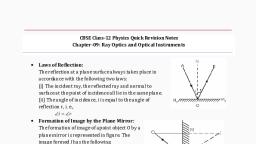
OPTICS, Reflection:, When a ray of light is allowed to fall on a reflecting surface such as mirror, it is, observed that light reflects in the same medium. It is shown in figure., Angle made by incident ray with normal is called angle of incidence., Angle made by reflected ray with normal is called angle of reflection., N, PQ = Incident ray, P, , R, QR = Reflected ray, NQ = Normal to reflecting surface, 𝑟, , i, , ∠PQN = angle of incidence, ∠NQR = angle of reflection, Q, , Laws of reflection:, ( 1 ) The angle of incidence is equal to the angle of reflection, ∠ i = ∠ 𝑟, ( 2 ) The incident ray, normal and reflected ray, lie in one plane., , Refraction:, When a ray of light is incident on a plane transparent medium such as glass, it is, observed that in the second medium, light ray deviates from its original path. The, bending of light in second medium is called as refraction., A, Air, , N, , AB = Incident ray, , i, , BC = Refracted ray, , (rarer medium), , NN` = Normal to surface, (denser medium), , Glass, , B, , ∠ i = angle of incidence, r, N`, , Optics, , ∠ r = angle of refraction, C, Page 1 of 5
Page 2 :
Angle made by refracted ray with normal is called angle of refraction., The refracted ray bends either towards or away from the normal depending upon, whether the second medium is optically denser or rarer than the first medium. In the, second medium, velocity of light also changes., Laws of refraction:, ( 1 ) Angle of incidence and angle of refraction are always on opposite sides of normal., ( 2 ) The incident ray, the refracted ray and the normal to the surface separating two, media, lie in the same plane., ( 3 ) Snell’s Law: For any two media, the ratio of the sine angle of incidence to the sine, angle of refraction is constant., sin i, , Thus,, , sin r, , = constant, Where, i = Angle of incidence, r = Angle of refraction, , This constant is called refractive index of second medium with respect to first and is, denoted by 1μ2., sin i, , ∴, , sin r, , = 1μ2 =, , μ2, μ1, , = constant, , A, N, Air, , i, , i, , Glass, , Glass, , Air, r, N`, Case 1, , r, C, Case 2, , Case 1: When light enters from air (optically rarer) medium to glass (optically denser), medium, ray bends towards normal. Thus, i > r, Optics, , Page 2 of 5
Page 3 :
sin i, , ∴, , sin r, , = constant > 1, , The constant is called refractive index of glass with respect to air and is denoted as aμg, sin i, , ∴, aμg, , Also, , sin r, , =, , μg, μa, , =, , = aμg > 1, , velocity of light in air (Va ), velocity of light in glass (Vg ), , Case 2: When light enters from glass (optically denser) medium to air (optically rarer), medium, ray bends away from normal. Thus, i < r, sin i, , ∴, , sin r, , = constant < 1, , The constant is called refractive index of air with respect to glass and is denoted as gμa, sin i, , ∴, Also, Thus,, , gμa, , sin r, , =, , μa, μg, , =, , aμg, , = gμa < 1, , velocity of light in glass (Vg ), velocity of light in air (Va ), , = 1 / gμa, , Refraction of light through a glass prism:, When light is passed through the glass prism, it is refracted at two surfaces as shown in, figure., PQ = Incident ray, A, QR = Refracted ray, N, N``, RS = Emergent ray, Q, 𝛿 R, e, i, e = Angle of emergence, P, 𝛿 = Angle of deviation, N`, S, ∠ BAC = Angle of prism, B, C, , Optics, , Page 3 of 5
Page 4 :
Angle of deviation ( δ ): A ray of light passing through prism suffers two refractions, and gets deviated through an angle ‘δ’ from its original path. This angle is called as, angle of deviation., Angle of minimum deviation ( δm): The minimum possible value of angle of deviation, is called angle of minimum deviation., The angle of deviation depends upon following factors:, ( 1 ) Angle of incidence ( i ), ( 2 ) Angle of prism ( A ), ( 3 ) Refractive index of the material of prism., , Determination ( Derivation ) of Refractive Index of Material of a Prism:, It is observed that as ‘i’ increases, δ initially decreases and then again it increases., Also when δ = δm , then i = e …………( 1 ) and r1 = r2. Let r1 = r2 = r …………( 2 ), A, , N, , N’’, , E, i, , Q, , x, r1, , P, , y δm R, r2, , e, , N’, , S, , B, , C, , Consider quadrilateral AQN’R in which, ∠ A + ∠ AQN’ + ∠QN’R + ∠N’RA = 360° ………( ∵ NN’ and N’N’’ are normal ), i.e. ∠ A + 90° + ∠QN’R + 90° = 360°, ∴, In Δ QN’R ,, Optics, , ∠ A + ∠QN’R = 180°, , ……………………..( 3 ), , ∠ r1 + ∠ r2 + ∠QN’R = 180°, , ………………..( 4 ), Page 4 of 5
Page 5 :
Equating ( 3 ) and ( 4 ),, ∠ A + ∠QN’R = ∠ r1 + ∠ r2 + ∠QN’R, ∴, , ∠ A = ∠ r1 + ∠ r2, , ∴, , A = r + r = 2r, , ∴, , r =, , In Δ EQR ,, , A, , ;, , A = r 1 + r2, , but, , r 1 = r2 = r, , ……………………….( 5 ), , 2, , x + y = δm, , ( exterior angle theorem ), , ( i - r1 ) + ( e - r2 ) = δm, i + e - r 1 - r 2 = δm, , but, , r 1 = r2 = r, , i + e - 2r = δm, i + e = 2r + δm, From equation ( 5 ),, ∴, , A = 2r, i + e = A + δm, , ………………………………….( 6 ), , Put e = i from equation ( 1 ), ∴, , 2i = A + δm, ∴, , i = (, , By Snell’s law,, , A + δm, , μ =, , μ =, , 2, , sin i, sin r, , ,, , ), , .……………………..( 7 ), using equations ( 5 ) and ( 7 ), , A + δm, ), 2, A, sin ( 2 ), , sin(, , This is called as prism formula., Exercise theory questions:, 1) State laws of reflection., 2) State laws of refraction., 3) State Snell’s law., 4) Define angle of minimum deviation., Optics, , Page 5 of 5



 Learn better on this topic