Notes of XI Literature & Grammar, English KC WS XI We're not Afraid to Die.docx - Study Material
Page 1 :
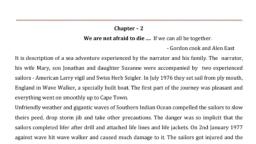
Krishna Classes, Worksheet, We’re Not Afraid to Die If we Can all be Together, Notes:-, Summary:, We are not afraid to die if we can all be together summary tells about the extreme bravery and skill exhibited by Gordon Cook. Gordon Cook’s family and crewmen in a war with water and the waves for existence. In the month of July in the year 1976, the writer, his wife Mary, his son Jonathan and his daughter Suzanne set sail from Plymouth, in England to duplicate the round-the-world journey made 200 years ago by Captain James Cook. They took the trip in their professionally designed ship, named the Wavewalker, accompanied by 2 sailors. Larry Vigil, who was an American and Herb Sailor, a Swiss, to tackle one of the world’s coarsest oceans – the Southern Indian Ocean., The first portion of the journey that is about 1,05,000 kilometres up to Cape Town passed off very enjoyably. On the 2nd day out of Cape Town, they started to encounter strong windstorms. Windstorms did not worry about the narrator. But the height of the waves was alarming up to fifteen meters above that was as high as the mainmast. On the 25th of December, the writer’s ship reaches in the southern Indian Ocean that was about 3,500 kilometres to the east of Cape Town. The family welcomed the New Year on the ship., At the dawn of 2nd January, the waves were huge in size. Unfriendly weather and massive waves forced the sailors to slow the speed of the ship, drop the storm jib and take various other precautions. The risk was so obvious that the sailors accomplished a life-raft drill, attached the lifeline boats and the life jackets. Unexpectedly at 6 pm, a terrific explosion shook the Wavewalker and the writer was thrown overboard. The Wavewalker was about to overturn when another massive wave hit it throwing it upright one more time. The writer was thrown back again on the deck, his head and ribs were smashing touching the walls of the Wavewalker. In spite of a lot of injuries, the writer took charge of the situation and decided to handle it on his own. Larry and Herb started pumping out water from the ship., The author somehow managed to cover the canvas across the gaps to stop the water from entering into the ship. Moreover, their hand pumps stopped functioning and the electric pumps short-circuited at the same time. Luckily, the writer found a spare electrical pump that was in a working condition. The entire night everyone was pumping, steering, repairing and sending radio signals for help. The author checked the charts and found that He Amsterdam, a French scientific base was their last hope., Sue and Jon got heavily injured. But, they were not afraid to die if they were all together. Sue’s head got swelling and she was having a deep injury. Moreover, the writer became extra determined to see the courage of his children. Finally, they were able to touch the lie Amsterdam. It was a volcanic island where 28 inhabitants were ready to receive them., Conclusion, To sum up, we are not afraid to die if we can all be together summary, we can say the collective power of unity and the never-failing confidence of the sailors made it possible for them to survive and come out from the jaws of death., Glossary:, Voyage – a long journey by sea or space, Leisure – free time, Honing – sharpen, improving, Seafaring – regularly traveling by sea, Honing our seafaring skills – improving the skills required to travel by sea, Wooden-hulled – a watertight body of a ship, Gales – A very strong wind, Mast – a tall upright structure on a boat or ship, Atrocious – bad; of a very poor quality, Gigantic – huge; of a big size, Jib – a triangular staysail set forward the mast in a ship, Knots – a unit of speed equal to one nautical mile per hour, used especially of ships, aircraft, or winds, Enormous – a very large size, Lashed – to hit with a lot of force, Mooring – the ropes, chains, or anchors by or to which a boat, ship, or buoy is moored, Loop – a shape produced that bends round and crosses; bent, Stern – the back part of a ship or a boat, Donned – put on, wore, Oilskins – heavy cotton cloth waterproofed with oil, Impending – about to happen, Ominous silence – unpleasant or threatening silence, Aft – near the stern of the ship, Frightful – very unpleasant or shocking, Crest – reach the top of a wave, Tremendous – very great in amount, Shook – past tense of shake (vibrate), Deck – a floor of a ship, Torrent – a fast moving stream of water, Smashed – shattered or violently broken, Capsizing – be overturned in the water, Hurled – throw with a great force, Taut – stretched or pulled tightly, Boom – pole that controls the angle and shape of the sail, Scrambled – climb; claw one’s way, Hatch – door, Timbers – wood board used in building of a ship, Starboard – side of a ship which is on the right side when one is facing forward, Bulged – swell, Sloshed – move through liquid with a splashing sound., Bashed – strike hard; hit, Deflected: turned aside, Canvas – a strong unbleached cloth, Debris – rubbish, Wrenched – pull suddenly, removed, Forestay – a rope to support ship’s foremast, Dinghies – a small boat for recreation with mast or sail, Mayday calls –words used to signal ships stuck in a disastrous situation through radio, Smashed – badly broken, Keel – steel structure along the base of the ship, Pinpricks – a prick caused by a pin, Pinpricks in the vast ocean – the two small islands in the vast ocean were very tiny like the prick caused by a pin, Abated – something unpleasant to become less intense, Auxiliary engine – small secondary engine used to board ships to operate a windlass in the ship, Sextant – an instrument with graduated arc of 60 degrees for taking altitudes and navigation, Caricatures – picture of a person; cartoon, Anchored – moor a ship to the sea bottom, Offshore – situated at the sea some distance from the shore, Ashore – on the shore of the land, Optimistic – hopeful and confident, Multiple Choice Questions:, 1. From where did the ship sail for the voyage?, A. America, B. Mexico, C. Germany, D. Plymouth, England, 2. Why did the author decide to go for a round-the-world voyage?, A.to duplicate the voyage made 200 years ago by Captain James Cook, B. to see the world, C. to settle down in different country, D. to show his children the world through ship, 3. What was the occupation of the author?, A. Businessman, B. Sailor, C. Teacher, D. None of the above, 4. What was the name of the ship of the author?, A. Amazon, B. Wavewalker, C. Waveship, D. Sailorship, 5. What part of the journey was pleasant for them?, A. First leg - from England to Cape town, B. Last part of the journey, C. First few months, D. Never, 6. What were the names of the two crewmen whom the author hired?, A. Shelly and Cabil, B. Larry Vigil and Herb Seigler, C. Herb Seigler and Shelly Cooper, D. Larry Vigil and Adam Moore, 7. Why did the author hire the two crewmen?, A. to take rest from long the voyage, B. to help tackle one of the world’s roughest seas, the southern Indian Ocean, C. because he could no longer sail the ship, D. he wanted to spend some time with his family, 8. When did the waves start getting gigantic?, A. December 25, B. January 2, C. November 30, D. December 31, 9. What did they do to slow down the boat in the storm?, A. Stopped sailing, B. dropped the storm jib and lashed a heavy mooring rope, C. just dropped the storm jib, D. did nothing and waited for storm to calm down, 10. What was the first indication of disaster?, A. around 6 pm when winds dropped and sky grew darker, B. next morning when the ship started creaking, C. when it started raining, D. when winds were strong, 11. What happened after the first indication of the disaster? , A. a wave appeared vertical and almost twice the height of other waves, B. it broke the ship from inside, C. the ship turned upside down, D. it didn't affect the ship, 12. How did the explosion affect the ship?, A. A torrent of green and white water broke over the ship, B. the ship started sinking, C. the ship turned upside down, D. None of the above, 13. Why did the author accept his approaching death?, A Pirates had attacked the ship, B because he was injured by the explosion, C he was thrown in the sea, D he was stabbed, 14. What did the author see when his head popped out of the water?, A. the ship was sinking, B. the ship was nowhere to be seen, C. the ship was near capsizing, her masts almost horizontal, D. it was still standing, 15. What happened to the author's body when he managed to reach the deck?, A. his head smashed again, B. his left ribs cracked; mouth filled with blood and broken teeth, C. he broke his leg, D. his broke his left hand, 16. Who said, “We’re sinking!” ?, A. His crewmen, B. Mary, C. His daughter, D. His son, 17. What was the condition of the ship?, A. Broken timbers, starboard side bulged inwards; clothes, crockery, charts, tins and toys sloshed, B. There personal belongings were missing, C. water filled in every room and their clothes were missing, D. Can't say, 18. What had happened to Sue when the author entered their room to check on them?, A. her head hurt as there was a bump, B. She was unconscious, C. her legs hurt, D. she was fine, 19. What was the age of Suzanne and Jonathan?, A. 8 & 9 years old, B. 7 & 6 years old, C. 10 & 7 years old, D. 4 years & 6 years, 20. How did the author manage to stretch the canvas?, A. by repairing the holes, B. by asking crewmen for help, C. it happened on its own, D. the problem got over as the storm had passed, 21. What happened after the hand pumps started to block up with the debris floating around the cabins?, A. the author connected an electric-pump to an out-pipe, B. by taking out water with the help of bucket, C. by repairing hand pump, D. the author found another hand pump, 22. Where did they decide to reach to save themselves and the ship?, A. Australia, B. Ile Amsterdam, C. Mumbai, India, D. Japan, 23. What was their first meal in two days?, A. Meat loaves, B. bread and milk, C. noodles, D. corned beef and cracker biscuits, 24. Who said, “we aren’t afraid of dying if we can all be together — you and Mummy, Sue and I.”?, A. Jon, B. Crewmen to each other, C. Suz, D. Mom, 25. When did they reach lle Amsterdam?, A. around 6 pm in the evening, B. never reached there, C. at 11 in the next morning, D. they decided to take different route, 26. What was the status of the ship on January 3?, A. "pumps had the water level sufficiently under control ", B. condition was getting worse, C. they were still struggling to control the pumps, D. everything was just right, 27. How long did they take for the ship's testing and fitting? , A. months, B. few days, C. 2 years, D. few weeks, 28. Where had they reached on the 25th of December?, A. 3,500 kilometres east of Cape Town, B. they were suffering the waves away from Cape Town, C. 2500 km from Cape Town, D. reached capeTown, 29. What happened when the author's head smashed into the wheel?, A. he was hurt but steady, B. he flew overboard sinking below the waves, C. he was not hurt, D. he gained control immediately, 30. What does 'Mayday call' mean?, A Call made in the month of May, B Distress call for help, C Both A and B, D None of these



 Learn better on this topic