Notes of Class -10th, Sst Federalism.pdf - Study Material
Page 1 :
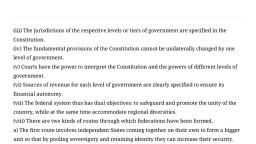
Syllabus, , What is federalism?, , What makes india a federal country?, How is federalism practiced?, Decentralization in india, , , , , , @ Revision Notes, , , , , , , » The sharing of power among the central, state, regional and local governments is known as federalism., , » In the federal form of government, there is a clear-cut division of powers between the central authority and, , Various constituent units of the country., , The key features of federalism are :, , © There are two or more levels (or tiers) of government., , © Different tiers of government govern the same citizens, but each tier has its own, jurisdiction in specific matters of legislation, taxation and administration. Me |, , © The jurisdictions of the respective levels or tiers of government are specified in the, , Constitution., , The fundamental provisions of, , level of government. Such change: tee, , © Courts have the power to interpret the constitution and the powers ©!, , Sovernment., , Sources of revenue for each level of governmen', , © The federal system thus has dual objectives: To, same time accommodate regional diversity., , “Argentina, Austria, Australia, Belgium, Brazil, Canada,, , States have federal governments. a, , Constitution clearly provided a threefold distribution, , oe it contains three lists :, a ey ct ae os of national importance such as defence of the country, foreign affairs,, ion List: It includes su, , cl vA ent alone can make laws relating to the subjects, ig, communications and currency. The Union Government al l, , Mentioned in the Union List., State List: It contains subjects of sae an, Brigation. The State Governments alone, , >, , , , , , , , , , , , the constitution cannot be unilaterally changed by one, s require the consent of both the levels of government., f different levels of, , , , t are clearly specified to ensure its financial autonomy., safeguard and promote the unity of the country and at the, , , , , , , , , Germany, India, Mexico, Switzerland and the United, , of legislative powers between the Union Government and, , d local importance such as police, trade, commerce, agriculture and, can make laws relating to the subjects mentioned in the State List.
Page 2 :
vy, , Federalism is a system of government, , Z, ) Fe Linguistic States, In 1947, the boundaries of several, 3 old States of India were changed in order to in which the power is divided between a central authority, E create new States. This was done to ensure and various constituent units of the country. Different tiers of, g that people who spoke the same language Lived in the government govern the same citizens, but each tier has its own, g same State, Some States were created on the JURISDICTION. The fundamental provisions of the Constitution, 5 hases of culture, ethnicity or geography. ee ees Shanert by var level ot gpverumest., 5 ces of revenue for each level of government, a are clearly specified., z Language policy, ) Hindi was identified as the official language. A ., 7% There are 21 other languages recognised as =< How is federalism What is federalism?, a Scheduled Languages by the Constitution. practised?, The Central Government responded by agreeing to, continue the use of English along with emi, Hindi for official purposes. W Pee, hat makes \ndia, a federal country?, , Federalism, , Centre-State relations, After 1990, there was the beginning of the era of, COALITION GOVERNMENTS at the Centre., This led to a new culture of power sharing and respect, for the autonomy of State Governments. Federal power, sharing is more effective today than it was in the, early years after the Constitution came into force., , Decentralisation in India, , : In 1992, the Constitution was amended to make the, 4 third-tier of democracy more powerful and effective., Seats are reserved for the Scheduled Castes, Scheduled Tribes, and Other Backward Classes. The State governments are, required to share some powers and revenue with, local government bodies. There are now about 36 Lakh elected, representatives in the panchayats, municipalities,etc., , , , 4, :, , , , , , , , , , , The Constitution clearty provided a threefold distribution of, , legistative powers between the Union Government and, the State Governments. Union List includes subjects of, , national importance such as defence of the country, foreign affairs,, banking, communications and currency. The State Governments, , an make laws relating te the subjects mentioned in the, _ State List. Concurrent List includes subjects of common interest, to both the Union Governments as well as the State Governments,, , such as education, forest, trade unions, marriage, etc., , EO OTTERS, , , , —
Page 3 :
yore, a it List: It i _, @ Concurrent List: It includes subjects, f co; i, Governments, such as educatio ae ee, me : ‘0 both the Ui, well as the State Governments can ee me cedar, each other, the law made by the Uni ieee, , y Some units of the Indian Union ill prevail., , are smaller in size ;, jndependent state and they also ca fe T In size in comparison to other states to become an, merged with other existing states. Such units are known as, , Union Territories. mnot b:, , , , Telnet, more about, Red s1(9, , Hindi was identified as the official language. B, recognized as Scheduled Languages The cone, » States like Nagaland, Uttarakhand and Jharkhand i, but to recognize differences based on culture, anes Soe eee, ert - th Cc s - = = :, > Bee cae ie State relations is one more way in which federalism has been, , , When no single party gets a clear Majority in the Lok Sabha, the major national parties enters, , into an alliance with many parties including several regional parties to f, Ge Conitioecivecen 1g Bi Parties to form a government at the, , > Amajor step towards decentralisation was taken in 1992., , , , , , wv, , besides Hindi, there are 22 other languages, stitution., , , , , , , , , , Division of Power, , > The Constitution was amended to make the third-tier of democracy more powerful and effective. The following, measures were taken regarding this:, | ® Itis constitutionally mandatory to hold regular elections for local government bodies., | @ Seats are reserved in the elected bodies and the executive heads of these institutions for the Scheduled Castes,, Scheduled Tribes and Other Backward Classes., ® Atleast one-third of all positions are reserved for women., @ Anindependent institution called the State Election Commission has been created in each State to conduct, panchayat and municipal elections., ® The State Governments are required to share some powers and revenue with local government bodies., > Rural local government is popularly known by the name Panchayati Raj. Each village, or a group of villages in, some states, has a gram panchayat., > The functions of gram panchayats are : es, ‘ Ba 3 je village:, : Fe its Gucer the overall uperviion of the gram sabha. All the voters in the village are its, e en at least twice or thrice in a year to approve the annual budget of the gram panchayat., s i fhe gram panchayat., ne ccc peed eetete form what is usually called a panchayat samiti PATI, , ecbinck of mandal. yest, , All the panchayat samitis or mandals in a district together constitute the zila (district) Rincon, arishad., , , , , , , , , , , , , , , political head of the Zila Parishad., Big cities are constituted into municipal corporations., , orations are controlled by elected bodies consisting | \iberal language, Policy, , ila Parishad chairperson is the, , Municipalities are set up in towns., , Both municipalities and municipal corp, People’s representatives., , Municipal chairperson is the political, ich an officer is called the Mayor, , Be eeu, , , , , , , , , , head of the municipality. In a municipal corporation,, , lerali: ini al government (the, , deralism: i i de of government, combining a genera’ go, , tral ede = ae i thee oral governments (ovina state, cantonal, territorial or other subor 'federal’ gover: A, , pe eanirents) in a single political system., , ‘A jurisdiction is a state or other area in which a particular court and system of laws have authority., tion : A juris
Page 4 :
v, , v, , y, , Vv, , Vv, , Vv, , Vv, , Vv, , Vv, , Vv, , ponies alone can mane weusions op,, Government é, Union List : It includes 97 subjects of national importance: mee communication. Pt in the Sey, these matters such as defence of the nation, foreign affairs, | ‘ally there weTe 66 items in the coe Seventh, State List : The State List or List-II is a list of 61 items (Initia’y level importance. The State Government, Schedule of the Constitution of India. It includes matters of stale °°". “ade, agriculture, commerce anq, alone can make decisions on these areas. They include matters such as P ay 3 ;, irrigation. st item is num ere 2 given in the, Concurrent List: The Concurrent List is a list of 52 items (though the 16 ich are of common interest to bot}, Seventh Schedule of the Constitution of India. It includes hs i adoption & succession and trade unions, the Central and State Governments such as education, forest, Dv ee aie ai, Both the Central and State governments can make decisions one dependent states CO me together on their own, ‘Coming Together’ Federation: It isa federation in which several at Hanes they can increase their security, |, to form a bigger unit so that by pooling sovereignty and retaining, includes the USA, Switzerland and Australia. - ivide its power betwee., ”, HE x decides to divi Pi een, ‘Holding Together’ Federation : It is a federation in which a Bie ee and Belgium., the constituent states and the national government. It includes India, : teare known as residuary subjects and, Residuary Subjects: Matters which are not included in any of the ee s' = =i Government (the Parliament) has, the right to make laws on these subjects is called residuary power. The Cen’ ter software, that came up after the, been given rights to legislate on these subjects. New subjects such as comput, , Constitution was made, come under residuary subjects. :, , Unitary System: It is a system of government in which either there is only on, , subunits are subordinate to the Central Government. , h Peaster, , Language Policy: It is to safeguard other languages. Under this policy, besides peti iportien Dan guages are, , recognised as Scheduled Languages by the Constitution. an, , Scheduled Languages: 22 Languages which are listed in the Eighth Schedule of the Constitution are known as, , the Scheduled Languages., , Indian Federation: It has 28 states and 9 union territories. Its capital is New Delhi., , Union Territories: These territories do not have the powers of a state and hence, they come under the direct rule, , of central or union government. For example, Chandigarh, Lakshadweep, etc., , Regionalism: A political ideology that focuses on the national or normative interest of a particular region, group, , of regions or other subnational entity., , Autonomy: A region or territory to govern itself independently., , Linguistic States: India is a multilingual country where people speak different languages. After independence,, , some states were created on the basis of the languages people used to speak. These are known as linguistic states, , ee ere It is a body created in each state to conduct panchayat and municipal elections., ‘anchayati Raj: A system of government in which Gram Panchayats are the basic units of Imini i s, , three levels — Gram (village), Tehsil (block) and Zila (District). 2 ecuusization: It has, , Panchayat Samiti: It is a local government body at the tehsil or taluka | i i ichasiali 5., , Panchayat and Zila Parishad. uy evel in India, which is a link between Gram, , Gram Sabha: The body for the supervision of Gram Panchayats., , Tier System: It is the system which si;, , levels(three tiers)., , Mayor: The Chairperson of a Municipal Corporation is known as the Mayor., , e level of government or the, , ignifies levels of government. It may be two levels (two tiers) and three, , , , , , ,, '



 Learn better on this topic