Notes of Class 10, Social Science Political Parties - Study Material
Page 2 :
CIVICS POLITICAL PARTIES, , Political Parties, A political party can be termed an organised group of like-minded people who hold similar views on, political issues of the country., , Basic Characteristics of Political Parties, Unity: Formation of a political party is possible only when the members of a party work as a team and, share similar opinion on basic issues and policy matters., Organised System of Working: A political party follows some rules and regulations to maintain discipline, in the party., Constitutional Means: In a country like India, a political party has to work within the democratic and, constitutional framework., Objectives: A political party has certain aims and objectives. For example, the Marxist party has the main, aim to work for the upliftment of the downtrodden section of society., National Interest: Political parties should work to promote and safeguard national interests. They also, work on non-sectarian issues., , Objectives of the Political Party, Basic objectives of the political parties:, To capture power and form the government, To safeguard national interests through their programmes and ideologies, The parties in opposition scrutinise the policies of the ruling party, To provide public leaders who can lead the country on the path of development, To provide a common platform for uniting masses which are divided on religious, social, cultural and, other religious groups, , Types of Political Parties, There are two types of political parties at present—national and regional political parties., , National Political Parties, , , , , , A national party is one which is recognised by the Election Commission in four or more states and has, a nationwide presence., A political party is recognised as a national party if it fulfils the following criteria:, o It secures at least six percent of total votes in the Lok Sabha elections., o It secures at least six percent of total votes in the Assembly elections in at least four states., o It wins at least four seats in the Lok Sabha., o Its candidates are elected from at least two percent of the total number of parliamentary, constituencies in at least three states., The Election Commission has recognised the following parties as national parties:, o Indian National Congress (INC), o Bharatiya Janta Party (BJP), o Communist Party of India (CPI), o Communist Party of India (Marxist CPIM), o Bahujan Samaj Party (BSP), o Nationalist Congress Party (NCP), , www.topperlearning.com, , 2
Page 3 :
CIVICS POLITICAL PARTIES, Importance of the National Party, , Works for the, upliftment of people, and nation, , National presence, helps it to solve, regional issues, also, , It takes part in forming, the government at the, centre, , Importance of the, Political Party, , The opposition party, keeps check on the, ruling party, , Formulate policies for, solving major national, issues, , Regional Parties, Regional parties function at the state level. A political party which is recognised in less than four states is, known as a state party. Political parties are recognised as regional parties if they fulfil the following, criteria:, A party secures at least six percent of the total votes in an election to Legislative Assembly of a state., A party should win at least one seat in the Lok Sabha from the state in the general elections., , Differences between a National and Regional Party, National Party, It has presence in many states in the country. It is, recognised in four or more states., It can form the government at the centre either by, securing majority or by forming a coalition., It is more concerned with national issues., , Regional Party, It has presence in one or two states only. It is, recognised in less than four states., It cannot form the government on its own in the, centre. It can be a part of the central government, only if it supports a national party., It concentrates more on regional issues., , Importance of the Regional Party, , , , , , It looks into the problems and issues at the regional level., A regional party with representation in the Lok Sabha and the Rajya Sabha helps draw attention of the, nationalist parties and the people towards regional issues., Many regional parties have extended their support to national parties. This helps give a stable, government at the centre., Regional parties can play the role of the opposition party if it is not a part of the government., , www.topperlearning.com, , 3
Page 4 :
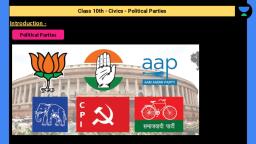
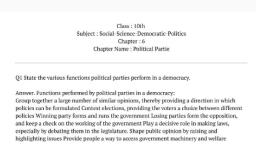
CIVICS POLITICAL PARTIES, Role of Political Parties, , , , , , , , , It acts as a link between the people and the government., Election-related functions of a political party are, o It participates in the election and addresses major social, economic and political issues which are, faced by the nation or state., o A political party selects suitable candidates for contesting elections., o It campaigns for its own party policies and candidates by organising rallies, public meetings and, taking out processions., o The party workers help a political party to win public support and cooperation., One of the major roles of a political party is to provide good governance after forming the government, at the centre or state level., Political parties provide people with an alternative choice at the time of elections. When people are not, happy with the performance of a ruling party, they can vote for another political party., Political parties unite the nation by integrating different classes, interest groups and overcoming, geographical distances., Political parties can also plan for social progressive changes., , Nationalist Parties in India, Name of the, party, Indian National, Congress, , Year of, foundation, 1885, (however, the, party has split, many times), 1980, , Basic ideologies, , Bahujan Samaj, Party, , 1984, , Champions the cause of Dalits, Adivasis and OBCs, , Communist, Party of IndiaMarxist (CPI-M), Communist, Party of India, (CPI), , 1964, , Believes in the principles of socialism, Marxism,, Leninism, secularism and democracy, , 1956, , Believes in Marxism–Leninism, secularism and, democracy, , Nationalist, Congress Party, , 1999, , Believes in democracy, equity, social justice and, federalism, , Bharatiya Janta, Party, , www.topperlearning.com, , Symbol, , Endorses secular principles and aims at the welfare of, weaker sections and minority communities, , Complete integration of Jammu and Kashmir with India;, believes in cultural nationalism (Hindutva) and uniform, civil code for all people, , 4



 Learn better on this topic