Notes of IKAT Class 10, 2021-22, Science X Science MCQ, CASE STUDIES, A&R.pdf - Study Material
Page 1 :
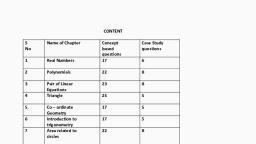
COURSE STRUCTURE CLASS X, , EVALUATION SCHEME, , THEORY, , Units, , Term ‐ I, , I, , Chemical Substances‐Nature and Behaviour:, Chapter 1,2 and 3, , 16, , II, , World of Living: Chapter 6, , 10, , Natural Phenomena: Chapter 10 and 11, , 14, , III, Units, , 5|Page, , Marks, , Term ‐ II, , Marks, , Chemical Substances‐Nature and Behaviour:, Chapter 4 and 5, , 10, , World of Living: Chapter 8 and 9, , 13, , Effects of Current: Chapter 12 and 13, , 12, , Natural Resources: Chapter 15, , 5, , Total Theory (Term I+II), , 80, , Internal Assessment: Term I, , 10, , Internal Assessment: Term II, , 10, , Grand Total, , 100
Page 2 :
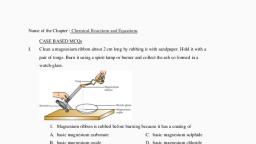
Chemical Substances‐ Nature and Behavior, CH.1‐CHEMICAL REACTIONS AND EQUATIONS, (A) Single Response Questions, Q1. Electrolysis of water is a decomposition reaction. The mole ratio of hydrogen and oxygen gases liberated during, electrolysis of water is, (a) 1 : 1, (c) 4 : 1, , (b)2:1, (d)1:2, , Q2. Which among the following is (are) double displacement reaction(s)?, (t) Pb + CuCl → PbCl2 + Cu, (ii) Na2SO4 + BaCl2 → BaSO4 +2NaCl, (iii) C + O2 → CO2, (iv) CH4 + 2O2 → CO2 + 2H2O, (a) (i) and(iv), (b) (ii) only, (c) (i) and(ii), (d) (iii) and(iv), Q3 Which option denotes a double displacement reaction?, (a) A + B + C, (b) A + B → C, (c) AC + BD → AD + BC, (d) AC + B → AB + C, Q4 Which of the following is correct balanced equation:a) Fe + H₂O → Fe₃O₄ + H₂↑, b)2Fe+4H₂O→Fe₃O₄+4H₂↑, c) 3Fe+ 4H₂O→Fe₃O₄+ 4H₂↑, d) 3Fe+ H₂O→Fe₃O₄+ H₂↑, Q5. A reaction in whicha single product isformed fromtwo or more reactants isknown asa, ......................reaction., a) combination, , b) doubledisplacement, , c)decompositionreaction, , d) displacement reaction Q6., , What is chemical formula for marble?, a)CaO, , b) Ca(OH)2, , c)CaCO3, , d) CaCl2, , Q7. What is the chemical formula for quick lime?, a) CaO, , b) Ca(OH)2, , c)CaCO3, , d)CaCl2, , Q8. Whatisobservedwhenasolutionofpotassiumiodideisaddedtosilvernitratesolution?, (a) No reaction takes place, (b) White precipitate of silver iodide is formed, (c) yellow precipitate of Agl is formed, (d) Agl is soluble in water., 6|Page
Page 4 :
CHEMICAL REACTIONS AND EQUATIONS, , a) (i) and (iv), (b) (ii) and(iii), (c) (i) and(iii), (d) (iii) and(iv, Q10. Which of the following reactions is not correct:, (a) Zn+ CuSO4 → ZnSO4 + Cu, (b) 2Ag + Cu(NO3)2 → 2AgNO3 + Cu, (c) Fe+CuSO4 → FeSO4 +Cu, (d) Mg + 2HCl → MgCl2 +H2, Q11.Ifasubstancelosesoxygenorgainshydrogenduringareactionitissaidtobe………………, a)Oxidised, , b) Reduced, , c) tarnished, , d) corroded, , Q12. Some metals tarnished by substances around them such as moisture when left for some time what is this process, called as?, a)Corrosion, , b) Rancidity, , c)Galvanization, , d) Reduction, , Q13. Respiration is a /an:, a) endothermic reaction, b) exothermic reaction, c) decomposition reaction, d) displacement reaction, Q14. Keeping food in airtight containers helps to slow down:, a) reduction, b) displacement, c) oxidation, d) all of the above, Q15. Whenasinglereactantbreaksdowntogivesimplerproductsthereactionisknownas:, a) endothermic reaction, b) exothermic reaction, c )decomposition reaction, d) oxidation reaction, , (B) Multiple Response Questions, Q1. Which among the following is an exothermic reaction?, a) respiration, b) decomposition of vegetables, c) burning of natural gas, d) decomposition of silver chloride, Q2 Identify combination reactions given below:, 8|Page
Page 5 :
CHEMICAL REACTIONS AND EQUATIONS, , a) heating of ferrous sulphate, b) reaction of quick lime with water, c) burning of coal, d) formation of water from hydrogen and oxygen, Q3 Which among the following is/are chemical reactions?, a) souring of milk, b) cutting of wood, c) cooking of food, d) burning, Q4 Identify endothermic reactions given below:, a) respiration, b) photosynthesis, c) melting of ice cube, d) reaction of silver bromide in sunlight. Q5, How can we prevent rancidity?, a) Adding antioxidants, b) Storing food in airtight containers, c) Replacing oxygen in the containers with another gas., d) Its not possible to prevent rancidity., , (C) Assertion‐ Reason questions, Followingquestionsconsistoftwostatements–Assertion(A)andReason(R).Answerthese questions, selecting the appropriate option given below:, (a) Both A and R are true and R is the correct explanation of A., (b) Both A and R are true but R is not the correct explanation of A., (c) A is true but R is false., (d) A is false but R is true., Q1Assertion (A):Calcium hydroxide when reacts with carbondioxide gives calcium carbonate and water., Reason (R) : On heating calcium carbonate, decomposition reaction takes place., Q2 Assertion (A) : Decomposition of vegetable matter into compost is an example of exothermic reactions., Reason (R) : Exothermic reaction are those reactions in which heat is absorbed., Q3 Assertion (A) : Green fumes are produced when lead nitrate is heated., Reason (R) : Nitrogen dioxide gas is produced as a by product due to the decomposition of lead nitrate., , 9|Page
Page 6 :
CHEMICAL REACTIONS AND EQUATIONS, , Q4 Assertion(A): When copper powder heated it becomes black in colour ., Reason(R): Copper oxide is produced due to oxidation which is black in colour., Q5 Assertion (A): Chips manufacturers usually flush bags of chips with gas such as nitrogen to prevent the chips, from getting oxidised., Reason (R): Nitrogen being antioxidant prevents the chips from being oxidised., , (D), , CCT Questions, , Q1, A student has been collecting antique silver utensils for her research. One day she observed a black coatingonsilver, utensils. Whichchemicalphenomenonisresponsibleforthischange?Writethe chemical name of black coating., Q2 Whenan ironnailisdippedincoppersulphatesolution,abrowncoatingofcopperisformedonthe surfaceofironand, thecolourofcoppersulphatesolutionchangesfrombluetolightgreen., , Why does the colour of copper sulphate change when an iron nail is kept in it? Justify your answer., Q3 Adarkroomisusedtoprocessphotographicfilm,tomakeprintsandtocarryoutother associatedtasks.Itisa, roomthatcanbemadecompletelydarktoallowtheprocessingofthelight- sensitive photographic materials, including, film and photographic paper. Silver bromide is a light- sensitive compound thatisit getsdecomposed when exposed, to light. Sowhen silverbromideis exposed to sunlight, it gets decomposed to give silver metal and bromine gas is, liberated. The reaction is called a photolysis reaction., , a., , During decomposition reactions ………. is required., , b., , Reactionsinwhichenergyisabsorbedareknownas… ...................................... reactions, , Q4 Rashiwhitewashedherhome.Sheusedawhitepowder forwhitewashing. Itproducescalcium hydroxide (CaOH)2, when it reacts with water (H2O) and absorbs carbon dioxide (CO2) from the, , 10 | P a g e
Page 7 :
CHEMICAL REACTIONS AND EQUATIONS, , environment, as a result, it produces calcium carbonate (CaCO3) which creates a hard coating on the walls and after 2-3, days the walls start shining., , a) Which is slaked lime in above reaction?, b) Why is slaked lime is used for white washing?, c) AsolutionofasubstanceXisusedforwhitewashing.(1)NamethesubstanceXandwriteits formula. (2) Write, the reaction of the substance X named in (1) above with water., d) Why walls start shining after 2-3 days?, , ., Answer‐Key CH.1‐CHEMICAL REACTIONS AND EQUATIONS, (A) Single Response Questions, 1. b (2 Hydrogen and 1 oxygen), 2. B (Both reactants undergo displacement), 3. C, 4.c 5. A, 6. C, 7. A 8.b (Whiteprecipitate of silveriodide isformed), 9.C(DisplacementandRedox, reaction), 10.a(Applyruleforbalancingchemicalequation), 11. B(Reduction is loss of Oxygen or, gain of Hydrogen), 12. a (Itisa slowprocess), 14.Ansc–oxidation, , 13. Ans b- Exothermic reaction, 15. Ans c – decomposition reaction, , (B) Multiple Response Questions:, 1. Ans1 - options(a) (b) and(c), Explanation: In exothermic reaction heat/energy is resleased, 2. Ans2 -Options (b),(c) and (d), Explanation: In combination reaction two or more reactants combine to form a product., 3. Ans3 – Options (a), (c) and (d), Explanation: Chemical changes occur in chemical reactions., 4. Ans 4-Options (b), (c) and (d), Explanation: In endothermic reaction energy is absorbed., 11 | P a g e
Page 8 :
5. Ans5 - Options (a), (b) and (c), , 12 | P a g e, , CHEMICAL REACTIONS AND EQUATIONS
Page 9 :
CHEMICAL REACTIONS AND EQUATIONS, , Explanation: Rancidity can be prevented by slowing down oxidation of food containing fats and oils. (C) Assertion‐, Reason questions, 1. b, 2.c, 3. d, 4. a, 5.a, (D) CCT Questions, Ans1.The phenomenon is called corrosion (oxidation). Blackcoating, onsilverutensilsissilversulphide., 2 Ag(s) + H2S(g) ---> Ag2S(s) + H2(g), silver sulphide, Ans2.Whenanironnailimmersedinthesolutionofcoppersulphatethanirondisplacescopperfrom the solution of, copper sulphate because iron is more reactive than copper. Therefore copper sulphate solution colour, changes from blue to pale green., Reaction: CuSO4(aq)+Fe(s)→FeSO4(aq)+Cu(s) Ans 3., a) energy b) endothermic, Ans4. a) Ca(OH)2 calcium hydroxide, b) White-wash is especially compatible with masonry because it is absorbed easily and the resultant chemical reaction, hardens the medium., c)(1)The solution of the substance used for whitewashing is calcium oxide also called quicklime with chemical formula, CaO., (2) Itformsslackedlimeorcalciumhydroxidewhenthequicklimereactswithwater CaO (s) + H2O, (l) → Ca(OH)2(aq)., d)Quicklime is used for whitewashing as it produces calcium hydroxide (CaOH) when it reacts with water (H2O) and, absorbs carbon dioxide (CO2) from the environment, as a result, it produces calcium carbonate (CaCO3) which creates, a hard coating on the walls. Walls start shining due to the formation of calcium carbonate., , 13 | P a g e
Page 10 :
CH.2‐Acid,Bases and Salts, Section‐A ( Multiple choice Questions), 1. Plaster of pairs is prepared from(a) limestone (b) Slaked lime (c) quicklime (d) gypsum, 2. A solution reacts with crushed egg-shells to give a gas that turns lime-water milky. The solution contains, (a) NaCl (b) HCl (c) LiCl (d) KCl, 3. Antacids contain(a) weak base (b) weak acid (c) strong base (d) strong acid, 4. The correct statement regarding universal indicator is, (a) it is an indicator having pH =7 (b) it gives blue colour at pH =3, (c) it becomes colourless at pH =7 (d) it gives orange colour at pH =3, 5. An aqueous solution turns red litmus solution blue. Excess addition of which of the following solution would, reverse the change?, (a) Baking Powder (b) Lime (c) Ammonium Hydroxide Solution (d) hydrochloric Acid, 6. The organic acid present in tomato is:, (a)oxalicacid, , (b) lactic acid (c) malic acid (d) tartaric acid, , 7. Bleaching powder gives smell of chlorine because it(a)isunstable, , (b) gives chlorine on exposure to atmosphere, , (c) is amixture of chlorine andslakedlime, , (d) contains excess of chlorine, , 8. The reaction of metal with acid results in the formation of(a) only hydrogen gas, , (b) only salt, , (c) both salt and hydrogen gas, , (d) none of these, , 9. Inoneoftheindustrialprocessesusedformanufactureofsodiumhydroxide,agasX isformedas by-product. The, gas X reacts with lime water to give acompound Y which is used as a bleaching agent in chemical industry. The, compound X and Y could be:, (a) H2and NaHCO3respectively(b) CO2and CaOCl2respectively, (c) Cl2and CaOCl2respectively, , (d) Cl2andNaHCO3respectively, , 10. Chemical formula of baking soda is:(a)MgSO4, , (b) Na 2CO3, , (c) NaHCO3, , (d) MgCO3, , 11. The acid used in making of vinegar is(a)formicacid, , (b)aceticacid(c)sulphuricacid, , (d) nitric acid, , 12. Aceticacid wasaddedtoasolidX keptinatesttube.Acolourlessandodourlessgaswasevolved. The gaswas passed, through lime water which turned milky.Itwas concludedthat., (a) Solid X is sodium hydroxide and the gas evolved is CO2, (b) Solid X is sodium bicarbonate and the gas evolved isCO2, (c) Solid X is sodium acetate and the gas evolved isCO2, (d) Solid X is sodium chloride and the gas evolved isCO2, 14 | P a g e
Page 11 :
13. Which of the following acid is present in sour milk?, , 15 | P a g e, , CHEMICAL REACTIONS AND EQUATIONS
Page 12 :
Acid,Bases and Salts, , (a)glycolicacid(b)lacticacid(c)citrusacid(d)tartaricacid, 14. isthefixednumberofwatermoleculeschemicallyattachedtoeachformulaunitofasaltin, , its crystalline form., (a) water of crystallisation (b) water content (c) hydration (d) none, 15. When an acid reacts with a metal carbonate or metal hydrogen carbonate, it gives the corresponding, , salt, water and releases which gas :(a)O2, , (b) CO2, , (c)H2, , (d) N2, , Section –B‐(MCQ with Multiple Correct answers), 15. Which of the following is used for dissolution of Gold?, (a)HCl, (b)NitricAcid, (c) Sulphuric Acid, (d) Carbonic Acid, 16. Which of the following are alkali:(a) NaOH (b) Ca(OH)2, (c) CuO, (d) HCl, 17. Which of the following is not formed as a product of Chlor-Alkali process:(a)HCl, (b) HF (c) Cl2 (d) NaOH, 18. Which of the following is/are acidic in nature?, (a)AppleJuice, (b) Soap Solution, (c) Lemon Juice, (d) CausticSoda, 19. Whichofthefollowingistakenorallyasmedicineinthecaseofhyperaciditytogetrelief?, a. Milk of magnesia, b. NaOH, c., , HCl, , d. Eno, , Section‐C (Assertion and Reason type), Directions:-In the following questions, a statement of assertion (A) is followed by a statement of reason (R). Mark the correct choice, as:, (a) Bothassertion(A)andreason(R)aretrueandreason(R)isthecorrectexplanationofassertion(A)., (b) Both assertion (A) and reason (R) are true butreason (R) is not the correct explanation ofassertion(A)., (c) Assertion(A)istruebutreason(R)isfalse., (d) Assertion(A)isfalsebutreason(R)istrue., (e) Both Assertion and Reason arefalse., 20. Assertion :Phenolphthalein gives pink colour in basic solution., Reason :Phenolphthalein is a natural indicator., 21. Assertion :H2CO3is a strongacid., Reason :A strong acid dissociates completely or almost completely inwater., 22. Assertion :When common salt is kept open, it absorbs moisture from theair., Reason :Common salt contains magnesium chloride., 23. Assertion :Baking soda creates acidity in thestomach., Reason :Baking soda is alkaline., 24. Assertion :While dissolving an acid or base in water, the acids must always be added slowly to water with, constantstirring., 16 | P a g e
Page 13 :
Reason :Dissolving an acid on a base in water in highly exothermic reaction., , 17 | P a g e
Page 14 :
Acid, Bases and Salts, , Section‐D (CCT Questions), 25. Following are the observations ofanexperiment on conduction ofelectricity byacids:, S.No. Sample Solution, Observation, Inference, 1, , Hydrochloric Acid, , Bulb Glows, , Conducts Electricity, , 2, , Sulphuric Acid, , Bulb Glows, , Conducts Electricity, , 3, , Glucose Solution, , Bulbdoesnotglow, , No conduction, , 4, , Alcohol Solution, , Bulbdoesnotglow, , No conduction, , This shows that acidic solution conducts electricity while glucose and alcohol solutions do not conduct electricity., (a) What makes acids conducting in nature?, (b) Why do glucose and alcohol solutions do not conduct electricity?, (c) can all substances containing hydrogen be called acids?, (d) Write an equation that shows the ionisation of H2SO4 in aqueous solution., 26. OurbodyworkswithinthepHrangeof7.0to7.8.Livingorganismscan survive only in, a narrow range of pH change. When pH of rain water is less than 5.6, it is called acid rain., When acid rain flows into the rivers, it lowersthepH oftheriverwater. Thesurvival of, aquaticlifeinsuch rivers becomes difficult., (a)At whatpHhumanbodynormally works?, (b)When does Rain water becomes acidic?, (c)why does life of aquatic animals becomes difficult?, 27. It is very interesting to note that our stomach produces hydrochloric acid. It helps in the digestion offoodwithout, harmingthestomach.Duringindigestionthestomachproducestoomuchacidand thiscausespainandirritation.To, getridofthispain,peopleusebasescalledantacids.These antacidsneutralisetheexcessacid.Magnesiumhydroxide, (Milkofmagnesia),amildbase,isoften used for this purpose., (a) why Antacids are used?, (b) name any one antacid along with its chemical formula?, (c) Namethechemicalreactionwhichhappenswhenstomachacidreactswithmilkofmagnesia?, 28. Acid and Bases are encountered daily in chemistry and our everyday life. Both acids and Bases are thepart and parcel, of our livelihood. They play an efficient roleinside or outside of ourbody. From theformationoffoodtothe, decomposition ofanysubstance,acidandbasesplayacrucialroleinour everyday life., (a)Givethenameof acommon acid thatisusedineverydaylife. (b)Give an, example of a basic substance used in everyday life., (c) Which acid is secreted in our stomach along with gastric juices?, (d) Nameonenaturalindicatorthathelpustodetecttheacidicorbasicnatureofanysubstance., , 18 | P a g e
Page 15 :
Acid,Bases and Salts, , Answer Key ‐ CH.2‐ Acid, Bases and Salts, 1., 2., 3., 4., 5., 6., 7., 8., 9., , (d) It contains Calcium sulphate, (b) CO2 gas is evolved, (a) Neutralisation reaction, (d) It can detect both acid and base, (d) hydrochloric Acid, (a) oxalic acid, (b) gives chlorine on exposure to atmosphere, (c) both salt and hydrogen gas, (c), The gas released during the manufacture of sodium hydroxide is chlorine, Cl2(X)., Cl2(X) when reacts with lime water (Y), a compoundcalled bleaching powder, CaOCl2is obtained., 10. (c) sodium Bicarbonate, 11. (b) acetic acid, 12. (b) sodium bicarbonate and the gas evolved isCO2, 13. (b) Lactic Acid, 14. A)Water of Crystallisation, 15. B)Carbon dioxide, 16. (a)&(b) Explanation: Aquaregia is a mixture of nitric acid (HNO3) and hydrochloric acid (HCl) in a molar ratio 1:3, it, can dissolve noble metals like gold & platinum., 17. (a)&(b) Explanation: Alkalies are strong bases that turns red litmus to blue, they react with acids to give neutral salts,, corrosive in nature., 18. (c)&(d) Explanation: Reaction of chlor-alkali process is- NaCl(aq.), +2H2O(l)→ 2NaOH(aq.) +Cl2(g) +H2(g), 19. (a)&(c) Explanation: Acids are sour in taste, have pH value less than 7., 20. (a)&(d) Explanation: Antacids are basic in nature, they neutralizes the effects of acids., 21. (c) sodium Bicarbonate, 22. (d), 23. (a), 24. (d), 25. (a), 26. (a)Acidsionizeinwatertoformhydrogenionsandcorrespondinganionswhichmakesacidic solutions, conducting in nature., (b) Glucoseandalcoholdonotioniseinwater.Hence,thesesolutionsdonotconductelectricity., (c) All compounds containing hydrogen do not ionise to give H+ ions and hence are not acids. (d) H2SO4(aq), → 2H+(aq) +SO42- (aq), 27. (a)7.0-7.8, (b) When pH goes below 5.5, (c) Due to fall in pH life of aquatics animals becomes difficult., 28. (a)Toreducetheacidityofstomach, (b)Milk of Magnesia, Mg(OH) 2, (c)Neutralisation reaction., 29. (a)Acetic Acid in form of Vinegar, (b)Baking Soda, (c) Hydrochloric Acid, (d)Litmus, 19 | P a g e
Page 16 :
CH.3‐METALS AND NON ‐ METALS, Section‐A ( Multiple choice Questions), Q. Choose the one correct option from the following 1., , 2., , 3., , 4., , 5., 6., 7., , 8., 9., , Which of the following is the correct arrange-ment of the given metals in ascending order of their reactivity?, Zinc, Iron, Magnesium, Sodium, (a) Zinc > Iron > Magnesium > Sodium, (b) Sodium > Magnesium > Iron > Zinc, (c) Sodium > Zinc > Magnesium > Iron, (d) Sodium > Magnesium > Zinc > Iron, An element Xissoft and can becut with aknife. Thisisvery reactive toairand cannot bekept openinair.Itreacts, vigorously withwater.Identifytheelementfromthefollowing, (a) Mg, (b) Na, (c) P, (d) Ca, ReactionbetweenXandYformscompound Zand XloseselectronandYgainselectron. Which of the, following properties is Not shown by Z ?, (a) Has high melting point, (b) Insoluble in water, (c) Conducts electricity in molten state, (d) Occurs as solid, What happens when dilute sulphuric acid is poured on silver plate:(a) Silver sulphate is formed, (b) SO2 gas is evolved, (c) No reaction takes place, (d) Hydrogen gas is evolved, Chemical formula of rust is:(b) ) Fe2O3.x H2O, (a) Fe2O3, (c)FeO, (d) Fe3O4, A metal which is exists in liquid state at room temperature., a) Na b) Ag, c) Hg, d) Au, The electronic configuration of three elements X, Y and Z are as follows:, X=2,4,Y=2,8,1,Z=2,8,7 two elements will combinetoformanioniccompound and the correct formula is:(b) YZ, (a) X2Y, (c)XZ3, (d) Y2Z, Nature of metal oxides are:, a)acidic, b) basic, c) amphoteric, d) neutral, The colour of aqueous solution of zinc sulphate as observed in the laboratory is:, a)Green, b) Yellow, c) Blue d) Colourless, , 10. Which of the following are not ionic compounds?, (i) KCl, (ii) HCl, (iii)CCl4, (iv) NaCl, (a) (i) and(ii), (b) (ii)and(iii), (c) (iii)and(iv), (d) (i) and(iii), 20 | P a g e
Page 17 :
METALS AND NON ‐ METALS, , SECTION‐B (MULTIPLE RESPONSE QUESTIONS) –, Q. Select the correct options form the choices given below in each question –, 1. Which of the following are most malleable metals –, a) Sodium, b)calcium, c) gold, d) silver, 2. Which of the following pair will show displacement reaction?, i) CuSO4 solution and Iron metal, ii) MgCl2 solution and aluminum metal, iii) FeSO4 solution and silver metal, iv) AgNO3 solution and copper metal., 3. Anelementreactswithoxygentogiveacompoundwithahighmeltingpoint.Thiscompoundis also soluble in, water. The element is likely to be:, (a) calcium, (b) carbon, (c) silicon, (d) Magnesium, , SECTION‐C (ASSERTION –REASONING QUESTIONS) Q,Fromquestionnumbers1to3twostatementsaregiven-onelabelledAssertion(A)andtheother labelledReason(R)., Selectthecorrectanswertothesequestionsfromthecodes(a),(b),(c)and(d) as given below:, a) Both A and R are true, and R is correct explanation of the assertion., b) Both A and R are true, but R is not the correct explanation of the assertion., c) A is true, but R is false., d) A is false, but R is true., 1. A : Ionic compounds have high melting and boiling points ., R : Alargeamountofenergyisrequired tobreakthestronginter-ionicattractioninionic compounds., 2. A : Gold , Silver , Platinum are metals which are used for making jewelleries, R : Gold , silver ,Platinum are very expensive metals., 3. A : Iron nails changes the colour of copper sulphate solution when kept dipped in it for 30 minutes ., R : Copper being more reactive reacts with iron nails ., SECTION‐D (CCT BASED QUESTIONS)–, 1. Pihuwasastudentofclass7th,shewasnoticingfromfewdaysthat hergrandmother’snew copperbottlewas, becomingdullduetoformationofagreencolouredcoatingonit,althoughitwas cleaned everyday. Shealsoobserved, thesechangesinothermetallicobjectslike–metalstatues, ironnails,ironarticlesetc.Shewasindeepthoughtsand, wantedtoknowwhatisreasonbehindthis dullappearanceofmetalsanddo allmetalsshowthisproperty?Canthis, damagingofmetalsurface prevented ?, Answer the following questions reading the above paragraph –, a) What is this process called which makes surface of metals dull and faded ?, i) corrosion, , ii)reduction, , iii) electrolysis, , iv) combination, , b) Write the reaction taking place during rusting of iron in form of equation., , 21 | P a g e
Page 18 :
METALS AND NON ‐ METALS, , Ans …………………………………………………………………………………………….., What is the green coloured coating that appeared on copper bottle ?, i) Copper carbonate ii) Copper chloride, iii)BasicCoppercarbonate, iv) Acidic Copper chloride, d) Metals can be protected from corrosion by –, i) Washing ,cleaning, ii) painting , galvanizing, iii)heating, iv) None of the above, , c), , 2. Metalscanbearrangedinaseriesoftheirreactivity,thisseriesiscalledreactivityseries.Metals atthetopoftheseries, areveryreactiveandthereforetheydonotoccurfreeinnature.Themetalsat thebottomoftheseriesareleastreactive, andthereforeoccurfreeinnature.Metalsmorereactive than hydrogen reacts with acids to give H2 , whilemetals less, reactive than hydrogendonot react with acidstogive H2. Answer thefollowing question observing thereactivity series, given below., METAL, , SYMBOL, , Potassium, , K, , Sodium, , Na, , Calcium, , Ca, , Magnesium, , Mg, , Aluminium, , Al, , Zinc, , Zn, , Iron, , Fe, , Lead, , Pb, , Hydrogen, , H, , Copper, , Cu, , Mercury, , H, , Silver, , Ag, , Platinum, , Pt, , Gold, , Au, REACTIVITY SERIES, , A) Least reactive metal is i) Sodium, ii)Copper, , iii) Gold, , iv) Platinum, , B) Complete the following equations –, i) Zn + HCl →………………………………………, ii) Au + HCl →……………………………………., C) Acopperplateisdippedinsilvernitratesolution,theresultobservedis– i)silveris, displaced by copper, , ii) silver displaces copper, , iii) no reaction takes place, , iv) nitric acid is formed, , D) Sodiumisstoredinkeroseneoilbecause– i)It is, least reactive metal, ii) it is very reactive metal and explodes when comes in contact with air ., 22 | P a g e
Page 19 :
METALS AND NON ‐ METALS, , iii) it evaporates in open ., iv) none of the above., , ANSWER KEY, CH.3-METALS AND NON‐METALS, SINGLE RESPONSE ANSWER –, Q. (1) d Take help of reactivity series, (2) b. Na, (3) b Insoluble in water, (4) c No reaction takes place it is dil. Acid, (5) b Rusting of Iron yields Fe2O3.x H2O, (6) c. Hg ( Mercury ), (7) b Take example of Nacl, (8) b)Basic, (9) d Colour of Zink Sulphate, (10) b, , Multiple Response‐ANSWERS –, Q. 1) c and d, Explanation: Malleability is the property by which metals to be hammered into thin sheets without breaking., 2) i and iv, Explanation: A more reactive element can displaces a less reactive element from its salt solution or compound., 3) a and d, Explanation: Metals loose electrons while non metals accept electrons to form ionic bond., , ASSERTION AND REASONING BASED ANSWERS –, 1.a) Both A and R are true, and R is correct explanation of the assertion., 2.b)BothAandRaretrue,butRisnotthecorrectexplanationoftheassertion. 3.c) A is true,, but R is false., CCT BASED QUESTION’S ANSWERS :, 1. a) i.) Corrosion, b) 2Fe + 3/2 O2 + x H2O → Fe2O3.xH2O ( hydrated ferric oxide)Rust., c) iii) Basic copper carbonate – CuCO3.Cu(OH)2, d) ii) painting , galvanizing, 2. a) i) Gold, b) i)Zn +HCl→ ZnCl2 +H2, , ii) Au + HCl→ No Reaction, , c) i) silver is diplaced by copper (as copper is more reactive than silver), d) ii) sodium is very reactive metal and explodes when comes in contact with air ( moisture), 23 | P a g e
Page 20 :
LIFE PROCESSES, MCQ‐SINGLE RESPONSES, 1. In which of the following groups of organisms, food material is broken down outside the body and, , absorbed?, (a) Mushroom, green plants, Amoeba, (b) Yeast, mushroom, bread mould, (c) Paramecium, Amoeba, Cuscuta, (d) Cuscuta, lice, tapeworm, 2. If salivary amylase is lacking in the saliva, which of the following events in the mouth cavity will be, affected?, (a) Proteins breaking down into amino acids, (b) Starch breaking down into sugars, (c) Fats breaking down into fatty acids and glycerol, (d) Absorption of vitamins, 3. A few drops of iodine solution were added to rice water. The solution turned blue‐black in colour., This indicates that rice water contains, (a) complex proteins, (b) simple proteins, (c) fats, (d) starch, 4. The procedure used for cleaning the blood of a person by separating urea from it is called:, , (a) osmosis, (b) filtration, (c) dialysis, (d) double circulation, 5. How is the circulations of blood in fish different from that in humans?, (a) The heart in fish is bigger in size., (b) The flow of blood in fish is unidirectional., (c) The blood goes through heart only once in fishes., (d) The heart of fish has more chambers compared to that of a human., 6. In the experiment given here water will rise in the tube because, , 24 | P a g e
Page 21 :
METALS AND NON ‐ METALS, , 25 | P a g e
Page 22 :
LIFE PROCESSES, , (a) Oxygen of air in the flask will be taken up by the germinating seeds, (b) Carbon dioxide given out by the germinating seeds will be absorbed by KOH., (c) Carbon dioxide given out we'll go through the glass tube and push water up into the tube, (d) Moisture in the germinating seeds will reach the water in the beaker through the delivery tube., The correct reason of water to rise in the tube is, (i), , (a), , (ii), , (b), , (iii), , (c), , (iv), , (d), , 7. The image shows the circulation of blood in fishes and human, , How is the circulations of blood in fish different from that in humans?, (a) The heart in fish is bigger in size., (b) The flow of blood in fish is unidirectional., (c) The blood goes through heart only once in fishes., (d) The heart of fish has more chambers compared to that of a human., 8. We test for starch and not glucose to prove that photosynthesis has taken place because:, (a) Glucose is not produced during photosynthesis in variegated leaves, (b) Glucose formed during photosynthesis gets stored as sucrose, (c) Glucose formed during photosynthesis gets stored as starch, (d) Glucose is a stable product and cannot be tested, , 26 | P a g e
Page 23 :
LIFE PROCESSES, , 9. Given below is the figure of a stomata select the correct labelling for this diagram, , (a) 1 epidermal cells, 2 stoma, 3 guard cell, 4 chloroplast, (b) 1 guard cell, 2stoma, 3 epidermal cells, 4 chloroplast, (c) 1 stoma,2 epidermal cell, 3chloroplast, 4 guard cell, (d) 1 chloroplast, 2 stoma 3 epidermal cells 4 guard cell, MCQ WITH MULTIPLE RESPONSES, 1. Which of the following statement(s) is (are) true about respiration?, (i) During inhalation, ribs move inward and diaphragm is raised, (ii) In the alveoli, exchange of gases takes place i.e., oxygen from alveolar air diffuses into blood and, carbon dioxide from the blood into the alveolar air, (iii) Haemoglobin has a greater affinity for carbon dioxide than oxygen, (iv) Alveoli increase surface area for exchange of gases, (a) (i) and (iv), (b) (ii) and (iii), (c) (i) and (iii), (d) (ii) and (iv), 2. Which of the following statement (s) is (are) true about the heart?, , (i) The left atrium receives oxygenated blood from different parts of the body while the right atrium, receives deoxygenated blood from lungs., (ii) Left ventricle pumps oxygenated blood to different body parts while right ventricle pumps, deoxygenated blood to lungs., (iii) Left atrium transfers oxygenated blood to the right ventricle which sends it to different body parts., (iv) The right atrium receives deoxygenated blood from different parts of the body while the left, ventricle pumps oxygenated blood to different parts of the body., (a) (i), (b) (ii), (c) (ii) and (iv), (d) (i) and (iii), 27 | P a g e
Page 24 :
LIFE PROCESSES, , 3. The role of nasal cavity in human respiratory system, , (i) Filtration of inhaled air., (ii) Removal of germs and dust., (iii) Moistening of the inhaled air., (a)(i) & (ii), (b)(ii) & (iii), (c)(i), (ii) & (iii), (d) None of these, REASON AND ASSERTION, 1. Assertion: Although bile juice has no digestive enzymes it is still considered to be very important during, digestion of food, Reason: Bile provide alkaline medium and emulsifies fat., (a) Both the Assertion and the Reason are correct and the Reason is the correct explanation of the, Assertion., (b) The Assertion and the Reason are correct but the Reason is not the correct explanation of the, Assertion., (c) Assertion is true but the Reason is false., (d)Assertion is false but the Reason is true., 2. Assertion:Herbivores have longer small intestine as compared to Carnivores, Reason: Food takes more time to digest in Carnivore, (a) Both the Assertion and the Reason are correct and the Reason is the correct explanation of the, Assertion., (b) The Assertion and the Reason are correct but the Reason is not the correct explanation of the, Assertion., (c) Assertion is true but the Reason is false., (d) Assertion is false but the Reason is true., 3. Assertion: Haemoglobin content is more in the children than the adult., Reason: Children have higher metabolic rate and growth rate than the adults., (a) Both the Assertion and the Reason are correct and the Reason is the correct explanation of the, Assertion., (b) The Assertion and the Reason are correct but the Reason is not the correct explanation of the, Assertion., (c) Assertion is true but the Reason is false., (d) Assertion is false but the Reason is true., , 28 | P a g e
Page 25 :
LIFE PROCESSES, , CCT‐1, Amoeba is an animal having no fixed shape.It ingests food particles by formation, of temporary finger‐like projections. The food vacoule inside amoeba breaks down, the food into small and soluble molecules., , The digested food is thrownout by the amoeba by the rupture of cell membrane and it goes on for the, search of next food particle., Q1.Amoeba belongs to which group of microorganisms?, (1) Fungi, (2) Bacteria, (3) Protozoa(4) Virus, Q2. What are the temporary projections made in amoeba called?, (1) Walking legs, (2) Limbs, (3) Pseudopodia, (4)None of the above, Q3. What type of nutrition is followed by amoeba?, (1) Parasitic, (2) Holozoic, (3) Saphrotrophic, (4) Autotrophic, Q4. The process of throwing out of undigested food in Amoeba is called, (1) Egestion, (2) Digestion, (3) Nutrition, (4) None of the above, Q5. Give an example of organism which follows same mode of nutrition in amoeba., (1) Vertebrates, (2) Fungi, (3) Tapeworms, (4) Cuscuta plants, , 29 | P a g e
Page 26 :
LIFE PROCESSES, , CCT‐2 ITEM, RESPIRATION, , Most living things need oxygen to obtain energy from food. The oxygen reacts with food molecules and, that is how energy is obtained which is stored in the form of ATP molecules in the cells. This energy can, be used anywhere the bodywants to do so. The process of releasing energy from food is called, respiration., Q1. What is the full form of ATP?, (1) Adenisyne tri‐phosphate, (2) Adenosine tri‐phosphate, (3) Adenosine tetraphosphate, (4) Adenosine monophosphate, Q2. Respiration is, (1) Catabolic process, (2) Anabolic process, (3) Physical process, (4) Biophysical process, Q3. Respiration is the process in which‐, (1) Energy is released and stored in the form of ATP, (2) Energy is stored in the form of ADP, (3) Energy is not released at all, (4) Energy is used up, Q4. The form of energy used in respiration is ‐, (1) Electrical energy, (2) Chemical energy, (3) Mechanical energy, (4) Radiant energy, Q5. How many types of respiration are there?, (1) 1, (2) 3, (3) 2, (4) None of the above, , 30 | P a g e
Page 27 :
LIFE PROCESSES, , Answer, 1. The answer is (b) Yeast, mushroom, bread mould, , Explanation:, Yeast, mushroom and bread mould are saprophytes and Saprophytes break the food material outside, their body and absorbed., 2. The answer is (b) Starch breaking down into sugars, , Explanation:Salivary Amylase enzyme present in the saliva breaks down Starch into simpler sugar and, helps in digesting them. Hence the breakdown of starch will be affected if salivary amylase is lacking in, the saliva., 3. The answer is (d) starch, , Explanation: Starch is made up of two components Amylose and Amylopectin. When we add iodine to, starch‐containing water Amylose reacts with iodine to form a blue colour complex. Here solution gives, blue‐black colour on adding Iodine which confirms the presence of starch in the rice water., 4.( c) Dialysis, Explanation: Dialysis is a procedure to remove waste products and excess fluid from the blood when the, kidneys stop working properly., 5.Correct Answer: Option (c), 6.Correct Answer: Option (b), 7.Correct Answer: Option (c), 8.Correct Answer: Option (c), 9.Correct Answer: Option (b), MULTIPLE RESPONSES, 1. The answer is (d) (ii) and (iv), , Explanation:Statement i) is wrong because ribs move outward and the diaphragm is lowered during, inhalation. Similarly Option iii) is wrong because Haemoglobin has greater affinity for oxygen than CO2., 2. The answer is (c) (ii) and (iv), , Explanation:Oxygenated blood circulates through the left part of the heart whereas deoxygenated blood, circulates through the right part of the heart. Atrium receives blood and ventricle pumps the blood out of, the heart., 3. The answer is (c)(i), (ii) & (iii), , REASON AND ASSERTION, 1.(a), 2.(c), 31 | P a g e
Page 29 :
Topic: Light‐ Reflection and Refraction, MCQ (Single response questions), , LIFE PROCESSES, , Q1. What is the radius of curvature of a plane mirror?, (a) Dependonsizeofmirror, (b) zero, (c) Infinity, (d)Dependuponthedistanceofobjectfrommirror Q2. An, incidentrayfallsnormally onaglassslab,whatistheangleofrefraction?, (a)900, (b) 450, (c) 250, (d) 00, Q3.Thefocallengthofasmallconcavemirroris2.5cm.inordertousethisconcavemirrorasa dentist’s, the, distance of tooth from the mirror should be, (a) 5.5 cm, , (b) 4 .5 cm, , (c) 3.5 cm, , (d) 1.5 cm, , Q4.Thespeedoflightinatransparentmediumis0.6timesasthatofitsspeedinvacuum. Whatisthe refractive index of, the medium?, (a) 1.0, , (b) 1.33, , (c) 1.55, , (d)1.66, , Q5. Does refractive index vary with colour of light?, (a) yes, , (b) no, , (c)sometime, , (d) depend on the colour of light, , Q6.Whatshouldbetheposition oftheobject,whenaconcavemirroristobeusedintorches producing, parallel beam of light?, (a) at C, , (b)between C and F, , (c) at F, , (d) between F and P, , Q7. No matter how far you stand from a mirror, your Image appears erect. The mirror is likely to be, (a) plane, (b)concave, (c)convex, (d)Eitherplaneorconvex Q8., Magnification produced by a rear-view mirror fitted in vehicles is, (a) 0, , (b) 1, , (c), , lessthanone, , (d) more than one, , Q9. You are given water, mustard oil, glycerine and kerosene. In which of these media a ray of light incident obliquely at, same angle would bend the most?, (a) water, , (b)mustardoil, , (c) glycerine (d)kerosene, , Q10. Find the angle of incidence and the angle of reflection from the diagram, , (a)550, 450 (b) 450, 550 (c) 550, 550 (d) 450, 450, Q11.Anobjectisplacedbeforeasphericalmirror. Theimageisfoundtobevirtualforallthe positions of the, 33 | P a g e
Page 30 :
object. Name the spherical mirror., , 34 | P a g e
Page 31 :
Topic: Light‐ Reflection and Refraction, , (a)Plane (b)convex (c)concave, , (d) both (b) and (c), , Q12. sin i / sin r = constant, is called…, (a) lawofreflection, , (b)Snell’slawl, , (c)ohm’slaw, , (d) none of these, , Q13.Alightrayentersfrom medium AtomediumBasshowninthefigure. Therefractiveindexof medium B relative, to A will be, , (a) Greater than unity, , (b)lessthanunity, , (c)equaltounity, , (d) zero, , Q14. A convex lens produces a magnification of +5. Where the object should be placed?, (a) At 2f, , (b)between2fandf, , (c) at f, , (d) at less than f, , Q15.A2.0cmtallobjectisplacedperpendiculartotheprincipalaxisofaconvexlensoffocallength 10 cm. The distance, of the object from the lens is 15 cm. Find its magnification., (a)1, , (b)2, , (c)-1, , (d)-2, , MCQ (Multiple Response Type), Q1.Wecangetrealandhighlydiminishedordiminishedsizeofimagebyconvexlensinthe following, conditions when object is placed at(i) Infinity, , (ii) beyond 2F1, , (iii) At F1, , (iv) Between F1 and O, , Choose the correct option, (a) (i) and (ii), (c) (i) and (iv), , (b) (i) and (iii), (d) (ii) and (iv), , Q2.Therearecertainrulesfortheimageformationinsphericalmirror.Whichofthefollowingare applicable in, convex mirror?, , 35 | P a g e
Page 32 :
Topic: Light‐ Reflection and Refraction, , (i) Inaconvexmirrorarayoflightparalleltotheprincipalaxisafterreflectionappearstodiverge from the focus., (ii) Inaconvexmirrorarayoflightdirectedtowardsthecentreofcurvatureafterreflectionis reflected back, along the same direction., (iii) In a convex mirror a ray of light passing through the optical centre goes without any deviation., (iv) Inaconvexmirrorarayoflightdirectedtowardsthefocusafterreflectiongoesparalleltothe principal axis., Choose the correct option, (a) (i) (ii)and (iii), , (b) (i) (ii)and (iv), , (c) (ii) (iiii)and (iv), , (d) (i) (iii)and (iv), , Q3. The properties of the image formed by the plane mirrors are(i) Virtual, (ii) laterally inverted, (iii) inverted, (iv) Size of theimage is equal tothat of theobject Choose, the correct option, (a) (ii) (iii)and (iv), , (b) (i) (iii)and (iv), , (c) (i) (ii)and (iii), , (d) (i) (ii)and (iv), , Q4. WhentheobjectisplacedbetweenthepoleofthemirrorandItsprincipalfocusofconcave mirror, what, would be the characteristic of the image?, (i) Virtual, , (ii) erect, , (v)Larger thantheobject., Choose the correct option, (a) (i) (ii)and (v), (c) (iii) (iv)and (v), , (iii) real, , (iv) Inverted, , (vi) Smaller than the object., (b) (i) (ii)and (vi), (d) (iii) (iv)and (vi), , Q 5. We use concave mirrors in day-to-day commonly (i) bydentist, (ii) as shaving mirror (iii) as traffic mirror, (iv) Asrear-viewmirror, , (v) as reflectors in torches, , Choose the correct option, (a) (i) (ii)and (iii), , (b) (i) (ii)and (iv), , (c) (i) (ii)and (v), , (d) (i) (iv)and (v), , 36 | P a g e
Page 33 :
Topic: Light‐ Reflection and Refraction, , ASSERTION‐REASON BASED, From question numbers 1 to 5 two statements are given‐ one labelled Assertion (A) and the, other labelled Reason (R). Select the correct answer to these questions from the codes (a), (b),, (c) and (d) as given below:, a) Both A and R are true, and R is correct explanation of the assertion., b) Both A and R are true, but R is not the correct explanation of the assertion., c) A is true, but R is false., d) A is false, but R is true., , Q 1. Assertion (A): Higher is the refractive index of a medium, lesser is the velocity of light in that medium., Reason (R): Refractive index is inversely proportional to velocity., Q 2. Assertion (A): When a concave mirror is held under water, its focal length will increase., Reason (R): The focal length of a concave mirror is independent of the medium in which it is placed., Q 3. Assertion (A): Refractive index has no unit., Reason (R): The refractive index is a ratio of two similar quantities., Q 4. Assertion (A): An object placed at a distance of 15 cm from a convex mirror of focal length 15 cm, its, image will be formed at infinity., Reason (R): The distance of image in convex mirror can be never infinity., Q5.Assertion (A): Propertyofconvergingofconvergentlensdoesnotremainsameforallmedia., Reason (R): Property of lens whether the ray is diverging or conversing is independent of the surrounding medium, CCT BASED, QI. Read the following passage carefully and answer the questions from 1 to 4., Ramfocusedtheimageofacandleflameonawhitescreenbyplacingtheflameatvariousdistances from a concave, mirror. He noticed his observation in the following table., SET, , Distance of candle flame from the, mirror(cm), , Distance of screen from the, mirror(cm), , 1., , 150, , 10, , 2., , 25, , 15, , 3., , 20, , 20, , 4., , 15, , 25, , 37 | P a g e
Page 34 :
5., , 10, , 150, , 6., , 5, , 70, , Q1. Find out the focal length of concave mirror., A.10, , B.15, , C.20, , D.25, , Q2. Which set of observation is incorrect?, A. 3, , B. 4, , C. 5, , D. 6, , Q3. In which set Ram gets the image of candle flame highly diminished?, A. 1, , B. 2, , C. 3, , D. 4, , Q4. In which observation he gets the same size of image as candle flame?, A. 1, , B. 2, , C. 3, , D. 4, , Q II.Akashisstudyingin classX. Hethinks about variouschanges related tolightinhissurroundings after the completion, of achapter about light in hisschool. Theteachertaught him that lightisaform of energy which involves the phenomena, of reflection, refraction, polarization etc. He also learnt about the formation of image. When light rays actually meet,, theseresultsinformationofrealimage and when they appear to meet, a virtual image is formed., 1. Out of following which is the best reflector of light:, A. Paper, , B. Wood, , C.Silver, , D. Cloth, , 2. Howmanyimagescanbeseenintotwoplanemirrorskeptinfrontofeachother? A. 2, C. 5, , B. 3, , D.∞, , 3. Anything which gives out light rays is called:, A. Real image, , B.Virtualimage, , C. Object, , 4. Theimageformed ona cinema screenandimageformedinoureyes,areexamplesof:, A. Real and Virtual, C. Virtual and Real, B., , Real and Real, , D. Virtual and Virtual, , Q III. The relationship between the distance of object from the lens (u), distance of image from the lens (v) and the focal, , length (f) of the lens is called lens formula. It can be written as 1/f=1/v-1/u. The size of image formed by a lens, depends on the position of the object from the lens. A lens of shortfocallengthhasmorepowerwhereasalensoflong, focallengthhaslesspower.Whenthelens is convex, the power is positive and for concave lens, the power is, negative., Themagnificationproducedbyalensistheratioofheightofimagetotheheightofobjectasthesize oftheimage relative, totheobjectisgivenbylinearmagnification (m).When,misnegative, image formed isrealand when mispositive,, imageformed isvirtual. Ifm <1, sizeofimageissmallerthan the object. If m > 1, size of image is larger than the, object., (i), An object 4cmin heightisplaced at adistance of10 cmfrom aconvexlensoffocallength 20 cm. The, position of image is, A. 10 cm, , B. -10 cm, , (ii) In the above question, the size of image is, A. 2 cm, B. 4 cm, 38 | P a g e, , C.20cm, , D. -20 cm, , C. 6cm, , D. 8 cm
Page 35 :
Topic: Light‐ Reflection and Refraction, , (iii) Anobjectis,placed50cmfromaconcavelensandproducesavirtualimageatadistanceof10 cm in front of lens., The focal length of lens is, A. 12 cm, B.-12.5cm, C.10cm, D. -10cm, (iv) A concave lens of focal length 5 cm, the power of lens is, A. 0.2D, , B -0.2 D, , C. -2D, , D. -20D, , Q. IV Ram placed a glass slab on a drawing sheet and marked its boundary as PQRS. Then he removedtheglass, slab and drew a line AO on the side PQ. Heplaced the glass slab in position, passed light from a laser torch through it along, AO. He observed the path of light through the glass slab and marked the points O, B and C. PQ is the surface of, separation of air and glass and that RS is the surface of separation of glass and air, , 1. Where does the incident and emergent ray meet in above figure??, a) inside the glass, , b) infinity, , c) above the glass slab, , d)noneof these, , 2. Which is of greater optical density?, a) Air b) Glass, , c) Both Glass and Air, , 3. Istheangleofrefractiongreaterorlowerthantheangleofincidencewhenitgoesfromglassto air?, a) Greater, b) Lower, c)Equal, d) None of these, 4. In the above figure lateral displacement is mentioned by, a) AO, , b) OB, , c) BC, , d) CD, ANSWER, , MCQ (Single response questions), Ans1. Infinity, Explanation: it is cut of sphere of infinite radius, , Ans2., Zero, Explanation: from snell’s Law (sin i/sin r) = canstant Ans3., 1.5 cm, Explanation: for Erect Image object must lies between F and pole of concave mirror, 39 | P a g e
Page 36 :
Topic: Light‐ Reflection and Refraction, , Ans4. 1.66, Explanation: n=Vair/Vm, Ans5. Yes, Explanation:Fordeferent colour refractive index of medium arediffrent Ans6. At, the focus, Explanation:Lightrayincidentthroughfocusbecomeparalleltoprincipal axis Ans7. Either, plane or convex., Explanation: Size of image does not depend on position of object, Ans8. Less than one, Explanation: Image formed by convex mirror always diminished Ans9., Glycerine, Explanation: optical density of Glycerine is greater than others Ans10., 550,550,, Explanation: incident angle θ1= 90- 35 and angle of refraction =angle of incident Ans11., Convex, Explanation: Size of image formed by convex mirror does not depend on position of object Ans12 . Snell’s, law, Ans13. greater than unity, Explanation: from Snell’s Law (sin i/sin r)=n, Ans14 At less than f, Explanation: for Virtual image object must lies between F and optical centre, Ans15. -2, , (Explanation: O=2 cm, f=10 cm, u=-15 cm from( 1/f)=(1/v)-(1/u) v = 30, cm and from m=(v/u) m= -2), , MCQ(Multiple Responce), Q1. (a), , Q 2. (b), , Q3. (d), , Q4. (a), , ASSERTION‐REASON BASED, Ans1-A, , Ans2-D, , Ans3-A, , Ans4-D, , Ans5-C, , CCT BASED, QI., Q1. A.10, QII., 1.C. Silver, QIII., (i)-20 cm, QIV., 1.b)infinity, , 40 | P a g e, , Q2. D.6, , Q3. A.1, , 2. D.∞3.C. Object, (ii) D. 8 cm, , Q4. C. 3, 4. Real and Real, , (iii)B.-12.5cm, , 2.b)Glass, , 3. a) Greater, , (iv) D. -20D, 4.d) CD, , Q 5. (c)
Page 37 :
Human Eye and Colorful World, MCQ (Single Response Type), 1. When white light is propagating through air which ofthe following statements is true:, (a) Red light moves fastest, (b) Blue light moves fastest, (c) All the colours of the white light move with the same speed, (d) Yellow light moves with the mean speed as that of the red and violet light., 2. Whenabeamof whitelightfallsonaglassprism,thecoloroflightwhichwilldeviateleastand most are :, (a)VioletandRed, (b)RedandViolet, (c) Green and Violet, (d) Blue and Red, 3. The star appear shifted from their actual position due to the phenomenon of:, (a) Diffractionoflight, (b) Scattering of light, (c) Refraction of light, (d) Reflection of light, 4. Blue colour of the sky is due to the phenomenon of:, (a) Reflectionoflight, (b) Refraction oflight, (c) Dispersion of light, (d) Scattering of light, 5. Which of the following figures correctly represents the passage of white light through prism?, , 5. Whichofthefollowinggraphrepresentsthecorrectvariationofangleofincidence(i)and angle of, deviation (δ)?, , 41 | P a g e
Page 38 :
Human Eye and Colorful World, , 7. Inwhichofthefollowingcaseswillnodispersiontakeplacewhensunlightpassesthroughit, , 8. Lengthofthedayisincreasedby4minutesdueto, (a) Scattering, (c) Totalinternal reflection, , of light., (b) Refraction, (d) Dispersion, , 9. A ray of light travelling in air fall obliquely on the surface of a calm pond. It will- *, (a) Gointo water without deviating from its path ( b), Deviate away from the normal., ( c ) Turn back on its original path. (d), Deviatetowardsthenormal, 10. What Colour we obtain on mixing red, green and blue light?, (a) White, (b) Black, (c) Cyan, (d) Magenta, , 42 | P a g e
Page 39 :
Human Eye and Colorful World, , MCQ (Multiple Response Type), 1. Which are true in the following?, (i) Red colour of sun during sunset is due to scattering of light, (ii) Scattering is same for all colours when size of scattering particles is smaller than wavelength., (iii) Twinkling of stars is due to scattering of light, (iv) Scatteringis same for all colours when size of scattering particles is greater than wavelength, Choose the correct option, (a) Only (i)., (b) (i) And (ii), (c) (i) and (iv), (d) (i), (ii) and (iv), 2. 1. Which are the phenomenons involved in the formation of rainbow?, (i) Refraction, (ii) dispersion (iii) Total internal reflection (iv) Reflection, Choose Correct Option:‐, (a) (i), (ii) and (iii), (b) (i) And (ii), (c) (ii) and (iii), (d) (i), (ii) and (iii), 3. Which of the following happen due to atmospheric refraction?, (i) Twinkling of stars, (ii) Advance sunrise and delayed sunset (iii), Flickering theobject above thefire, (iv) Blue colure of sky, Choose Correct Option:‐, (a) Only (i)., (b) (i) And (iv), (c) (ii) (iii) and (iv), (d) (i), (ii) and (iii), Assersion and Reasoning Type Question, Instructions:, Two statements are given‐one labeled Assertion (A) and the other labelled Reason (R). Select, the correct answer to these questions from the codes (a), (b), (c) and (d) as given below., a) Both A and R are true and R is the correct explanation of A, b) Both A and R are true but R is NOT the correct explanation of A, c) A is true but R is false, d) A is false and R is also false, 1. Assertion : The cloud in sky generally appear to be whitish., Reason : Diffraction due to cloud is efficient in equal measure at all wavelengths, 2. Assertion : A beam of white light gives a spectrum on passing through a hollow prism., Reason :Speedoflightoutsidetheprismisdifferentfromthespeedoflightinsidetheprism., 3. Assertion : The sky appear reddish during sunrise and sunset., Reason : Red light Scattered lesser than other colures., , 43 | P a g e
Page 40 :
Human Eye and Colorful World, , Case study based questions, I- SCATTERING OF LIGHT, , Ankithaand Nikitha aresisters. Both arestudents. Oneevening, whilewalkingin abeach Nikitha, the younger sister, noticed the red colour of the sky during the Sun set. She asked her sisterwhy the skysees read in colour. Ankitha,, who recently studied about light told that it happens because of scattering. Scattering is nothing but irregular, reflection. Scattering of light depends on its wavelength. Red colour has long wavelength, because of which less, scattering takes place. Blue scatters more. This type of scattering is known as selective, scattering or Rayleigh's scattering. It happens when the size of the scattering particles are smaller than the wavelength, of light. Otherwise all colours scatter in equal amount., , 1 Which colour of light scatter less?, (a) Red, (b) Violet, (c) Green, 2. By analyzing the diagram 1 which are Correct, 44 | P a g e, , (d), , Yellow
Page 41 :
Human Eye and Colorful World, , (A).Bluescattersmorethanred (B)., Red scatters more than orange, (C). Green scatters more than yellow, Choose Correct Option:‐, (a) Only (A)., (b) (A) And(B), (c) (A) and (C), (d) (C) and (B), 3. Sometimes sky appears to be white, due to, (A) the size of the molecules is larger than the wavelength of light, (B) all colour of light will be scattered in equal amount, ( C) the size of the molecules is smaller than the wavelength of light, Choose Correct Option:‐, (a) Only (A)., (b) (A) And(B), (c) (B) and (C), (d) (A), (B) and (C), II‐ Formation of rainbow, , One day Anjith and family were going to their village in a car. During the journey it was raining. Children were enjoying, travelling in rain. It was a high range route. After sometime rain stopped and started toget bright sunlight. It was atthat time,, his youngerson noticed a rainbow inthesky. His curious mind could not stop him to ask how it forms. Anjith explained his, children how a rainbow forms., 1. Which are the phenomenons involved in the formation of rainbow?, (A) Refraction, (B) dispersion (C) Total internal reflection (D) Reflection, Choose Correct Option:‐, 45 | P a g e
Page 42 :
Human Eye and Colorful World, , (a) (A), (B) and (D), (b) (A) And(B), (c) (B) and (C), (d) (A), (B) and (C), 2. Which acts as prism in the formation of rainbow?, (a) Water droplets present in the atmosphere, (b) Layers ofatmosphere ( c), Water Drop, (d) None of these, 3. Which is/are true in the following statements?, (a) Rainbow is formed on a sunny day without rain, (b) Rainbowcanbeseenfromthesurfaceofmoon. ( c ), Rainbow is formed during rain, (d) Rainbow is formed just after the rain, , ANSWERS, , MCQ (Single Response Type), 1. (c) Allthecolorsofthewhilelightmove withthe samespeed., Explanation: Speed of light not depends on colures of light, 2. (b) Red and Violet, Explanation: Refractive index of prism for red is least than for the Violet is most, 3. (c) Refraction of light, Explanation:‐ Atmosphericrefraction, 4. (d) Scattering of light 5., (a), Explanation:‐ Refractive index of prism for red is least than for the Violet is most 6. (a), 7. (b), Explanation:‐ No dispersion take place in glass slab, 8. (b) Refraction, 9. ( d ) Deviate towards the normal, Explanation:‐ Light enters from rare to denser mediam, 10. (a) White, , MCQ (Multiple Response Type), 1. (b) (i) And (ii), 2. (d) (i),(ii)and(iii), 3. (d) (i),(ii)and(iii), Assersion and Reasoning Type Question, 1. c) A is true but R is false, 2. d) A is false and R is also false, 46 | P a g e
Page 43 :
3. a) Both A and R are true and R is the correct explanation of A, , 47 | P a g e, , Human Eye and Colorful World
Page 44 :
Case study based questions, I- SCATTERING OF LIGHT, 1. (b) Violet, 2. (c) (A) and (C), 3. (b) (A) And (B), II‐ Formation of rainbow, 1. (d) (A), (B) and (C), 2. (a) Water droplets present in the atmosphere, 3. (d) Rainbow is formed just after the rain, , 48 | P a g e



 Learn better on this topic