Notes of Class 10th New, Science Ch1.pdf - Study Material
Page 1 :
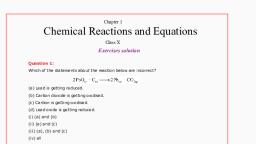
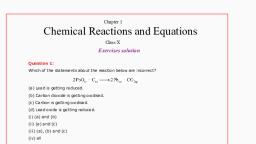
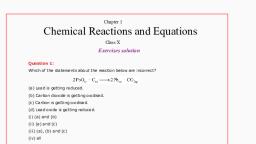
Chapter 1, , Chemical Reactions and Equations, Class X, , Exercises solution, Question 1:, Which of the statements about the reaction below are incorrect?, , (a) Lead is getting reduced., (b) Carbon dioxide is getting oxidised., (c) Carbon is getting oxidised., (d) Lead oxide is getting reduced., (i) (a) and (b), (ii) (a) and (c), (iii) (a), (b) and (c), (iv) all, Answer 1:, (i)(a) and (b), , Question 2:, , The above reaction is an example of a, (a) combination reaction., (b) double displacement reaction., (c) decomposition reaction., (d) displacement reaction., Answer 2:, (d) The given reaction is an example of a displacement reaction., , Question 3:, What happens when dilute hydrochloric acid is added to iron filings? Tick the correct, answer., (a) Hydrogen gas and iron chloride are produced., (b) Chlorine gas and iron hydroxide are produced., (c) No reaction takes place., (d) Iron salt and water are produced.
Page 2 :
Chapter 1, , Chemical Reactions and Equations, Answer 3:, , Class X, , (a) Hydrogen gas and iron chloride are produced. The reaction is as, follows:, , Question 4:, What is a balanced chemical equation? Why should chemical equations be balanced?, Answer 4:, A reaction which has an equal number of atoms of all the elements on both sides of the, chemical equation is called a balanced chemical equation. The law of conservation of, mass states that mass can neither be created nor destroyed. Hence, in a chemical reaction, the total mass of reactants should be equal to the total mass of the products. It, means that the total number of atoms of each element should be equal on both sides, of a chemical equation. Hence, it is for this reason that chemical equations should be, balanced., , Question 5:, Translate the following statements into chemical equations and then balance them., (a) Hydrogen gas combines with nitrogen to form ammonia., (b) Hydrogen sulphide gas burns in air to give water and sulphur dioxide., (c) Barium chloride reacts with aluminium sulphate to give aluminium chloride and, a precipitate of barium sulphate., (d) Potassium metal reacts with water to give potassium hydroxide and hydrogen gas., Answer 5:, (a), , (b), (c), (d)
Page 3 :
Chapter 1, , Chemical Reactions and Equations, Class X, Question 6:, Balance the following chemical equations., (a), , (b), (c), (d), Answer 6:, (a), , (b), (c), (d), , Question 7:, Write the balanced chemical equations for the following reactions., (a) Calcium hydroxide + Carbon dioxide → Calcium carbonate + Water, (b) Zinc + Silver nitrate → Zinc nitrate + Silver, (c) Aluminium + Copper chloride → Aluminium chloride + Copper, (d) Barium chloride + Potassium sulphate → Barium sulphate +, Potassium chloride, Answer 7:, (a), , (b), (c), (d)
Page 4 :
Chapter 1, , Chemical Reactions and Equations, Class X, Question 8:, Write the balanced chemical equation for the following and identify the type of reaction, in each case., (a)Potassium bromide, , (aq), , + Barium iodide, , (aq), , → Potassium iodide, , (aq), , +, , Barium bromide(s), (b) Zinc carbonate, (c) Hydrogen, , (g), , (d) Magnesium, , (s), , → Zinc oxide, , + Chlorine, , (s), , (g), , (s), , + Carbon dioxide, , → Hydrogen chloride, , + Hydrochloric acid, , (aq), , (g), , (g), , → Magnesium chloride, , (aq), , + Hydrogen, , (g), , Answer 8:, (a), (b), (c), (d), , Double displacement reaction, ; Decomposition reaction, Combination reaction, Displacement reaction, , Question 9: What does one mean by exothermic and endothermic reactions? Give, examples., Answer 9:, Chemical reactions that release energy in the form of heat, light, or sound are called, exothermic reactions., Example: Mixture of sodium and chlorine to yield table salt, , In other words, combination reactions are exothermic., Reactions that absorb energy or require energy in order to proceed are called, endothermic reactions., For example: In the process of photosynthesis, plants use the energy from the sun to, convert carbon dioxide and water to glucose and oxygen.
Page 5 :
Chapter 1, , Chemical Reactions and Equations, Class X, Question 10:, Why is respiration considered an exothermic reaction? Explain., Answer 10:, Energy is required to support life. Energy in our body is obtained from the food we eat., During digestion, large molecules of food are broken down into simpler substances such, as glucose. Glucose combines with oxygen in the cells and provides energy. The special, name of this combustion reaction is respiration. Since energy is released in the whole, process, it is an exothermic process., , Question 11:, Why are decomposition reactions called the opposite of combination reactions? Write, equations for these reactions., Answer 11:, Decomposition reactions are those in which a compound breaks down to form two or, more substances. These reactions require a source of energy to proceed. Thus, they are, the exact opposite of combination reactions in which two or more substances combine to, give a new substance with the release of energy., Decomposition reaction:, , Combination reaction:, , Question 12:, Write one equation each for decomposition reactions where energy is supplied in the, form of heat, light or electricity., Answer 12:, (a) Thermal decomposition:
Page 6 :
Chapter 1, , Chemical Reactions and Equations, Class X, , (b) Decomposition by light:, , (c) Decomposition by electricity:, , Question 13:, What is the difference between displacement and double displacement reactions? Write, equations for these reactions., Answer 13:, In a displacement reaction, a more reactive element replaces a less reactive element, from a compound., where A is more reactive than B, In a double displacement reaction, two atoms or a group of atoms switch places to, form new compounds., , For example:, Displacement reaction:, , Double displacement reaction:, , Question 14:, In the refining of silver, the recovery of silver from silver nitrate solution involved, displacement by copper metal. Write down the reaction involved., Answer 14:
Page 7 :
Chapter 1, , Chemical Reactions and Equations, Class X, , Question 15:, What do you mean by a precipitation reaction? Explain by giving examples., Answer 15:, A reaction in which an insoluble solid (called precipitate) is formed is called a, precipitation reaction., For example:, , In this reaction, calcium carbonate is obtained as a precipitate. Hence, it is, a precipitation reaction., Another example of precipitation reaction is:, , In this reaction, barium sulphate is obtained as a precipitate., , Question 16:, Explain the following in terms of gain or loss of oxygen with two examples each., (a) Oxidation, (b) Reduction, Answer 16:, (a) Oxidation is the gain of oxygen., For example:, , (i), , (ii), In equation (i), H2 is oxidized to H2O and in equation (ii), Cu is oxidised to CuO., (b) Reduction is the loss of oxygen.
Page 8 :
Chapter 1, , Chemical Reactions and Equations, Class X, For example:, , (i), , (ii), , In equation (i), CO2 is reduced to CO and in equation (ii), CuO is reduced to Cu., , Question 17: A shiny brown-coloured element ‘X’ on heating in air becomes black in, colour. Name the element ‘X’ and the black coloured compound formed., Answer 17:, ‘X’ is copper (Cu) and the black-coloured compound formed is copper oxide (CuO). The, equation of the reaction involved on heating copper is given below., , Question 18: Why do we apply paint on iron articles?, Answer 18:, Iron articles are painted because it prevents them from rusting. When painted,, the contact of iron articles from moisture and air is cut off. Hence, rusting is prevented their presence is essential for rusting to take place., , Question 19: Oil and fat containing food items are flushed with nitrogen. Why?, Answer 19:, Nitrogen is an inert gas and does not easily react with these substances. On the, other hand, oxygen reacts with food substances and makes them rancid. Thus, bags, used in packing food items are flushed with nitrogen gas to remove oxygen inside, the pack. When oxygen is not present inside the pack, rancidity of oil and fat containing food items is avoided.
Page 9 :
Chapter 1, , Chemical Reactions and Equations, Class X, Question 20:, Explain the following terms with one example each., (a) Corrosion, (b) Rancidity, Answer 20:, (a) Corrosion:, Corrosion is defined as a process where materials, usually metals, deteriorate as a result, of a chemical reaction with air, moisture, chemicals, etc. For example, iron, in the presence of moisture, reacts with oxygen to form hydrated iron oxide., , This hydrated iron oxide is rust., (b) Rancidity: The process of oxidation of fats and oils that can be easily noticed by the, change in taste and smell is known as rancidity., For example, the taste and smell of butter changes when kept for long. Rancidity can be, avoided by:, 1. Storing food in air tight containers, 2. Storing food in refrigerators, 3. Adding antioxidants, 4. Storing food in an environment of nitrogen
Page 12 :
Page 10, Question 1:, A solution of a substance ‘X’ is used for white washing., (i) Name the substance ‘X’ and write its formula., (ii) Write the reaction of the substance ‘X’ named in (i) above with water., Answer 1:, (i). The substance ‘X’ is calcium oxide. Its chemical formula is CaO., (ii). Calcium oxide reacts vigorously with water to form calcium hydroxide, (slaked lime), 𝐶𝑎𝑂, ⏟, , + 𝐻, ⏟, 2𝑂 →, , 𝐶𝑎(𝑂𝐻), ⏟, 2, , 𝐶𝑎𝑙𝑐𝑖𝑢𝑚 𝑂𝑥𝑖𝑑𝑒, , 𝑊𝑎𝑡𝑒𝑟, , 𝐶𝑎𝑙𝑐𝑖𝑢𝑚 𝐻𝑦𝑑𝑟𝑜𝑥𝑖𝑑𝑒, , ⏞, 𝑄𝑢𝑖𝑐𝑘 𝐿𝑖𝑚𝑒, , ⏞, 𝑆𝑙𝑎𝑑𝑒𝑑 𝐿𝑖𝑚𝑒, , Question 2:, Why is the amount of gas collected in one of the test tubes in Activity 1.7 double, of the amount collected in the other? Name this gas., Answer 2:, During the Electrolysis of water, hydrogen and oxygen is get separated by the, electricity. Water (H2O) contains two parts hydrogen and one part oxygen. Since, hydrogen goes to one test tube and oxygen goes to another, the amount of gas, collected in one of the test tubes is double of the amount collected in the other., , 1
Page 13 :
Page 13, Question 1:, Why does the colour of copper sulphate solution change when an iron nail is, dipped in it?, , Answer 1:, When an iron nail is dipped in a copper sulphate solution, iron (which is more, reactive than copper) displaces copper from copper sulphate solution forming, iron sulphate, which is green in colour., 𝐶𝑢𝑆𝑂, ⏟ 4, , + 𝐹𝑒, ⏟ →, , 𝐶𝑜𝑝𝑝𝑒𝑟 𝑆𝑢𝑙𝑝ℎ𝑎𝑡𝑒, , 𝐼𝑟𝑜𝑛, , 𝐹𝑒𝑆𝑂, ⏟ 4, , + 𝐶𝑢, ⏟, , 𝐼𝑟𝑜𝑛 𝑆𝑢𝑙𝑝ℎ𝑎𝑡𝑒, , ⏞, 𝐵𝑙𝑢𝑒 𝐶𝑜𝑙𝑜𝑢𝑟, , 𝐶𝑜𝑝𝑝𝑒𝑟, , ⏞, 𝐺𝑟𝑒𝑒𝑛 𝐶𝑜𝑙𝑜𝑢𝑟, , Therefore, the blue colour of copper sulphate solution fades and green colour, appears., Question 2:, Give an example of a double displacement reaction other than the one given in, Activity 1.10., , Answer 2:, Sodium carbonate reacts with calcium chloride to form calcium carbonate and, sodium chloride., 𝑁𝑎2 𝐶𝑂3, ⏟, Sodium carbonate, , +, , 𝐶𝑎𝐶𝑙, ⏟ 2, , →, , Calcium chloride, , 𝐶𝑎𝐶𝑂, ⏟ 3, Calcium carbonate, , +, , 2𝑁𝑎𝐶𝑙, ⏟, Sodium chloride, , In this reaction, sodium carbonate and calcium chloride exchange ions to form, two new compounds. Hence, it is a double displacement reaction., , 1
Page 14 :
Question 3:, Identify the substances that are oxidised and the substances that are reduced in, the following reactions., (i) 4Na(s) + O2(g) → 2Na2O(s), (ii) CuO(s) + H2(g) → Cu(s) + H2O(l), Answer 3:, (i). Sodium (Na) is oxidised as it gains oxygen and oxygen gets reduced., (ii). Copper oxide (CuO) is reduced to copper (Cu) while hydrogen (H2) gets, oxidised to water (H2O)., , 2



 Learn better on this topic