Notes of Class 10th New, Science Ch1.pdf - Study Material
Page 1 :
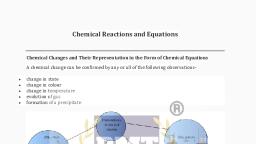
Chemical Reactions and Equations, , , , , , , , , In a chemical reaction, at least one of the following will occur:, Change in state, Change in colour, Evolution of a gas, Change in temperature, Formation of a precipitate, A chemical equation is the symbolic representation of a chemical reaction in the form of, chemical formulae, signs, symbols, and directions. In which the reactant entities are given, on the left-hand side and the product entities on the right-hand side., , , , Balanced chemical equation, Reactants → Products, LHS, RHS, Total number of atoms on the LHS = Total number of atoms on the RHS, , , , , , , , How to balance an equation, Write reactants and products, Balance the maximum number of a particular atom on both sides, Balance other atoms, A complete balanced equation should look like, CO g + 2H2 g →340 atm CH3OH l, Types of reactions, , , o, , Combination reaction, Two or more reactants combine to form one single product., , Examples: CaO s + H2O l → Ca(OH)2 aqCalcium oxide Water, Calcium hydroxid, e (Quick lime), (Slaked lime) C s + O2 g → CO2 gCarbon, Oxygen Ca, rbon dioxide 2H2 g + O2 g → 2H2O lHydrogen Oxygen, Water, , , Exothermic reaction – Heat gets released in the reaction. Most combination reactions are, exothermic. For example,

Page 2 :
, , Endothermic reaction – Heat is absorbed in the reaction. Very few combination reactions, are endothermic. For example,, 12N2 g + O2 g → NO2 g, , , o, , Decomposition reaction, A single reactant breaks into several simple products., , Examples:2FeSO4 Ferrous sulphate→ Δ Fe2O3Ferric oxide+SO2 +SO3CaCO3Limestone →, Δ CaOCalcium oxide+ CO22AgClSilver chloride→ Δ 2AgSilver+Cl2, o, , All decomposition reactions are endothermic [they absorb heat]., , , o, , Displacement reactions:, In displacement reactions, a more reactive metal can displace a less reactive metal from, their compounds in aqueous solutions. (However, a less reactive metal cannot displace a, more reactive metal.), Example: CuSO4, + Zn → ZnSO4 + Cu Copper Sulphate Zinc, Zinc Sulph, ate Copper, (Blue), (Colourless), (Red), Fe s + CuSO4 aq → Cu s + FeSO4 aqIron Copper sulphate Copper Iron sulphat, e, , , o, , Double displacement reaction, Exchange of ions occurs between two compounds., , Example; Na2SO4 aq + BaCl2 s → BaSO4 aq + 2NaCl sSodium sulphate Barium chlori, de Barium sulphate Sodium chloride, , , , , , When the aqueous solution of two compounds react by exchanging their respective ions,, such that one of the products formed is insoluble salt and appears in the form of a, precipitate, then the reaction is said to be precipitation reaction., When an acid solution reacts with a base and the two exchange their respective ions, such, that only salt and water are products, then the reaction is called neutralisation reaction., When two compounds react with each other and displace their ions, in such a manner that, one of the product formed either decomposes into gaseous compounds or is formed in, gaseous state, then the reaction is called gas-forming reaction., , , , Oxidation →When a substance gains oxygen or loses hydrogen, , , , Oxidation in everyday life
Page 3 :
o, o, , Corrosion – When a metal is oxidised by the action of air and moisture [that’s why metals, are coated], Rancidity – When fats and oils are oxidised, their smell and taste change [that’s why food, is kept in air-tight containers], , , , Reduction → When one substance loses oxygen or gains hydrogen, , , , Redox – Oxidation–reduction reaction