Notes of 10th, Sc & Maths Metals And Non Metals - Study Material
Page 1 :
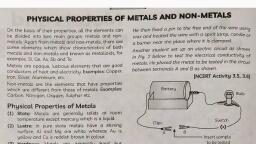
Class:10" Metals And Non Metals Chemistry, , There are 118 elements at present. Each of the elements is unique. The discovery of the elements started about, 8000 years ago, when people obtained shiny materials from the rocks by heating. By 1940, all the 92 naturallyoccurring elements had been discovered., , , , All elements are classified into three categories: - Metals, Non Metals, and Metalloids. Metals are placed on the, left-hand side, in the middle and at the bottom of the periodic table. Non metals are placed on the right hand side, and in the upper middle part of the periodic table. Metalloids are located at the left end of the non- metals. On the, extreme right side of the periodic table are the noble gases., , Q, , Ans., , Ans., , Ans., , Ans., , What are metals? Give examples., , Metals are the elements (except hydrogen) which form positive ions by losing electrons. Thus, metals are, electropositive elements. Metals are lustrous (shiny) malleable and ductile. They possess high density and, are good conductors of heat and electricity, The oxides of metals are basic in nature. Some examples of, metals are Iron, Aluminium, Copper, Zinc and Sodium. Metals generally have | to 3 electrons in the, valance shell of their atoms., , What are non metals? Give examples., , The elements which tend to form anions by gaining electrons are termed as non metals. Thus, non metals, are electronegative elements, Non metals have no lusture. They are non malleable and non- ductile. Non, —metals are brittle. Most of the non- metals possess low density and they are poor conductors of heat and, electricity. The oxides of non metals are acidic or neutral in nature. Some examples of non metals are, carbon, silicon, phosphorous, iodine, bromine, hydrogen, nitrogen, oxygen, fluorine, etc. Non metals, usually have 4 to 8 electrons in the outermost shell of their atoms., , What are metalloids?, The elements which behave like metals as well as non-metals are called metalloids. Arsenic, Tin, Bismuth,, Silicon, Antinomy, Germanium are common examples., , Write down the physical properties of metals., , The important physical properties of metals are given below:, , a) Metals are Malleable:- This means that metals can be hammered into very thin sheets. Gold and, Silver are the most malleable metals. Both Gold and Silver can be hammered into foils much, thinner than the thinnest paper. Copper, Aluminium and Iron are also highly malleable., , b) Metals are ductile:- This means that metals can be drawn into than wires, All metals are not, equality ductile. Gold, silver and copper are among the most ductile metals. For example, we can, draw a wire of about 200m length from 100mg of silver. Zinc, arsenic and antimony are not ductile., , c) Metals are good conductors of heat:- Metals are good conductors of heat. Silver metal is the best, conductor of heat. Copper and aluminium metals are also very good conductors of heat. The, poorest conductor of heat is lead., , d) Metals are good conductors of electricity:- Metals allow or permit electricity to pass through, them easily, They offer very little resistance to the flow of electric current. Silver is the best, conductor of electricity. Copper is the next best conductor of electricity. Gold, aluminium and, Tungsten are good conductors of electricity after silver and copper. Mercury and iron are not good, conductors of electricity,, , e) Metals are lustrous:-Metals are lustrous (shiny) and can be polished. For example, gold, silver and, copper metals have metallic luster and they can be polished.
Page 2 :
Class:10", , Ans., , 9), h), , i), k), )), , m), , Metals And Non Metals Chemistry, , Metals have high tensile strength:- Metals are very strong (except sodium and potassium), They, bear a lot of stress., , Most metals except sodium and potassium are hard:- Sodium and potassium metals can be easily, cut with a knife. Osmium is hard enough to scratch glass,, , Metals have high melting points and boiling points:-Metals have high melting points and boiling, points (except sodium and potassium metals which have low melting and boiling points). The, melting point of Gallium and Cesium metals are so low that they start melting in hand., , Metal Copper Iron Silver Sodium Potassium, M.P/C 1083 1539 960.8 97.9 63.8, B.P/C 2310 2450 1955 882 760, , Metals have high densities except sodium and potassium:- The densities of some common metals, are given below, , Metal Copper Iron Silver Gold Sodium Potassium, Density g/cm? 8,94 7,86 10.47 195 0.97 0.86, , Metals are sonorous:- Metals when hit by a hammer produce a characteristic metallic sound., , All metals except mercury are solids., , Metals usually have a silver or grey colour except copper and gold. Copper has a reddish-brown, colour whereas gold has a yellow colour., , Metals can form alloys with other metals. For example, copper and zinc dissolve in each other to, form an alloy called brass., , Write down the physical properties of non metals., , 1), , 3), , 4), 5), , 6), , 7), , 9), , 10), , 11), , Non metals are neither ductile nor malleable:- Non metals cannot be drawn into wires and beaten, into leaves/ sheets because they are brittle. They break up into pieces when pressed hard or, hammered. For example, sulphur and red phosphorous are brittle. The property due to which nonmetals break up on hammering is called brittleness., , Non metals are insulators: - Non metals do not conduct heat and electricity, This is because they, do not have free electrons. However, diamond is a non metal which is a good conductor of heat and, graphite is a non metal which is a good conductor of electricity., , Non metals do not have lustre:- Non metals are not shiny, However, graphite and iodine are the, only non metals which have metallic lustre. As a result non metals cannot be polished., , Non metals are generally soft except diamond which is the hardest natural substance known., , Non metals have low tensile strength:- They can be easily broken. For example, when a large, weight is placed on a graphite sheet, it gets snapped (breaks)., , Non metals have low melting and boiling points:- For example, the m.p. of sulphur is 115°C and, m.p of white phosphorous is 44°C , However, graphite, which is a non metal, has a high m.p., (3700°C)., , Non metals may be solid, liquid or gaseous at room temperature., , Non metals have low densities:- Non metals are light substances for example, the density of, sulphur is 2g/em*. Only non —metal iodine has, however, high density., , Non metals are non sonorons :- Non metals do not produce sound when hit with an object., , Non metal have many different colours:- For example, sulphur is yellow, phosphorous is white or, red. Graphite is black; chlorine is yellowish green whereas hydrogen and oxygen are colourless., Non metals show allotropy:- Some non metals exist in more than one allotropic forms. For, example, phosphorous exists in five different forms; sulphur exists in three forms etc.
Page 3 :
Class:10" Metals And Non Metals Chemistry, , Q, Ans., , °), , Give the chemical properties of metals., The chemical reactivity of different metals is different depending upon their nature and the reaction, conditions. Some of the important chemical properties of metals are given below:, a) Reaction with oxygen:- All metals combine with oxygen to form metal oxides. The reactivity of a, metal towards oxygen depends upon its nature. For example,, , i) Sodium reacts with oxygen at room temperature to form sodium oxides., 4Na . Or ees 2NaO, Sodium Oxygen Sodium oxide, , ii) Magnesium on heating in air gives magnesium oxide,, 2Mg + Or a. 2MgO, Magnesium Oxygen Magnesium oxide, , iii) | Copper is a metal less reactive metal. It reacts with oxygen slowly only on prolonged strong, , heating., 2Cu + Oz See = 20, Copper Oxygen Copper (ii) oxide, , The order of reactivity of these metals with oxygen is, , Na > Mg > Zn > Fe > Cu, Most reactive least reactive, , b) Metal oxides are basic in nature. Soluble metal oxides react with water to give metal hydroxides, (alkalies). The solutions of metal oxides in water turn red litmus blue and colourless phenolphthalein to, pink, For example, sodium oxide (Na2O) reacts with water to give sodium hydroxide., , Na2O + AO, 2NaOH, Sodium oxide Sodium Hydroxide, (base oxide) (alkali), , Some metal oxides e.g. aluminium oxide (Al2O3), Zine oxide (ZnO) show both acidic as well as basic, character. Such metal oxides are called amphoteric oxides. For example,, , ZnO + H2SO.(dil) ———> ZnSOx + H20, , Zinc oxide Zinc sulphate, , (basic oxide) (Salt), , ZnO + 2NaOH _— Na2ZnOQ2 + HO, , Zinc oxide Sodium zincate, , Acidic oxide Salt, , Reaction with water:- When a metal reacts with water, than a metal oxide or metal hydroxide and, , hydrogen gas are formed. Different metals react with water under different conditions. Some metals react, with cold water, whereas some other metals react only with hot water or steam. For example,, , 1) Sodium reacts vigorously with cold water to give hydrogen gas, 2Na (s) + 2H20 + ——-» 2NaOH + H2g), Sodium Cold water Sodium hydroxide
Page 4 :
Class:10" Metals And Non Metals Chemistry, , d), , 3), , 4), , Magnesium reacts only with hot boiling water to form magnesium oxide and hydrogen gas, , Mg(s) + H20 —> MgO + H2(g), Magnesium Boiling Magnesium oxide, , Red hot iron reacts with steam to liberate hydrogen, , 3Fe + 4420 —— Fes0s + 4H, Red hot iron steam iron (II, III) oxide, , Copper metal is very unreactive and does not react even with steam. The order of reactivity of some, metals with water is, , Na >Mg > Al >Zn >Fe >Cu, Most reactive least reactive, , Reaction with dilute acids:- Metals react with dilute hydrochloric acids to give metal chloride and, hydrogen gas. However, the less reactive metals, such as copper, silver; gold, etc. do not displace hydrogen, from dilute acids. Some metals react rapidly, some metals react on heating, whereas other metals do not, react with dilute acids at all., , For example,, Sodium metal reacts violently with dilute hydrochloric acid to form sodium chloride and hydrogen gas., , 2Na(s) + 2HC\K(g) : > 2NaClI(g) + Ha(g), Sodium Hydrochloric acid Sodium chloride Hydrogen, , Aluminium metal at first reacts slowly and then rapidly with dilute hydrochloric acid to form, aluminium chloride and hydrogen gas., , 2Al (s) + 6HCI(aq) —> _~— 2 AICI (aq) + 3H2(g), Aluminium Hydrochloric acid Aluminium chloride Hydrogen, , Zinc reacts with dil HCI at moderate rate to give zinc chloride and hydrogen gas., , Zn + 2HCI(dil) ——> ZnCh(aq) + H2(gas), Zine hydrochloric acid Zine Chloride Hydrogen, , Copper does not react with dil HCI or dil. H2SOx but slowly dissolves in dil H2SOy in the presence of, air., 2Cu + 2H2SO.dil) + O> from air ——> _ 2CuSO4(aq) + 2H20, , The order of the reactivity of these metals with dilute acid is, Na> Mg > Al > Zn > Fe > Cu, , e) Reaction of metals with chlorine:- Most metals react with chlorine to form chlorides. Metals chlorides, are mostly ionic (or electrovalent) compounds. Metal chlorides have high melting point and boiling point., For example,, , Sodium readily reacts with chlorine o form an ionic chloride called sodium chloride.
Page 5 :
Class:10", , i), , ii), , 2Na(s) +, Sodium, , +, , Ca(s), Calcium, , +, , Mg(S), Magnesium, , Cu(s), Copper, , +, , Metals And Non Metals Chemistry, Clg) aes 2NaCli(s), Chlorine Sodium chloride,, Chg —e>» CaCh(s), Chloride Calcium Chloride, cag ——s=, MgCh(s), Chlorine Magnesium Chloride, Chg) oat CuCh(s), Chloride Copper (II) chloride, , Reaction with hydrogen:- Most metals do not react with hydrogen . Only highly electropositive metals, such as sodium, potassium, calcium and magnesium react with hydrogen to form hydrides, Metal hydrides, , are ionic compounds., 2Na +, Sodium, , Ca +, Molten Calcium, , iii) Mg +, , iv), , Ans., , H a heat, Hydrogen, H heat, >, Hb high temp, - Pressure, , 2NaH, Sodium Hydride, , CaH2, Calcium hydride, , MgH2, Magnesium hydride, , Aluminium, Zinc, Iron, Copper do not react with hydrogen., , What is the activity series of metals?, The arrangement of metals in a vertical column in the order of decreasing reactivity is called activity series, of metals. The activity series is also called reactivity series,, , The more reactive metals have greater tendency to lose electrons. So, more reactive metals are, more electropositive or more metallic in nature. Therefore the electropositive character of metals decreases, as we go down from top to the bottom in the activity series of metals., , The activity series of some common metals is given below:, , Potassium, Sodium, Calcium, Magnesium, Aluminium, Zinc, , Iron, , Tin, , Lead, Hydrogen, Copper, Mercury, Silver, Gold, Platinum, , K, Na, Ca, Mg, Al, Zn, Fe, Sn, Pb, H, Cu, Hg, Ag, Au, Pt, , Most reactive metal, , Decreasing chemical reactivity, , least reactive metal



 Learn better on this topic