Notes of Class-11th, Math/Science Maths Standard-MS.pdf - Study Material
Page 1 :
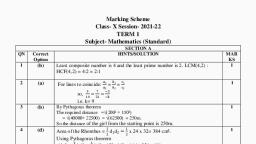
Marking Scheme, Class- X Session- 2021-22, TERM 1, Subject- Mathematics (Standard), QN, , Correct, Option, , 1, , (b), , SECTION A, HINTS/SOLUTION, Least composite number is 4 and the least prime number is 2. LCM(4,2) :, , MAR, KS, 1, , HCF(4,2) = 4:2 = 2:1, 2, , (a), , 𝑎₁, , 𝑏₁, , 𝑐₁, , 1, , For lines to coincide: 𝑎₂ = 𝑏₂ = 𝑐₂, 5, , 7, , −3, , so, 15 = 21 = −k, i.e. k= 9, 3, , (b), , By Pythagoras theorem, The required distance =√(200² + 150²), = √(40000+ 22500) = √(62500) = 250m., So the distance of the girl from the starting point is 250m., , 4, , (d), , 1, , 5, , (a), , 6, , (d), , 7, , (b), , 8, , (c), , 9, , (a), , 10, , (d), , 11, 12, , (b), (c), , Area of the Rhombus = 2 d₁d₂ = 2 x 24 x 32= 384 cm²., Using Pythagoras theorem, 1, 1, side² = (2d₁)² + (2d₂)² = 12² +16² = 144 +256 =400, Side = 20cm, Area of the Rhombus = base x altitude, 384 = 20 x altitude, So altitude = 384/20 = 19.2cm, Possible outcomes are (HH), (HT), (TH), (TT), Favorable outcomes(at the most one head) are (HT), (TH), (TT), So probability of getting at the most one head =3/4, Ratio of altitudes = Ratio of sides for similar triangles, So AM:PN = AB:PQ = 2:3, 2sin2β – cos2β = 2, Then 2 sin2β – (1- sin2β) = 2, 3 sin2β =3 or sin2β =1, β is 90ᵒ, Since it has a terminating decimal expansion,, so prime factors of the denominator will be 2,5, Lines x=a is a line parallel to y axis and y=b is a line parallel to x axis. So they, will intersect., Distance of point A(-5,6) from the origin(0,0) is, √(0 + 5)2 + (0 − 6)2 = √25 + 36 = √61 units, a²=23/25, then a = √23/5, which is irrational, LCM X HCF = Product of two numbers, 36 X 2 = 18 X x, x=4, , 13, , (b), , tan A= √3 = tan 60° so ∠A=60°, Hence ∠C = 30°., So cos A cos C- sin A sin C = (1/2)x (√3/2) - (√3/2)x (1/2) =0, , 1, , 14, , (a), , 1x +1x +2x =180°, x = 45°., ∠A , ∠B and ∠C are 45°, 45° and 90°resp., sec A, tan A, sec 45, tan 45 √2 1, –, =, –, =, –, = 1-1= 0, cosec B cot B, cosec 45 cot 45 √2 1, , 1, , 1, , 1, , 1, , 1, , 1, 1, , 1, 1, 1, 1, 1
Page 2 :
15, , (d), , Number of revolutions=, , total distance, circumference, , =, , 176, , 1, , 22, 2 X 7 X 0.7, , = 40, 16, , (b), , perimeter of ∆ABC, perimeter of ∆DEF, 7.5, perimeter of ∆DEF, , 17, , (b), , =, =, , BC, , 1, , EF, 2, 4, , . So perimeter of ∆DEF = 15cm, , Since DE∥ BC, ∆ABC ~ ∆ADE ( By AA rule of similarity), So, , AD, AB, , =, , DE, BC, , 3, , DE, , 7, , 14, , i.e. =, , 1, , . So DE = 6cm, , 18, , (a), , Dividing both numerator and denominator by cosβ,, 4 𝑠𝑖𝑛𝛽−3 cos 𝛽, 4 𝑡𝑎𝑛𝛽−3, 3−3, =, =, =0, 4 sin 𝛽+3 cos 𝛽, 4 tan 𝛽+3, 3+3, , 19, , (d), , -2(–5x + 7y = 2) gives 10x – 14y = –4. Now, , 20, , (a), , Number of Possible outcomes are 26, Favorable outcomes are M, A, T, H, E, I, C, S, , 𝑎₁, , 𝑏₁, , 1, , 𝑐₁, , = 𝑏₂ = 𝑐₂ = -2, 𝑎₂, , 1, 1, , probability = 8/26 = 4/13, SECTION B, 21, , (c), , Since HCF = 81, two numbers can be taken as 81x and 81y,, ATQ 81x + 81y = 1215, Or x+y = 15, which gives four co prime pairs1,14, 2,13, 4,11, 7, 8, , 1, , 22, , (c), , 1, , 23, , (b), , Required Area is area of triangle ACD = ½(6)2, = 6 sq units, tan α + cot α = 2 gives α=45°. So tan α = cot α = 1, tan20α + cot 20α = 120 + 120 = 1+1 = 2, , 24, , (a), , Adding the two given equations we get: 348x + 348y = 1740., So x +y =5, , 1, , 25, , (c), , 1, , 26, , (a), , LCM of two prime numbers = product of the numbers, 221= 13 x 17., So p= 17 & q= 13, ⸫3p - q= 51-13 =38, Probability that the card drawn is neither a king nor a queen, 52−8, = 52, , 27, , (b), , Outcomes when 5 will come up at least once are(1,5), (2,5), (3,5), (4,5), (5,5), (6,5), (5,1), (5,2), (5,3), (5,4) and (5,6), Probability that 5 will come up at least once = 11/36, , 1, , 28, , (c), , 1+ sin2α = 3 sinα cos α, sin2α + cos2α + sin2α = 3 sinα cos α, 2 sin2α - 3sinα cos α + cos2α = 0, (2sinα -cos α)( sinα- cosα) =0, ⸫cotα = 2 or cotα = 1, , 1, , 29, , (a), , Since ABCD is a parallelogram, diagonals AC and BD bisect each other, ∴ mid, , 1, , 1, , 1, , = 44/52 = 11/13, , point of AC= mid point of BD
Page 3 :
𝑥+1, , 6+2, , 3+4, , 5+𝑦, , ( 2 , 2 )=( 2 , 2 ), Comparing the co-ordinates, we get,, 𝑥+1, 3+4, = 2 . So, x= 6, 2, 6+2, , Similarly, 2 =, ∴(x, y) = (6,3), 30, , (c), , 5+𝑦, 2, , . So, y= 3, , ∆ACD ~∆ ABC( AA ), , 1, , AC, AD, (CPST), ∴, =, AB, AC, , 31, , (d), , 32, , (b), , 8/AB = 3/8, This gives AB = 64/3 cm., So BD = AB – AD = 64/3 -3 = 55/3cm., Any point (x, y) of perpendicular bisector will be equidistant from A & B., ∴ √(𝑥 − 4)2 + (𝑦 − 5)2 = √(𝑥 + 2)2 + (𝑦 − 3)2, Solving we get -12x – 4y + 28=0 or 3x + y – 7=0, cot 𝑦 °, cot 𝑥 °, , 33, , (a), , 34, , (b), , =, , AC/ BC, , 𝐴𝐶/𝐶𝐷, , 1, , 1, , = CD/ BC = CD/ 2CD = ½, , The smallest number by which 1/13 should be multiplied so that its decimal, 1, 13, 1, expansion terminates after two decimal points is 13/100 as 13 x 100 = 100 =, 0.01, Ans: 13/100, , 1, , 1, , ∆ABE is a right triangle & FDGB is a, square of side x cm, ∆AFD ~∆ DGE( AA ), AF, FD, (CPST), ∴, =, DG, GE, 16 − x, x, (CPST), =, x, 8−x, 128 = 24x or x = 16/3cm, 35, , (a), , Since P divides the line segment joining R(-1, 3) and S(9,8) in ratio k:1 ∴, 9k −1 8k+3, , coordinates of P are ( k+1 ,, , k+1, , ), , Since P lies on the line x – y +2=0, then, 9k -1 -8k-3 +2k+2 =0, which gives k=2/3, 36, , 1, , 9k −1, k+1, , -, , 8k+3, k+1, , +2 =0, , 1, , (c), Shaded area = Area of semicircle +, (Area of half square – Area of two, quadrants), = Area of semicircle +(Area of half, square – Area of semicircle), = Area of half square, = ½ x 14 x14 = 98cm²
Page 4 :
37, , 1, , (d), .o, , Let O be the, center of the circle. OA = OB = AB =1cm., So ∆OAB is an equilateral triangle and ∴ ∠AOB =60°, Required Area= 8x Area of one segment with r=1cm, ѳ= 60°, 60, , √3, , = 8x(360 x π x 1²- 4 x 1²), = 8(π/6 - √3/4)cm², 38, , (b), , Sum of zeroes = 2 + ½ = -5/p, i.e. 5/2 = -5/p . So p= -2, Product of zeroes = 2x ½ = r/p, i.e. r/p = 1 or r = p = -2, , 1, , 39, , (c), , 2πr =100. So Diameter = 2r =100/π = diagonal of the square., side√2 = diagonal of square = 100/ π, ∴ side = 100/√2π = 50√2/π, , 1, , 40, , (b), , 3x+y = 243 = 35, So x+y =5-----------------------------------(1), 243x-y = 3, (35) x-y = 31, So 5x -5y =1--------------------------------(2), 𝑎₁, 𝑏₁, Since : 𝑎₂ ≠ 𝑏₂ , so unique solution, , 1, , SECTION C, 41, , (c), , Initially, at t=0, Annie’s height is 48ft, So, at t =0, h should be equal to 48, h(0) = -16(0)² + 8(0) + k = 48, So k = 48, , 1, , 42, , (b), , When Annie touches the pool, her height =0 feet, i.e. -16t² + 8t + 48 =0 above water level, 2t² - t -6 =0, 2t² - 4t +3t -6 =0, 2t(t-2) +3(t-2) =0, (2t +3) (t-2) =0, i.e. t= 2 or t= -3/2, Since time cannot be negative , so t= 2seconds, , 1, , 43, , (d), , t= -1 & t=2 are the two zeroes of the polynomial p(t), Then p(t)=k (t- -1)(t-2), = k(t +1)(t-2), When t = 0 (initially) h₁ = 48ft, p(0)=k(0²- 0 -2)= 48, i.e. -2k = 48, So the polynomial is -24(t²- t -2) = -24t² + 24t + 48., , 1, , 44, , (c), , A polynomial q(t) with sum of zeroes as 1 and the product as -6 is given by, q(t) = k(t² - (sum of zeroes)t + product of zeroes), = k(t² -1t + -6) ………..(1), When t=0 (initially) q(0)= 48ft, , 1
Page 5 :
q(0)=k(0²- 1(0) -6)= 48, i.e. -6k = 48 or k= -8, Putting k = -8 in equation (1), reqd. polynomial is -8(t² -1t + -6), = -8t² + 8t + 48, 45, , (a), , When the zeroes are negative of each other,, sum of the zeroes = 0, So, -b/a = 0, (k-3), - −12 = 0, , 1, , k−3, , + 12 = 0, k-3 = 0,, i.e. k = 3., 46, , (a), , Centroid of ΔEHJ with E(2,1), H(-2,4) & J(-2,-2) is, 2+−2+ −2 1+4+ −2, (, ,, ) = (-2/3, 1), 3, 3, , 1, , 47, , (c), , If P needs to be at equal distance from A(3,6) and G(1,-3), such that A,P and G, are collinear, then P will be the mid-point of AG., 3+1 6+ −3, So coordinates of P will be ( 2 , 2 ) = (2, 3/2), , 1, , 48, , (a), , Let the point on x axis equidistant from I(-1,1) and E(2,1) be (x,0), then √(𝑥 + 1)2 + (0 − 1)2 = √(𝑥 − 2)2 + (0 − 1)2, x2 + 1 + 2x +1 = x2 + 4 - 4x +1, 6x = 3, So x = ½ ., ∴ the required point is (½, 0), , 1, , 49, , (b), , Let the coordinates of the position of a player Q such that his distance from, K(-4,1) is twice his distance from E(2,1) be Q(x, y), , 1, , Then KQ : QE = 2: 1, 2 X 2+1 X−4, , Q(x, y) = (, , 3, , ,, , 2 X 1+1 X 1, 3, , ), , = (0,1), 50, , (d), , Let the point on y axis equidistant from B(4,3) and C(4,-1) be (0,y), then √(4 − 0)2 + (3 − 𝑦)2 = √(4 − 0)2 + (𝑦 + 1)2, 16 + y2 + 9 - 6y = 16 + y2 + 1 + 2y, -8y = -8, So y = 1 ., ∴ the required point is (0, 1), , 1



 Learn better on this topic