Notes of Grade 10, Maths G10 A.P Test 3 Solution - Study Material
Page 1 :
CBSE Test Paper 03, Chapter 5 Arithmetic Progression, , 1. 200 logs are stacked in a such a way that 20 logs in the bottom row, 19 logs in the next, row, 18 logs in the row next to it and so on. The total number of rows is (1), a. 16, b. 12, c. 15, d. 10, 2. Sum of n terms of the series,, , is (1), , a., b., c., d., 3. A sum of Rs.700 is to be used to award 7 prizes. If each prize is Rs.20 less than its, preceding prize, then the value of the first prize is (1), a. Rs.160, b. Rs.100, c. Rs.180, d. Rs.200, 4. The sum of odd numbers between 0 and 50 is (1), a. 625, b. 600, c. 500, d. 2500, 5. The common difference of an A.P. in which, , is (1), , a. – 8, b. 6, c. 8, d. – 6, 6. If Sn denotes the sum of first n terms of an AP, prove that S12 = 3(S8 - S4). (1)
Page 2 :
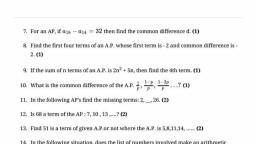
7. For an AP, if, , then find the common difference d. (1), , 8. Find the first four terms of an A.P. whose first term is - 2 and common difference is 2. (1), 9. If the sum of n terms of an A.P. is 2n2 + 5n, then find the 4th term. (1), 10. What is the common difference of the A.P., , (1), , 11. In the following AP's find the missing terms: 2, __, 26. (2), 12. Is 68 a term of the AP : 7, 10 , 13 ,....? (2), 13. Find 51 is a term of given A.P.or not where the A.P. is 5,8,11,14, ...... (2), 14. In the following situation, does the list of numbers involved make an arithmetic, progression, and why? The amount of money in the account every year, when Rs, 10000 is deposited at compound interest at 8% per annum. (3), 15. If 7th term of an A.P. is, , and 9th term is, , , find 63rd term. (3), , 16. Find the sum of first 22 terms of an AP in which d = 7 and 22nd term is 149. (3), 17. In an A.P. the first term is 8, nth term is 33 and the sum to first n terms is 123. Find n, and the common difference(d). (3), 18. Each year, a tree grows 5 cm less than it did the preceding year. If it grew by 1 m in, the first year, then in how many years will it have ceased growing? (4), 19. If the sum of the first m terms of an AP be n and the sum of its first n terms be m then, show that the sum of its first (m + n) terms is -(m + n). (4), 20. Find the sum of all integers between 100 and 550, which are divisible by 9. (4)
Page 3 :
CBSE Test Paper 03, Chapter 5 Arithmetic Progression, , Solution, 1., , a. 16, Explanation: The number of logs in the row from bottom to the top are 20, 19,, 18, …. which form an AP with first term 20 and common difference, Let the 200 logs be arranged in, , rows., , Then, , or, or, is not poaaible as on calculating number of logs in 25th row, there is, negative number of logs, which is not possible., Therefore, number of rows are 16., 2., , b., Explanation: Given:, Here,, , =, 3., , a. Rs.160
Page 4 :
Explanation: Let the first prize be, The seven prizes form an AP with first term, , and common difference,, , n=7, Now the sum of all seven prizes = Rs. 700, , Therefore, the value of first prize is Rs. 160., 4., , a. 625, Explanation: Odd numbers between 0 and 50 are 1, 3, 5, 7, ………, 49 Here, and, =, S25 = 25, , 25, , = 625, 5., , c. 8, Explanation: Given:, , 6. Let a be the first term and d be the common difference of the given AP. Then,, Sn=, , [2a+(n-l)d],, [, , =, ., Hence, S12= 3(S8 - S4)., 7. We know,, and, , term of an AP is given by, , is the common difference, , Given,, , , where, , is the first term
Page 6 :
Assume that 68 is, We know that, , term of given AP, term is given by, , Since, n cannot be fraction, but a whole number. Therefore, 68 is not a term of given, AP., 13. Given, A.P. is 5,8,11,14, ......, Here a = 5 and d = (8 - 5) = 3., Let the nth term of the given AP be 51. Then,, Tn = 51, We know that Tn = a + (n - 1)d., a + (n -1)d = 51, 5 + (n- 1), , 3 = 51 [Because, a = 5 and d = 3], , 5 + 3n - 3 = 51, 3n = 51 - 2, 3n = 49, n=, But, the number of terms cannot be a fraction., Therefore, 51 is not a term of the given Arithmetic progression., 14. Amount of money after 1 year, Amount of money after 2 year, Amount of money after 3 year, Amount of money after 4 year, , a3 - a2
Page 7 :
Since., , .It does not form AP., , 15. Let the first term be, , and the common difference be ., , Given, t7 =, t9=, =, and, , .....(i), =, , ....(ii), , On subtracting eqn.(i) from (ii), =, or,, or,, , =, =, , Substituting the value of, , in (ii) we get, , or, a =, or, a =, , or,, Hence, t63= 1., 16. Here, d = 7, a22 = 149, Let the first term of the AP be a., We know that an = a + (n - 1)d, a22 = a + (22 - 1)d, a22 = a + 21d, 149 = a + (21) (7), 149 = a + 147, , a=2, , Again, we know that
Page 8 :
S22 = (11) [4 + 147], S22 = (11) (151), , S22 = 1661, , Hence, the sum of the first 22 terms of the AP is 1661., 17. Given First term (a) = 8, and, nth term (an) = 33, a + (n - 1)d = 33, 8 + (n - 1)d = 33, (n - 1)d = 33 - 8, (n - 1)d = 25 .....(i), and, Sum of first n terms = 123, , n=6, Put value of n in equation (i), (6 - 1)d = 25, 5d = 25, 18. Given that , tree grows 5 cm less than preceding year, and grew by 1m (100 cm) in the, first year., means, 95cm in the 2nd year, 90 in the 3rd year , 85 in the fourth year and so on., growth in the year in which it will stop growing will be 0cm, Therefore, The following sequence can be formed., i.e,, Here,, Let, Then,, , which is an AP., and
Page 9 :
Hence, Tree will ceased growing in 21 years., 19. Let a be the first term and d be the common difference of the given AP. Then,, Sm = n, , [2a + (m-1)d] = n, , 2am + m(m- 1)d - 2n ...... (i), And, Sn = m, , [2a + (n - 1)d] = m, , 2an + n(n - 1)d = 2m ...... (ii), On subtracting (ii) from (i), we get, 2a(m-n) + [(m2 - n2) - (m - n)]d = 2(n - m), (m - n)[2a + (m + n - 1)d] = 2(n - m), 2a + (m + n- 1)d = -2 ..... (iii), Sum of the first (m + n) terms of the given AP, =, , {2a + (m + n - 1)d}, [using (iii)]., , Hence, the sum of first (m + n) terms of the given AP is -(m + n)., 20. According to the question,, All integers between 100 and 550, which are divisible by 9, = 108, 117, 126,.........., 549, First term (a) = 108, Common difference(d) = 117 - 108 = 9, Last term(an) = 549, a + (n - 1)d = 549, 108 + (n - 1)(9) = 549, 108 + 9n - 9 = 549, 9n = 549 + 9 - 108, 9n = 450, Sum of 50 terms =, = 16425