Notes of Class 10th, English IMG_20211207_185956.jpg - Study Material
Page 1 :
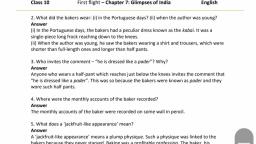
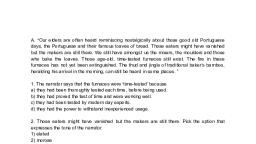
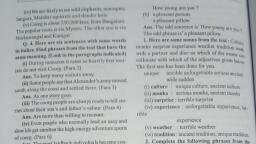
a is not alive but the son still, ‘id May be the father is not live e son, (nostalgic/hopefiil/sad), iii) I still recall the typical fragrance of those, (i toaves (nostalgic/hopeful/naughty), @v) The tiger never brushed his teeth. Hot tea, wash and clean up every thing so, nicely after all. (naughty, angry, funny), Cakes and bolinhas are a must for Christmas, as well as other festivals., (sad/hopeful/matter of fact), (vi) The baker and his family never starved. They, always looked happy and prosperous., (matter of fact/hopeful/sad), Ans. (i) nostalgic, (ii) hopeful, (iii) nostalgic,, iv) funny, (v) matter of fact, (vi) matter of fact., Writing, L In this extract the author talks about tradidenal bread-baking during his childhood days., Complete the following table with the help of the, clues on the left. Then write a paragraph about, the author’s childhood days., , Ans., Author’s childhood days, , The way bread was | We still have amongst us, the mixers, the moulders, and those who bake the, loaves. Those age old, time, tested furnaces still exist., He used to come at least, twice a day. Once, when, he set out in the morning, on his selling round and, then again, when he retur, (v), , , , , The way the pader, sold bread, , ned after emptying his, huge basket., , The baker or bread-seller, of those days had a peculiar dress known as a, , , , Author’s Childhood-Days, , The author remembers his childhood days very, well. The pader would come to sell his bread in the, morning. He wished “Good morning” to the lady of, the house. He placed his basket on the vertical bamboo. Children loved the baker and longed for bread, bangles which were sweet-bread of special make. The, pader wore a particular dress called a Kabai. He, looked fat and plumpy which showed that bread-making was a profitable business in the author’s childhood days., , Il. (1) Compare the piece from the text (on the, left below) with the other piece on Goan bakers, (on the right). What makes the two texts so different ? Are the facts the same ? Do both writers, give you a picture of the baker ?, , Our elders are often After Goa’s liberation,, , , , , , , , , , , , , , , , , , , , , , , , , , , , , , , , , , , , heard reminiscing people used to say nosnostalgically about talgically that the Portuthose good old Por- _| guese bread vanished, tuguese days, the Por- | with the paders. But the, tuguese and their fa- | paders have managed to, , , , , , mous loaves of bread., Those eaters of loaves, , survive because they, have perfected the art, , , , , , , , , , , , , , , , , , , , , , , , , , , , , , , might have vanished | of door-to-door delivery, but the makers are still | service. The paders pick, there. We still have up the knowledge of, amongst us the mixers, | bread-making from tradi, the moulders and those] tions in the family. The, who bake the loaves. | leavened, oven-baked, Those age-old, time- | bread is a gift of the por, tested furnaces still tuguese to India., , exist. The fireinthe | [Adapted from, , furnaces had not yet | Nandakumar Kamat’s, been extinguished. The| ‘The Unsung Lives of, thud and the jingle of | Goan Paders’], , the traditional baker’s, bamboo, heralding his, arrival in the morning,, can still be heard in, some places., , May be the father is not, alive but the son still, carries on the family, profession.