Page 1 :
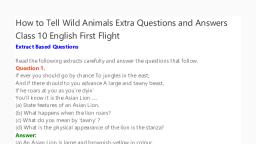
(First Flight)(Chapter 3)(Poem - 1) (How to Tell Wild Animals), (Class - 10), Thinking about the Poem, Question 1:, Does 'dyin' really rhyme with lion'? Can you say it in such a way that it does?, . Answer 1:, Yes, 'dyin' somehow rhyme with lion'. We can rhyme 'dyin' properly with the words 'fine' or 'sign', etc., Question 2:, How does the poet suggest that you identify the lion and the tiger? When can you do so, according, to him?, . Answer 2:, The poet suggests that if a huge and yellowish-brown beast in the jungle in the east makes a move, towards us, then it is an Asian lion. We can identify it when it roars at us while we are dying with, terror. When we come across a wild beast that is yellow in colour with black stripes, it is a Bengal, tiger. We can identify it when it eats us., Question 3:, Do you think the words 'lept' and 'lep' in the third stanza are spelt correctly? Why does the poet, spell them like this?, Answer 3:, No, the words 'lept' and 'lep' are spelt incorrectly. The poet has spelled them like this so that he can, keep the rhythm of the poem. When spelled this way, they rhyme with the first part of 'leopard',, thus giving emphasis to 'leopard' in each line., Question 4:, Do you know what a 'bear hug' is? It's a friendly and strong hug - such as bears are thought to give,, as they attack you! Again, hyenas are thought to laugh, and crocodiles to weep ('crocodile tears') as, they swallow their victims. Are there similar expressions and popular ideas about wild animals in, your own language(s)?, Answer 4:, 'A bear hug' pertains to an action which shows actual love by the core of its heart. It is always, friendly. On the other hand a hyena and crocodile do not spare human beings. Hyenas never laugh., But their faces look like that. Crocodiles do not weep but tears come when they swallow their prey., In every language we get similar expressions and popular ideas about wild animals., Question 5:, Look at the line "A novice might nonplus". How would you write this 'correctly'? Why is the poet's, 'incorrect' line better in the poem?, Answer 5:, The line "A novice might nonplus" can be correctly written as "A novice might be nonplussed". The, poet's incorrect line is better in the poem as it keeps the rhyme scheme of the poem intact. By, writing it incorrectly, 'nonplus' rhymes with 'thus'., 1
Page 2 :
(First Flight)(Chapter 3)(Poem - 1) (How to Tell Wild Animals), (Class - 10), Question 6:, Can you find other examples of poets taking liberties with language, either in English or in your own, language(s)? Can you find examples of humorous poems in your own language(s)?, Answer 6:, Yes, many poets take such liberties to create proper rhyming. These are for example: Kirk is used, for 'church' to rhyme with 'work'. Ken is used for 'see' to rhyme with 'pen'., Question 7:, Much of the humour in the poem arises from the way language is used, although the ideas are funny, as well. If there are particular lines in the poem that you especially like, share these with the class,, speaking briefly about what it is about the ideas or the language that you like or find funny., C. Answer 7:, The following lines show humour in this poem:, > A true chameleon is small., > He roars at you as you're dyin., > Hyena comes with merry smiles., > Twill do no good to roar with pain., 2