Notes of Class10, English Glimpses of India.docx - Study Material
Page 1 :
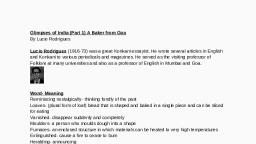
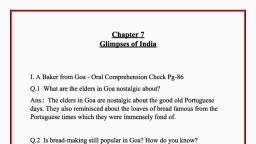
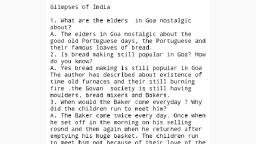
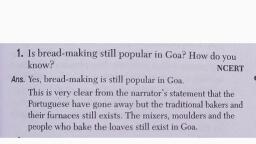
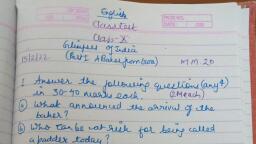
Summary of Glimpses of India, The chapter includes three short stories. First one is the A Baker from Goa by Lucio Rodrigues. This is a story about a baker and relates to the old Portuguese days. The second one is Coorg by Lokesh Abrol. It is a story about Coorg, a place in Karnataka. The author describes the weather, environment, people, wildlife and the landscape of Coorg in this story. The last one is Tea from Assam by Arup Kumar Datta. This story is about two friends exploring the tea gardens of Assam and also learning the legends behind it., A baker from Goa is a story that relates to the time when there was Portuguese rule in Goa. The story is of a baker living in a Goan village. During those times people ate loaves of bread. These were made in big furnaces. The bakers known as paders would come to sell these bread in the street and would make a jingle sound with the bamboo. Although, nowadays we may not see these loaves but may sometimes see the furnaces and some bakers carrying on the traditional business of their forefathers. The author remembers the coming of the baker twice a day during his childhood days. He was the author’s friend and guide. The maidservants in the author‘s house would buy loaves of bread which they ate with tea., During those days, bread was an important part of any occasion especially the sweet bread, Bol. Also, the baker had a peculiar dress, Kabai. It was a single-piece frock that would reach up to knees. Baking was a profitable business at that time., Coorg is a story describing the Coorg or Kodagu, the smallest district of Karnataka. The author describes Coorg as a heavenly place that lies between Mangalore and Mysore. It is certainly God’s abode as it has evergreen forests, spices and coffee plantations. From September to March, the weather is good here and thus many tourists come to visit the place. The air here has the coffee aroma in it. There’s a famous story about the Greek or Arabic descent of the Coorg people that a part of Alexander’s army had to settle here as it was not possible for them to return. They thus settled here and married with the locals. We may find people of Coorg wear Kuppia, a long black coat similar to the kuffia that Arabs wear., People of Coorg are also very brave. The Coorg Regiment of Indian Army is one of the most significant regiments. Also, our first army chief, General Cariappa hails from Coorg. The forests and hills of Coorg provide a major source of water to the River Cauvery. Also, Mahaseer, the largest freshwater fish is found in these waters. From the top of the Brahmagiri hills, we can see the complete view of Coorg. Also, Buddhists monks live in Bylakuppe in the Island of Nisargadhama near Coorg., The last story Tea from Assam starts with two friends, Rajvir and Pranjol travelling to Assam. On their way, they buy the tea from a roadside vendor. While sipping the tea, Rajvir tells Pranjol that people drink over 800,000,000 cups of tea throughout the world in a day. While Rajvir is looking at the beautiful and serene scenery, Pranjol is busy reading detective book. There were tea-bushes all over as far as one could see. They also saw a building which was a tea garden., Assam has the largest tea plantations and no one knows who discovered the tea for the first time. But, there are many legends associated with it. According to a Chinese legend, a few branches of tea fell accidentally in the boiled hot water. The Emperor liked the delicious flavour. This is how it came into being. As per an Indian legend, Buddhist Monk, Bodhidharma cut off his eyelids as to avoid sleep during meditation. About ten tea plants grew out of these and thus, they banish sleep when put in hot water and drunk. Both of them got down at Mariani Junction and went to Dhekiabari Tea Estate. There they saw women plucking tea leaves. Pranjol’s father had come to receive them there and said that he knew a lot about tea plantations. Rajvir says that he is keen to learn from him., Conclusion of Glimpses of India, In the chapter – Glimpses of India, we learnt about the beautiful landscapes and specialities of different parts of India. There are a lot of beautiful places to explore in India itself before we make our way to explore foreign locations., Part I : A Baker from Goa :-, Summary of Part 1-, This story is written by Lucio Rodrigues who talked about Goa that was once ruled by the Portuguese. Due to this reason, the people of the region are swayed by the Portuguese culture. Baking was the conventional profession of the Goan people and the bakers were known as ‘paders’ there. This story particularly revolves around the bakers living in a Goan village. The author mentioned how people in old times ate loaves of bread which were baked in large furnaces. The paders would come to sell those loaves in the street and would make a jingling sound with the bamboo whenever they arrived. He further added how the villagers enjoyed eating the loaves and bread-bangles brought in baskets for children by these bakers during his childhood., The author also described the special attire of the bakers called Kabai that was a single-piece frock that would reach up to their knees. Besides, he also mentioned how baking became the most profitable profession among people in Goa and many bakers led a prosperous life and their jackfruit-like physical appearance was a valid testimony of their well-being., Vocabulary words, 1.Traditional = conventional;, 2. Baker = one who bakes bread, 3.reminiscing = remembering, 4.nostalgically =fondly, 5. loaves = pieces of bread, 6.vanished = disappeared, 7. moulders = those who mould, 8.exist= being still there, 9. Furnaces = ovens, 10.extinguished = put out, 11. thud and jingle = falling sound along with musical sound, 12. Heralding = announcing, 13. carries on = continues, 14. pader = a kind of baker, 15. longed = wished, 16.staff = a long stick, 17. supported = helped, 18.banged = beat with, 19.vertical = straight, 20. mild = light, 21.rebuke = chide, 22.parapet = wall on the edge of root, 23.peep = see, 24.Feast = grand party, 25.Absolutely = completely, 26.peculiar = strange, 27.starved = die of hunger, 28.plump = having a soft round body, 29.testimony s= tatement, Q1. What are the elders in Goa nostalgic about?, The narrator often finds his elders thinking about ‘those good old days’ and telling them about the famous breads that date back to the time when Portuguese ruled over Goa. They ponder over the past and tell them that though the Portuguese have left Goa but the bakers still exist, if not the original ones, their legacy is being continued by their sons., Q2. Is bread-making still popular in Goa? How do you know?, Yes, bread-making is still popular in the city of Goa. It is evident from the existence of time-tested furnaces, mixers and moulders. The legacy of bakers is being continued by their sons. You will find a bakery in every Goan village as bread is an important part of the Goan culture., Q3. What is the baker called?, The baker is referred to as ‘Pader’ in the city of Goa., Q4. When would the baker come everyday? Why did the children run to meet him?, The baker would come twice every day during the narrator‘s childhood days. Once in the morning to deliver the loaves of bread and secondly, in the evening on his return after selling his stock. The children would go running to him to take the special bread bangles he had made for them., Q5. Match the following. What is a must, As marriage gifts? – cakes and bolinhas, For a party or a feast? – sweet bread called bol, For a daughter’s engagement? – bread, For Christmas? – sandwiches, Answer:-, As marriage gifts- Sweet bread called bol, For a party or a feast -Bread, For daughter’s engagement- Sandwiches, For Christmas- Cakes and bolinhas, Q6. What did the bakers wear:, In the Portuguese days?, When the author was young?, (i) In the Portuguese days, the bakers wore a unique knee-length frock dress typically known as ‘kabai’., (ii) In the narrator‘s childhood days, he had seen them wearing shirts and shorter than usual pants., Q7. Who invites the comment — “he is dressed like a pader”? Why?, During the narrator‘s childhood days, the bakers had a peculiar dress. They wore shirts and shorter than usual pants. Thus, if someone is seen wearing pants of this much length, they invite the comment – “he is dressed like a pader”., Q8. Where were the monthly accounts of the baker recorded?, The monthly accounts of the baker were recorded on some wall with a pencil., Q9. What does a ‘jackfruit-like appearance’ mean?, ‘Jackfruit-like appearance’ means a well-built or plump physique, similar to a jackfruit. In those days, bakers had plump physique because baking was a profitable profession. His family and servants never starved and were prosperous., Q. Which of these statements are correct?, The pader was an important person in the village in old times. True, Paders still exist in Goan villages. True, The paders went away with the Portuguese. False, they still exist in Goan villages., The paders continue to wear a single-piece long frock. False, they wear shirts and trousers that are shorter than the usual ones and longer than the half-pants., Bread and cakes were an integral part of Goan life in the old days. False, they are still an integral part of Goan culture., Traditional bread-baking is still a very profitable business. True, Paders and their families starve in the present times. False, it is still a very profitable business and their families are happy and prosperous., Is bread an important part of Goan life? How do you know this?, Bread is an important part of the Goan culture and it is evident from its presence at every important occasion. From sweet breads at marriages to sandwiches at engagement parties and cakes and Bolinhas at Christmas as well as other occasions, makes the presence of a baker in every village, very essential., Tick the right answer. What is the tone of the author when he says the following?, The thud and the jingle of the traditional baker’s bamboo can still be heard in some places. (nostalgic, hopeful, sad), Maybe the father is not alive but the son still carries on the family profession. (nostalgic, hopeful, sad), I still recall the typical fragrance of those loaves. (nostalgic, hopeful, naughty), The tiger never brushed his teeth. Hot tea could wash and clean up everything so nicely, after all. (naughty, angry, funny), Cakes and bolinhas are a must for Christmas as well as other festivals. (sad, hopeful, matter-of-fact), The baker and his family never starved. They always looked happy and prosperous. (matter-of-fact, hopeful, sad), Answers-, Nostalgic, Nostalgic, Nostalgic, Funny, Matter-of-fact, Matter-of-fact, Part II : Coorg:, Summary of Part 2- The writer Lokesh Abrol describes the hill station of Coorg located in the western ghats in the state of Karnataka. It is located midway between Bengalore and Mangalore. The suitable time to visit Coorg is from September to March. The place is famous for coffee plantations and spices. There are abundant rainforests which cover 30 percent of the area. The Coorgi men are brave warriors who are permitted to keep firearms without a licence due to their trustworthiness. The women of Coorg are pretty. Coorg is also known as Kodavu and the Kodavus, though are Hindus by religion but their customs differ from those of mainstream Hindus. They marry within their community. Kodavus are said to be of Greek or Arabic descent. Some soldiers of Alexander‘s army settled there. Also, as the ethnic dress of the Kodavus, Kuppia is similar to the Arab garment Kuffia, it is said that maybe their ancestors were Arabs or Kurds. The river Kaveri originates from Coorg. The fish named Mahaseer is found in the river. Many animals and birds like kingfisher, langur, squirrels and elephants can be spotted along the river. Tourists relax in the serene atmosphere and also enjoy adventure sports like river rafting, canoeing, rappelling, mountain biking, rock climbing and trekking. While trekking on the nature trails, animals like Macaques, Malabar squirrels, langurs and slender loris can be spotted on the trees. The major tourist attractions are Brahmagiri hills, Nisargdham island and Bylakuppe Tibetan settlements. Coorg gives visitors a feel of India’s diverse cultures., Vocabulary words:, Coastal of the coast, drifted = carried along, inhabited = resided by, Martial = concerning war, pours = rains, Commences = begins, invigorating = strength giving, tucked = placed, canopies = hanging covers, prime = of the best quality, Fiercely (here) = great, descet = ancestry, apparent = clear, religious rites = religious ceremony, Origin = lineage, Recount = narrate, firearms = weapons, ripple = round waves, Mahout = man who controls the elephant, rafting = Sailing in a raft, Thinking About The Text, (Page 92), Question 1.Where is Coorg?, Answer: Coorg or Kodagu is the smallest district of Karnataka. It is situated midway between Mysore and the cbastal town of Mangalore., Question 2.What is the story about the Kodavu people’s descent?, Answer:, The fiercely independent people of Coorg are descendents of Greeks or Arabs. A section of Alexander’s army moved South along the coast and settled here only when they were unable to return to their country. These people married among the locals. This is the story about the descent of Kodavu people., Question 3.What are some of the things you now know about?, 1. the people of Coorg?, 2. the main crop of Coorg?, 3. the sports it offers to a tourists?, 4. the animals you are likely to see in Coorg?, 5. its distance from Bangalore and how to get there?, Answer: 1. They are fiercely independent people and have descended from the Greeks or the Arabs., 2. Coffee is the main crop of Coorg., 3. It mostly offers adventure sports which include river rafting, canoeing, rappelling, rock climbing and mountain biking., 4. The animals likely to be seen in Coorg are macaques, Malabar squirrel, langurs, slender loris, elephants etc., 5. By road, it is around 250 – 260 kilometres from Bangalore., Question 4. Here are six sentences with some words in italics. Find phrases from the text that have the same meaning. (Look in the paragraphs indicated), 1. During monsoons it rains so heavily that tourists do not visit Coorg. (Para 2), 2. Some people say that Alexander‘s army moved south along the coast and settled there. (Para 3), 3. The Coorg people are always ready to tell stories of their son‘s and father’s valour. (Para 4), 4. Even people who normally lead an easy and slow life get smitten by the high energy adventure sports of Coorg. (Para 6), 5. The theory of the Arab origin is supported by the long coat with embroidered waist-belt they wear. (Para 3), 6. Macaques, Malabar squirrels observe you carefully from the tree canopy. (Para 7), Answer: 1. to keep visitors away, 2. As one story goes, 3. are more than willing to recount, 4. The most laidback individuals become converts to, 5. draws support from, 6. keep a watchful eye, Thinking About Language (Page 93), Certain words ‘go together’. Such ‘word friends’ are called collocations. The collocation of a word is ‘the company it keeps’. For example, look at the paired sentences and phrases below. Which is a common collocation, and which one is odd? Strike out the odd sentence or phrase., Questions., ‘How old are you?’, ‘How young are you?’, A pleasant person a pleasant pillow, Answers:, 1. The odd sentence is ‘How young are you?’, 2. The odd phrase is ‘a pleasant pillow’., Question 1.Here are some nouns from the text,‘culture’ ‘monks’ ‘surprise’ ‘experience’ ‘weather’ ‘tradition’, Work with a partner and discuss which of the nouns can collocate with which of the adjectives given below. The first one has been done for you., ‘unique’ ‘terrible’ ‘unforgettable’ ‘serious’ ‘ancient’ ‘wide’ ‘sudden’, Questions.1. culture : unique culture, ancient culture, 2. monks : _____________, 3. surprise: ___________, 4. experience: __________, 5. weather: ___________, 6. tradition: ___________, Answer:, 2. serious monks, unique monks, 3. unique surprise, sudden surprise, unforgettable surprise, terrible surprise, 4. unique experience, terrible experience, unforgettable experience, sudden experience, 5. terrible weather, unforgettable weather, 6. unique tradition, ancient tradition, Question 2. Complete the following phrases from the text. For each phrase, can you find at least one other word that would fit into the blank?, Answer:, Missing Alternate word, Valour bravery, Town belt, village, Heaven cake, Rainforests jungle, Coffee tea, banana, Rope steel, concrete, Creatures animals, Part III Tea from Assam, Summary of Part 3-, Tea from Assam is a story written by Arup Kumar Datta. This is the last story of the prose, Glimpses of India. The story began with two friends, Rajvir and Pranjol who were travelling to Assam. On their way, they bought fresh tea from a roadside vendor and discussed the special tea of this region. As they sipped the hot steaming tea, Rajvir told Pranjol that over eighty crore cups of tea are being consumed every day throughout the world. Rajvir thoroughly enjoyed the scenic beauty of Assam consisting of tea plantations and bushes, while Pranjol was engrossed in a detective book., Rajvir further explained to Pranjol about Assam as a place that is famous for having the largest tea plantations. However, no one knows the origin of tea in the region. According to a Chinese legend, a few leaves of tea accidentally fell in a pot of boiling hot water. The Emperor enjoyed the delicious flavour of the liquid and that’s how tea came into being. Further, Rajvir mentioned how an Indian legend, Bodhidharma who was a Buddhist monk cut off his eyelids because he fell asleep during meditation. In no time, ten tea plants grew out of his eyelids and when these leaves were put in hot water, it helped in banishing sleep., Soon, both of them arrived at Mariani Junction, picked up their luggage and made their way towards Dhekiabari Tea Estate. On their way, they saw batches of tea-pluckers who draped plastic aprons with bamboo baskets hung on their backs as they plucked the newly sprouted leaves. Pranjol’s father had come to receive both of them. Pranjol’s father was amazed at Rajvir’s knowledge about tea plantations when he heard the young boy mention the second-flush or sprouting period of tea that yields the best tea. Rajvir further said that he was keen to learn more about the place from Pranjol’s father., Vocabulary words, Vendor = seller, High = pitched sharp sound, sipped =drink with lips, steaming = emitting steam, whew = word of exclamation, detective = suspenseful, ardent = strong, keener = very much, magnificent = beautiful, backdrop = background, stretched = spread, sturdy = strong, Billowing out = coming out, legends = myths, scoffed= laughed, ascetic =monk, banished = removed, clattered = made a clattering sound, veered = moved, pruned = cut, aprons = outer dress, Thinking About Language (Page 96,97), Question 1. Look at these words: upkeep, downpour, undergo, dropout, walk-in. They are built up from a verb (keep, pour, go, drop, walk) and an adverb or a preposition (up, down, under, out, in). Use these words appropriately in the sentences below. You may consult a dictionary., 1. A heavy _____ has been forecast due to low pressure in the Bay of Bengal., 2. Rakesh will _____ major surgery tomorrow morning., 3. My brother is responsible for the ____ of our family property., 4. The ____ rate for this accountancy course is very high., 5. She went to the Enterprise Company to attend a _____ interview., Answer:, 1. downpour, 2. undergo, 3. upkeep, 4. dropout, 5. walk-in, Question 2. Now fill in the blanks in the sentences given below by combining the verb given in brackets with one of the words from the box as appropriate., ‘over’ ‘by’ ‘through’ ‘out’ ‘up’ ‘down’, 1. The Army attempted unsuccessfully to ____ the Government, (throw), 2. Scientists are on the brink of a major _____ in cancer research, (break), 3. The State Government plans to build a ____ for Bhubaneswar to speed up traffic on the main highway, (pass), 4.Gautama‘s ____ on life changed when he realised that the world is full of sorrow, (look), 5. Rakesh seemed unusually _____ after the game, (cast), Answers:, 1. overthrow, 2. breakthrough, 3. bypass, 4. lookout, 5. Downcast, Question 3. Notice how these -ing and -ed adjectives are used., Chess is an interesting game., I am very interested in chess., Going trekking in the Himalayas this summer is an exciting idea., We are very excited about the trek., Are all your School books this boring?, He was bored as he had no friends there. The -ing adjectives show the qualities that chess, trekking or these books have: they cause interest, excitement, or boredom in you. The – ed /-en adjectives show your mental state or your physical state: how you feel in response to ideas, events or things., Question 1. Think of suitable -ing or -ed adjectives to answer the following questions. You may also use words from those given above.How would you describe, 1. a good detective serial on television? ____, 2. a debate on your favourite topic ‘Homework Should Be Banned’? ____, 3. how you feel when you stay indoors due to incessant rain? ____, 4. how you feel when you open a present? ____, 5. how you feel when you watch your favourite programme on television? ____, 6. the look on your mother‘s face as you waited in a queue? ____, 7. how you feel when tracking a tiger in a tiger reserve forest? _____, 8. the story you have recently read, or a film you have seen? _____, Answers:, (Sample answers are given; you may have a different answer.), 1. exciting, 2. interesting, 3. bored, 4. excited, 5. interested, 6. disappointed, 7. thrilled, 8. thrilling



 Learn better on this topic