Notes of Class X, PHYSICS IMG_20211013_084627.jpg - Study Material
Page 1 :
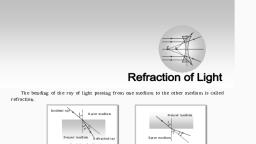
Eng kal tlang theihna ho hi Transparent medium an vuah a, eng kal tlang theih lohna ho hi Opaque, body an vuah., , Velocity of light in Air =3x 10° m/s =3 x 10° km/s, Velocity of light in Water = 2.25 x 10° m/s, Velocity of light inGlass | =2x 10° m/s, , Hemi an velocity in an lohna avang hian Eng hi alo kalkawi thei ta thin ani. Pencil emaw hmawlhte ngil, tak tuiah a awna kan chiah a, alan kawihna chhan te, No a tui awm ,amawng arawn lan thuk lohna chhan te,, enlenna hmanga thil kan en len theihna chhan te, leh adangte hi Refraction of light vang ani., , Eng kal tlangna medium muk zawk hi optically denser medium tiin an sawi a, a pan zawk hi optically, rarer medium tiin an sawi thin., , Q. What is refraction of light ?, Ans : The phenomenon of bending or the change in direction of light rays when it travels from one, medium to another medium is known as refraction of light., , Q. What is the cause of refraction ?, Ans : The refraction is caused due to the change in velocity of light in the different media., , Q. What is Lateral displacement ?, , Ans : The shift in the path of the light on emergence from a medium with parallel faces is called Lateral, displacement., , Q. On what factor does the lateral displacement depends ?, , Ans: The lateral displacement is proportional to the thickness of the slab., , Refraction through a Glass slab N, , — angle of incidence, , rarer medium(air), B, , , , , incident ray —, , , , angle of refraction, *s, denser medium] (glass), refracted ray | ., , , , , , , , D, , ~ IC., emergent ray a Lateral displacement, LAWS OF REFRACTION : Se, , 1. The incident ray, the refracted ray and the normal at the point of incidence,all lie in the same plane., , , , , , 2. The ratio of the sine of angle of incidence to the sine of angle of refraction is a constant for any, , . oo sind § a, given pair of media. i.e. car? constant (1). This constant is known as refractive index., i, , Q. State Snell’s law., Ans : Snell’s law states that ‘ The ratio of the sine of angle of incidence to the sine of angle of refraction is, a constant for any given pair of media.’, Q. Define Refractive index of a medium., Ans : The ability of a transparent medium to bent light as it enters the medium is called refractive index. (14), [Medium hrang hrang refractive index chu Page 24, table 1.4 ah a awm], , Q. For what condition does the angle of refraction be equal to the angle of incidence ?, Ans : The angle of refraction is equal to the angle of incidence when the light enter the medium normally., , Q. Why does the coin place in a water tank( or glass tumbler) appears raised ?, Ans : The coin appears raised due to the refraction of light., , REFRACTION THROUGH LENSES :, , Two types of Lenses are (i) Convex lens (converging lens) (ii) Concave lens (diverging lens), 1. Centre of Curvature : The centres of the spheres of which, the lens is a part is called centre of curvature. (3 f f, 2. Principal axis : An imaginary line passing through Q FE,, the two centres of curvature of a lens. VV, , 3. Optical centre (O) : The geometrical centre (0) of the lens is called its Optical centre., , 4. Focus (F) : The point on the principal axis where all the light rays parallel to the principal axis after, refraction meets (in case of convex lens) or appears diverge from (in case of concave lens) is, called its focus., , 5. Focal length (f) : The distance between the optical centre(O) and focus(F) of a lens is called focal length.