Notes of 10th, English SPELLING RULES - Study Material
Page 1 :
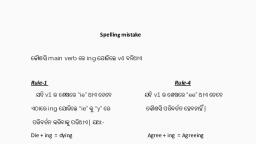
Spelling Rules, Spelling is the most important part of any language and especially English language, as in this every sound is represented by a full alphabet. There is no need to mug up, all the spelling, even otherwise it is a tough proportion to do. However there are, some set rules of course with some exceptions that can help to write correct, spellings. Main spelling rules are as follows:-, , Spelling Rule No 1., In single syllable words ending in single vowel + single consonant double the, consonant before a suffix beginning with a vowel., Example:, , , , , beg + ed = begged, rob + er = robber, run + ing = running, sad + est =saddest, , Spelling Rule No 2., Words of two or more syllables ending in single vowel + single consonant double, the final consonant if the last syllable is stressed., Example:, , , , run + ing = running, occur + ed = occurred, control + er = controller, , In the above examples last syllable ie n, r and l respectively are stressed, However the consonant is not doubled if the last syllable is not stressed., Example:, , , benefit + ed = benefited, Suffer + ing = suffering, , There are some exceptional words too like handicap, kidnap and worship to write a, few., , , , worship + ed = worshipped, handicap + ed = handicapped
Page 2 :
Spelling Rule No 3., In British English the consonant l is doubled irrespective of the absence of stress on, the last syllable., Example:, , , , quarrel + ed = quarrelled, travel + er = traveler, distil + er = distiller, , Rare Exception to the rule, , , Parallel + ed = paralleled, , Spelling Rule No 4., In the words to which the suffix ful is added ends in ll, the second l is dropped., Example:, , , skill + full = skilful, will + ful = willful, , Spelling Rule No 5., Word ending in silent e drops the e before a suffix beginning with a vowel., Example:, , , , live + ing = living, hope + ing = hoping, drive + er =driver, , However e remains as such before a suffix beginning with a consonant., , Spelling Rule No 6., Some special case of words ending in ce and ge keep the e when, adding able and ous., Example:, , Notice + able = noticeable
Page 3 :
, , , , Peace + able = peaceable, Change + able = changeable, Courage + ous = courageous, , In these kind of words c and g are pronounced soft before e. Thus the e is retained, to avoid confusion with a similar word., Example:, , , Singe + ing = singeing (should not be confused with singing), Swinge + ing = swinging (should not be confused with singing), , Spelling Rule No 7., Words ending in ee do not drop an e before a suffix., Example:, , , see + ing = seeing, agree + ment = agreement, , Spelling Rule No 8., Words ending in ie change the ie to y when ing is added., , , , , Die = dying, Tie = tying, Lie = lying, , Spelling Rule No 9., 1. A final y following a consonant changes to i before a suffix except ing., , , , , , happy + ly = happily, carry + ed = carried, beauty + ful =beautiful, marry + age = marriage, , Some exception of the Rule No 8 (i) are:, , , carry + ing = carrying, marry +ing = marrying, , 2. Whereas a y following a vowel does not change.
Page 4 :
, , , Pray + ed = prayed, Play + er = player, , Some exception of the Rule No 8 (ii) are:, , , , pay + ed = paid, say + ed = said, lay + ed = laid, , Spelling Rule No 10., When ie or ei is pronounced like ee in jeep, i comes before e except after c., Example:, , , , , , , , , , believe, receive, relieve, receipt, achieve, grieve, deceit, conceive, conceit, , Some exception of Rule No 9. are, , , , , , , , seize, protein, counterfeit, weird, surfiet, plebeian, , Rearranging scramble sentences, Rearranging the sentences requires a sound knowledge of grammar, a, command over the structure and ability to form a logical sequence of ideas, behind sentences., For this one has to read every sentence carefully, concentrate on the meaning, of the passage and then form a sequence at the level of idea., Illustrations:, 1. a noun precedes a pronoun and the noun helps identify the pronoun.
Page 5 :
Ex: A king lived in central India., He was handsome but very vain, 2. the definite articles ‘the’ generally follows a sentence where an indefinite, article is used, 3. certain words, say linkers help to decide the sequence of the sentence, 4. If the sentence starts with a ‘name’ of a person, then that sentence will, definitely be the 1st sentence of the paragraph, 5. The sentence starts with ‘A’ or ‘An’ come first followed by ‘The’, sentence, 6. If there are three sentences starting with the ‘But’, So’ and ‘Now’, respectively, they follow the below given sequence:, , But, So, Now, 7. If the sentence starts with the words ‘Hence’, ‘Finally’ or ‘ Therefore’, then that sentence comes last in the paragraph., , Rearranging the sentences requires a sound knowledge of grammar, a, command over the structure and ability to form a logical sequence of, ideas behind sentences., For this one has to read every sentence carefully, concentrate on the meaning, of the passage and then form a sequence at the level of idea., Illustrations:, 1. If the sentence starts with a ‘name’ of a person, then that sentence will, definitely be the 1st sentence of the paragraph, 2. a noun precedes a pronoun and the noun helps identify the pronoun., Ex: A king lived in central India., He was handsome but very vain, 3. The sentence starts with ‘A’ or ‘An’ come first followed by ‘The’, sentence, 4. The definite articles ‘the’ generally follows a sentence where an, indefinite article is used, 5. Certain words, say linkers help to decide the sequence of the sentence, 6. If there are three sentences starting with the ‘But’, So’ and ‘Now’
Page 6 :
•, •, •, 7., , respectively, they follow the below given sequence:, But, So, Now, If the sentence starts with the words ‘Hence’, ‘Finally’ or ‘ Therefore’, then that sentence comes last in the paragraph.



 Learn better on this topic