Notes of Biology, Biology cell cycle and division pdf.pdf - Study Material
Page 1 :
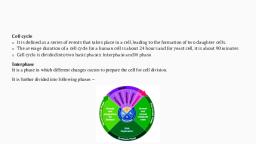
CELL CYCLE AND CELL DIVISION, ✓, , It is the life period of a cell during which a cell synthesizes DNA (replication),, grows and divides into two daughter cells., , ✓, , Cell cycle has two basicphases:, Interphase, , ➢, , ➢, , ➢, , It is the phase betweentwo, , M Phase, , ➢, , It represents the actualcell division, , successive M phases., , (mitosis)., , It includes cell growth & DNA ➢, , M Phase includes, , synthesis., , ✓, , Karyokinesis: Nuclear division., , Includes G1, S and G2Phase, , ✓, , Cytokinesis: Division of cytoplasm.
Page 2 :
CELL CYCLE AND CELL DIVISION, ✓, , Includes 4 stages, , ✓, , Prophase, metaphase,, , ✓, , M Phase, , Cells that do not divide further exit, G1 phase and enter an inactive, stage called quiescent stage (Go)., , anaphase, Telophase, , G0, G2 Phase, ✓, , Second growth phase., , ✓, , Cell growth continues., , ✓, , Synthesis of RNAand, , Cell, Cycle, , proteins continues., , ✓, , G1 Phase, , Cell is prepared for mitosis., ✓, , It is the longest phase., , ✓, , Continuous growth of cell., , ✓, , DNA replication takes place. SPhase, , ✓, , Cell becomes metabolically active., , ✓, , Amount of DNA per cell doubles., , ✓, , Prepares machinery for DNAreplication., , ✓, , But, chromosome number is not increased. ✓, , Synthesizes RNA and proteins.
Page 3 :
CELL CYCLE AND CELL DIVISION: MITOSIS, ✓, , Occurs in somatic cells., , ✓, , Also called as equational division as the number of chromosomes in the parent, and progeny cells issame., , ✓, , Include four stages, , Prophase, , Metaphase, , Anaphase, , Telophase
Page 4 :
CELL CYCLE AND CELL DIVISION, Prophase, Following events takes place during prophase, ✓, , Chromosomes condensed, , ✓, , Spindle apparatus assembles, , ✓, , Centrioles move to opposite poles forming spindle apparatus, , ✓, , Asters – radial array of microtubules in animals (not plants), , ✓, , Nuclear envelope breaks down
Page 5 :
CELL CYCLE AND CELL DIVISION, METAPHASE, Following events takes place duringmetaphase, , ✓ Chromosomes align at metaphase plate
Page 6 :
CELL CYCLE AND CELL DIVISION, ANAPHASE, Following events takes place duringANAPHASE, ✓, , Begins when centromeres split, , ✓ Sister chromatids pulled to opposite poles
Page 7 :
CELL CYCLE AND CELL DIVISION, TELOPHASE, Following events takes place during TELOPHASE, ✓, , Spindle apparatus disassembles, Nuclear envelope forms around each set, of sister chromatids, , ✓, , Chromosomes begin to uncoil Nucleolus reappears in each new nucleus
Page 8 :
CELL CYCLE AND CELL DIVISION, CYTOKINESIS, , It is the division of cytoplasm resulting in the formation of 2 daughter cells., It starts when telophase is in progress., ✓ Cleavage of the cell into equal halves, ✓ Animal cells – Constriction of actin filaments produces a cleavage furrow, ✓ Plant cells – Cell plate forms betweenthe nuclei
Page 9 :
CELL CYCLE AND CELL DIVISION, Significance Of Mitosis, , ✓ Produces daughter cells with identical genome., ✓ Retain the same chromosome number in all somatic cells., , ✓ Restores the nucleo-cytoplasmic ratio that disturbed due to cell growth., ✓ Helps in cell repair & replacement.
Page 10 :
CELL CYCLE AND CELL DIVISION, Meiosis, ✓, , Meiosis is a reductional division., , ✓, , Reduces the chromosome, number., , ✓, , Occurs in diploid germ cells, , during gametogenesis., ✓, , It leads to haploid phase in the, life cycle of sexually reproducing, organisms., , ✓, , Fertilization restores the diploid, , phase.
Page 11 :
CELL CYCLE AND CELL DIVISION, Meiosis, ✓, , Meiosis consists of two celldivisions:, Meiosis 1, , ✓, , First division is a reduction, , Meiosis 2, , ✓, , division, , division, ✓, , Reduces diploid nucleus, , to form haploid nuclei, , Second division is equational, , ✓, , Separates sister chromatids, , ✓, , Produces four haploid cells
Page 13 :
CELL CYCLE AND CELL DIVISION, Meiosis Prophase I: Includes 5 Phases, 5. Diakinesis, Terminalisation of chiasmata., Nucleolus & nuclear envelope, , 1. Leptotene, , disappear., , ✓, , Chromatin fibres become long, slender chromosomes., , 4. Diplotene, , ✓, , Nucleus enlarges., , Recombined homologous chromosomes, of bivalents separate from each other, , Prophase I, , except at sites of crossovers. chiasmata., , 3. Pachytene, ✓, , Formation of tetrads., , ✓, , Crossing over occurs., , ✓, , Recombination of genetic material onthe, homologous chromosomes., , 2. Zygotene, ✓, , Pairing of homologous, chromosomes. (synapsis), , ✓, , Each pair of homologous, chromosomes is called a bivalent.
Page 14 :
CELL CYCLE AND CELL DIVISION, Meiosis: Metaphase I, ✓, , Spindle formation is complete, , ✓, , Chromosomes align on the equatorial, , Kinetochore, microtubule, , plate., ✓, , Microtubules from the spindle attach to, the pair of homologous chromosomes., , Homologous pair, on metaphase plate
Page 15 :
CELL CYCLE AND CELL DIVISION, Meiosis: Anaphase I, , ✓, , Sister chromatids, , The homologous chromosomes, separate, while sister, chromatids remain associated at, their centromeres., , Homologous, chromosomes
Page 16 :
CELL CYCLE AND CELL DIVISION, , Non Identical, sister chromatids, , Meiosis: Telophase I, ✓, , Nuclear membrane and nucleolus reappear, , ✓, , 2 haploid daughter nuclei are formed (Diad)., , ✓, , Cytokinesis may or may not occur., , ✓, , Short interphase,it is followed by meiosis II., , ✓, , The short stage between the two meiotic divisions is, , Chromosome, , called interkinesis., ✓, , DNA replication does not occur in this phase., , Homologous, chromosomes, , Telophase I
Page 17 :
CELL CYCLE AND CELL DIVISION, Meiosis II:, ✓, , Second division separates sister chromatids (these chromatids may not be, identical due to crossing over in prophase I), , Prophase II, ✓, , Chromosomes again become compact., Nucleolus and nuclear membrane, disappear in both nuclei., , Metaphase II, ✓, , Chromosomes align at equator and, microtubules from opposite poles of, spindle get attached to thekinetochores, of sister chromatids.
Page 18 :
CELL CYCLE AND CELL DIVISION, Meiosis II:, Anaphase II, ✓, , Begins with splitting of the centromere, of each chromosome and separate the, sister chromatids, Chromatids move, , toward opposite poles., Telophase II, ✓, , Chromosomes decondense, nuclear, , membrane reforms, cells divide, (cytokinesis) to form four haploid, daughter cells
Page 19 :
CELL CYCLE AND CELL DIVISION, SIGNIFICANCE OF MEIOSIS, ✓, , Formation of gametes that are responsible for sexual reproduction., , ✓, , Maintains the constant number of chromosomes by reducing the same., , ✓, , Restores diploid number after fertilization., , ✓, , Crossing over produces a new combination of traits and variations.
Page 20 :
Cell cycle, o It, , is defined as a series of events that takes place in a cell, leading to the formation of, two daughter cells., o The average duration of a cell cycle for a human cell is about 24 hours and for yeast, cell, it is about 90 minutes, o Cell cycle is divided into two basic phases: Interphase and M phase
Page 21 :
Interphase, It is a phase in which different changes occurs to prepare the cell for cell division., It is further divided into following phases –
Page 22 :
G1 phase• It is also known as first gap phase., • During this phase, biosynthetic activities occur at a very fast rate., • Cell synthesizes more proteins, increase the number of mitochondria and ribosomes., • Cell also prepares itself for DNA replication.
Page 23 :
S phase• It is the phase where DNA is replicated., • At the end of DNA replication, each chromosome is with two sister chromatids., • Thus, the amount of DNA gets doubled during this phase, but the ploidy remains same
Page 24 :
G2 phase• It is the phase where the cell prepare itself for mitosis., • It also involves protein synthesis and further growth of the cell.
Page 25 :
Significance of Cell Division, o It is the mean of asexual reproduction in unicellular organisms., o It is essential for the growth of a single celled zygote into a whole new multicellular organism., o It helps in the repair of injuries and worn out tissues., o It replaces dead cells of the body and thus is essential for growth of organism., o In sexual reproduction, meiosis occurs., o This type of cell division not only results in production of gametes, but also brings new, combinations of genes, thus resulting in variations among a population. This also leads to, evolution of a species.
Page 26 :
Mitosis, o A cell division, chromosomes replicate and get equally distributed into two daughter cells., Hence, it is also called equational division., o mitosis keeps the chromosome number equal in daughter as well as parental cell., o Mitosis usually takes place in somatic cells., Mitosis involves four stages:
Page 27 :
• Prophase, o It involves initiation and condensation of chromosomes., o Nucleolus and nuclear membrane disappear.
Page 28 :
• Metaphase, o Chromosomal material condenses to form compact chromosomes that get aligned in the, middle of nucleus at equatorial plate.
Page 29 :
• Anaphase, o Centromere splits and chromosomes move apart towards two opposite poles due, to shortening of spindle fibres
Page 30 :
• Telophase, o Chromosomes finally reach their respective poles., o Nuclear envelope assembles around each chromosome cluster., o Nucleolus and other organelles reform.
Page 31 :
• Karyokinesis and Cytokinesis, o Karyokinesis is the division of nucleus during mitosis or, meiosis that is followed by cytokinesis., o Cytokinesis involves the division of cytoplasm of a cell., o Cytokinesis is achieved in animal cell by cleavage that, deepens and divides the cell into two., o It is achieved in plant cell by cell plate formation., o When karyokinesis is not followed by cytokinesis, a, multinucleate condition arises. This is called syncytium.
Page 32 :
Significance of mitosis, • Produce genetically identical daughter cells., • Growth of the body occurs via mitosis., • Cell repair and replacement also occurs via mitosis., • Maintenance of nucleo-cytoplasmic ratio.
Page 33 :
Cell cycle exit, Some cells divide at a fast rate whereas some divides slowly and some even do not divide, once they are formed., Those cells which do not divide once formed, enter into a phase known as GO phase. For, example, neuronal cells once, formed will not divide.
Page 34 :
Meiosis, o It is the process which involves the reduction in the amount of genetic material., o It mainly occurs in germ cells., o At the end of meiosis II, four haploid cells are formed., o It is comprised of two successive nuclear and cell division with a single cycle of DNA, replication., • The phases of meiosis are as shown below
Page 35 :
Meiosis I
Page 36 :
1. Prophase I –, , It is the longest phase of meiosis I., During this phase, homologous chromosomes pairs and DNA segments are exchanged (known as, recombination)., It is further divided into 5 stages:
Page 37 :
i. Leptotene, • It is the first stage of meiosis., • Each individual chromosome exists with two sister chromatids., • Elements of synaptonemal complex assemble., • Condensation and coiling of chromosomes occur.
Page 38 :
ii. Zygotene, • Chromosomes align as homologous pair of chromosomes., • Synapsis of homologous chromosomes occur., • The paired chromosomes are known as bivalent or tetrad.
Page 39 :
iii. Pachytene, • During this stage, crossing over and homologous recombination occurs., • Chiasmata are formed where homologous chromosomes exchange their segments.
Page 40 :
iv. Diplotene, • Homologous chromosomes start to separate., • Synaptonemal complex disassemble., • Chromosomes remain bound at the chiasmata.
Page 41 :
v. Diakinesis, • Chromosomes condenses further, so that four parts of the tetrads are visible., • The nucleoli disappear, nuclear membrane disintegrates., • Mitotic spindle starts to form.
Page 42 :
Metaphase I, Homologous chromosomes are aligned on the metaphasic plate. The replicated, chromosomes are joined together via protein known as cohesin.
Page 43 :
Anaphase I, As the kinetochore microtubules shorten, homologous chromosomes are pulled to the, opposite poles. The cohesin (protein, complex) degrades from the chromosome arms while remaining safe surrounding the, centromere. Thus the sister, chromatids remain together while homologs segregate.
Page 44 :
Telophase I, Each daughter cell now has half the number of chromosomes as compared to parent, cell., The microtubules forming the spindle begin to disappear. The chromosomes forms, chromatin once again. Sister chromatids remain attached.
Page 45 :
Meiosis II, Meiosis II is the second meiotic division. It is similar to mitosis,, but the genetic results are different., It results in the formation of four haploid cells from the two, haploid cells produced in meiosis I., The four main steps of Meiosis II are as follows- Prophase II,, Metaphase II, Anaphase II, and Telophase II.
Page 46 :
prophase II, nucleoli and nuclear membrane disappears., Shortening and thickening of the chromatids also occur during this phase., Centrosomes move to the poles and spindle fibers are formed for the second meiotic division.
Page 47 :
metaphase II the centromeres are present with two kinetochores that are attached to spindle, fibers from the centrosomes at opposite poles., The metaphasic plate is rotated by 90 degrees when compared to meiosis I,, perpendicular to the previous plate.
Page 49 :
Telophase II, It is like telophase I, de-condensation of chromosomes occurs., Nuclear envelopes reorganize and cleavage or cell plate formation starts to produce four, daughter cells, each with a haploid set of chromosomes.
Page 50 :
Significance of Meiosis:, • Maintenance of chromosome number generation after, generation in case of sexual reproduction., • Increases variation in population.



 Learn better on this topic