Notes of NSAM INTEGRATED MATHS LS, Mathematics Chapter 8 Application of integral.pdf - Study Material
Page 1 :
Chapter 8 Applications of definite Integral [3 + 8], Area under simple curves, = ( ),, , , , The area of the region bounded by the curve, - axis and the lines = and, = ( > ) is given by the formula:, =∫, =∫ ( ) ., , , , The area of the region bounded by the curve = ( ), - axis, and the lines = and = is given by the formula:, =∫, =∫ ( ) ., , Area between two curves, , , The area of the region enclosed between two curves = ( ),, = is given by the formula:, = ∫ [ ( ) − ( )] , where ( ) ≥ ( ) in [ , ], , , , If, , ( ) ≥ ( ) in [ , ] and ( ) ≤ ( ) in [ , ] , <, = ∫ [ ( ) − ( )] + ∫ [ ( ) − ( )] ., , = ( ) and the lines, , < , then, , =, , and
Page 2 :
Question carrying Three mark:, =, , 1. Find the area of the region bounded by the curve, 2 ., Ans : Required area = 4 (shaded region area), = 4∫, , and the x-axis between, , = 0 and, , =, , ., ] = −4, 0, , = −4, , −, , 0, , = −4(0 − 1) = 4 sq. units., 2. Find the area bounded by the curve =, between, Ans: Required area = 4(shaded region area), = 4∫, , = 2 ., , ., ], , =4, , = 0 and, , 0, , =4, , −, , 0, , = 4(1 − 0) = 4, , sq., , units., , 3. Find the area of the circle, +, = 4 bounded by the lines = 0 and = 2 which is lying in the, first quadrant., Ans: Required area lying in the first quadrant and bounded by the circle, +, = 4 and the lines, = 0 and = 2 is, Required area = shaded region area, =∫, = ∫ √4 −, = √4 −, , 2, 0, , + sin, , = 0+2 −0−0, =, , 4., , sq.units., , +, , Find the area enclosed by the ellipse, , = 1 using integration., , Ans: Required area = 4 (shaded region area), = 4∫, , = 4∫, , =, , √, , =, , 0+, , =, , −, , +, , √, sin, , × −0−0, , square units., , −, 0
Page 3 :
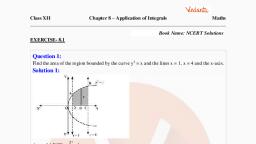
5., , =, , Find the area under the curve, Ans : Let, , =, , and given lines, , = 1,, , = 5 and X-axis., , . Here, x is even, so curve is symmetrical about Y-axis and passes through the, , origin., Required area, = shaded region area, =∫, =, = [5 − 1 ], = [5 − 1] = 624.8 square units., 6., , Find the area of the region bounded by the curve y = x2 and the line y = 4, Ans:, , (M14), , Required area = 2 (shaded region area), 4, , 2 x dy, 0, , 2, , 4, , 0, , y dy, , =2, , =, , = (8) =, 7., , ∵, , =, , , , =, , 4 −0, sq. units, , Determine the area of the region bounded by y2 = x and the lines x = 1 and x = 4 and the, x – axis in the first quadrant ., J 14, Ans : Required area = shaded region area, =∫ √, =, =, , 4 −1, , = (8 − 1) =, 8., , sq. units, , Find the area of the region bounded by the curve y2 = 4x and the line x = 3., , M 15, , Ans: Required area = 2 (shaded region area), = 2∫, = 2 ∫ 2√, =4, =, , 3 −0, , = 8√3 sq. units, 9., , Find the area lying between the curve y2 = 4x and the line y = 2x., Ans: y2 = 4x , y = 2x, (2x)2 = 4x, ⟹ 4x2 = 4x, ⟹ x2 - x = 0, ⟹ x (x - 1) = 0, , J 15
Page 4 :
⟹ x = 0, x = 1, ⟹ x = 0, x = 1, Required area = shaded region area, area bounded below parabola, area below the line, =, −, between x = 0 and x = 1, between x = 0 and x = 1, = ∫ 2√x − 2x dx, = 2, 10., , −, , =, , x − x, , =, , − 1=, , sq. units., , Find the area of the region bounded by y2 = 9x, x = 2, x = 4 and the x-axis in the first quadrant., J 16, Ans: y = 9x ⇒ = 3√, Required area = shaded region area, = ∫, = ∫ 3√, =3, =2 4 −2, = 2 8 − 2√2 sq. units, , 11., , Find area of the region bounded by the curve y2 = 4x, y-axis and the line y = 3., Ans:, , =4 ⟹, , M 17, , =, , Required area = shaded region area, =∫, =∫, , =, , 3, 0, (3 − 0), , =, , =, , =, , 12., , sq.units ., , Find the area of the parabola y 2 4ax bounded by its latus rectum., , J 18, , Ans: Equation of the latus rectum is x a . The required area of the parabola y 2 4ax bounded, by x a , Required area = 2(shaded region area), = 2∫, = 2 ∫ 2√, a, , 4 a, , 2 3/ 2 , x , 3, 0, , = √, , −0, , =, , sq.units
Page 5 :
Find the area of the region bounded by, =4 ,, quadrant., Ans : Required Area = shaded region area, , 13., , = 2,, , = 4 and the y- axis in the first, , = ∫, =∫ 2, 4, 2, , = 2×, , 14., , =, , 4 −2, , =, , 8 − 2√2, , =, , −, , √, , sq.units., , Find the area of the smaller part of the circle, Ans :, , +, , =, , cut off by the line, , =, , √, , ., , Required area = 2(shaded region area), = 2∫, √, , = 2∫ √, , −, , √, , =2, , √, , −, , +, , sin, √, , = 2 0+, , −, , =2, , −, , =2, , −, , √, , √, , −, , −, =, , − 1 sq. units., , The area between =, and = 4 is divided into two equal parts by the line, value of ., Ans : Since the line = divides the shaded area in two equal parts., Therefore, ) =2∫ (, ), 2∫ (, , 15., , ⇒, ⇒, , 2, 2, 3, , ⇒, ⇒, , 2, , ⇒, , =2, , √, , = , find the, , √, , 2, 0, 3, −0 = 4 −, , 4, , =, , =4 =8, =4, , ⇒, , =4, , Question carrying Five mark:, 1., , Find the area of the region in the first quadrant enclosed by x-axis, the line y = x and the circle, x + y2 = 32, 2, , Ans: Let y = x ---- (1) and the circle x2 + y2 = 32 ---- (2 ), , , = √32 −, , Solving (1) and (2) x2 + x2 = 32, 2, , = 32 ⟹, , x = 4, y = 4, , = 16 ⟹, , = ±4,, , B(4,4) is point of intersection.
Page 6 :
∴ Required area =, , area below the circle (2), area bounded below st. line (1), +, between x = 0 and x = 4, between x = 4 and x = 4√2, , +, , =, , √, , +∫, , =∫, , √32 −, , √32 −, , +, , sin, , √, √, , = 8 + [8 − (8 + 4 )] = 4 sq. units, , 2., , Find the area of the region enclosed by the parabola x2=4y and the line x=4y - 2 and the x- axis., Ans: Given equations are x2 = 4y, , …(1), , x = 4y - 2 …(2), Solve (1) and (2) we get, x2 = x + 2, , x = 2, -1., , Required area = shaded region area, =∫, , (, , ), , =∫, , (, , −∫, , ), , −, 2, , 1 x2, x3 , , 2x , , , 4 2, 3 1, , 3., , , , 1 , 8 1, 1 , 2 4 2 , 4 , 3 2, 3 , , , , 1 , 8 1, 1 , 2 4 2 = square unit., 4 , 3 2, 3 , , Using integration, find the area of the region bounded by the triangle whose vertices are, (1, 0),(1, 3) and (3, 2)., Ans: Let A (1, 0), B (1, 3) and C (3, 2) be the vertices of a triangle., Equation of AB, , y 0 30, 3, , y ( x 1), x 1 11, 2, , Equation of BC, , y3 23, 1, , y 3 ( x 1), x 1 3 1, 2, y, , 1, 7, x, 2, 2, , From the figure, Area of Δ, 1, , …(2), , y 0 20, 1, , y ( x 1), x 1 3 1, 2, , Equation of AC, , Area = ∫, , …(1), , (, , ), 3, , …(3), , is, +∫, , (, , ), 3, , −∫, , 3, 7, 1, 1, A ( x 1) dx x dx ( x 1)dx, 2, 2, 2, 2, 1, 1, 1, , (, , )
Page 7 :
1, , 3, , 3, , 1 x2, , x2 7 , , 3 x2, x , x , x , 2 2, 1 4 2 1 2 2, 1, , =, , +1− +1 +, , +, , + −, , −, , +3− +1, , = 3 + 5 – 4 = 4 sq units ., 4., , 5., , 6., , Using integration find the area of the region bounded by the triangle whose vertices are, (2,0), (4,5), and (6,3)., Ans : Similar, Using integration find the area of the region bounded by the triangle whose vertices are, (1,0), (2,2), and (3,1)., Ans : Similar, Using integration, find the area of the triangular region whose sides have equations = 2 + 1,, = 3 + 1, and = 4., Ans: The given lines are, = 2 + 1 ----- (1), = 3 + 1 ----(2), and = 4 …..(3), Clearly (1) and (2) meet at A (1, 0), (1) and (3) meet at B (4, 9), (2) and (3) meet at C (4, 13), From the figure, Area of Δ, is, Area = ∫, , (, , ), , −∫, , (, , ), , = ∫ (3 + 1 − 2 − 1), =∫, 4, 0, = 8 sq. units., Find the area of the circle, +, =, by the method of integration and hence find the area of the, circle, +, = 6., Ans: Required area = 4( Shaded region area), = 4∫, =, , 7., , = 4∫ √, =4, , √, , −, −, (sin, , = 4 0+, = 4×, The area of the circle, ∴, 8., , =, , =, , × √6, , ×, +, , +, , sin, 1 − sin, , =, , 0), , sq. units, , = 6. Here, , = √6, , = 6 sq. units, , Find the area of the region bounded by the two parabolas y = x2 and y2 = x, Ans:, y2 = x -----(1) &y = x2------(2), on solving (1) and (2), we get x = 0 , y = 0, &x=1,y=1, equation (1) can be re-written as, y = √ = f(x), Let y = x2 = g(x), Required area = shaded region area, , (M 14)
Page 8 :
(1), , =∫, , (2), , −∫, , =∫ √ −, =, 9., , −, , = sq.units, , Find the area of the region enclosed between the two circles x2 + y2 = 4 and (x- 2)2 + y2 = 4, J 14, Ans : Equation of the given circles are x2 + y2 = 4…(1) and (x – 2)2 + y2 = 4…(2), Eq. (1) is a circle with centre O at the origin and radius 2., Eq. (2) is a circle with centre C (2, 0) and radius 2., Solving Eqations (1) and (2), we have, (x – 2)2 + y2 = x2 + y2 or x2 – 4x + 4 + y2 = x2 + y2 or x = 1 which gives y = ±√3, Thus, the points of intersection of the given circles are A(1, √3) and A (1, √3) as shown in the, fig., Required area = 4(shaded region area), (, , =4, , 4 − ( − 2), , =4, =4, =4, =4, , =4, =, 10., , 11., , ), , ( − 2), 4, 4 − ( − 2) + sin, 2, 2, (, , ), , 4 − (1 − 2) + sin, , −2, 2, , 1, 0, , − 0 − sin, , −√3, +2 − −2 −, 2, 6, 2, √3, 3, 2, − 2√3 sq. units, −, , −, , Find the area bounded by the curves (x – 1)2 + y2 = 1 and x2 + y2 = 1 using integration method., J15, Ans: similar, 2, 2, Find the area of the ellipse x 2 y 2 = 1 by the method of integration and hence find the area, , a, , 2, , of the ellipse x y, 16, , b, , 2, , 9, , = 1., , J 16, , Ans : + = 1, then = ± √ −, Area of the ellipse is = 4 (shaded region area), =4 ∫, = 4∫, , √, , =, , √, , =, , 0+, , =, , 0+, , −, −, , +, , sin, , sin (1) − 0 +, − (0 + 0), , sin (0)
Page 9 :
=, , sq. units., , The area of the ellipse + = 1 is, = 4,, Area = × 4 × 3 = 12 sq. units, 12., , =3, , Find the smaller area enclosed by the circle x2+y2=4 and the line x+ y= 2, , 4 x2, , Ans: x2 + y2 = 4 y =, , Area =, , , , 2, , 0, , 4 x, , 2, , ------- (1), ------- (2), , y=2–x, , x+y=2, , J 17, , (2 x)]dx, , , 2, , x, 4, x, x2 , , 4 x 2 sin 1 2 x , 2, 2, 2 0, 2, = [0 + 2 sin – 1 1 – 4 + 2] – [0] = 2, , , 2, 2, , = 2 sq. units., 13., , Find the area of the region bounded by the parabola, , =, , and, , = | |., , Ans : Given curves are =, ………...(1), and = | |……………(2), Solving (1) and (2) we get,, The intersection points are (0 ,0) , (−1 , 1), (1 , 1), Required area = 2 ∫ [ ( ) − ( )], =2 ∫, =2, =2, , 14., , − ∫, 1, −, 0, − = sq. units., , Find the area of the region in the first quadrant enclosed by x- axis, line, +, = 4., Ans:, Given curves are = √3 ……..(1), +, = 4 …………..(2), Solving (1) and (2) we get, 3 +, = 4 ⟹ 4 = 4 ⟹ = 1 , = √3, ∴ √3 , 1 is the point of intersection, Required area = ∫, =, =, , =, , √, , √, , √, , (, ∫, , √, , (3 − 0) + 0 +, , ), , √, , + ∫√, , (, , = √3 and the circle, , ), , + ∫√ √4 −, √3 +, 0, −, , √, , 15. Find the area of the circle 4, , −, , √2 −, , =, +4, , −, , + sin, , =, , 2, √3, , square units., , = 9 which is interior to the parabola, , =4
Page 10 :
Ans : figure, Given curves are 4 + 4 = 9…………(1), and, = 4 ………..(2), Solving (1) and (2) we get, 4(4 ) + 4 = 9, ⇒ 4 + 16 − 9 = 0, ⇒ 4 + 18 − 2 − 9 = 0, ⇒ =, ⇒ = ±√2, ∴ The intersection points are √2 ,, Required area = 2 ∫, , √, , =2 ∫, , (, −, −, , = √2, √, , ), , √, , =2, , =, , and −√2 ,, , √, , +, , + sin, , sin, √, √, , =, , −, −, , √, , √, , + sin, , 16. Find the area of the region bounded by the curves, Ans :, Given curves are =, + 2……….(1), and = ………..(2), Since (1) and (2) do not intersect at real points (∵, )− (, Required area = ∫ [ (, )], =∫ (, =, , √, , (, , ), , −, , − 2 + sin, , −, , −∫, , √2, 0, , =, , √, , +2,, , sq. unit., =, , , = 0 and, , =3, , +, , and, , < 0), , +2− ), 3, +2 −, 0, − [0] =, , = 9+6−, , sq. units., , 17. Find the area of the region enclosed above x-axis by the circle, inside the parabola, = 4 ., Ans :, , 8x x 2 = 16 ( x 4) 2, , x2 + y2 = 8x y =, , Solve x2 + y2 = 8x and y2 = 4x, x2 + 4x = 8x x(x 4) = 0, = 0,, , = 4., , Required area = shaded region area, = ∫ √4, =2 ∫ √, , 4, 3, , = x, , 3/ 2, , +∫, +∫, , 16 − ( − 4), 4 − ( − 4), , 4 x 4, 16, x 4 8, 16 ( x 4) 2 sin 1 , , 0+ 2, 2, , 4 4, , = 8
Page 11 :
=, , 32 4 0 1 4 2 sin1 1, + , , 2, 3, 2, , , =, , 32 0 8 , 4, + , = 3 8 3 sq. units., 2, 3, ,



 Learn better on this topic