Notes of B.Sc. S.Y. Minor Zoology , Developmental Biology Introduction to Dev.Bio. - Study Material
Page 1 :
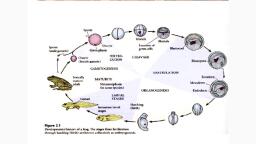
1. Introduction, Developmental Zoology deals with all events of the entire, developmental period of an animal. It is also called embryology., Development refers to the gradual transformation of the egg in, to a new adult individual. The developmental history of an individual, from the egg to the adult is called ontogenetic development or simply, ontogeny. Ontogeny begins with fertilization and includes, embryological periods and the periods of infancy, childhood,, adolescence, maturity and old age., Embryology deals with the development of an organism from, the egg to an adult., The word embryo refers to the juvenile stage of an animal, when, it is inside the egg or inside the maternal body. A young one when it has, first come out of the egg or just born cannot be called an embryo., Embryology is the phase of development before metamorphosis, in amphibia, before hatching in birds and before birth in mammals., However, some embryologists think that embryology includes all, developmental processes upto maturity., The word development is also applied to the gradual, transformation of a group of animals from simple forms to complex, forms. This developmental history of a group is calledphylogenetic,, development or simply phylogeny. It is often referred to as, Evolution., The Programme of Development, The development of an animal starts from gametogenesis and, proceeds with fertilization, cleavage, gastrulation,, organogenesis, growth, differentiation, metamorphosis,, regeneration, etc., Scanned by CamScanner
Page 2 :
2, 1. Gametogenesis, The development of any organism starts with the formation of, gametes. The formation of gametes is termed as gametogenesis., Gametogenesis includes spermatogenesis and oogenesis., Spermatogenesis leads to the formation of the male gamete or, spermatozoon and oogenesis leads to the formation of female gamete, or egg. The gametes are produced by meiotic division and hence they, contain only haploid number of chromosomes., 2. Fertilization, The second step in embryonic development is the fusion of male, and female gametes. It is called fertilization. It results in the formation, of zygote. It brings together the paternal and maternal chromosomes, in the developing organism. Fertilization activates the egg to start its, development., 3. Cleavage, Fertilization is followed by cleavage. It is the segmentation of the, zygote. It produces thousands of cells called blastomeres. These are, the building blocks for the construction of the body of a multicellular, organism., Cleavage ends in the formation of an embryonic stage called, blastula. Generally the blastula is a hollow spherical embryo with a, cavity called blastocoel., Some animals develop a morula before blastula., 4. Gastrulation, The fourth stage in embryonic development is the gastrulation., Gastrulation is a dynamic process which converts the single layered, blastula into a two or three layered gastrula. These layers are, called germinal layers., The three germinal layers are ectoderm, endoderm and, mesoderm., The gastrula is more or less oval in shape with a cavity called, archenteron lying inside. The archenteron communicates to the, exterior by an opening called blastopore., The archenteron develops into the gut and the blastopore, develops into the mouth in invertebrates (except echinoderms) and, the anus in chordates and echinoderms., Scanned by CamScanner
Page 3 :
3, 5. Organogenesis, Gastrulation is followed by organogenesis. Organogenesis is, the development of various organ systems. The germinal layers split in, to small cellular masses called primary organ rudiments. The primary, organ rudiments develop into the adult organs., The ectoderm develops into the central nervousS system, sensory, organs and skin epidermis. The endoderm develops into the alimentary, canal and the associated glands. The mesoderm develops into the, skeletal system, muscles, urinogenital system, circulatory system, etc., 6. Growth, The sixth step in embryogenesis is growth. During growth, the, various organ rudiments increase in volume. The cells undergo, multiplication. As a result the general structure of the body attains the, maximum size., 7. Differentiation, Differentiation is the specialization of different cells to do different, functions. Differentiation brings about a definite and specialized, function for the various organ rudiments., 8. Metamorphosis, In some cases, the young ones emerging out of the egg may not, resemble the adult. Such young-ones are called larvae. The larvae, develop into the adult after undergoing radical changes. These changes, converting the larva into an adult constitute metamorphosis., 9. Regeneration, The repair of lost parts is called regeneration., Historical Thoughts, Aristotle, Embryology as a branch of biology was initiated by the famous, Greek Philosopher Aristotle (384-322 B.C.)., • Aristotle is the father of Embryology. He was the first, Embryologist., • He described the development and reproduction of many kinds, of organisms in his book entitled DeGeneratione Animalium., • He wrote another book titled Historia Animalium which, described the development of hen's egg., Scanned by CamScanner
Page 4 :
4, • He believed firmly that the complex adult organism develops, from a simple formless beginning. Thus he laid the foundation for the, basic principles of epigenesis, a theory postulated after 2000 years., • Aristotle has written that the male contributes the semen and, the female contributes the catamenia. The semen is secreted by the, testis. The catamenia is carried through very fine vessels into the uterus., It is equivalent to the menstrual blood. He had no knowledge of ovary., He thought that the female reproductive system is formed of uterus, only and not of anything else., The catamenia represents the material foundation of the, embryo. The development is activated and guided by the semen., Scanned by CamScanner
Page 5 :
Branches of Embryology, Embryology has many sub-branches in it. They are:, 1. Descriptive Embryology, This term is applied to the method of study concerned with the, direct observation and description of embryological development., Embryology in ancient times started as a branch of study based on the, direct observation and description by scientists like Aristotle (340, BC), Fabricius (1537-1619), Harvey (1578-1657) and so on., 2. Comparative Embryology, In comparative embryology, the embryological development of, different animals are studied and compared. Comparative embryology, throws much light on the understanding of evolution and phylogenetic, significance. It also gives some ideas on the developmental stages of, certain animals in whose case the study of development is difficult., 3. Experimental Embryology, In experimental embryology, experiments are used for studying, the developmental stages. It helps to understand the fundamental, mechanisms. In experimental embryology, the various parts of, developing embryo are removed, transplanted, parts exchanged or, the environmental conditions altered. This helps to understand, induction, gradient system, etc. Roux (1850-1924) is the pioneer in, the field of experimental embryology. Experimental embryology is also, called casual embryology or analytical embryology., 4. Chemical Embryology, Here the developmental stages are studied by biochemical,, biophysical and physiological techniques. It is also called, physiological or biochemical embryology. Needham (1931) is the, pioneer in this field., 5. Teratology, It is a branch of embryology concerned with the study of, malformations., Scanned by CamScanner



 Learn better on this topic