Notes of BSc ZOO 3&4 RSB, Zoology Pisces, types of tail, accessory respiratory organs.pdf - Study Material
Page 1 :
Phos ees Chordate, so eae va A 4), , wala, pba horductn’d tate, , C faolee ae vert, __\sub ts _ i, —Frarndin cephatetundatn WM? Piha i ig Ee, Wee etn ¢ Davotbn Jsurmies, , pete, , eae, 0 s\nacotw oe, : {\acodwd chontaschy oo, , Super claus akves9, Pisces, , , , 2.1 SALIENT FEATURES OF CHONDRICHTHYES AND =, , OSTEICHTHYES c, , The superclass Pisces comprise of fishes exhibiting varied shapes, colour,, , etc. They are adapted for aquatic life and live in fresh, marine and estuarine, , water's of the world. According to one estimation approximately 40,000 species, are described by Zoologists., , General characters :1) They are aquatic cold blooded (ectotherm) with stream lined body and, , spindle shape. Some show dorsoventrally flattened body., 2) Appendages are paired pectoral and pelvic fins, supported by skeletal fin, , , , rays., 3) Median fins are one or two dorsal, an anal and a caudal., 4) Dermal scales, bony plates serve as protective exoskeleton on skin., 5) Mouth bear true jaws and teeth., 6) Internal bony skeleton or cartilaginous skeleton present. B:, 7) Blood flows through body, occur ina single circuit. Heart with one auricle =, and one ventricle. Sinus venosus and renal-portal system are present., 8) Operculum may or may not be present covering the gill slits which are 57 in number bearing gills which function as respiratory organs., 9) Excretion by mesonephric kidneys., , 10) _ Internal ears, is the only balancing organs., , 11) Lateral line system is present., , 12) ° Sexes are separate, fertilization is external and internal. Direct =, development, some forms display little metamorphosis. t, , 39
Page 2 :
BSc. - II Semester - Il] (Paper - I), , Life & Diversity of Animals - Chordates, , Salient feature of class Chondrichthyes, , 1), 2), 3), 4), 5), 6), , 2, 8), , 9), 10), , 11), 12), , 13), , chii), Cee es ew dwell in brackish, , . ; ya fe, Fishes are-found in marine habitat exclusively, a, water also. : er of skin., Placoid scale is denticle like, tere ae ue, Cartilaginous but calcified internal skele oD iy A ea, Of the toa pairs of fins, pelvic fins contain oe or myxipterygi, male. Median fins present, tail fin is heterocerca PS es, Lower jaw is made of Meckel's cartilage jaw suspension may be hyostylic,, amphistylic or holostylic. is, Gea, located mouth bearing teeth. Stomach J-shaped, spiral valve, increase absorptive, surface of intestine. ! = : z, Air bladder and lungs are wanting, respiration by 5-7 pairs of gills., One auricle one ventricle, a conus arteriosusand sinus Neos iS) Comprise,, the circulatory system. enter, Opisthonephric kidneys excrete urea, cloaca is present. :, Large cerebellum and olfactory lobes present. 10 pairs of nerves arise from, brain., Membranous labyrinth shows 3 semicircular canals in internal ear., Gonads and gonoducts paired in male and female. Sex cells conveyed to, cloaca., Internal fertilization of large yolky eggs is characteristic of life cycle. Show, direct development, Oviparous or Ovoviviparous forms includes sharks,, tays, skates and Chimaeras. (Fig.1), , General characters of class Osteichthyes (Bony fishes), , 1), 2), , 3), 4), , 5), a, 7), , 8), 9), , , , Fresh and marine dwelling forms with streamlined, spindle shaped body,, skin is mucous covered. i, Ganoid, cycloid or ctenoid scales Present on skin, some forms without, scales., , Internal skeleton of bone, pelvic girdle small or absent., , Jaws terminating into a terminal or sub-terminal, mou arin:, anus present, no cloaca, th be g teeth,
Page 3 :
Life & Diversity of Animals - Chordates B.Sc. - Il Semester - III (Paper - 1), , Major carps like catla, rohu, mrigal, catfishes like Clarias and Wallago,, etc. and minor carps, snakeheaded fishes, eels, etc., are bony fishes., , Heterocereal tail, Epichordal or, upper lobe of, , cauda fin, , 2nd dorsal fin, , , , , , , , 1st dorsal fin, , Dorsal Lateral line, , Head Eye, , , , , , , , , Hypochordal of, lower lobe of, caudal fin, , Ventral caudal pit, , aris, , \/ Mouth, A xternal gill-slits, Position dfclonen Median anal, , Fig. 1: Female Indian dogfish shark (Scoliodon sorrakowah) in lateral view., , Origin of paired fins in fishes., , , , , , , , Dorsal fin, Lateral line sense organs, , Mouth, perculum, , , , , al O}, Homocereal= a Nal fin Pectoral tin, , Gurl, caudal fin, , 5 eS ee Anis’, \" Fig. 2: Labeo rohita. External features in side view., , Ss All types of fishes do not posses a well developed tail. The prehensile tail, , of Hippocampus and the taif of eel are reduced. In the sting rays caudal fin is, absent. Some Zoologist classify caudal fin in to three, whereas some others into, four types. fa wide &, 1) Diphycercal tail : It means double and is the earliest most type of tail not, observed in living fishes. It is also called protocercal, means the first evolved tail,, also regarded as secondarily formed modified tail in some fishes . At the tip of, the tail the vertebral column show two lobes, one is called the ventral or, hypochordal and the other as dorsal or epichordal. Both lobes are equal in size, and shape. Eg. Cyclostomes, Primitive sharks, Chimaeras, living lung fishes,, many larval teleost fishes, etc., , The caudal fin is three lobed in Latimeria and extinct Coelocanths. Here, median lobe is prominent. Elongated and symmetrical tail are Observed in deep, sea fishes it is of isocercal type., , Pelvic fin, , 41
Page 4 :
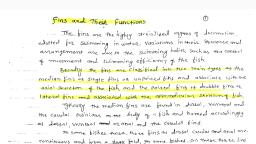
«TL Semester = 111 (Paper ~1), , B.So,, Life & Diversity of Animals - Chordates, big the other small a, , ; strical, Ong s, i rR Rew aE an Dipterus, living Acipenser, hes, extinct Osteoleplas, , feature of Elasmobranch f bottom dwellers. The, , T hes f and are, and Polyodon. These fishes have ventral mouth, ¢ Pee lobe show, 1 the fish downward in water., , dorsal lobe being larger prope it, In hypocergal tail the large, the terminating bent tip of the vertebral column in i " ‘umn. Hlypocercal tail is, ventral lobe show the terminal curved tip of vertebra . ‘atue iobe generates, found in primitive fishes and Oteacopsra: ea : eoase arus, , i Speedin larno es sr into the air, eg. f no, maximum speed while gliding from water into th 8 Becahomocercal, , sree a a advan, 8) Homocereal tail ; Higher teleosts show highly adve Beth ice the, , 1 i inter’ it is not, caudal fin, appear symmetrical externally but internally it i tbe ee, ) forned, It is well developed in Salmon, the, , original dorsal lobe or epichordal is i, , Sietete slightly terminates" The ventral lobe also called Peet way be, one or two large lobes, The ventral lobes are symmetrical. Fishes with terminal, mouth show this tail and use it for forward propulsion in water. If one studies, the embryology of fish the fo lowing trend isc observed in teleost, development of tail from diphycereal primitive — heterocereal intermediate and, homocercal highly advanced condition. The change in the evolution of these tail, types is important in their phylogeny study, Many variations in homocercal caudal, fin is observed in fishes, When vertebral column and fin both get reduced or, vestigial it forms gephyrocercal tail eg. Fieraspis. In akbreviated homocercal type, (Amia) the urostyle is upturned in the lobe, but in Pei ciemaite trcagie, terminates somewhat straight in the caudal fin, (Gigs5) ee, , 2.1 Origin of Paired fins ;, arlier or first evolved chordates did not develop paired appendages. It is, , believed that a continuous fold of tissue arising from the posterior part of head, spread upto tail region and continue ventrally below the tail till the anus and is, supported by a number of rods made up of cartilage, This tissue fold is the, precursor of unpaired median fins in fishes. During evolution each supportin, skeletal cartilaginous rod is separated by dividing to form a basal loves ae, submerged in tissues of body wall. While the top or upper radial pi oo, accommodated in the skin fold which formed the fin, Theories of cr ie 3 sat, proposed by various Zoologists are mentioned below. (Fig, 3 5) rigin of fins, 1) Gegenbaur's Theory (19 th century) : fhe gi Bie, , paired fins were formed from the gill bars, oa nace Supported the, and the fold of skin around it formed the paired fing oe last gill arches, undergoing modification during development, Theor te nngin Skeleton by, morphological and embryological studies do not sup a 's untenable because, 2) Graham Kerr's external gill theory is also He forms of fishes external gills are observed and are su ue, fins and their supporting skeletal structures, ao, 3) Balfour -, Thatcher's fin ~ fold Theory ;, fishes distinct dorsal, anal, caudal, Pectoral and pelvi, several divisions of the continuous median and later, , , , , , , , , , , , elieved. In larval, BlVe rise to paired
Page 5 :
Life & Diversity of Animals - Chordates B.Sc. -Il Semester - III (Paper -t), , evidences support this theory. A common mode of origin of the skeletal elements, of paired and unpaired fins in fishes have been proposed. Early stages of, embryonic development in cartilaginous fishes show that bands of muscles, developed ina serial manner, those which form unpaired and paired fins remain,, but remaining ones disappear or are absorbed. Palaentologists haven't discovered, any primitive fish fossil possessing continuous fin folds. Thus, the explanation of, origin of pectoral and pelavic fins in extinct Cladoselache is not favoured by, many Zoologists. Moreover, these paired fins of Cladoselache were supported, by parallel rods of cartilage called pterygiophores. These fins were broad and, lacked notches at its bases. Another view is, that a double row of small extra, spiny fins between the pectoral and pelvic fins originated from the fin folds., These extra spine like fins are remains of the the fin folds in extinct Acanthodian, sharks. Wiedersheim, Parker and Goodrich supported this theory., , 4) Ostracoderm theory : The pectoral fin’s developed from lateral fleshy, lobes of body in some Ostracoderms. In Acanthodian extra fins on the ventrodorsal aspect of body were present, which was also exhibited by some other, Ostracoderms. These extra fins were spines developed from dermal layer of skin., From these Ostracoderm ancestors probably paired fins and limbs originated by, retention of origin of paired fins in fishes. Some dermal spines were retained in, the pectoral and pelvic regions. The remaining dermal spines were lost due to, degeneration. 2, , Anterior dorsal Posterior dorsal, i fin, , , , , , , Gill-openings Median dorsal fin fold, , , , = ‘audal fin, Anal fin, , Anus, , Pectoral fin, , , , Ventral fin fold Pelvic fins., , Ventro lateral folds Anus, , Fig. 3: Diagrams illustrating the origin of fins according to Balfour's fin-fold, theory., , , , , , , , Dorsal fins, Fleshy webs, , Caudal fin, Keetocal a Pelvic fin Ventral fin, Smaller paired fins, , Fig. 4: Schematic derivation of fins according to the fin- spines theory., , 43



 Learn better on this topic