Notes of M.Sc Final Year, Zoology OSTEICHTHYES FISHES.pdf - Study Material
Page 2 :
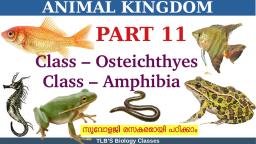
INTRODUCTION, Osteichthyes is a class of jawed fishes having a bony endoskeleton. It is, the largest class of vertebrates and includes a diverse group of marine and, freshwater bony fishes., The other group of jawed fishes are cartilaginous fishes, which are, included in the class Chondrichthyes., CLASSIFICATION (OUTLINE ), Osteichthyes is a class of fishes included in the division Gnathostomata,, which includes all the vertebrates having jaws. Jawless fishes are included, in the division Agnatha and the class Cyclostomata., Gnathostomata is divided into two superclasses, viz. Pisces (having fins), and Tetrapoda (bear limbs)., Pisces is divided into two classes:, Osteichthyes- Bony fishes, Chondrichthyes- Cartilaginous fishes, Osteichthyes is subdivided into two subclasses:, Sarcopterygii- lobe-finned fish, Actinopterygii- ray-finned fish, Kingdom-Animalia, Phylum-Chordata, Subphylum-Vertebrata, , MKL
Page 3 :
Division-Gnathostomata, Superclass-Pisces, Class-Osteichthyes, CHARACTERS OF OSTEICHTHYES FISHES, , ● With more than 29,000 species of bony fishes, it is the largest class, of vertebrates., ● It includes both marine and freshwater fishes, most of the, commercially used fishes are included in this class., ● The size ranges from less than 8 mm which is also the smallest, known vertebrate to 4 m and weigh about 1500 kg in the ocean, sunfish (Mola mola)., ● Their endoskeleton is made up of bones., ● Paired and median fins are present, which are supported by long rays, of cartilage or bone. Fleshy lobed fins are present in sarcopterygians., These types of fins are supported by bones having joints. These are, adapted to live at the bottom of the sea., ● The tail is mostly homocercal., ● They contain swim bladder or air bladder, which provides buoyancy, to them and prevents sinking. Swim bladder also facilitates gaseous, exchange., ● The mouth is terminal., ● Bony fishes contain four pairs of gills. A protective covering of bony, flap known as the operculum protects the gills., ● The sarcopterygians, lungfishes and lobe-finned fishes contain, lungs., ● The skin is covered by bony dermal scales known as ganoid, cycloid, or ctenoid scales., ● They are poikilotherms or cold-blooded animals and lack the, capacity to regulate their internal body temperature. Some of the, MKL
Page 4 :
●, , ●, ●, , ●, ●, ●, , ●, , larger marine fishes like tuna, swordfish, etc. show some level of, endothermy., The heart is two-chambered, contains one auricle and one ventricle., Lungfishes have a three-chambered heart with two auricles and one, ventricle., The brain has a small olfactory lobe and cerebellum. There are ten, pairs of cranial nerves present., The lateral line organ contains hydrodynamic receptors. The sensory, unit is called neuromasts. It helps in sensing vibration, water, pressure, navigation and locate their prey., Cloaca is absent, different genital and anal openings are present., They are ammonotelic and have mesonephric kidneys., Sexes are mostly separate but some are hermaphrodites. They are, mostly oviparous and lay a huge amount of eggs. Fertilisation is, mostly external and direct development., In male Hippocampus, the brood pouch is present, where eggs, incubate., , CLASSIFICCATION OF OSTEICHTHYES FISHES, , ● The class Osteichthyes includes a large assemblage of true bony, fishes. There are well over 30,000 to 40,000 living species, both, freshwater and marine. Some of the freshwater forms are the carp,, perch, bass, trout, catfish, sucker, etc., while the marine fishes are, the tarpon, meckerel, tuna, sailfish, barracula, flying fish, etc., ● The classification of class Osteichthyes described here has been, largely followed after A.S. Romer (1966) which has also been, followed by most authors including Storer and Usinger. However,, several new schemes of classification, such as Greenwood, et.al.,, (1966), Lander and Liem (1983), Nelson (1984) and Pough, et.al,, (1989) are also known., , MKL
Page 5 :
● Two subclasses are recognised- Sarcopteygii and Actionopterygii., , Subclass I. Sarcopterygii:, (Gr., sarcos = fleshy; pterygium = fin), 1. Paired fins leg-like or lobed, with a fleshy, bony central axis covered by, scales., 2. Dorsal fins two, caudal fin heterocercal, 3. Olfactory sacs usually connected to mouth cavity by internal nostrils or, choanae., 4. Popularly called fleshy or lobe finned, or air breathing fish., Sarcopterygii has been divided into two superorders or ordersCrossopterygii and Dipnoi., , Order 1. Crossopterygii:, (Gr., crossoi = a fringe; pteryx = fin), 1. Paired fins lobed covered with scales. Pectoral fins are supported by a, jointed median axis bearing radials. Caudal fin three-lobed., 2. Scales covered by a layer of cosmine., 3. Premaxillae, maxillae and squamosal bones present., 4. Internal nares present or absent., 5. Spiracles present., MKL
Page 7 :
3. Paired fins lobed., 4. Tail fin symmetrical (diphycercal), with no trace of separate dorsal fins., 5. Internal nares present opening into mouth; spiracles absent., 6. Air-bladder single or paired, lung-like., 9. Lower jaw (palato-quadrate) firmly fused to neurocranium (skull, autostylic)., 10. Stomach absent, intestine ciliated. No hepatic caeca. Spiral valve, present., 11. Auricle partly divided into two, ventricle completely divided by a, ridge., 14. Cleavage holoblastic., , Examples:, Lung fishes. Only three living genera- Neoceratodus,Protopterus, Lepidosiren., , MKL
Page 8 :
Subclass II. Actinopterygii:, (Gr., actis – ray; pteryx = fin), 1. Includes all ray-finned fishes., 2. Paired fins thin, broad, without fleshy basal lobes and supported by, dermal fin-rays., 4. One dorsal fin, may be divided., 6. Tail generally homocercal, in a few heterocereal or semi-heterocercal., 7. Scales either ganoid or reduced to thin horny structures or completely, absent in some., MKL
Page 9 :
8. Gill-slits covered by operculum. Spiracles absent., 9. Olfactory sacs not connected to mouth cavity. Internal nares absent., 10. Squamosal bone absent., Actinopterygii has been divided into three infraclasses or superordersChondrostei, Holostei and Teleostei., Superorder A. Chondrostei:, 1. Primitive ray-finned fish or cartilaginous ganoids., 2. Tail fin heterocercal., 3. Scales usually ganoid, 4. Mouth opening large., , Order 1. Polypteriformes:, 1. Typical rhomboid ganoid scales., 2. Dorsal fin of eight or more finlets., 3. Pectoral fins with a small prominent scale covered fleshy lobe., 4. Ossified skeleton., 5. Spiracles present., 6. Air-bladder bilobed opening into the intestine ventrally., , MKL
Page 12 :
Order 1. Amiiformes:, 1. Thin, overlapping cycloid scales., 2. Casual fin abbreviate heterocercal., 3. Long dorsal fin., 4. Pectoral radials are attached to the scapulocoracoid cartilage., 5. Vertebral centra non-opisthocoelous., 6. Premaxillary not protractile, firmly articulated with the cranium., 7. Snout normal rounded., 8. Spiracles and clavicles absent., 9. Presence of a single swim-bladder., Examples:Amia (Bowfin)., , MKL
Page 13 :
Order 2. Semionotiformes or Lepidosteiformes:, 1. Scales rhomboidal ganoid and in oblique rows., 2. Body elongated., 3. Nasal opening at the end of much elongated snout., 4. Caudal fin abbreviate heterocercal., 5. Vertebrae completely ossified opisthocoelous., 6. Air-bladder cellular., Example:Lepidosteus or Lepisosteus (Garpike)., , MKL
Page 15 :
5. Single external gill-slit on each side of the head covered over by, operculum., 6. Cloaca and claspers absent., 7. Air-bladder usually present., 8. Spiracle is lost., 9. Spiral valve in the intestine absent., 10. Conus arteriosus greatly reduced. There is an enlarged bulbus, arteriosus., 11. Advanced or modem ray-firmed fishes., Order 1. Clupeiformes:, 1. Scales cycloid and well developed., 2. Head and operculum not scaled., 3. Single dorsal and a small ventral fin without spines. Ventral fin may be, absent. Pelvic fins abdominal., 4. Caudal fin homocercal., 5. Air-bladder communicate with the pharynx., 6. Vertebral centra completely ossified., 7. No auditory vesicles., 8. Weberian apparatus absent., , MKL
Page 17 :
Order 3. Cypriniformes or Ostariophysi:, 1. Fins either without spines or dorsal, anal and pectoral have a spine each., 2. Ventral (pelvic) fins abdominal., 3. Air-bladder connected with the pharynx by a duct., 4. A peculiar Webarian apparatus, connecting the internal ear with the air-bladder,, present., , Representatives of this order are grouped in two divisions- Cyprini, Siluri., Division I. Cyprini:, 1. Body covered with scales or naked. Never covered with bony plates., , MKL
Page 19 :
Order 4. Anguiliformes:, 1. Body elongated eel-like or snake-like., 2. Scales vestigial or absent., 3. Dorsal and anal fins long and confluent behind., 4. Pelvic fins, if present, abdominal., 5. Fins devoid of spines., 6. Air-bladder with duct., Examples:Anguilla (Freshwater eel), Muraena (Moray)., , MKL



 Learn better on this topic