Page 1 :
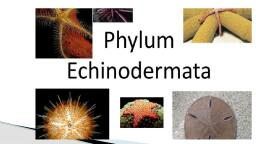
hedge?, = phe sla», Spin, , 7. Phylum - Echinodermata, (General characters, Classification upto classes) b el, , Porcupine Neping aT, Echinodermata (Gr. echinos-hedgehog; derma = skins) includes about 6000 species, of marine spiny skinned animals such as starfishes, brittle stars, seaurchins, sea cucumbers,, sand dollars and sea lilies. These districtly have an unique water vascular system equiped, , Echinoderms are enterocoelous coelomates having pentamerous radial symmetry,, without distinct head or brain. They contain an endosketeton of calcareous plates!or !, ossicles and a peculiar water vasuclar or hydrolic ambulacral system of coelomic origin, with Podia or tube feet Projecting out of the body., , , , General Characters :- adie, Phylum Echinodermates contains 5300 known species. Bather (1900) stated the phylum, , as “one of the best characterised and most distinct phyla of the animal, kingdom’, i, , 1) The echinoderms are exclusively marine, free living, mostly bottomdwellérs and, , widely distributed of marine animals. isle, 2) They are triploblastic, coelomate with distinct oral and aboral surfaces and |, unsegmented animals. i, , 3) They are of moderate to considerable size but none are microscopic., , 4) Adults show radial symmetry (usually Pentamerous) but their larvae show bilateral, , —_, symmetry,, ae 61, , , , we, , Shey

Page 3 :
Phylum - Echinodermata, , 5. _ The tube feet with suckers are mainly locomotory organs and ambulacral groove, , usually not poor food., , 6. Main nervous system is oral., Classes closed ain di cubrr Se, , 1. Holothuroidea, , a. They are commonly called sea cucumbers., , b. They have not arms and spines., , c. Body is elongated on oral-aboral axis and body wall is leathery., , d. Mouth is anterior and surrounded by a set of tentacles attached to water vascular, system., , e. _ Podia or tube feet with suckers for locomotion., , f£ —_ Usually with respiratory tree for respiration., , g. Examples are Cucumania, Holothuria, Thyone, Synapta etc., , 2. Echinoidea, , a. Body is discoid, oval or heart shaped without arms., , b. Body is enclosed in an endoskeletal shell or test of closely fitted calcareous plates, covered with movable spines., , c. Chewing appratus or Aristotle’s lantern with teeth., , d. _ Podia or tube feet come out from the pores of ambulacral plates and are locomotory, in function., , e. Mouth is centrally placed on the oral surface and surrounded by Peristone., , £ Anus is situated at the aboral pole & surrounded by membranous petiproct., , g Pedicellariae are stalked and three jawed. ‘, , h. Gonads usually five or less. é: oP Ee linus, , 4 eae called starfishers or sea stats., , b. Body is pentagonal or starshaped, Five or more arms radiating symmetrically from, a central disc., , c Both oral & aboral surfaces are distinct, the oral direct downwards and aboral, , toward upward., , 63
Page 4 :
Zoology, , d., , Don, , =, , 4., , a., , b., , Mouth is centrally placed at the oral surface surrounded by Peristoume while Anus, is inconspicuous situated on the aboral surface., , Tube feet in orally placed ambulacral grooves, with suckers., Endoskelaton is flexible & made of separate ossicles., Pedicellariae are present., , Sexes separate & gonads are radially arranged., Development includes bipinnaria or brachiolaria larva., Examples are Asterias, sea stars, Astropecten, Asterina etc., Ophiuroidea, , They are commonly called as brittle stars and allies., , Body is flattened, star like pentamerous with Five or more long, slender arms, , marked off from the central disc., , c, , d., , B09, , Sts., , Both oral & aboral surfaces are distinct., , Madreporite is on the oral surface., , Tube feet without suckers., , Stomach is sac like, anus is absent., , Ambulacral grooves are absent., , Brusae usually ten., , Development includes a free swimming pluteas larva., , Examples are ophiothrix, ophiura, basket star, Asteronyx ete., Pelmatozoa, , It is mostly extinct echinoderms and has only one living class - crinaidea., Body is attached by the aboral stalk., , Mouth and anal aperture present on the oral surface facing upwards., Tube feet or Podia are food catching and devoid of suckers., , Main nervous system is aboral.
Page 5 :
S G\ ), Phylum - Echinodermata, , 1. Class - Crinoidea, a. They are commonly called as sea lilies as feather stars., b. Both extinct and living forms., c. Living members are without stalk and extinct forms are attached by stalk., d. Mouth and anus are on oral surface., e. Body consists an aboral cup called calyx and oral root called tegmen., , f Pentamerous and arms with Pennules., , & Tube feet is without suckers., h. — Ciliat3ed ambusacral grooves are on the oral surface., i Sexes are separate and larva is doliolaria., J. Examples are Antedon, Neometra., Study of Asterias rubens (siar fish), , Systematic Position ki hoa os SPin on skein,, Phylum - Echinodermata In ed ye 9, Sub-Phylum = - Eleutherozoa “Fret & — nes), , y 5 ea 0! fenta D> a, , Class = Asteroidea $ tensed, k ee peerin, ; ca a a aaa OT, , oat ies sage Dhen He fort i's damped SU 2ed, Species - rubens She Heind simp Covel Hen Aegeneraled Habit and Habitat : 'Asterios is exclusively marine, bottom dwelling or benthonic, animal, inhabiting various types of bottom mainly in the littoral zone where they crawl, or may remain quiscent at times, either in the open or less concealed. Asterios forbesi, is found equally abundant on hard, rocky, sandy or soft bottom, while the other species, have been found to prefer rocky sea bottoms. The most species of Asterios are generally, solitary but under certain ecological conditions, such as to avoid direct sunlight or excessive, drying, many individuals may gather at some place for the purpose of protection./Most, of them are noctunal, remain quiet in day time and become active during the night., , They move by crawling on the bottom, mostly at a rather slow rate. 4All sea stars are, carnivorous and feed voraciously on a most any available slow moving or sessile animals,, chiefly on Podychates, Crustaceans, molluscs and other echinoderms. Sea stars exhibit, remarkable Power of autotomy and regeneration., , auto a<el} tomes severe, 27 se/y. anpula hon, , 65,, , ” ds #2, sel amputation ts #pe bedaviiour Where by ae Lae pe, Gee one a mere pf ts 2D OCA OTEE pate) } sely. de pense, , Bs ska je ire, bectAw sin fy elude a fredater 5 GUEP 2 Zoi ter 4 We dy lies escape