Notes of +2 POLITICAL SCIENCE, Political Science & Political Science Era Of One Party Dominance - Study Material
Page 1 :
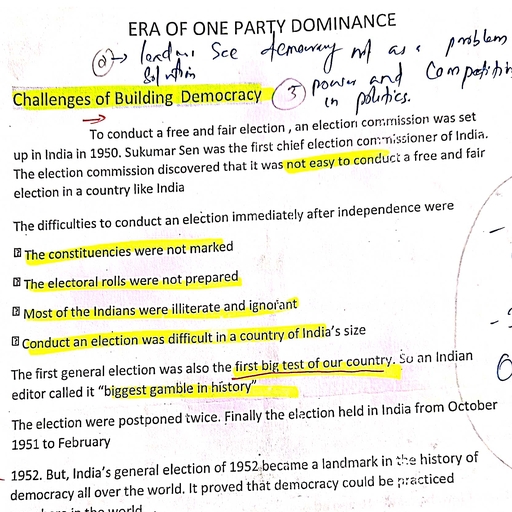
Chapter 2, ERA OF ONE PARTY DOMINANCE, Challenges of Building Democracy, To conduct a free and fair election , an election commission was set, up in India in 1950. Sukumar Sen was the first chief election commissioner of India., The election commission discovered that it was not easy to conduct a free and fair, election in a country like India, The difficulties to conduct an election immediately after independence were, The constituencies were not marked, The electoral rolls were not prepared, Most of the Indians were illiterate and ignorant, Conduct an election was difficult in a country of India’s size, The first general election was also the first big test of our country. So an Indian, editor called it “biggest gamble in history”, The election were postponed twice. Finally the election held in India from October, 1951 to February, 1952. But, India’s general election of 1952 became a landmark in the history of, democracy all over the world. It proved that democracy could be practiced, anywhere in the world., , Congress Dominance in the First Three General Elections, The result of first general election did not surprise anyone. The Indian, national congress won majority seats in that election. The result of first three, general elections is given below.
Page 2 :
Years Total seat Congress won, , Congress had dominance in the first three general elections by winning three forth, of seats. IN the first general election CPI was the second largest political party in, India. The party got only 16 seats in that election., The Factors Of Congress Dominance In The First Three General Election, L Legacy of national movement, Charismatic leadership of Jawaharlal Nehru and others, Congress was largest political party at that time, Party had an organizational strength, India’s oldest party
Page 3 :
NATURE OF CONGRESS DOMINANCE, Congress dominance in India is different from the dominance of the single, party in China, Cuba, Syria etc . In other countries the dominance of one party was, ensured by compromising democracy. But in India congress dominance was by, democratic measures. More over in other countries ,their constitution permitted, only a single party. No other parties were allowed to contest in election. But in, India anyparties can contest in the elections, , Communist Victory in Kerala, The first assembly election to Kerala was held in 1957. In that election CPI won 60, Seats out of 126 seats. With the support of 5 independents EMS became the first, chief minister of Kerala. For the first time in the world a communist party, government had come to power through democratic election. In 1959 congress, government at the center dismissed the communist government in Kerala under, article 356 of constitution., , Emergence of Opposition, Opposition parties is the important feature of a political system. in a democracy, the opposition is must. According to Iver Jennings “if there is no opposition there is, no government”. The Opposition parties play a very important role in the, development of Indian Politics. In the earlier time the opposition parties could win, only a small percentage of votes during the loksaba elections. Eventhogh, The, ruling congress leaders and the opposition leaders always respected each other., Nehru , even invited the Socialist leaders like Jaya Prakash Narayan into his, cabinet. The opposition is very important for successful democracy. The opposition, reveals the failure of ruling party and prevent the dictatorship of ruling party., , Functions of opposition parties, ❖, ❖, ❖, ❖, ❖, , To form alternative government, To expose the failure of the government, To provide political education to the people, To form public opinion, To avoid dictatorship of the ruling party, , Major opposition Parties in India
Page 4 :
1. SOCIALIST PARTY, The Congress Socialist Party [CSP] was formed within the congress in 1934 by a, group of young leaders., who wanted a more radical and egalitarian congress. In 1948 the congress, amended its constitution to prevent dual membership. Thus a socialist party, formed in 1948., Programs and policies of Congress Socialist Party, ❖ Socialist party criticized both the congress and the communist., ❖ They said the congress always stood for land lords and capitalist., ❖ Party believe Democratic socialism which distinguish them both from the, Congress as well as the communist., ❖ Party give more important to peasants and workers., The socialist party went on splitting into several other parties. Kisan Mazdoor Party,, Praja Socialist party and Samyuktha Socialist Party.SM Joshy , Acharya Narendra, Dev, Jaya Prakash Narayan, Ashok Mehta were some the leaders of these socialist, parties, , 2. The Communist party of India, In the early 1920s communist groups emerged in different parts of India, taking inspiration from the Bolshevik Revolution in Russia. In the first general, election CPI won 16 seats and emerged as largest opposition party., AK Gopalan, SA Dange , EMS Namboodiripad , PC Joshi, Ajay Gosh and P, Sundarayya were the notable leaders of CPI., The party went through a major split in 1964 following the ideological rift between, Soviet Union and China., The supporters of Russia remained as CPI while the opponents forms the CPI[M], Policies and programs of Communist Party, ❖, ❖, ❖, ❖, ❖, , Communist Party work for the upliftment of peasants and workers, it to give more importance to revolution, Fight against capitalism, Major idea is socialism, Communist Party believed equality provided only through socialism
Page 5 :
3. BJS [ Barathiya Jana Snagh], The Baratiya Jana Sang was formed in 1951 . Shyama Prasad Mukarjee was, the founder president of BJS., It had its roots in the RSS and the Hindu Maha Sabha even before independence ., The BJS had totally different ideology from other political parties., Policies and programs of BJS, ❖ It believed the idea of ‘One Country , One Culture and One Nation’., ❖ Party wanted to have an Akanda Barath through the reunion of India and, Pakistan., ❖ It also stood for Hindi language., ❖ It opposed to the granting of concessions to religious and cultural, minorities ., Syama Prasad Mukarjee, Deen Dayal Upadhyaya, and Balraj Madhok were the, leaders of BJS. Later BJP was formed Form BJS in 1980, , 4. Swatantra Party, Swantantra Party was formed In August 1959 after the Nagpur resolution of the, congress., The Party was led by Congress men like C Rajagopalachari, KM Munshi, NG Ranga, and Minoo Masani, Policies and programs of Swatantra party, ❖ Swatantra Party did not want the government to control the economy., ❖ They believed that the prosperity would come only through the individual, freedom., ❖ Party wanted to have a closer relation with US ., ❖ The Swatantra party was against The government’s relations with the, USSR.



 Learn better on this topic