Notes of B.Sc. Ag. 2nd Year, Plant Breeding hybridization.pdf - Study Material
Page 1 :
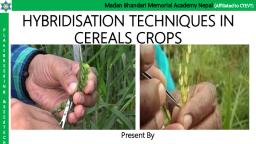
10, , Hybridization : Techniques, and Consequences, , 10.1. INTRODUCTION, Natural variability present in self-pollinated populations is exhausted quickly when they are, , subjected to selection. For further improvement, therefore, new genetic variability has to be, created, which is easily and most commonly achieved by crossing two different purelines The, y/mating or crossing of two plants or lines of dissimilar genotype is known as hybridization. In, “plants, crossing is done by placing pollen grains from one genotype, called the male parent, onto, the stigma of flowers of the other genotype, referred to as the female parent. It‘is essential to, prevent self-pollination as well'as chance cross-pollination in the flowers of the female parent., At the same time, it must be ensured that the pollen from desired male parent reaches the stigma, of flowers of the female parent for successful fertilization (Table 10.1). The seeds ‘as well as the, - progeny resulting from hybridization are known as hybrid or Fy. The progeny of Fy, , obtained, by selfing or intermating of F; plants, and the subsequent generations are termed as segregating —, generations. The term cross is often used to denote the products of hybridization, Le, the Fas, - well as thé segregating generations. " ~ — ;, TABLE 10.1. The three corner-stones of hybridization and the activities to achieve them, , , , , , , , , , , , , Corner-stone Activiti to achieve the corner-stone, 1. Prevention of self-pollination in the flowers of female parent Emasculation of the flowers, 2. Prevention of pollination of the flowers of female parent by Bagging of the flowers, pollen from undefined sources , ~, 3. Ensuring pollination by the selected male parent Hand pollination, (Prevention of contamination of the pollen used for . (Bagging of the male inflorescence), , pollination, particularly, in a crop like maize) 2, , », , Scanned with CamsScanner
Page 2 :
Hybridization : Techniques and Consequences 171, , 10.2. HISTORY OF HYBRIDIZATION, , In comparison to selection, hybridization is of more recent origin. There is evidence that, Babylonians and Assyrians hand-pollinated data palm as early as 700 B.C. for metaxenic effects, of pollen. Metaxenia is the effect of pollen on fnaternal tissues of fruit) Clearly, the artificial, pollination in this case was not for the purposes of crop improvement. Sex in plants was discovered, by Camararious jh 1694. ‘In 1717, Thomas Fairchild produced’ the first artificial hybrid, the, Fairchild’s mule, by crossing sweet William (Dianthus barbatus) with carnation (Dianthus, caryophyllus). Subsequently, many scientists used hybridization for scientific studiésas-well as, for crop improvement. Notable among such scientists are, Koelreuter who made many crosses in, tobacco during 1760-1766, and emphasized hybrid vigour in Fj; Knight who developed several, varieties of apples, pears, peaches, grapes and currants during 1759-1835; and Goss, Sargaret,, Gaertner and Naudin who had noted uniformity in F\, dominance in Fi, and segregation and, appearance of parental types in F>. But it was left for Mendel (1865) to propose the clear-cut laws, of inheritance. These and subsequent discoveries in genetics have given hybridization a scientific ., basis. With the help of genetic principles, the breeder is able to predict the kind of progeny he, is likely to obtain from a given cross. Therefore,.he can plan the crosses from which he is most, likely to obtain the desired plant type. Today, hybridization is the most common method of crop, improvement, and the vast majority of crop varieties'have resulted from:hybridization., , 10.3. OBJECTIVES OF HYBRIDIZATION >> |, , The chief objective of hybridization is\to. create’ genetic variation.| When two genotypically, different plants are crossed, their F, is heterozygous for all the “genes for which they differ., » Segregation of and recombination among the heterozygous genes would produce many new gene, combinattons—in—f5 andthe Tater generations, Le., the segregating generation. The degree Of yw, genetic variation produced in the segregating generations would, therefore, depend on the number, of genes that differ in the parents of F\. If the two parents are closely related, they are likely to, differ for few genes only. But if they are not related, or are distantly related, they may differ for, several, even a few hundred, genes. However, it is not likely that the two parents will ever differ, for all their genes. Therefore, when it is said that the F, is 100 per cent ‘hetero, , WETS The dims of bos, reference only to those genes for which the two parents differ. The aim of hybridization, , , , , , , , , , ne aim of hybridization may be, (D) transfer of one or few qualitative characters, (2) improvement. in one or more quantitative [we, characters, or (3) to use the Fi as a hybrid variety. a, , 10.3.1. Combination Breeding, , The main aim of combination breeding is transfer of one or more oligogenic and/or olygenic Ue, characters into a single variety from another variety or other varieties. The intensity of transferted ., character in the new variety is either comparable 7, , rie to or, more generally, lower than that in the, parent variety from which’ it was transferred. In this approach, the ‘increase in the yield of new |, eee ere GSE 1h INE |, , variety is obtained by correcting the weaknesses in yield contributin,, , rains per spike, test weight, disease resistance, etc., of the SHR noi ance ae, eae method of breeding’ was designed for combination breeding, and often Kedigres ibe), ~\also Tulfils the same purpose. In this approach, genetic divergence between the parents is not h “, major consideration, but one of the parents must have in a sufficient ‘intensity the cha oe, under transfer, while the other parent is generally a popular -variet : aracter(s), , Ys, , Scanned with CamsScanner
Page 3 :
172 Plant Breeding: Principles and Methods, , 10.8.2. Transgressive Breeding, , Transgressive breeding aims at improvin, yield or its contributing characters ‘through transgressive, ~Y_psegregation, ie, appearance of such plants in, generation that are 2 superior to both the parents, , for one or more characters, Such plants are produced by accumulation of favourable genes from, AU both the parents as a Consequence of recombination Obviously, the parents involved in, , hybridization must combine well with each other, and should preferably be genetically diverse,, , In such a situation, each parent is expected to contribute different p, , , , , , Jus genes that would be, , brought together by recombination to give rise to transgressive segregants. As a result, the, intensity of character in the transgressive segregant, i.e., the new variety, is greater than that in, either of the parents. The pedigree_method of. eeding and its modifications, particularly the, oduction_ of transgressive segregants. yt, , , , 10.8.8. Hybrid Varieties, In most self-pollinated crops, F is more vigorous and higher yielding than the parents. Wherever, it is commercially feasible, F, generation may be used directly as a variety, i.e., hybrid variety,, Therefore, the two parents must combine well to produce an outstanding F,. Hybrid varieties are, being cultivated on a commercial scale in rice and some other self-pollinated crops., , 10.4. TYPES OF HYBRIDIZATION, , The plants or lines involved in hybridization may belong to the same variety, different varieties, , of the same species, different species of the same genus or species from different genera. Based, , on the taxonomic relationships of the parents involved, hybridization may be classified into two, J broad groups: (1) intervarietal, and (2) distant hybridization. i, , , , 10.4.1. Intervarietal Hybridization" "9° Ey / ae,, The parents involved in intervarietal hybridization belong to the same species; they may be two, ‘Strains, varieties or races of the same species. Tt is also known as. intranspecific hybridization., if crop improvement programmes, intervarietal hybridization is the most commonly used. In fact,, itmay often appear to be the only form of hybridization used in crop improvement. Intervarietal ., crosses are called simple or complex depending on the number of parents involved., , _ 10.4.1.1, Simple Cross. In a simple cross, fie és are crossed to produce the Fy, ¢.8.,, Ax B-— F; (A x B). In case of a hybrid variety,such a cross is called single cross., , 10.4.1.2.. Complex Cross. In_a complex: cross, % fore than two parents) are crossed to, produce the F, hybrid. Such a cross is also known asconvergent cross because it aims_at, bringing together genes from several parents_into mple cros, , is crossed to a third parent, it is ree-way cross ot Fy-top cross,, single crosses are mated together th = ———, , , , , , , As crop improvement progresses, the crop varieties would accumulate more and more, favourable genes. This would lead to greater similarities between even unrelated varieties. In, view of this, it may be expected that in future complex crosses would become more and more, _common as is the present situation in highly improved self-pollinated crops like wheat and rice., , ah ey Notation of Crosses by CIMMYT, Mexico. As usual, the female parent, ¢.g., A,, ce ist first, Le, on the left, and is separated from the male parent, e.g., B, by a slash £8, -If the F, A/B is used as the female parent in a cross with another line C, the tree-way cross :, , Scanned with CamsScanner
Page 4 :
dization : Techniques and Consequences 173, fF, top-cross is depicted as A/B//C\But if the F, A/B were.used as the male parent, the notation, , will be CHA/B. A double cfoss"based on lines A, B, C and D will be shown as A/BI/CID if the, F, A/B were used as female, and as C/D//A/B if it were used as male. The F 1 top-cross A/B//, C (used as female) may be subsequently crossed with lines D, Eand F (used as males); this cross, will be denoted as follows., , AIB//C/3/D/4/E/S/E, , Here each subsequent male parent is denoted by a number that signifies its serial number among, the male parents used in the cross. For example, F is preceded by the number 5, which signifies, that it is the fifth male parent used in the cross. But if parents D and F were used as female and, E was used as male, the cross will be depicted as follows. ‘ :, , F/S/D/3/A/B/IC/A/E,, , In case of backcrosses, the recurrent parent is denoted by an asterisk (*), and the number:, , ee 3, of backcrosses is reptesented by a number placed next to the. asterisk; some examples are given, , below. ;, A*3/B : Three backcrosses with the recurrent parent A., A/2*B : Two backcrosses with the recurrent parent B., A/B*4//C/D ": Four backcrosses with the recurrent parent A/B., A/BIIS*C/D, , : Five backcrosses with the recurrent parent C/D., 10.4.2. Distant Hybridization :, , Distant hybridization includes crosses between different species of the same genus or of different, genera..When two species of the ‘same genus are crossed, it is often calléd” interspecific, Aybric ization; but when the species belong to two-different- genera, it is termed’ as interspecific, hybridization. Generally, the objective of such crosses is to transfer one or few Simply mhetited, Sea ike disease resistance to a crop species, but interspecific hybridization may be used, to achieve other objectives as well. Distant hybridization is likely to become increasingly important, in the correction of specific defects of crop species. In many cases, wild species may. contribute, valuable ‘quality genes’ and even. ‘yield. genes’ as well to the cultivated species (Chapter 34)., , 10.5. HYBRIDIZATION PROGRAMME e :, Hybridization is the most important method of crop improvement. The’ ptocéss of hybridization, itself is fairly simple and easy, asa result of which a beginner may be tempted to make many, crosses. The chief difficulty in‘ using hybridization:for crop improvement lies ‘in the handling of, the segregating generations obtained from crosses., , 10.5.1. Raising of the Segregating Generations aol,, Generally, F> and later generations consist.of several.thousand plants..R:, , aising of large segregating, generations from several crosses at the same time requires money, labour, land and other facilities,, which are often limited. : :, , 10.5.2. Handling of the Segregating Generations :, , Selection for desirable plant types has to be ¢ done in the segregate Selection for, qualitative characters is simple and quick, but that for quaiititative characters is often difficult and, time-consuming; If a breeder desires to practice sélection based on scientific considerations, he, will be able to handle only a limited number. of crosses at a time., , Scanned with CamScanner
Page 5 :
e wi ifi jecti crosses & ¥*~ 7 ., made with a specific objective, and the number of a nae “ith selection intensity, and sop,, , 50. The number of lines selected from each cross W1, crosses will be eliminated rather early from the programme., , 10.5.3. Advance Planning : \ i The develo;, - Jess O vious. pment, he first two, but is see the requirements abot, , This problem is more important than are t, Pini s to fore’, a new variety usually takes 7-8 years. Therefore, a breed programme accordingly, and hag, : : F re :, 8-9 years in advance so that he is able to plan his Feit Fa the requirements of the marks, , i when the needs arise. Thus he must be - :, variety ready and pests of the area, the environmental fluctuations an, , in terms of quality, etc., the diseases : ust know for the present tj, the prevalent management practices among the farmers. This he m as ceca Brat the me,, d forecast for the future as well. Thi Teedey, , and should also be able to expect ani, , , j js working with. Fu, must be thoroughly familiar with all the aspects of the crop species he 8 ther,, , e important characte;, he must clearly define the type of variety he wants to produce, and the imp 8 he, , i tribute these chara, : ‘ : : arents that will con haracters, wishes to improve. Then he has to search for suitable p ths the breeder nst be familiar yi, , and use them in a suitable hybridization programme. For ul om, , iad characteristic, , the existing varieties, and he should be able to obtain Toe on the ; S Of the, germplasm collections and the wild relatives of the crop species. —, , cut objectives based on the, , ‘well- learIn conclusion, the breeder should have well-defined, ¢!, present and the expected future needs while Teveloping anew variéty. He should-setect-the, uitable hybridization programme., , nis accordingly and use them in a s', , 10.6. PROCEDURE OF HYBRIDIZATION : ts, , Once the breeder has decided the objectives of programme, he is ready fo begin hybridization,, which has the following seven steps: (1) choice of parents, (2) evaluation of parents, @), emasculation, (4) bagging, (5) tagging, (6) pollination, and (7) harvesting and storage of F seed., , 10.6.1. Choice of Parents, The choice of parents mainly depends:on the objectives of breeding programme. Increased yields, are always _an_objective of the breeder. Therefore, at least one of the parents involved in a cross, , Should be a well adapted and proven variety in the, target.area, the area for which the new, variety is being developed. The other variety should be having the characters that are weak/, deficient in this variety. In combination breeding, the genetic diversity of parents is not important,, but in transgressive breeding it is of great significance. For transgressive breeding, it should be, made sure that the parents differ for many genes affecting yield or some other character of, importance. However, it would be desirable that the performance of parents is good, and they are, well adapted in the areas where they are commonly grown. Further, some parents produce, superior F;’s and F,’s, while others do not; this property is known as combining ability and can, , Scanned with CamScanner



 Learn better on this topic