Notes of Plus TwoScience 2021, Physics (Divya ) & Physics XII_Physics_Chapter 3- Current Electricity_saju_hsslive.pdf - Study Material
Page 1 :
CHAPTER 3, CURRENT ELECTRICITY, , 5. Derive a relation between drift, velocity and current., Ans: Consider a conductor of length, , 1. Define electric current. Give its SI, unit., , ‘’ and number density of electrons ‘n’., , Ans: Current is the rate of flow, of electric charge., , I=, , [n = number of electrons per volume], The distance travelled by electron in dt, time = vddt, , dq, [ or I = q/t ], dt, , SI unit is ampere (A), 1A=1C/s, 2. Define current density ( J ). Give its, SI unit., Ans:, , It is the current flowing, , through unit area of cross section, of a conductor., , J=, , I, A, , S.I unit is A/m2, , 3. Define drift velocity (vd)., Ans: In the absence of an external, electric field, inside a conductor the, free electrons are in random motion;, and so their average velocity is zero., When an electric field is applied, the electrons move opposite to the, electric field and get an average, velocity., , The number of free electrons in the, distance vddt, = Avddt × n, The total charge crossing the area A in, dt time, dq= neAvddt, Current I =, I=, , dq, dt, , neAvd dt, = neAvd, dt, , J=I/A, J=, , neAvd, A, , The average velocity acquired by, an electron in the presence of an, external electric field is called, drift velocity., , 4. Define relaxation time., Ans: Relaxation, , time, , is, , the, , average time interval between, two successive collisions., , 6. Derive a relation between drift, velocity (vd ) and relaxation time (τ)., Ans: Let vi be the initial velocity of an, electron just after a collision. The, velocity of the electron after the, relaxation time ‘τ’ is given by,, vd = vi + aτ, eE, = vi , m, , , , , SAJU K JOHN, M.Sc. Physics, NET, PhD Research Scholar at NIT Calicut, , 1
Page 2 :
But just after a collision electron can, be taken at rest ie, vi = 0, , 2. Emf exists only between the, terminals of the cell. But, , , , vd =, , eE, m, , e E , m, , , , vd =, , 7. Define mobility, Ans: Mobile charge carriers are, responsible for conductivity., In metals, electrons are the charge, carriers., In electrolytes both +ve and –ve ions, are charge carriers., In semiconductors, conduction is, partially by electrons and partially by, holes., Mobility ‘µ’ is defined as the ratio, of magnitude of the drift velocity, , throughout the circuit., 3. Emf, , is, , the, , cause, , and, , potential difference is the, after effect., 4. Emf is always greater than, potential difference., , 9. State Ohm’s law., Ans: Ohm’s law states that ‘at, constant temperature the current, flowing through a conductor is, directly proportional to potential, , to electric field strength., , µ=, , potential difference exists, , difference between the ends of, , | vd | eE, e, , , E, E, m, , the conductor’., , SI unit of mobility is CmN s or, m2V-1S-1., , Current α Potential difference., , 8. Distinguish between emf and, potential difference., Ans:, , R Resistance of the conductor., V = IR, , -1 -1, , IαV, , 1. Emf is the difference in, potential, , between, , the, , terminals of a cell, when no, current is drawn from it., Potential, , difference, , is, , the, , difference in potential between, the terminals of a cell or between, any two points in a circuit when, current is drawn from the cell., , I=, , 1, V, R, , 10. What is meant by resistance?, Ans:, , It, , conductor, , is, to, , the, , ability, , oppose, , of, , a, , electric, , current., , SI unit of resistance is ohm., 11. What are the factors which affect, the resistance of a conductor?, Ans:, 1. Nature of the material, of the conductor., , SAJU K JOHN, M.Sc. Physics, NET, PhD Research Scholar at NIT Calicut, , 2
Page 3 :
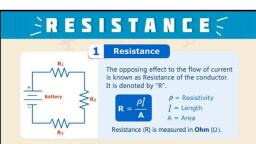
2. Length of the conductor, ‘’, , (Inversely proportional), 4. Temperature, , (directly, , proportional), , 12. Write the equation for the, resistance of a conductor in terms of, its length and area of cross section., , Conductivity 𝜎 =, , Conductivity is the reciprocal of, resistivity., SI unit of conductivity is Ω-1m-1or mho, m-1, 16. What are the factors which, affect resistivity?, Ans: i. Nature of the material of, ii. Temperature, , 1, 𝐴, 𝑙, , 17. Derive the relation for resistivity, in terms of relaxation time., , 𝐴, , 𝒍, 𝑨, , 𝜌 The resistivity of the material of, the conductor., S.I. unit of Resistivity ohm-metre (Ω m), 13. Define resistivity of the material, of a conductor., Ans: Resistivity,, , Ans:, We know, I neAv d, eE, m, eE ne 2 AE, I neA, , m, m, V, But we have E , and v d , , 𝑹𝑨, , 𝝆=, , I , , 𝒍, , Put A = 1 m2, = 1m, 𝜌=, , 𝑅.1, 1, , , , =R, , “Resistivity of the material of a, conductor is defined as the resistance, of the conductor having unit length, and unit area of cross section., 14. Define conductance (C), Ans:, , 1, 𝜌, , the conductor., , Ans: R ∝, , R=𝝆, , = ohm-1 = mho., , Ω, , 15. Define conductivity (𝝈), Ans:, , 3. Area of cross-section ‘A’, , R∝, , 1, , (directly, , proportional), , R∝, , SI unit =, , Conductance C =, , V, m, 2, I ne A, m, ne 2 A, , m, , , A ne 2 A, , R, , Re sistivity,, , , 1, 𝑅, , Conductance is the reciprocal of, resistance., , ne 2 AV, m, , m, ne 2 , , Conductivity,, , , ne 2 , m, , SAJU K JOHN, M.Sc. Physics, NET, PhD Research Scholar at NIT Calicut, , 3
Page 4 :
18. A wire of resistance 4𝛀 is drawn, , have the same resistance. Which wire, , (a) to twice its original length, , is thicker?, , (b) to thrice its original length., , 23. Why copper is used as for, making connecting wires?, Ans: Copper has low resistivity., , Calculate the new resistance in each, case, 19[P]. A wire of resistance 4R is bent, in to the form of a circle. What is the, effective resistance between the ends, of diameter?, , 20[P]. A copper wire is in the form of, a cylinder and has a resistance R. It is, stretched till its thickness reduces by, half of its initial size. Find its new, resistance in terms of R., 21[P].The voltage current graphs for, two resistors of the same material, and same radii with lengths L1 and L2, are shown in the figure. If L1>L2,, , 24., Why Nichrome is used as, heating element of electrical, devices?, Ans: Nichrome has, i) High resistivity, ii) High melting point., , 25. Why aluminium wires are, preferred for overhead power, cables?, Ans: Aluminium has low resistivity. It, is cheaper and lighter., 26. What are Ohmic and Nonohmic substances., Ans:, Ohmic substances, They are the substances which obey, ohms law. For these substances V-I, graph is linear., Eg: Metals, , state with reason, which of these, graphs represents voltage current, change for L1., , Non – ohmic substances, They are the substances which do not, obey ohm’s law. For these substances, V-I graph is nonlinear., 22[Q]. Two wires of equal lengths, one, of copper and the other of manganin,, SAJU K JOHN, M.Sc. Physics, NET, PhD Research Scholar at NIT Calicut, , 4
Page 5 :
temperature. Moreover these materials, have high resistivity., 30[P]. At room temperature (27.00C), , the resistance of a heating element is, 100 𝜴. What is the temperature of the, element if the resistance is found to be, Eg:-Semiconductors, diodes,, vacuum tubes, electrolytes etc., 27. Ohm’s law is not a universal law., Explain., Ans: All materials do not obey Ohm’s, law. Metals obey ohms law while, semiconductors, electrolytes, diodes, etc. do not obey Ohm’s law. So Ohm’s, law is not a universal law., 28. Explain how resistance depends, on temperature., Ans:, When temperature increases,, resistances of materials change., , R2 = R1[1 + α (T2-T1)], R1 resistance at the reference, temperature T1., R2 resistance at temperature T2., ∝ Temperature coefficient of, resistance., Unit of ∝ is 0C-1 or K-1, The value of ∝ is positive for metals, negative for semiconductors and nearly, zero for insulators., , 29. Why materials like constantan, and manganin are used to make, standard resistances?, Ans: The temperature coefficient of, resistance of these materials is nearly, zero. Therefore, their resistances do, not change, considerably with, , 117 𝜴. Given that the temperature, coefficient of the material of the, resistor is 1.70 x 10⁻⁴ 0C-1 ?, 31[P]. A silver wire has a resistance of, 2.1 𝜴 at 27.50C and a resistance of, 2.7𝜴 at 1000C. Determine the temp, coefficient of resistivity of silver., 32. Give the codes for different, coloured rings of carbon resistors., Ans:, Colour coding, resistors, , Colour, Black, Brown, Red, Orange, Yellow, Green, Blue, Violet, Grey, White, Gold, Silver, No, colour, , Code, 0, 1, 2, 3, 4, 5, 6, 7, 8, 9, -1, -2, , of, , carbon, , Tolerance, , 5%, 10%, 20%, , SAJU K JOHN, M.Sc. Physics, NET, PhD Research Scholar at NIT Calicut, , 5
Page 6 :
33. Determine the resistance of the, carbon resistor in the following, figure., Ans:-, , Consider resistances R1, R2 and R3, connected in series with a voltage V., In series circuit the current is the, same, but the voltages across, different resistors are different., , Resistance R = (47×102±5%)Ω, 34[P]. Determine the resistances of, the following carbon resistors., , 35. Determine the resistance of a, resistor with the following colours, for the rings: Blue, Grey, Black, No, colour., Ans:-R = (68 × 100 ± 20%)Ω, = (68 ± 20%) Ω, 36. What is the use of colour coding., Ans: Colour coding of a carbon, resistance is used to find the value of, resistance., , The applied voltage,, V = V1 + V2 + V3 ---- (1), But V = IRs, V1 = IR1,, V2 = IR2, and V3 =, IR3, (1) IRs = IR1 + IR2 + IR3, IRs = I (R1+R2+R3), Rs = R1 + R2+ R3, If there are ‘n’ resistors., Rs = R1 + R2 + R3 + ……… + Rn, ii) parallel, Consider three resistances R1, R2, and R3 connected in parallel., , In parallel circuit voltage across, each resistor is the same but the, , 37. Derive expressions for the, effective resistance when three, resistors are connected in (i) series, (ii) parallel, Ans:, (i), , currents are different., , I = I1 + I2 + I3 …………. (2), I=, , V, Rp, , series, , SAJU K JOHN, M.Sc. Physics, NET, PhD Research Scholar at NIT Calicut, , 6
Page 7 :
I1 =, , V, R1, , I2 =, , V, R2, , I3 =, , minimum effective resistance? What, , V, R3, , is the ratio of the maximum to, , , (2) , , minimum effective resistance?, , V, V, V, V, = +, +, Rp, R1, R2, R3, , 41[P]., , Determine, , the, , equivalent, , resistance of the network shown in, figure., , If there are n resistors, 1, 1, 1, 1, 1, , + …………….. +, R p R1 R2 R3, Rn, , 38[P]., , (a), , Three, , resistors, , 1 𝛺, 2𝛺 𝑎𝑛𝑑 3𝛺 are combined in, series. What is the total resistance of, the combination?, , 42[P]. Find the equivalent resistance, , between A and B., , (b) If the combination is connected to, a battery of emf 12V and negligible, internal, , resistance,, , obtain, , the, , potential drop across each resistor., 39[P]., , (a)Three, , resistors, , 2 𝛺, 4𝛺 𝑎𝑛𝑑 5𝛺 are combined in, parallel. What is the total resistance of, the combination?, (b) If the combination, is connected to a battery of emf 20V, and negligible internal resistance,, determine the current through each, resistor and the total current drawn, from the battery., , 43. Define internal resistance of a, cell., Ans: In the external circuit, the current, flows from the positive terminal of the, cell to the negative terminal. But inside, the cell the current flows from –ve, terminal to the +ve terminal., “Internal resistance of a cell is the, resistance offered by the electrolyte, and electrodes of the cell”., , 40[P]. Given n resistors each of, resistance ‘R’. How will you combine, them to get the (i) maximum (ii), SAJU K JOHN, M.Sc. Physics, NET, PhD Research Scholar at NIT Calicut, , 7
Page 8 :
the maximum current that can be, drawn from the battery?, 47[P]. A battery of emf 10V and, internal resistance 3𝜴 is connected to, a resistor. If the current in the circuit, is 0.5A, what is the resistance of the, resistor? What is the terminal voltage, , Effective resistance = R + r, Current I =, , E, Rr, , of the battery?, , I(R + r) = E IR + Ir = E, But IR = V, V Terminal Voltage, V + Ir = E, Ir = E – V, , r, , EV, I, , 48. Derive expressions for the, current due to a combination of, cells., Ans:, i) Series, Consider n cells connected in series, with a resistor R., , 44. What are the factors which affect, the internal resistance of a cell?, Ans: (i), , The, , nature, , of, , the, , electrolyte and the electrodes., (ii) The distance between, the electrodes., (iii) Temperature, , 45. It is easier to start a car engine on, a warm day than a chilly day. Why?, Ans: Internal resistance of a car battery, decreases on a warm day due to, increase in temperature. Therefore,, more current flows to the spark plug., , 46[P]. The storage battery of a car has, , Total emf= E +E + E + ……. + E = nE, Total Internal resistance, = r + r + r + …………… + r = nr, Effective resistance = R + nr, , Current I =, , emf, nE, , resis tan ce R nr, , ii), Parallel, Consider n cells connected in parallel, with an external resistance., , an emf of 12V. If the internal, resistance of a battery is 0.4𝜴, what is, , SAJU K JOHN, M.Sc. Physics, NET, PhD Research Scholar at NIT Calicut, , 8
Page 9 :
I1 + I2 + I3 – I4 – I 5 = 0, Or, I1 + I2 + I3 = I4 + I5, Kirchhoff’s Ist rule is a statement of law of, conservation of charge., Total internal resistance, , 2nd rule [Voltage Rule or Loop rule, or mesh rule], , Kirchhoff’s second rule states, that ‘In a closed circuit the, algebraic sum of the voltages is, zero’., , 49. State Kirchhoff’s rules., Ans:, 1st rule (Current rule or Junction, rule), , Kirchhoff’s first rule states, that “In a closed circuit the, algebraic sum of the currents, meeting at a junction is zero”, In other words,, The total current entering a junction, is equal to the total current leaving, the junction., , In the closed circuit ABFGA, I2R2 + I1R1= E, Similarly for the mesh [closed circuit], BCDFB,, I3R3 -I2R2 = 0, Kirchhoff’s second rule is a statement of law, of conservation of energy., , Wheatstone’s Bridge, 50., What is the use of a, Wheatstone’s bridge?, Ans: It is used to find the resistance, of a given wire., , SAJU K JOHN, M.Sc. Physics, NET, PhD Research Scholar at NIT Calicut, , 9
Page 10 :
51. Derive the balancing condition, of Wheatstone’s bridge. Explain, how the unknown resistance can be, determined., Ans:, Circuit Details, , Consider 4 resistances P, Q, R, and S connected in the form of a, bridge. A cell of emf ‘E’ is connected, between the terminals A and C. A, galvanometer is connected between the, terminals B and D., , This is the balancing condition of, Wheatstone’s bridge., Procedure, The wire whose resistance is to, be determined (Q) is connected across, B and C. The value of resistance S is, adjusted so that the current through the, galvanometer is zero. Now the bridge, P R, , is balanced and we have, Q S, Since the values of P, Q, R and S are, known, we can calculate the value of Q, PS, using the equation Q , R, 52[P]., , Calculate the equivalent, , resistance between X and Y of the, following network., , Balancing Condition, Applying Kirchhoff’s 2nd rule in the, loop ABDA,, I1P +IgG - I2R = 0 …. (1), Again in the mesh BCDB,, I3Q - I4S - IgG = 0 …………. (2), The resistance ‘S’ is adjusted so that, current through the galvanometer is, made zero. ie.,Ig = 0, Then, I1 = I3 and I2 = I4, (1) I1P - I2R = 0;, I1P = I2R ………… (3), (2) I3Q - I4S = 0;, I3Q = I4S ……….. (4), (3)/(4) , , 53[P]. Determine the current in each, branch of the network shown in, figure, ., , I1P I2 R, , I3 Q I 4S, , But when the bridge is balanced, I1=I3, and I2= I4, P R, , Q S, , SAJU K JOHN, M.Sc. Physics, NET, PhD Research Scholar at NIT Calicut, , 10
Page 11 :
Meter Bridge, 54. What is the use of a meter, bridge?, Ans: It is used to find the resistance of, a given wire., 55. Using a neat circuit diagram, explain the circuit details, principle, of a meter bridge. And give the, procedure to find an unknown, resistance., Ans:, Circuit Diagram, , no current flows, galvanometer., , through, , the, , X, r, , R (100 )r, , X, , R 100 , , X=, , X, , Rl, (100 l), , R, 100 , , Procedure, The key is closed. A suitable, resistance (say 1Ω ) is taken from the, resistance box. The jockey is moved, from A towards B, until the, galvanometer, shows, the, zero, deflection. The balancing length (AJ =, ) is measured. Unknown resistance, X is determined using the equation, X=, , R, 100 , , ., , X is determined for different, values of R (say 2Ω, 3Ω, -----). Now, the experiment is repeated after, interchanging X and R., Circuit Details, Meter bridge consist of a one, meter long resistance wire (made of, constantan or manganin) fixed on a, wooden board. A cell of emf E and a, key are connected between the, terminals A and B. A jockey is, connected to the terminal ‘C’ through, a galvanometer. The unknown, resistance is connected in the left gap, and a resistance box is connected in the, right gap., , Resistivity, Resistivity, , , , RA, L, , ,, , Here, R = X, A = πr2, Xr 2, , L, , L is the length and r is, , the radius of the given wire whose, resistance is to be determined., 56. (a) In a meter bridge the balance, point is found to be at 39.5cm from, , Principle, It works on the Wheatstone’s bridge, principle. At the balancing condition, P, R, , Q, S, , ,, , SAJU K JOHN, M.Sc. Physics, NET, PhD Research Scholar at NIT Calicut, , 11
Page 12 :
the end A, when the resistor Y is of, 12.5𝛺. Determine the resistance of X., Why are the connections between, resistors in a meter or Wheatstone, bridge made of thick copper strips?, , V = I r , r is the resistance per, unit length of the wire, V = (Ir) V = k, V α , where k=Ir, Principle, When a steady current (I) flows, , (b) Determine the balance point of the, , through a wire of uniform area of, , bridge if X and Y are interchanged., , cross, , (c) What happens if the galvanometer, and cell are interchanged at the, balancing point of the bridge? Would, the galvanometer show any current?, , 57. What are the, potentiometer?, Ans:, Potentiometer is used, (i), , uses, , of a, , To compare the emf of, two cells, , (ii), , To, , find, , the, , internal, , resistance of a cell, , 58. Explain the principle of a, potentiometer., Ans:, Consider a resistance wire of uniform, area of cross section carrying a current, I, , section,, , difference, , the, , between, , potential, any, , two, , points of the wire is directly, proportional to the length of the, wire between the two points., , 59., Using a neat connection, diagram, explain how potentiometer, can be used to compare the emf of, two cells., Ans:, Circuit details, The primary circuit consists of, potentiometer, cell of emf ε, key K and, a rheostat., The secondary circuit consists of two, cells ε1 and ε2, two-way key,, galvanometer, high resistance and, Jockey., Connection diagram, Procedure, , The potential difference across, length of the wire is given by,, V = IR, , SAJU K JOHN, M.Sc. Physics, NET, PhD Research Scholar at NIT Calicut, , 12
Page 13 :
The key K in the primary circuit is, closed. The cell є1 is brought into the, circuit by putting the key. Jockey is, moved from A towards B until the, galvanometer shows zero deflection., The balancing length AJ= is found, out. Now by the principle of, potentiometer,, , ε1 , , ….. (1), The cell ε1 is replaced by the cell ε2, by putting the key. Again balancing, length, , 2, , 1, , is found out., , Therefore, ε2 , (1) ÷ (2) , , 2, , …….. (2), , 1, , 2, , 1, , closed. The balancing length, found out., , 2 If one of, , ε 1 ………… (1), Now the key K in the secondary is, , the cells is a standard cell ( say ε1),, we can determine the emf of the, other, , 2 1, ., , Procedure, The key ‘K′’ in primary circuit is, , 2, 1, , 60., Using a neat connection, diagram explain how potentiometer, can be used to find the internal, resistance of a cell., Ans:, circuit details, The primary circuit consists of a, potentiometer, cell of emf є′, key K′, and a rheostat. The secondary circuit, consist of a cell of emf є, a, galvanometer, Jockey, a resistance box, R and key K., Connection Diagram, , closed. The balancing length, found out. Then we can write,, V, , , , is, , ……….. (2), , 2, , , , R , R r , , (1) ÷ (2), , Rr , , 2, , is, , 2, , R, , Rr, , Rr, , R, , 1, , 1, 2, , 1, 2, , R, , 1, 2, , r, , R, , 1, , R, , 2, , r, , R 1 R, , 2, , 2, , r=, , R(, , 1, , , , 2), , 2, , Using this equation we can, calculate the internal resistance of the, given cell., , SAJU K JOHN, M.Sc. Physics, NET, PhD Research Scholar at NIT Calicut, , 13
Page 14 :
61. Why potentiometer is preferred, over voltmeter for measuring emf of, a cell?, Ans: If we measure emf of a cell using, a voltmeter, a small current is drawn by, the voltmeter. So we will not get the, actual emf of the cell. But if we, measure the emf using a potentiometer,, while measuring emf, since null, deflection method is employed, no, current flows from the cell. So we will, get the actual emf of the cell., In, , 62[P]., , a, , potentiometer, , arrangement, a cell of emf 12.5V gives, a balance point at 35.0cm length of, , (c) Cell P is replaced by another, cell whose emf is lower than, that of cell Q., 64[P]. A potentiometer wire of, length 100cm has a resistance of 10, ohms., It is connected in series with a, resistance R and a cell of emf 2V, and of negligible internal, resistance. The circuit is as shown, below:, , the wire. If the cell is replaced by, another cell and the balance point, shifts to 63.0cm, what is the emf of the, 2nd cell?, 63[P]. In the potentiometer circuit, shown, the balance point is at X., , (a) What is the resistance of 40cm, length of the potentiometer, wire?, (b) If a source of emf 10 millivolts, is balanced by length of 40 cm, , State with reason, where the, balance point will be shifted,, when, (a) Resistance R is increased,, keeping all parameters, unchanged., (b) Resistance S is increased,, keeping R constant., , of the potentiometer wire, find, the value of the external, resistance R., (c) While performing an, experiment on potentiometer, what precautions (at least two), one must observe in the, laboratory?, , SAJU K JOHN, M.Sc. Physics, NET, PhD Research Scholar at NIT Calicut, , 14
Page 15 :
65. State Joule’s law of heating., Ans:, , Joule’s Law states that “the, , heat, , produced, , carrying, , in, , a, , current, , conductor, , is, , proportional to the square of, the, , intensity, , of, , 69. Which is the commercial unit of, electric energy? What is its relation, with joule., Ans: The commercial unit of electric, energy is kilo watt hour., 1kWh=1000W x 3600s =3.6 x 10⁶J, , electric, , current, the resistance of the, conductor and the time for, , ., , which the current flows”., H = I2Rt, S.I. unit of heat is joule (J), , 66. Define electric power., Ans: Electric power is defined as the, electric energy consumed per second, , SI unit of electric power is watt (W), 67P. A light bulb is rated at 125W for, a 250 V a.c supply. Calculate the, resistance of the bulb., 68P. Two electric bulbs one 25W and, other 100W, which one has greater, resistance?, , SAJU K JOHN, M.Sc. Physics, NET, PhD Research Scholar at NIT Calicut, , 15



 Learn better on this topic