Notes of SCHOOL OF MATHEMATICS, PHYSICS 1 C5 - Study Material
Page 1 :
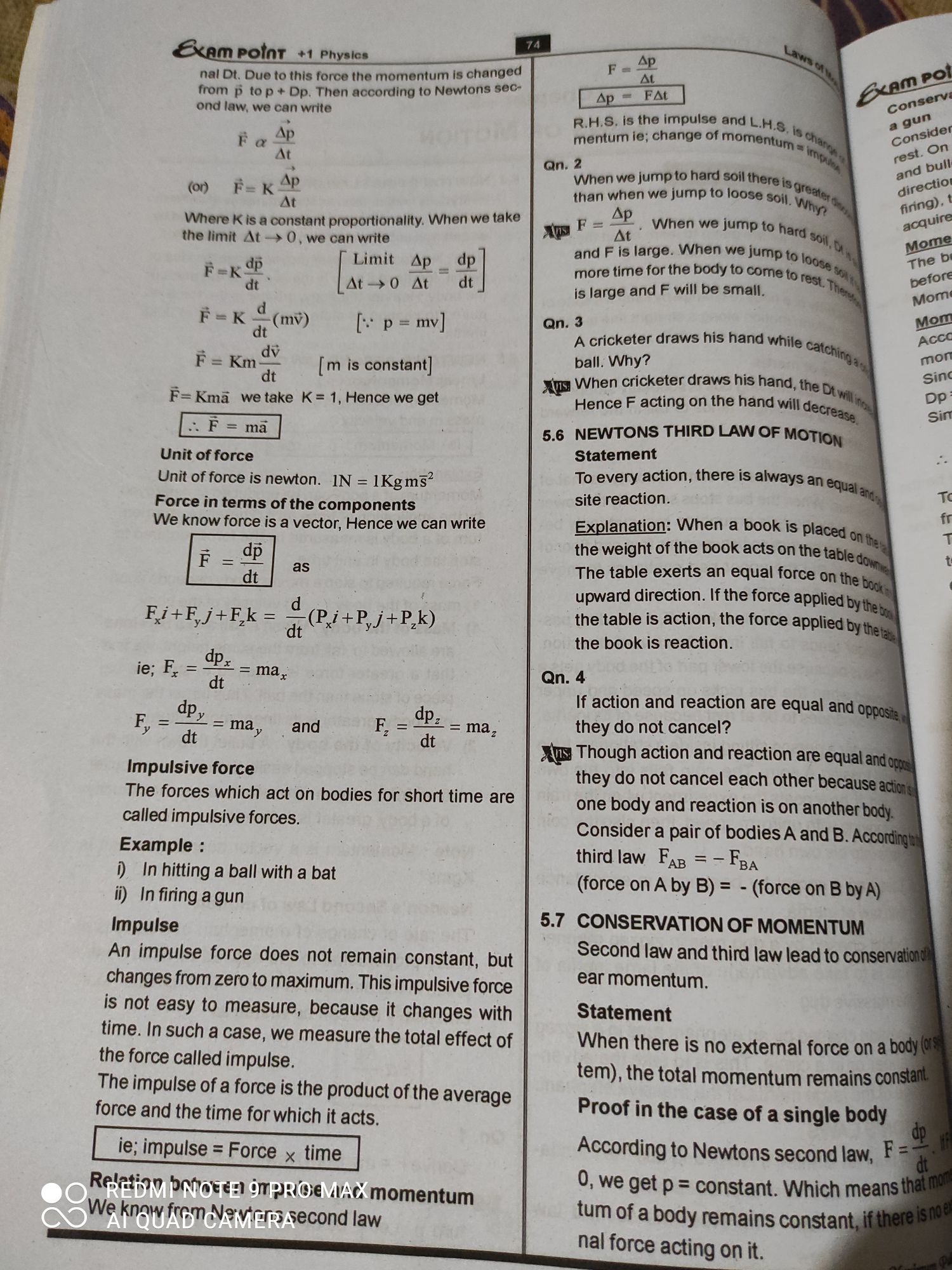
Exam polar +1 physics, , J, nal Dt. Due to this force the momentum is eae, from p to p + Dp. Then according to Newtons, ond law, we can write, , 5 Ap, Fas, “At, , A es Ap, F=K—, 7) at, , Where K is a constant proportionality. When we take, the limit At —> 0, we can write, , ee Limit ap. 2], RO At>0 At dt, , Fe K (av) [ht p= my], F= Km* [m is constant], , F=Kma_ wetake K= 1, Hence we get, , Unit of force, , Unit of force is newton. 1N = 1Kgms?, , Force in terms of the components :, We know force is a vector, Hence we can write, , , , dp, ie; F. = —*=ma, NO Clears x, , dp,, =—=ma, , dt F, Impulsive force, , The forces which act on bodies for short time are, called impulsive forces., , Example :, i) In hitting a ball with a bat, il) In firing agun, Impulse, An impulse force does not remain constant, but, changes from zero to maximum. This impulsive force, is not easy to measure, because it changes with, time. In such a case, we measure the total effect of, the force called impulse., The impulse of a force is the product of the average, force and the time for which it acts., , , , ES _and a, , ie; impulse = Force x time, , Relation dotwees im DNG, , 36... momentum, We know frem Ne, , ‘Vier3 Second law, , , , , , , , , , , , , , , , , , , , , , , , , , , , , , , , , , , , , , , , , , , , , , , , , , , , , , , , , , , , R.H.S. is the impulse and LAs, eal s eae, mentum ie; change of mome, Chg con esi, 0 J pull, an. When we jump to hard soil there jg . alle, than when we jump to loose sojiy_ ra, , Ui, , ae = 2. When we jump to harg a cau, and F is large. When we jump to ;, oa ee, more time for the body to COME to rag i soe, is large and F will be small. sor, mom, Qn. 3 ; on, , A cricketer draws his hand while «. Bi, , mon, ball. Why? - a, Xe When cricketer draws his hand, the Dh ye i, Hence F acting on the hand will g- a, , 5.6 NEWTONS THIRD LAW OF MoTigy, , Statement, To every action, there is always an «, ., = c, i ion., site reacti ;, 1, , The table exerts an equal force on they., upward direction. If the force applieqy, , the book is reaction., , Qn. 4 ‘, If action and reaction are equal and op ‘, they do not cancel?, , XW Though action and reaction are equal a, they do not cancel each other because, , thirdlaw F,, = — BA 4, (force on A by B) = - (force onB byA), 5.7 CONSERVATION OF MOMENTUM, , Second law and third law lead to conse, ear momentum., , Statement, When there is no extemal force on a bot, tem), the total momentum remains cons, Proof in the case of a single body, According to Newtons second law, F =, , 0, we get p = constant. Which means, tum of a body remains constant,, Nal force acting on it.