Notes of SCHOOL OF MATHEMATICS, PHYSICS 1 C5 - Study Material
Page 1 :
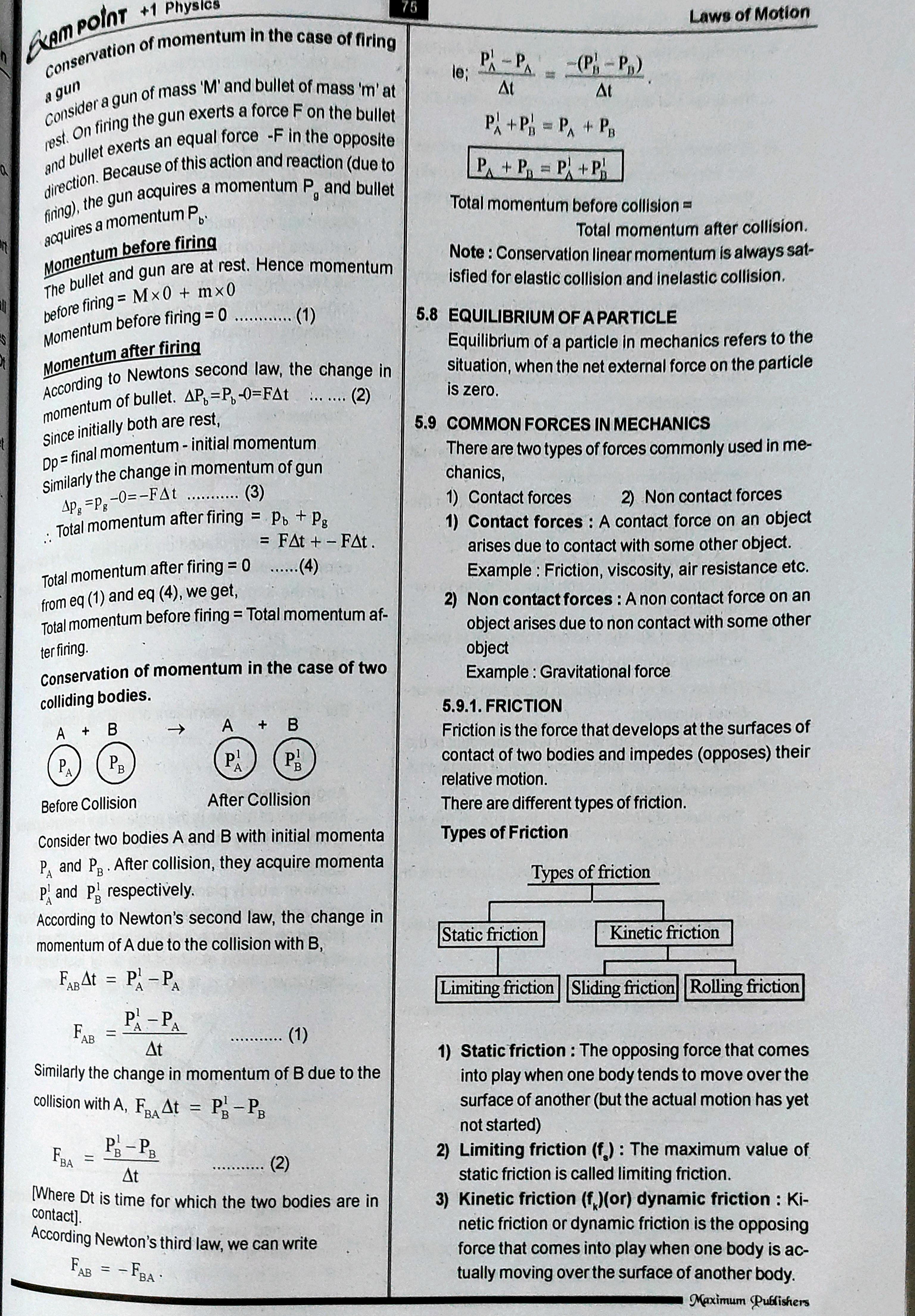
T +1 Physics Laws of Motion, , oln, vam? f momentum in the case of firing |, |, , agul cagun of mass M' and bullet of mass 'm’ at At NS ae, agnsiae ~ * exerts a force F on the bullet |, , v ining the gun 8 | p! |-P! a ., , res ON uae rs an equal force -F in the opposite | ee, and pul _ pecause of this action and reaction (due to, , actiOl: ., giree in acquires a momentum P, and bullet, , (\ Nh L, , Total momentum before collision =, , fing?» P.., rules : noe Total momentum after collision., oe eat rest Hienica momentum Note : Conservation linear momentum is always satne bullet ang a 4 BO Isfled for elastic collision and Inelastic collision., Dade ae before firing =0 «........... (1) 5.8 EQUILIBRIUM OF APARTICLE, momen matter firin ? Equilibrium of a particle in mechanics refers to the, you tons second law, the change in situation, when the net external force on the particle, ee of bullet. AP,=P,-O=FAt i. ....(2) Is zero,, Ae initially both are eet 5.9 COMMON FORCES IN MECHANICS, = final momentum - initial momentum There are two types of forces commonly used in mesimilarly the change in momentum of gun chanics, |, APs =P paca ie (3) 1) Contact forces 2) Noncontact forces, - total momentum after firing = Py © Pg 1) Contact forces : A contact force on an object, : = FAt+— Fat. arises due to contact with some other object., Total momentum afterfiring=0O ...... (4) : | Example : Friction, viscosity, air resistance etc., rom eq (1) and eq (4), We get, | 2) Non contact forces : Anon contact force on an, Total momentum before firing = Total momentum af- | object arises due to non contact with some other, ter firing. | object |, Conservation of momentum in the case of two Example : Gravitational force, colliding bodies. | 5.9.1. FRICTION 3, None >. | Friction is the force that develops at the surfaces of, @ | contact of two bodies and impedes (opposes) their, | . relative motion., Before Collision After Collision E There are different types of friction., Types of Friction, , Consider two bodies A and B with initial momenta, p, and P, . After collision, they acquire momenta, Pi and P; respectively., , According to Newton’s second law, the change in |, momentum of A due to the collision with B, |, , Types of friction, , , , F,,At = Pi ah, ], , F., = faint oe Bees (1), | At | 1) Static friction : The opposing force that comes, Similarly the change in momentum of B due to the | into play when one body tends to move over the, Collision with A, F,, At = P! =P | surface of another (but the actual motion has yet, , . | not started), Re Pi Bp (2) | 2) Limiting friction (f,) : The maximum value of, At -==aa8 | static friction is called limiting friction., ae Dt is time for which the two bodies are in | 3) Kinetic friction (f,)(or) dynamic friction : KiAccording Newton's ahaa | netic friction or dynamic friction is the opposing, : irdlaw, we canwrite force that comes into play when one body is acAB = > eee | tually moving over the surface of another body., , , , Meximum Publishers