Notes of 11 Science Physics, Physics Electrostatic.pdf - Study Material
Page 1 :
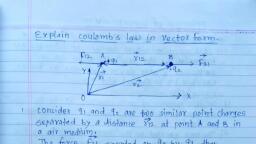
Electrostatics:, It is deals with study of electric charges at the, rest, the forces between them and the effects, , produced in the form of electric field and electric, potential., , Electric charges:, i)Electric charge is the basic property of, elementary particle., , ii)Elementary particle are proton,neutron,, electron., , ili)A proton is Positively charged., , iv)Electron is negatively charged, , v)Neutron is electrically neutral., , vi)The Matter is electrically neutral,, , vii)When dissimilar substances like fur and amber, or comb and dry rubbed with each other electron, , are transferred to the other substance making, them charged., , Method of Charging:, , i)Conduction :, , When two substance rubbed together the, substance receiving electrons develope a, negative charge while other is left with an equal, amount of positive charge .This method is called, charging by conduction as charges transferred, from one body to another., , ii)Induction:, , If an uncharged conductor is brought near a, charged body (not in physical contact)the nearer, side developed opposite charge to that on the, charged body and the far side of the conductor, developed charge similar to that on the charged, body. This method called induction., , This happen because electron in conductor are, , free and can move easily.In presence of charged, body., , Types of Charges:, i)Positive Charge ii)Negative Charge., , Additive nature of charges :, , i)Electric charges is additive similar to mass., ii)The total electric charge on an object is equal to, algebraic sum of the all the electric charges, distributed on different part of objects., , iii) While taking algebraic sum the sign of electric, charge must be taken into account., , 1 | Arya Acadamy junior college, Manjari, , , , Arya Acadamy Junior college, Manjari, Std_11 Physics ; ElectrostaticsBoard Notes, , \v)If two bodies have equal and opposite charges, , the net charge on the system of two bodies is, zero,, , Remark:, , 1)The masses of the particle constituting an, object are always positive where as charges, distributed on different part of object may be, positive or negative., , 2)The total mass of an object is always positive, but total charge on object may be, positive,negative or zero., , Quantization of charges:, 1.The value of charge on electron e= 1.6 x 10%C, 2.Unit of charge is coulomb( C ), 3.Quantization of charge means during the, charging process integral multiple of electron are, tranfered from one body to other body., , Q=tne, , Conservation of charges:, Q.State law of conservation of charge., , For an isolated system total charge cannot be, created or destroyed charge may get transferred, from one part of the system to other but total, charge in the system is remain constant., , Forces between charges:, , 1.When two charged object brought close, , together there is force between them. This force, is attractive or repulsive., , 2.Like charges repel each other., 3.Unlike charges attract each other., , Coulomb’s law in electrostatics:, , Q. State Coulomb’s law in electrostatics., Statement:, , The force of attraction or repulsion between two, electric charges is directly proportional to the, product of the magnitudes of the charges and, , inversely proportional to the square of the, distance between them., Explanation ;, , % r 4; 3, , Fig: Coulomb forces between two like charges., , 1. If q: and q2 are two point charges Separated by, a distance r, the force F between them is given by, , $$, , Scanned with CamScanner
Page 2 :
ND, FQ -------r, Nh, or Fz ----(1), , , , Where K is a constant taken as 1 / 4ne,k where £o, is called the permittivity of free space (vacuum), , or air., , 3.Thus Coulomb's law is given as, , 1 NI, Free ao. =--=+(2), , 4nek —r?, , 4.In vector form the force F2; exerted on charge, 2 by charges q, is given by, , , , Where #,, is a unit vector in the direction from, charge q; to charge qz., , 4.The force Fy2 exerted on charge q: by charge qz, , , , is given by, 1 q192, Fy = oy, 4nek or?, , Where #,, is a unit vector in the direction from, charge q; to charge qu., , Remark:, LAs, 1, K= -----, Ane ok, Therefore dimensions of kare [L°M'T+17|, 2 1, , = eneeee = 9x 10° Nm*/C?, Ane k, , 3. Permittivity of a medium measures the ability, of a medium to store energy in the electric field in, it., , , , Limitations of coulomb law:, , 1. Coulomb’s law Is applicable for stationary point, charges and not for the extended bodies,, , 2. Coulomb's law is also applicable for extended, objects when distance between them is large, compare to the size of objects., , Defination of one coulomb :, , We have, 1 NI, Fos wwnecee nnencenee seaneee(1), a, 4nek, As, , €>= 8,85x10" C’/Nm?, , 1/4me9=9 x 10° Nm?/C., qi = q2=1 coulomb, r=im, , For air k=1, , then from equation (1), 1 1x1, FS weseeee KX ateeee =9x10°N, Ane 1, , Thus a charge of one coulomb is defined as that, charge which when placed in vacuum or air at a, distance of one metre from an identical charge,, repels it with force of 9 x 10°newtons., , Relative permittivity or Dielectric constant:, Q.What is relative permittivity., , Defination:, , Relative permittivity or dielectric constant is ratio, of force between two point charges placed at, certain distance apart in space or vaccum to the, force between the same point charges when, placed at same distance in given medium., , Explanation:, , 1.The force between two charges placed in, medium given by, , 1 (44:, Fea = A h esees, med a 2 } (1), , é=called permitivity of medium, , , , my Junior college, Manjari, 2 | Arya Acadamy J, , Scanned with CamScanner
Page 3 :
a, , , , , , , , Dividing equation II by I, , J (*#), Fa Awl), Pert (Gh), 4ne\ ir?, ~ =6, =relative permitivity or dielectric constant, , Relative permittivity denoted by K therefore, , fo _ Fac x, & Foca, , £,— is also called specific inductive capacity, , 3. The dielectric constant k or relative, permittivity is the ratio of two similar quantities, (e and €,).Therefore the dielectric constant is a, pure number and it has no units or dimensions., , 4. For vacuum or air, k = 1, while for any other, medium, k> 1., , 5.For conductors k = 0 and for insulators k = «0, , Remark:, 1) Charge on electron = 1.602x10-"C, 2) Number of electrons carrying a total charge, , one coulomb is 6.25x10"* electrons., 3)We have, , (3, Fue 4mé,\ 9° £y, , = Bing, Fasa (ag) &, , , , 4ne\ 9°, For Water, Five, =e,, Figs, , , , Fre = ¢, =80, Facer, , F,, Fwater =a = —¥82., = a, , The material medium reduces the force between, charges by facter ¢, its relative permittivity., , , , The water medium reduces the force between, charges by facter 80,, , Principle of superposition of forces:, , Q: State and explain principle of superposition of, charges?, , Statement:, When a number of point electric charges are, interacting with each other, the resultant force, , acting on any charge is equal to the vector sum of, the forces exerted on that charge by all the other, charges., , Explanation :, —, — Fa, Fria =, , , , Fig.: Forces acting ona, point charge q,, , 1. Let us consider four point charges qu, qz, q3 and, Qa situated near each other., , 2. Let rai, rai and ra; be the respective distances of, charges qz, q3. and qg from the charge qi., 3.According to Coulomb’s law, the force F,2, , exerted on the charge q, by the charge qp is given, by, , 1 q1d2, Lye ek — Fy, , 4nek on, , Where F,, isa unit vector in the direction form, q2 to qi., , 4,Similarly the forces and exerted on the charge, , q: by the charges q3 and qq respectively are given, by, , , , 3 | Arya Acadamy junior college, Manjari, , i, , Scanned with CamScanner
Page 4 :
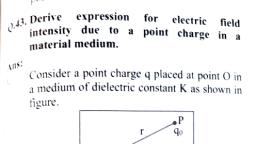
Fg meres Xmen Ta, , 4nek r,?, , Where #,, and F,, are unit vectors from q3 to qi, and qa to q; respectively., , 5.According to the principle of superposition of, forces, the resultant force(F,) acting on the, charge qi due to all the other charges is given by, , Fy = Faz + Fag + Faq, , Ty +h,, 2 3 2 4., 4a8yk, , F 1 a n a, Re mal gh 2 4%, ra ren ra, , Electric field:, The space surrounding an electric charge in, , which any other electric charge experiences a, force is called electric field of the charge., , Electric field intensity (electric intensity ):, , Q.Define electric intensity and derive an, expression for the electric intensity at any point, due to a point charge., , Def: The electric field intensity at any point in an, electric field is defined as the force actingona, unit positive charge placed at that point., , Explanation:, , 1. Imagine a small positive test charge qo to be, placed at some point in an electric field., , 2.If F is the force acting on the test charge, the, electric intensity (E) at that point is given by, , 3. The test charge must be extremely small so as, not to disturb the original electric field. Therefore, Eq. (1) should be represent as, , , , qo, , 4. The electric intensity is a vector quantity. Its, direction is the same as that of the force acting, on the test charge., , 5. Sl unit of the electric field intensity is N/C or, V/m., , 4 | Arya Acadamy junior college, Manjari, , , , Rel, , oo, { vw, F=qE, 6. Generally the strength of the electric field is, , expressed In terms of a vector quantity is called, electric field intensity or electric intensity., , 6.The force F acting on a finite charge q, placed at \, , a point where the electric intensity is E, is given, by, , Electric Intensity due to a point charge: \, , Q: Find expression for electric intensity at a point, due to a point charge?, , oO Pp °, , Fig: Electric intensity due to a point charge, , 1. Let a point charge q placed at a point 0 the, presence of the charge gives rise to an electric, field in the surrounding space., , 2. To find the electric field at a point P, situated at, distance r from the charge q , suppose that a, small test charge qois placed at the point P., , 3. According to Coulomb’s law, the force acting, , on the test charge is given in magnitude and, direction as, , 1 qqo —, F = ----- X -----= Ty, 4ne, or?, Where rq is a unit vector directed from 0 to P., , 4.The intensity of electric field (E) at the point P is, given by, , = F, E=-qo, 1 q, , a, , _, ane, ?, , If the charge q is + ve, the intensity is directed, away from it and if the charge q is -ve, the, intensity is directed towards it., 5.The magnitude of the electric intensity is given, by, , 1 oq, , a, 4ne, i?, 6. It can be seen from this expression that, , intensity is maximum near the charge and goes, , on decreasing as the distance from the charge, increases,, , Scanned with CamScanner
Page 5 :
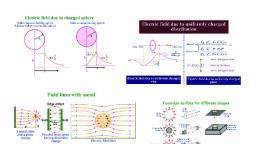
Remark:- The coulomb force between two, , charges & electric fleld E of charges both follow, inverse square law., , { Foc L/t?, Boe /t?, EIF, Uniform electric field:, , When magnitude as well as direction of electric, , 5, field intensity E is same at all the points in the, electric field then it is called uniform electric field,, , It is represented by set of equidistant, parallel, straight lines (Fig a), , Non uniform electric field:, When magnitude and direction of electric field, , 4, intensityEor both are different at different, , points in the field then it is called non uniform, electric field Fig (b)., , Radial electric field:, When electric field intensity E at any point in the, electric field is directed towards or away from the, , same fixed point then the field is called radial, electric field Fig.(c), , , , ‘Uniform electric Non uniform electric Radial electric, field field field, (a) (b) (c), , ‘Fig.: Uniform, Nonuniform& Radial electric field, , Electric lines of force:, , Q. What are electric lines of force? State their, properties., , Def:, , 1. An electric line of force is defined as the path, along which a free unit positive charge moves, when placed in an electric field., , 2. The line of force also defined as a curve such, , , , that the tangent at any point to this curve gives, 5 | Arya Acadamy junior college, Manjari, , ——, , , , the direction of the nonuniform electric field at, that point., , Properties of Electric lines of force :, (1) The lines of force originate from a positively, , charged object and end ona negatively charged, object., , (2) The lines of force neither intersect nor meet, each other, as it will mean that electric field has, two directions at a single point., , (3) The lines of force leave or terminate on a, conductor normally,, , (4) The lines of force do not pass through, Conductor i.e. electric field inside a conductor is, always zero, but they pass through insulators., (5) Magnitude of the electric field intensity is, Proportional to the number of lines of force per, unit area of the surface held perpendicular to the, field., , (6) Electric lines of force are crowded in a region, where electric intensity is large., , (7) Electric lines of force are widely separated, from each other in a region where electric, intensity is small, , (8) The lines of force of an uniform electric field, are parallel to each other and are equally spaced., , tc) td), Fig: Lines of force due to(a) isolated positive, charge, (b) isolated negative charge,(c) an electric, dipole, (d) a pair of like charges, , Practical way of calculating electric field:, , 1)In parallel plate the electric field is uniform., 2)A potential difference V is applied between two, parallel plate seperated by distance ‘d’, , 3)A charge +q placed between the plate, experience a force F due to electric field., , 4)If we have to move the charge +q from negative, , plate B to positive plate A the work done against, field is, , W=Fd, dis separation between the two plate., , lf, , Scanned with CamScanner



 Learn better on this topic