Notes of T Y B.Sc., Physical Chemistry & Environmental Chemistry IMG_20220121_100725.jpg - Study Material
Page 1 :
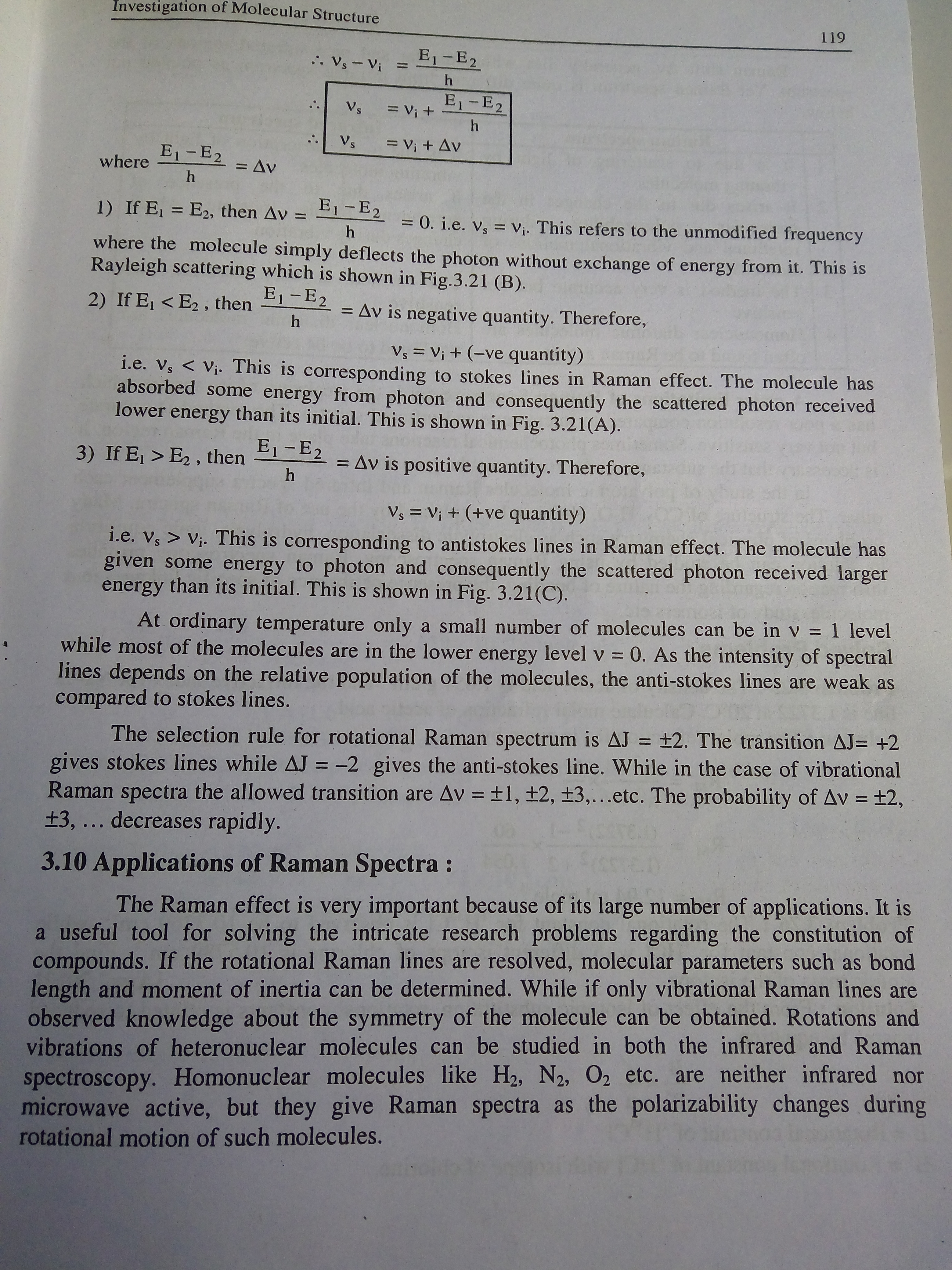
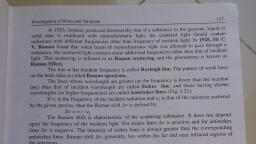
Investigation of Molecular Structure, , 119, lye Evoke,, h, , Eb,, where == = Ay, , —, , , , 1) Tf FE; = E,, then Ay = E17E>, h, , = 0) te Va= Viihis refers to the unmodified frequency, where the molecule sim, , ply deflects the hoton wit, Rayleigh scattering which is Shown in Peeoin, , hout exchange of energy from it. This is, OIE, <E, . then 21-22, h, , , , = Av is negative quantity. Therefore,, , : en Vs = Vi + (—ve quantity), -©. Vs < Vi. This is Corresponding to stokes lines in Raman effect. The molecule has, absorbed some energy from, , oe Photon and consequently the scattered photon received, lower energy than its initial. This is shown in Fig. 3.21(A)., , , , E,-E, 3) Ife, >E, , then d : = Av is positive quantity. Therefore,, , V, = Vj + (+ve quantity), , 1-€. V; > Vi. This is corresponding to antistokes lines in Raman effect. The molecule has, , given some energy to photon and consequently the scattered photon received larger, energy than its initial. This is shown in Fig. 3.21(C). ‘ay, , At ordinary temperature only a small number of molecules can be in v = | level, while most of the molecules are in the lower energy level v = 0. As the intensity of spectral, , lines depends on the relative population of the molecules, the anti-stokes lines are weak as, compared to stokes lines., , The selection rule for rotational Raman spectrum is AJ = +2. The transition AJ= +2, , gives stokes lines while AJ = —2 gives the anti-stokes line. While in the case of vibrational, Raman spectra the allowed transition are Av = +1, +2, +3,...etc. The probability of Av = +2,, +3, ... decreases rapidly. , ees, , 3.10 Applications of Raman Spectra :, , The Raman effect is very important because of its large number of applications. It is, eful tool for solving the intricate research problems regarding the constitution of, younds. If the rotational Raman lines are resolved, molecular parameters such as bond, and moment of inertia can be determined. While if only vibrational Raman lines are, ed knowledge about the symmetry of the molecule can be obtained. Rotations and, s of heteronuclear molecules can be studied in both the infrared and Raman, 7, Homonuclear molecules like H>, N2, O, etc. are neither infrared nor, active, but they give Raman spectra as the polarizability changes during, of such molecules.