Notes of Class 9th Maa Sai School, Maths & Science Class 9th gravitation - Study Material
Page 1 :
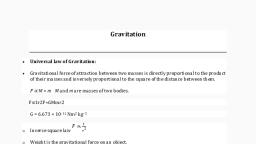
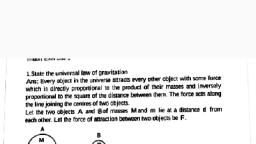
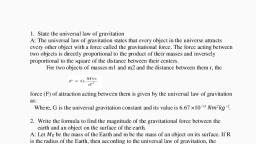
Class 9th, , SUBJECT - SCIENCE, , Chapter 10 Gravitation, , The universal law of gravitation: Every object in the universe attracts every other object with a force, which is proportional to the product of their masses and inversely proportional to the square of the, distance between them., The force is along the line joining the centers of two objects., , Let two objects A and B of masses M and m lie at a distance of d from each other as shown in the figure., Let F be the force of attraction between the law of gravitation, , G is called a universal constant because its value does not depend on the nature of intervening medium or, temperature or any other physical variable., S.I. unit of G = Nm2/kg2, Value of G = 6.673 x 10⁻¹¹ Nm2/kg2 (Found by Henry Cavendish), , Importance of universal law of gravitation, Universal law of gravitation successfully explained several phenomena like :, • the force that binds us to the earth., • the motion of moon around the earth., • the motion of planets around the sun., • the tides due to the moon and the sun., , Centripetal force, •, •, •, •, •, •, , When a body undergoes circular motion, it experiences a force that acts towards the centre of the, circle. This centre-seeking force is called a centripetal force, We know that an object in circular motion keeps on changing its direction., Due to this, the velocity of the object also changes., A force called Centripetal Force acts upon the object that keeps it moving in a circular path., The centripetal force is exerted from the centre of the path., Without the Centripetal Force objects cannot move in circular paths, they would always travel straight., For Example, The rotation of Moon around the Earth is possible because of the centripetal force, exerted by Earth., , Figure 1 Centripetal Force of Earth on Moon
Page 2 :
Freefall, When an object falls down towards the earth under the gravitational force alone, we say the object is in, free fall., The velocity of a freely falling body changes and is said to be accelerated., The sign of convention →, towards earth g is +ve, away from earth g is -ve., This acceleration is called acceleration due to gravity, denoted by ’g’. Unit is m/s 2., , The motion of objects under the influence of gravity ‘g’ does not depend on the mass of the body. All, objects small, big, heavy, light, hollow or solid fall at the same rate.
Page 3 :
The three equation of motion viz., , If an object is just let fall from a height then in that as u = 0 and a = g = 9.8 m/s -2., If an object is projected vertically upward with an initial velocity u, then a = – g = – 9.8 ms-2 and the object, will go to a maximum height h where its final velocity becomes zero (i.e., v = 0)., Then the three equations of motion can be represented as:, Velocity (v) after t seconds, v = u + ght, Height covered in t seconds, h = ut + ½gt2, Relation between v and u excluding t, v2 = u2 + 2gh, The value of g is taken as positive in case of the object is moving towards earth and taken as negative in, case of the object is thrown in opposite direction of the earth., , Weight and Mass, Mass of an object is the measure of its inertia and is constant throughout the universe. Weight of an object, keeps changing as the value of g changes. Weight is nothing but a force of attraction of the Earth on an, object = mg., Weight of an object on the Moon is 1/6 times the weight on Earth., , W=mxg, Difference between mass and weight
Page 4 :
Thrust and Pressure, •, •, •, •, •, •, •, •, , Thrust, The force that acts in the perpendicular direction is called thrust., It is similar to force applied to an object, It is a vector quantity., Pressure, The force that acts per unit area of the object is pressure., It is the thrust per unit area., Pressure is denoted by ‘P', P = thrust/ area = force/ area = F/A, SI unit: N/m2 or Pa (Pascal), , Figure 4 Pressure, , Why do nails have sharp edges?, , •, •, , We know that pressure is inversely proportional to area. As area increases, pressure decreases and, vice versa. So, nails' sharp edges make it easier for them to get into the wall because more pressure, is exerted on the wall from a single point., Solids - They exert pressure on the surface because of their weight., Fluids (gases and liquids) - They also have weight, therefore, they exert, pressure on the surface and the walls of the container in which they are, put in., , Buoyancy, •, , •, •, •, , Whenever an object is immersed in a liquid, the liquid exerts a buoyant, force or upthrust in the opposite direction of the gravitational force. This is, also called the Force of Buoyancy., It depends upon the density of the fluid., Therefore an object is able to float in water when the gravitational force is, less than the buoyant force., Similarly, an object sinks into the water when the gravitational force is larger than the buoyant, force.
Page 5 :
Why does an object sink or float on water?, •, •, •, •, o, o, , An object can sink or float on water based on its density with respect to water. The density is, defined as mass per unit volume., Objects having a density less than water float in it. For Example, Cork flows in water because its, density is lower than that of water., Objects that have a density higher than water sink in it. For Example, Iron nail sinks in water, because the density of iron is more than water's density., Thus, we can conclude that buoyancy depends upon:, The density of the liquid, The volume of the object (as the volume of object increases, its density decreases and vice-versa), , Archimedes Principle, , •, , •, , According to the Archimedes principle, whenever an object is immersed in a liquid (fully or partially),, the liquid exerts an upward force upon the object. The amount of that force is equivalent to the, weight of the liquid displaced by the object., This means that if the weight of an object is greater than the amount of liquid it displaces, the object, will sink into the liquid. However, if the weight of an object is less than the amount of water it, displaces, the object will sink., Submarines have a tank called Buoyancy Tank. Whenever the submarine needs to be taken inside, water the tank is filled which thus increases the weight of the submarine. Similarly, when the, submarine is to appear above water the tank is emptied and the weight of the submarine becomes, lighter and it rises above the water., Ships are heavier than water but their unique shape gives them a large volume. Their volume is, larger than their weight and hence the water displaced by a ship provides it with the right upthrust, so that it can float on water., , Applications of Archimedes Principle, •, •, •, , In evaluating relative density, In designing ships and submarines, In making lactometers and hydrometers, , Relative density :When density can be expressed in comparison with water's density it is called Relative Density. It has no, unit because it is a ratio of two similar quantities., , Why water is chosen as a reference?, Water is present everywhere on earth so it becomes easier to evaluate the density of a substance in, relation to water., How relative density can be used as a measure to determine in an object will sink or float in water?, , Relative Density of an object, , Float / Sink, , Greater than 1, , Sink in water, , Less than 1, , Float in water
Page 6 :
MULTIPLE CHOICE QUESTION :Q.1. What is the mass per unit volume of a substance called?, (a) Pressure, (b) Force, (c) Night, Q.2. One SI Unit of thrust is equal to ________ CGS Unit of it?, (a) 10, (b) 10-5, (c) 105, Q.3. What is the units of relative density?, (a) kg/m3, (b) g/cm3, (c) g/m3, , (d) Density, , (d) 107, (d) no units, , Q.4. Acceleration due to gravity of the Earth increases with, (a) decrease in the height from the surface of the Earth (b) increase in the height from the surface of the, Earth., (c) increase in the depth from the surface of the Earth., (d) increase in the temperature of the Earth., Q.5. The upthrust that acts on a body placed in a liquid is due to _____., (a) the volume of the displaced liquid, (b) the volume of the body floating above the liquid, (c) the volume of body inside the liquid, (d) both a and c, Q.6. What will happen when a body of relative density more than that of water is dropped into water?, (a) floats on the water., (b) sinks into the water., (c) suspends at the surface of the water., (d) sinks into or suspends in the surface., Q.7. The value of the universal gravitational constant is _______, (a) 6.67 x 10⁻¹¹ Nm2/kg2, (b) 66.7 x 10⁻¹¹ Nm2/kg2, (c) 0.6 x 10⁻¹¹ Nm2/kg, , (d) None of these, , Q.8. A cuboid is resting on a table in a way that its greater surface is in contact with the table. If its, position is changed, then the, (a) pressure applied by it on the table decreases. (b) pressure applied by it on the table does not change., (c) pressure applied by it on the table increases., (d) Insufficient information., Q.9. Pressure applied at any point of the liquid is transmitted equally and distributed in all directions is, given by ______., (a) Newton’s law, (b) Pascal’s law, (c) Archimedes’ principle, (d) Universal law of gravitation, Q.10. Upthrust on a body immersed completely in the water is equal to, (a) the weight of the body., (b) the weight of the water displaced., (c) the weight of the water in which the body is immersed., (d) None of these, Q.11. Earth moves in a circular motion around the Sun because of ______force,, (a) frictional, (b) static, (c) applied, , (d) gravitational, , Q.12. If two bodies of masses 2 kg and 4 kg are separated by 10 m, the gravitational force of attraction, between them is _____N., (a) 5.336 10-12, (b) 23.29 x 10⁻¹³, (c) 9.324 x 10⁻¹⁰, (d) 9.45 x 10⁻¹⁵



 Learn better on this topic