Notes of Class 10 SSC RIZAL, Mathematics & Mathematics CO_Math10_Q2_Module6.pdf - Study Material
Page 1 :
10, Mathematics, Quarter 2 – Module 6:, Applying the Distance Formula, to Prove Some Geometric, Properties, , CO_Q2_Mathematics 10_ Module 6
Page 2 :
Mathematics – Grade 10, Alternative Delivery Mode, Quarter 2 – Module 6: Applying the Distance Formula to Prove Some Geometric, Properties, First Edition, 2020, Republic Act 8293, section 176 states that: No copyright shall subsist in any work of, the Government of the Philippines. However, prior approval of the government agency or office, wherein the work is created shall be necessary for exploitation of such work for profit. Such, agency or office may, among other things, impose as a condition the payment of royalties., Borrowed materials (i.e., songs, stories, poems, pictures, photos, brand names,, trademarks, etc.) included in this book are owned by their respective copyright holders. Every, effort has been exerted to locate and seek permission to use these materials from their, respective copyright owners. The publisher and authors do not represent nor claim ownership, over them., Published by the Department of Education, Secretary: Leonor Magtolis Briones, Undersecretary: Diosdado M. San Antonio, , Development Team of the Module, Writer’s Name:, , Cerion T. Camhit, , Co-Writer’sName:, , Laila B. Kiw-isen, , Reviewer’s Name:, , Bryan A. Hidalgo, , Management Team:, May B. Eclar, Benedicta B. Gamatero, Carmel F. Meris, Ethielyn E. Taqued, Edgar H. Madlaing, Marciana M. Aydinan, Lydia I. Belingon, , Printed in the Philippines by:, Department of Education – Cordillera Administrative Region, Office Address:, Telefax:, E-mail Address:, , Wangal, La Trinidad, Benguet, (074) 422-4074,
[email protected]
Page 3 :
10, , Mathematics, Quarter 2 – Module 6:, Applying the Distance Formula, to Prove Some Geometric, Properties
Page 4 :
Introductory Message, This Self-Learning Module (SLM) is prepared so that you, our dear learners,, can continue your studies and learn while at home. Activities, questions, directions,, exercises, and discussions are carefully stated for you to understand each lesson., Each SLM is composed of different parts. Each part shall guide you step-bystep as you discover and understand the lesson prepared for you., Pre-tests are provided to measure your prior knowledge on lessons in each, SLM. This will tell you if you need to proceed on completing this module or if you, need to ask your facilitator or your teacher’s assistance for better understanding of, the lesson. At the end of each module, you need to answer the post-test to self-check, your learning. Answer keys are provided for each activity and test. We trust that you, will be honest in using these., In addition to the material in the main text, Notes to the Teacher are also, provided to our facilitators and parents for strategies and reminders on how they can, best help you on your home-based learning., Please use this module with care. Do not put unnecessary marks on any part, of this SLM. Use a separate sheet of paper in answering the exercises and tests. And, read the instructions carefully before performing each task., If you have any questions in using this SLM or any difficulty in answering the, tasks in this module, do not hesitate to consult your teacher or facilitator., Thank you.
Page 5 :
What I Need to Know, This module focuses generally in applying distance formula in proving, properties of some geometric figures., After going through this module, you are expected to:, 1. find the distance between two points using the Distance Formula; and, 2. apply Distance Formula in proving properties of some geometric figures., , What I Know, Direction: Choose the letter of the correct answer and write it on a separate sheet of, paper., 1. In the Cartesian plane, what is the distance of the point (2, -3) from the origin?, A) √5, , B) √13, , C) 5, , D) 13, , 2. What is the distance between point A(3, 4) and point B (10, 4)?, A) 4, , B) 5, , C) 6, , D) 7, , 3. Which of the following should be the value of x so that the distance between, the points (x, −2) and (12, −2) is 7?, A) 2, , B) 3, , C) 4, , D) 5, , 4. Which of the following equation describes the distance formula?, A) 𝑑 = √(𝑥2 − 𝑥1 )2 + (𝑦2 − 𝑦1 )2, , C)𝑑 = √(𝑥2 − 𝑥1 )2 − (𝑦2 − 𝑦1 )2, , B) 𝑑 = √(𝑥2 + 𝑥1 )2 + (𝑦2 + 𝑦1 )2, , D)𝑑 = √(𝑥2 + 𝑥1 )2 − (𝑦2 + 𝑦1 )2, , 5. What is the distance between two points with coordinates (4, 3) and (1,7)?, A) 25, B) 16, C) 5, D) 2, 6. What is the distance between point A (4a, 4a) and point C (0, a)?, A) 3a, B)5a, C) 9a, D)12a, 7. Both points D and U are on the fourth quadrant. If the distance between point, D and U is 3 units and D is at (2,-1), which of the following are the coordinates, of point U?, A) (2,- 4), B) (1, -6), C) (4,-1), D) (2,-5), 1, , CO_Q2_Mathematics 10_ Module 6
Page 7 :
Lesson, , Distance Formula, What’s In, , In your previous lessons, you have learned how to plot points and name the, coordinates of the points on the Cartesian plane. Examine the situation below., , https://www.dreamstime.com/illustration/classroom-cartoon.html, The picture above depicts a classroom with 9 seats arranged in 3 rows and 3, columns. During their Mathematics class, the teacher asked Juan and Juana to, describe their location., If you were Juan and Juana,, •, •, , How would you describe your location? What mathematical concepts can, you use to describe your location?, How far are you from each other? How will you determine your distance, from each other?, , 3, , CO_Q2_Mathematics 10_ Module 6
Page 9 :
What’s New, , Using the situation of Juan and Juana, find the distance between them if the, students in the class were seated 1 meter from each other., The distance between two points in the coordinate plane is the length of the, segment that joins the two points. Hence, to find the distance between Juan and, Juana, draw a segment joining the points of their location. The figure below, demonstrates that the distance between Juan and Juana can be found by forming a, right triangle in which their distance is the hypotenuse, while the horizontal and the, vertical segments are the legs of the right triangle., , Recall the Pythagorean, Theorem: The square of, the hypotenuse of a, right triangle is equal to, the sum of the squares, of its two legs., vertical distance (a), horizontal, distance (b), , We will apply the Pythagorean Theorem to solve for the distance between Juan, and Juana. Let c be their distance. The vertical distance and the horizontal distance, which are the legs of the triangle are 1 meter and 2 meters, respectively. Hence,, , 𝑐 2 = 12 + 22, 𝑐2 = 1 + 4, 𝑐2 = 5, 𝑐 = √5 ≈ 2.24, Therefore, the distance between Juan and Juana is √5 or approximately 2.24, meters., , 5, , CO_Q2_Mathematics 10_ Module 6
Page 11 :
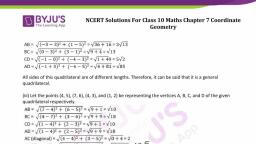
Example 1. Plot and solve the distance between the points E (1, 1) and R (2,4) in the, coordinate plane., Solution:, A) Graph:, , B) Distance:, Let P1 (x1, y1) be equal to E (1, 1) and P2 (x2, y2) be, equal to R(2,4). Hence,, x1 = 1 and y1 = 1; and, x2 = 2 and y2 = 4, Substitute the coordinates of points E and R in the, formula:, , 𝐝 = √(𝐱𝟐 − 𝐱𝟏 )𝟐 + (𝐲𝟐 − 𝐲𝟏 )𝟐, d = √(2 − 1)2 + (4 − 1)2, Simplify it further:, , d = √(1)2 + (3)2, d = √1 + 9, d = √10, Therefore the distance between points E and R is, √10., , Example 2. Show that the figure formed when points L (-4, 4), O (3, 9), V (8, 2), E, (1,-3) are connected consecutively is a square, then find its perimeter., Solution:, 1. Plot the points L (-4, 4), O (3, 9), V (8, 2), E (1,-3) on the coordinate plane., , 2. To show that the figure formed is a square, we need to show that all the, sides are equal in length and all angles are right angles., A) Show that the lengths of ̅̅̅̅, 𝐿𝑂, ̅̅̅̅, 𝑂𝑉, ̅̅̅̅, 𝑉𝐸 and̅̅̅̅, 𝐸𝐿 are congruent., i) to solve the length of LO, we will use the points L (-4, 4) & O (3, 9), , 7, , CO_Q2_Mathematics 10_ Module 6
Page 12 :
𝐿𝑂 = √(3 − −4)2 + (9 − 4)2 = √74, ii) to solve for the length of OV, use O (3, 9) & V (8, 2), 𝑂𝑉 = √(8 − 3)2 + (2 − 9)2 = √74, iii) to solve for the length of VE, use V (8, 2) & E (1,-3), 𝑉𝐸 = √(1 − 8)2 + (−3 − 2)2 = √74, iv) to solve for the length of EL, use E (1,-3)& L (-4, 4), 𝑉𝐸 = √(−4 − 1)2 + (4 − −3)2 = √74, Thus, LO=OV=VE=EL., B) Show that all angles L, O, V, & E are right angles. Note that if two lines, are perpendicular, then they formed a right angle and their slopes are, negative reciprocal of each other. Hence, we need to find the slope of, each side., Recall: Slope of a line, The slope of a line, m¸ given two points (𝑥1 , 𝑦1 ) and (𝑥2 , 𝑦2 ) is, 𝑦2 − 𝑦1, 𝑚=, 𝑥2 − 𝑥1, i) The slope of LO, use the points L (-4, 4) & O (3, 9), 9−4, 5, 𝑚𝐿𝑂 =, =, 3 − (−4) 7, ii) The slope of OV, use O (3, 9) & V (8, 2), 𝑚𝑂𝑉 =, , 2−9, 7, =−, 8−3, 5, , iii) The slope of VE, use V (8, 2) & E (1,-3), 𝑚𝑉𝐸 =, , −3 − 2 5, =, 1−8, 7, , iv) The slope of EL, use E (1,-3) & L (-4, 4), 𝑚𝐸𝐿 =, , 4 − (−3), 7, =−, −4 − 1, 5, , C) Based from the computed slopes of each segment, we can conclude the, following:, i. The slopes of LO and OV are negative reciprocals of each other,, then angle O is a right angle., ii. The slopes of OV and VE are negative reciprocals of each other,, then angle V is a right angle., iii. The slopes of VE and EL are negative reciprocals of each other,, then angle E is a right angle., iv. The slopes of EL and LO are negative reciprocals of each other,, then angle L is a right angle., 8, , CO_Q2_Mathematics 10_ Module 6
Page 13 :
3. Since all the sides of the figure are congruent and all the angles are right, angles, then quadrilateral LOVE is a square., 4. To solve for the perimeter, use the formula for the perimeter of square., 𝑃 = 4𝑠 = 4(√74) ≈ 34.409 𝑢𝑛𝑖𝑡𝑠, Example 3. Find the coordinates (in terms of a and, b) of points G, O, L, and D in the figure at the right., (Remember that the coordinate of points on the same, vertical line share the same x – coordinate while, points on the same horizontal line share the same y –, coordinate.), , 𝑮(−𝒂, ? ), , 𝑫(? , ? ), , 𝑶(? , 𝒃), , 𝑳(𝒂, ? ), , Solution:, a) finding the coordinates of G:, Since G and O lie on the same horizontal line, it implies that they have the, same 𝑦 – coordinate. Thus, the coordinate of G is (−𝑎, 𝑏), b) finding the coordinates of O:, Since O and L lie on the same vertical line, it implies that they have the, same 𝑥 – coordinate. Thus, the coordinate of O is (𝑎, 𝑏)., c) finding the coordinates of L:, Since L lies on the 𝑥-axis, it means that its 𝑦 – coordinate is 0. Thus, the, coordinate of L is (𝑎, 0)., d) finding the coordinates of D:, Since D lies on the 𝑥 – axis, it means that its 𝑦- coordinate is 0. D also lies, on the same vertical line with G which means that they have the same 𝑥 –, coordinate. Thus, the coordinates of D is(−𝑎, 0)., e) Therefore, the coordinates are 𝐺(−𝑎, 𝑏), 𝑂 (𝑎, 𝑏), 𝐿 (𝑎, 0) & 𝐷(−𝑎, 0)., Example 4. Prove that the two sides of an isosceles triangle are congruent., ̅̅̅̅̅, 𝐼𝐵, ̅̅̅, ̅̅̅̅,𝐼𝐴, Given: ∆ABI with sides 𝐴𝐵, ̅̅̅̅̅, ̅̅̅̅, Prove: 𝐴𝐵 ≅ 𝐼𝐵, Prov, To prove:, 1. Place ∆ABI on the coordinate plane and label the, coordinate points as shown below:, , 9, , CO_Q2_Mathematics 10_ Module 6
Page 14 :
2. Find the distance between A(-a,0) and B (0,b). Substitute –a and 0 to x2, and x1, respectively, and 0 and b to y2 and y1, respectively., AB = √(−a − 0)2 + (0 − b)2, AB = √a2 + b 2, 3. Find the distance between I (a,0) and B (0,b). Substitute a and 0 to x2 and, x1, respectively, and 0 and b to y2 and y1, respectively., IB = √(a − 0)2 + (0 − b)2, IB = √a2 + b 2, 4. Since AB = √a2 + b 2 and IB = √a2 + b 2 , by substitution we can say that, AB = IB., ̅ . The two sides of an isosceles triangle are congruent., ∴ ̅̅̅̅, AB ≅ IB, Here are some suggestions to help you place figures for your proofs., 1. Use the origin of the coordinate plane as vertex or center of the figure., 2. Place at least one side of the figure on a coordinate axis, either the x or, y- axis., 3. Keep the figure within the first quadrant if possible., 4. Use coordinates that make computations as simple as possible., , What’s More, , Activity 2:, The coordinates of points C and R are (2, 5) and (7, 2), respectively. Plot these, points on the coordinate plane and find their distance., , 10, , CO_Q2_Mathematics 10_ Module 6
Page 15 :
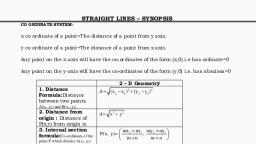
Activity 3. Use the given to answer each question., A) Show that the figure formed when the points F (-2, 6), U (-2, -3), N (7, 6) are, connected consecutively is an isosceles right triangle and find its area., B) Supply the missing coordinates of the points of each figure below without, introducing new letters., , (0, r), , (g, 0), 3. EQUILATERAL TRIANGLE, , C) Prove using coordinate plane that the diagonals of an isosceles trapezoid are, congruent., , What I Have Learned, , 1) The Distance Formula, The distance, 𝑑, between points 𝐴(𝑥1 , 𝑦1 ) and 𝐵(𝑥2 , 𝑦2 ) may be found, using the formula:, 𝑑 = √(𝑥2 − 𝑥1 )2 + (𝑦2 − 𝑦1 )2, 2) With the use of the coordinate plane, distance formula is very helpful in, proving properties of some geometric figures. However, the geometric figure, must be placed properly on the coordinate axes so that it will be easier to, prove. Here are some of the appropriate ways of placing geometric figures on, the coordinate plane., , 11, , CO_Q2_Mathematics 10_ Module 6
Page 16 :
SO=OI=SL=LI, , What I Can Do, , Activity 4. Answer the following problems:, 1) Lieutenant Santos orders an air strike in the battlefield targeting the enemy at a, coordinate (2, 5). If he is positioned at a coordinate (-14, -12), how far is he from, the target area? If the danger zone is within the 10 km radius from the strike, point, is Lt. Santos safe? (Let 1 unit = 1 km), , 2) Chester and his father stood on their newly-bought rectangular lot whose length, and width are 60 and 40 meters, respectively. His father told him that the place, they are standing at is one of the four boundary points of their lot. He then told, Chester that they are going to put a marker on each of the four boundary points., Help Chester to locate the coordinates of the 3 boundary points using the, Cartesian coordinate plane if the coordinates of their location is at (-30, 20). (Let, 1 unit = 1 meter), , 12, , CO_Q2_Mathematics 10_ Module 6
Page 17 :
Assessment, Direction: Choose the letter of the correct answer. Write it on a separate sheet of, paper., 1. In the Cartesian plane, what is the distance of the point (-5, 6) from the origin?, A) 61, , B) 11, , C)√61, , D) 11, , 2. What is the distance between point A(−3, 1) and point B (11, 1)?, A) 11, , B) 12, , C) 13, , D) 14, , 3. Which of the following should be the value of y so that the distance between the, points (2, −2) and (2, y) is 7?, A) 2, , B) 3, , C) 4, , D) 5, , 4. Which of the following describes the distance formula?, A) 𝑑 = √(𝑥2 − 𝑥1 )2 + (𝑦2 − 𝑦1 )2, , C)𝑑 = √(𝑥2 − 𝑥1 )2 − (𝑦2 − 𝑦1 )2, , B) 𝑑 = √(𝑥2 + 𝑥1 )2 + (𝑦2 + 𝑦1 )2, , D)𝑑 = √(𝑥2 + 𝑥1 )2 − (𝑦2 + 𝑦1 )2, , 5. What is the distance between two points whose coordinates are (4,−3) and (−4,3)?, A) 4, , B) 6, , C) 8, , D) 10, , 6. What is the distance between point A(3a, 2a) and point D(−a, −6a)?, A) 2a√10, , B) 4a√5, , C)5a, , D) 8a, , 7. What is the area of a triangle whose vertices are (0,2), (0,0) (5,0)?, A) 5 square unit, B) 8 square unit, unit, D) 12 square unit, , C), , 10, , square, , 8. What kind of triangle is formed when the vertices (−3, 5),(−3, 1) and (2, 1) are, plotted on the Cartesian plane?, A) equilateral, , B) isosceles, , C)right, , D) scalene, , 9. What type of quadrilateral is formed by the given vertices C(0,0), A(1,2), R(4,2), and E(3,0)?, A) kite, 10., , B) parallelogram, , C) rectangle, , D) square, , In Quadrilateral LOVE, what is the length, of the diagonal ̅̅̅̅, 𝐿𝑉., A) √𝑎2 + 𝑏 2, B) √𝑎2 − 𝑏 2, C) √𝑎 + 𝑏, 13, , CO_Q2_Mathematics 10_ Module 6
Page 19 :
Additional Activity, Direction: Answer the following problems on a separate sheet of paper., 1. Draw segment 𝑀𝑅 whose endpoints are M(-1,5) andR(2, -4) on the Cartesian, plane., a) Find the length of segment 𝑀𝑅., b) If point S(x, −1)lies on segmentMR and the length of segment SR is √10,, what is x?, 2. Refer to Figure 1. Solve the distance d in terms of a and b., 𝑦, , 𝑏, 𝒅, , 𝑎, , 𝑥, , Figure 1, , 3) The vertices of a quadrilateral are R(0,0) , U(a,0), D(a,b), Y(0,b) ., a) Illustrate the quadrilateral in the coordinate plane., b) Find the length of each diagonal., c) Compare the lengths of the diagonals., 4) Refer to Figure 2. The x-coordinate of D is the mean of the x-coordinates of, the vertices of triangle ABC and its y-coordinate is the mean of the ycoordinates of the vertices of triangle ABC. Find the distance between points, A and D., , Figure 2, , 15, , CO_Q2_Mathematics 10_ Module 6
Page 20 :
CO_Q2_Mathematics 10_ Module 6, What I Know, 1) B, 2) D, 3) D, 4) A, 5) C, 6) B, 7) A, 8) C, 9) B, 10) D, 11) C, 12) A, 13) B, 14) B, 15) D, , 16, , Activity 1, A), a) (-4, 7), b) (7, 8), c) (-7, -6), d) (2, -2), , Activity 2, , 𝑑 = √34, , B), , N, , A, , C, E, , Activity 3, A) 40.5 square units, B), 1), , 2), 3), 4), , B (b+a, c), O (0, 0), T (g, r), S (0, 0), W(2a, 0), O (0, 0), S (-a, b), T (-a, 0), D) (a, 0), , Activity 4, 1), a) √545 ≈ 23.35 𝑘𝑚, b) Yes, 2), a) (30, 20), b) (-30, -20), c) (30, -20), , Additional Activity, 1), a) 3√10, b) 𝑥 = 1, , Assessment, 1) C, 2) D, 3) D, 4) A, 5) B, 6) B, 7) A, 8) C, 9) B, 10) A, 11) D, 12) D, 13) D, 14) D, 15) B, 2 + 𝑏2, ̅̅̅̅, 3.b) 𝑅𝐷, =, √𝑎, ̅̅̅̅ = √𝑎2 + 𝑏 2, 𝑌𝑈, , 3.a), 𝑏𝑌, , 3.c) equal, , 𝐷, , (𝑏+𝑎)2 +𝑐 2, , 4) 𝑑 = ට, , 2) 𝑑 = √𝑎2 + 𝑏 2, , 𝑅, , 9, , 𝑎𝑈, , Answer Key



 Learn better on this topic