Notes of 11science, Home Science & Home Science Unit-3 Childhood.pdf - Study Material
Page 1 :
UNIT III, Childhood, The theme of this unit is ‘Childhood’. You may, wonder why did the book address the adolescent, years first and childhood later. Well, it is because, 225, if you as an adolescent understand issues, about yourself first, it would be easier to grasp, the issues that are concerned with the stage of, childhood, and later with adulthood. In this unit, you will be studying about children’s growth, and development, critical concerns about their, health and nutrition, education and clothing. As, we would like children with disabilities to be an, inclusive part of our society, the chapters provide, us important information on their needs and, ways to meet them.
Page 2 :
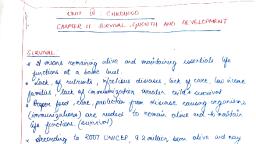
Human Ecology and Family Sciences, , Survival, Growth, and Development, , 11, , Learning Objectives, After completing this chapter the learner is able to –, , 226, , •, , explain the concepts of survival, growth and development., , •, , analyse the relationship between growth and health., , •, , discuss the characteristics of different stages of childhood., , •, , describe developmental milestones., , •, , examine development in different domains of childhood., , 11.1 The Meaning of Survival, The term survival has many meanings. But all of us associate it with, “remaining alive” and “maintaining essential life functions” at a basic level., Children remain alive and capable of basic functions when they are provided, with care, adequate food and protection from disease-causing organisms., If they suffer from lack of nutrients or develop infections, they need to, overcome these “assaults” as they threaten their survival. If the children, come from low income families, it is very important to provide them extra, food and give adequate nutrients in right amounts and proportions. In, addition they need to be immunised against the killer diseases of infancy, and childhood such as tuberculosis, whooping cough, diphtheria, polio, and tetanus. Diseases such as malaria, pneumonia are also a threat to, children’s lives., According to the 2007 UNICEF report 9.2 million children born alive, worldwide may die before their fifth birthday. Of these, three million children
Page 3 :
Survival, Growth and Development, , are from our part of the world — South Asia. Most of these children live in, developing countries and die from a disease or a combination of diseases, that could be easily prevented or treated – antibiotics for pneumonia, for, example, or a simple mix of salts and sugars for diarrhoea. Malnutrition, contributes to over a third of these deaths. Diarrhoeal diseases account for, 17 per cent of deaths among children under five years of age worldwide, or, nearly two million child deaths every year — making them the second most, common cause of child deaths globally., Child mortality is closely linked to poverty. Advances in infant and child, survival have occurred more slowly in poor countries and for the poorest, people in wealthier countries. Improvements in public health services are, the key, including safe water and better sanitation. Education, especially, for girls and mothers, will also save children’s lives. Raising incomes can, help, but little will be achieved unless a greater effort is made to ensure, that services reach those who need them most., A child begins to grow adequately only when enough essential inputs, are present in her/his environment. A child who is simply surviving will,, of course, not grow optimally. In fact, under such conditions the child may, even stop growing completely. This is called growth failure. Let us try to, learn more about how children grow., , 11.2 Growth and Development, , 227, , We have been using the words growth and development in the text. Do they, mean the same thing or are they different? They have slightly different, meanings. Growth refers to changes in size or quantity, i.e., physical, changes that can be measured. Development refers to changes in quality., Increase in weight, height and the size of the internal organs is growth., However, we do not only grow in size of the physical body. If that were so,, a newborn would simply be a bigger baby at the age of 20 years! Along, with growth in size, there is change in form and complexity of body parts, and their functioning. Thus the infant begins to raise her/his head, then, roll over on the back, then sit up, then crawl, walk and then run. These, changes are qualitative. Within each of these qualitative transformations, there is quantitative change. Thus, when the child begins to sit, she/he, can sit without falling over, for longer periods of time; when she/he begins, to walk, she/he can walk swiftly., Look at the figure on the next page which indicates the size of the child, with reference to age., It is evident that as a child grows from infancy to the preschool years,, there is increase in height and weight. Also, the proportions of various body, parts such as the head and chest change. But is that all? No. We all know, that along with these physical changes, the body organs are continuously, increasing in size and improving in functional capacity. This process does, , unit_3_as_26_7_09_cyan-Final.indd 227, , 22-07-2019 11:20:55
Page 4 :
Human Ecology and Family Sciences, , 228, Figure 1: Size for age in children, Source: Adapted from WHO, , not stop at the preschool years. It continues through the school years, and adolescence till the adult body size, composition and functionality are, reached., While growth refers mainly to physical changes, development occurs, across many dimensions simultaneously. The infant’s thinking capabilities, develop; she/he forms relationships, with people, learns to understand, Activity 1, and manage her/his emotions and, speaks increasingly complex sentences., Would you term the following changes, Thus, development is multifaceted., as development?, We can define development as the, •, walking to running, orderly appearance over time of the, •, deciding which movie to watch or, physical structures, psychological, deciding which career to choose, traits, behaviours, ways of thinking, as an adolescent, and adapting to the demands of, Give reasons for your answers, life. These changes are progressive,, and discuss with others in the, orderly and last for a reasonable length, class., of time. By ‘progressive’ it is meant, that these changes result in the child
Page 5 :
Survival, Growth and Development, , acquiring skills and abilities that are complex, finer and more efficient, than the ones that preceded these. By ‘orderly’ it is meant that there is an, order in development. Every development is built on the previous one and, cannot occur before it. The changes must last for a reasonable length of, time to be called development. When the infant cries with hunger there is a, change in behaviour. But as soon as the infant is given food, she/he stops, crying. Thus, the crying behaviour lasts for a very short time. Such a short, behavioural change is not development., , 11.3 Areas of Development, Let us now define areas of development. Although we live as an integrated, person, we separate the different dimensions of development for the, purpose of scientific study. The various developments that take place in, the life of an individual can be classified as – physical development, motor, development, sensory development, cognitive development, language, development, social, emotional and personal development., Physical development refers to the physical changes in the size,, structure and proportion of the parts of the body that take place since, conception., Motor development refers to control over body movements which, result in increasing co-ordination between various parts of the body., Physical growth makes the body grow, whereas, it is motor development, which results in smooth, controlled and effective body movements. The, control over movements is brought about by control over the movement of, the muscles of the body. Motor development is of two types. Gross motor, development refers to control over the movements of the large muscles, of the body such as muscles of the shoulder, thighs, upper arm, lower, arm, abdomen and back. As a result of this control we are able to sit,, bend, walk and move our whole arm. Fine motor development refers to the, control over the fine muscles of the body such as that of the wrist, fingers, or toes. As a result of this control we are able to write, turn the pages of a, book, stitch and knit., Cognitive development refers to emergence of thinking capabilities, in the child from the time she/he is born. As one grows from one year to, the other there are qualitative differences in the way in which one thinks., These changes in our way of thinking are because of changes in our, mental structures and understanding of experiences, and this is referred, to as cognitive development. To give just one example, the infant behaves, as if the object removed from her/his eyes does not exist any more. It is, only in the second half of the second year of life that the infant begins to, understand that objects exist even though they are out of sight., Sensory development refers to the development of the sensory, capabilities of vision, hearing, smell, touch and taste. While the infant is, , 229
Page 6 :
Human Ecology and Family Sciences, , born with fairly well developed sensory, capabilities, these refine and develop, further with age. For example, the, Which area of development does each newborn can focus her/his eyes on, of the following changes represent?, faces and objects best when they are, •, Learning to share, eight inches from the face. Gradually,, •, Learning to count, the child’s visual abilities develop to, •, Using tenses correctly, enable her eyes to focus on objects, •, Being able to run, whether they are farther or nearer., •, Growth in height, Language development refers to, •, Controlling one’s anger, the changes that enable the infant, •, Using the scissors, who can only cry at the time of birth, •, Turning towards the direction of, to understand the speech of others as, sound, well as speak complex sentences., , Activity 2, , 230, , Social development refers to the development of those abilities that, enable an individual to behave in accordance with the expectations of the, society, form and sustain relationships with people., Emotional development refers to the emergence of emotions and, learning of the socially acceptable ways of expressing them. Personal, development refers to the domain of the self and includes the evolution of, one’s idea of who he or she is; what personal talents and skills one has and, what ambitions for the future one holds., Although all the above domains are listed separately (personal, cognitive,, social, other), in fact these are simply different dimensions of an individual, in real situations, and must be understood as such. For instance, a child, learning how to ride a cycle (a physical set) also has a corresponding, emotional side (maybe fear or excitement) that must be considered while, teaching how to ride a cycle., Good nutrition has an important role in growth and development. As, children enter school age, their nutritional needs increase. In fact, there, are differences in the nutrient requirements of boys and girls from the age, of 10 years., There are various ways of classifying childhood years into different, stages. One such approach is to classify childhood based on nutrient, requirements as suggested by the Indian Council of Medical Research, (ICMR). The stages thus identified would be as follows–, • Infancy: Birth–6 months, and 6–12 months, • Preschool Years: 1–3 years, and 4–6 years, • School Years: 7–9 years, 10–12 years, It is interesting to note that nutrient requirements of boys and girls, remain the same till the age of nine years. Once the child completes 10, years, the nutrient needs of girls and boys start to differ., Now, let us try to understand the relationship between growth and, health. We all know that normal growth is a good indicator of health.
Page 7 :
Survival, Growth and Development, , But normal growth by itself is not sufficient to predict good health. A, range of resources and conditions, such as adequate educational and, physical stimulation within the home, are required to ensure that broader, developmental milestones are achieved. What do we mean by resources, and conditions here? These may include a stimulating environment as we, mentioned earlier. These may also include access to adequate breast milk;, a safe, hygienic environment; proper health care services; avoidance by, the mother of habits such as smoking or drinking. In other words, normal, growth is a necessary condition for attaining all the functional capacities, associated with health, but growth alone is not adequate to do so., There is research evidence to show that all children grow very similarly, for the first five years of life when their physiological needs are met and, their environments support healthy development. Growth falters or slows, down because of environmental “assaults” such as the attack by infections, and infestations or because of lack of good food in adequate amounts. In, India it has been found that children from well-to-do families have growth, performance similar to that in children from developed countries, specially, when parents have higher levels of education., Growth charts continue to be widely used across the globe for monitoring, the growth of children. There is an upward direction in a normal growth, curve. But if something goes wrong, the curve would get disturbed. The, , Activity 3, , Weight, , 1 year, , 2 year, , 3 year, , 4 year, , 5 year, , Age, The figure given above shows you a normal growth curve. Now answer the, following questions., 1., A child has a bout of severe diarrhoea. What would happen to the growth curve?, 2., A malnourished child is given good food for two months. What will be the change, in the growth curve?, , 231
Page 8 :
Human Ecology and Family Sciences, , curve may become flattened or may even start moving downward. What do, the growth curves mean if they show–, • flattening, • an upward direction, • a downward direction, Flattening would depict that the growth has stopped. An upward, direction shows that growth is taking place. A downward trend shows a, child falling behind the healthy growth pattern. If this child is given extra, food and infections are treated, an increasing trend will again be visible., This highlights the catch-up growth., , 11.4 Stages in Development, , 232, , You have read till now one way of classifying the human life span, i.e., on, the basis of nutritional requirements. In the field of Child Development the, life span is classified into stages on the basis of milestones of development., By this term, we mean specific abilities/tasks or skills that most children, achieve within the age range. These tasks are then used to assess whether, the child’s’ development is as per her/his age or not. These are also, referred to as norms of development. There are milestones in each area, of development and this will become clear to you as you read the chapter, further., Human life span can be divided into five stages: infancy (birth-2 years),, early childhood or preschool years (2–6 years), middle childhood years, (6–11 years), adolescence (11–18 years) and adulthood (18 years and, above)., Further, in the chapter you will read about how development takes, place in different aspects or domains during each of these stages. Physical, development and language development are two examples of domains., Before we describe the development in the various domains, let us read, briefly about the child in the first month of her/his birth, as this is a very, special stage., , Neonate, Neonate is the term used to refer to the newborn baby in the first month, of life. We tend to think of newborn babies as helpless. While it is true that, they are completely dependent on adults, it is also true that they have, many capabilities that help them to adapt to their surroundings and they, are more aware than we imagine., (i) Reflexes: Neonates are born with certain reflex actions which help, them to survive and adapt in the time it will take them to develop, motor capacities. Reflexes are simple, unlearned responses that are, , unit_3_as_26_7_09_cyan-Final.indd 232, , 22-07-2019 11:21:45
Page 9 :
Survival, Growth and Development, , elicited by certain type of stimulation. They do not require higher, brain functions – they occur without thinking; in other words, they, occur automatically. For example, when something touches your eye,, you blink automatically to protect the eye – this is the eye blink reflex., The newborn has other reflexes such as the sucking reflex which, helps in feeding, elimination reflex which helps in urination and bowel, movements., (ii) Sensory capabilities: Vision is the most well developed sense at birth., The neonate can distinguish between light and dark and actively, searches for light. She/he can follow a moving object with her eyes,, and can focus best when the object/person is about 8 inches from her/, his face. The infant is predisposed to focus on the human face., Newborns respond to sound and are most responsive to human voice, than any other sound. They can distinguish between basic tastes – sweet,, sour, salt and bitter. They are responsive to touch and can distinguish, good and bad smells, responding by turning away their face from the, latter. Newborns sleep for about 16–18 hours in a day in phases and when, awake and alert, they look around the surroundings and like it when the, caregivers interact with them., Crying is the way the newborn communicates her/his needs. There, are different cries that indicate hunger, anger, pain, discomfort and the, caregivers are usually able to make out the reason for the infant’s cries., , 11.5 Development Across Stages, Let us now read how development takes place in the various domains, during the first four stages of the human lifespan – infancy, early childhood,, middle childhood and adolescence., , Physical and motor development, (i) Increase in height and weight: The most dramatic gains in height, and weight occur in the prenatal period when a single celled organism, grows to a foetus that is 20 inches in length and about 2.5 to 3 kgs, in weight. Infancy is the next period of fastest growth. By the time the, infant is six months old, she/he has doubled her weight, and by the, time she/he is one year old the weight is three times that at birth. Most, infants are 8 to 9 kgs by the time they are a year old., , 233
Page 10 :
Human Ecology and Family Sciences, , Table 1: Weight for Age, , Age Range, , Girls (kg), , Boys (kg), , 0-2 years, , 3.2 – 11.5, , 3.3 – 12.2, , 2-5 years, , 11.7 – 18.2, , 12.4 – 18.3, , 5-6 years, , 18.3 – 20.2, , 18.5 – 20.5, , 6-7 years, , 20.3 – 22.4, , 20.7 – 22.9, , 7.8 years, , 22.6 – 25.0, , 23.1 – 25.4, , 8-9 years, , 25.3 – 28.2, , 25.6 – 28.1, , 9-10 years, , 28.5 – 31.9, , 28.3 – 31.2, , Now, with the help of your teacher prepare a table up to the age of 19 years., Table 2: Height for Age, , 234, , Age Range, , Girls (cms), , Boys (cms), , 2-5 years, , 85.7 – 109.4, , 87.1 – 110.0, , 5-8 years, , 109.6 – 126.6, , 110.3 – 127.3, , 8-11 years, , 127.0 – 145.0, , 127.7 – 143.1, , 11-14 years, , 145.5 – 159.8, , 143.6 – 163.2, , 14-17 years, , 160.0 – 162.9, , 163.7 – 175.2, , 17-19 years, , 162.9 – 163.2, , 175.3 – 176.5, , Source: Child Growth Reference Standards from birth to 5 years, 2006, and WHO Growth, Reference data for 5–19 years, 2007. These standards of height and weight are expected, to be achieved under desirable health and nutritional conditions. The children from six, countries were assessed to arrive at the above mentioned standards and one of the, countries sampled was India., , (ii) Motor development: Gross motor development (e.g., use of arms and, legs) precedes the development of fine motor skills (e.g., holding a glass, in one hand). Let us read the milestones in the development of gross, motor skills first. It is important to remember that each milestone is, achieved in a certain age range rather than in a specific month. What, this means is that there are differences among children in the rate, of development so that one cannot specify exactly the month when a, particular milestone will be achieved. If a child does not achieve more, than one milestone in the expected age range, then it is a cause for, concern. Table 3 lists the important motor milestones in the first 10, years of childhood.
Page 11 :
Survival, Growth and Development, , Table 3: Motor Development Milestones, , S. No., , Age, , Nature of Milestone, , 1., , Birth-3 Months, , yy, , Lifting and holding the head, , 2., , Newborn, , yy, , Newborns can move their head from side to side, slightly, , 3., , 1 month, , yy, , They can raise their head, , 4., , 2 months, , yy, , They can also lift their chest while lying on stomach, (prone position), , 5., , 3 months, , yy, , The infant begins to hold her/his head, and this is a, major milestone in development. If the child is unable, to do this even by the age of 6 months, it shows that, there is delay in development, , 6., , 4 – 6 months, , yy, , Can roll over from back to stomach and stomach to, back, , 7., , 6 – 8 months, , yy, yy, , Sitting with adult support or in a seat with straps, Sitting without support, , 8., , 8 – 9 months, , yy, , Crawling; however, some children do not crawl and, directly learn to stand after being able to sit, Standing if supported or by holding on to something, , yy, 9., , 10 – 11 months, , yy, , Can pull up from sitting position to standing; standing, independently briefly, , 10., , 12 – 18 months, , yy, , Walking; initially the child’s walk is unsteady but, gradually it becomes steady., Running; after the child learns to walk, she/he begins, to run, falling down often. As the balance improves,, she/he is able to run in a more coordinated manner, without falling frequently by the age of 2 years., , yy, , 11., , 18 – 24 months, , yy, , Climbing stairs/steps by placing both feet on each, step, if hand held by someone, , 12., , 2 years, , yy, yy, , Walking backwards, goes down slide, climbs ladder, Jumping from low platform with both feet, , 13., , 3 years, , yy, yy, yy, , Can balance on one foot, Can kick large ball, Can throw and catch a ball, , 14., , 3 – 4 years, , yy, , Can walk upstairs with alternating feet as adults do,, by holding onto something, , 15., , 5 years, , yy, , Skipping and pedalling a tricycle, , 16., , 6 years, , yy, , Well coordinated hopping, jumping and climbing, , 17., , 7 years, , yy, , Balancing and pedalling a bicycle, , 18., , 8 – 10 years, , yy, , Has balance, coordination and strength that allows, child to participate in various games and gymnastics, , 235
Page 12 :
Human Ecology and Family Sciences, , Language development, Many species have systems of communication. Can you think of some, species where the members communicate with each other and also think of, the way in which they do so? The dance of the honey bee communicates to, the other bees the approximate direction and distance of food source and, the enemy. Birds communicate that they have taken possession of a certain, tree or bush by special chirps and shrieks. Then what is special about the, human language. Is it too not a method of communication? The entire, communication pattern of all species other than humans is inborn – that, is, the communication pattern is un-influenced by experience. In contrast,, while the human infant is innately endowed and programmed to learn, language, the infant’s language learning is influenced by the environment, and humans can produce an infinite number of original sentences – by, ‘original’ we mean not imitated or inborn but produced by the individual., Humans can also talk about events and objects in another time and place., , Activity 4, 236, , Observe a 2-year-old child with her/his father/mother in your neighbourhood and observe, them as they talk with each other. If you can, write down what each one of them says., Focus on what the child said and analyse whether the child was repeating what the, adult was saying or was the child thinking on her own and speaking ‘original’ sentences., If possible observe an even younger child who has just learnt to speak and hear what, she/he says. Did the child speak ‘original’ sentences or did she/he imitate the adult’s, speech or was it a combination of both?, , All children – whatever language they may speak – develop language, through similar stages and sequence. The sounds made by the children, in the first year of life, before they are able to speak words are called prelinguistic sounds. These include crying, cooing and babbling. Children, acquire the first words around the end of the first year and after that language, develops rapidly and by adolescence they have become sophisticated, producers of language though vocabulary continues to develop even later, throughout life. An important aspect about language is that the child from, the first day can understand more than she can speak. Comprehension, (receptive language) precedes production (expressive language)., Stages in Development of Language, (i) Crying is the first form of a child’s communication. It is innate, or, inborn which means that the child does not have to be taught to cry. In, the first month of birth, this is the only sound that the infant makes.
Page 13 :
Survival, Growth and Development, , An infant’s crying produces a physiological response in adults and, children which motivates them to run to the baby to try to relieve her/, his distress. The child’s crying communicates a variety of needs as the, child has a different type of a cry for different bodily states – hunger,, pain, illness., By the second month, children begin ‘cooing’. This is also innate,, vowel-like sound – like “oooh”, “aaaaaah” – which the infants make, when they are contented or feeling pleasure. When the infant coos, the, parents respond by talking, smiling or imitating the sound and then, wait for the child to coo again. Thus, it appears as though the infant, and the parents are ‘talking’. Cooing decreases markedly by about 8, months and by 6 months the infant begins to babble., (ii) Babbling is a consonant-vowel combination like da, ma or pa. The infant, repeats this combination, leading to sounds like “dadada”, “mamama”., Babbling sounds like human speech. The infant is capable of producing, all the sounds contained in all human languages. Thus, the infant can, produce sounds used in the German or African languages even though, she/he has not heard those sounds. Even a deaf child, who is not, able to hear the speech of others, babbles. These two facts bring out, that babbling is innate. However, gradually, the sounds that the child, does not hear in her environment get dropped. This tells us that the, environment plays a tremendous role in language learning., Around the first birthday, the child says the first word. How do we, know that what the child has uttered is a word? We know it is a word, because she uses it consistently to refer to the same meaning. First words, are brief, consisting of one or two syllables – papa, amma, tata, bye. By 18, months children begin to produce about two dozen words. But at this time, they understand simple commands and many more words. By two years of, age the child has about 250 words and after that adds hundreds of words, every year. Around the second birthday the child begins to combine words, to speak two word ‘sentences’. The child’s’ first words are names of people,, animals and things – i.e., nouns, action words (bye bye); and expressive, words (no, namaste). Sometimes the child uses a word to refer to things, and actions for which they do not yet have words., An interesting feature of the child’s one-word or two-word utterances, is that these express complete meanings which are found in complete, sentences. Thus, when the child sees the mother and says “mamma”,, depending upon the context, it may mean that “I want to go to mamma” or, “My mamma is there” or any other meaning. This simple one or two-word, sentences which express entire meanings are called telegraphic speech., Between 2 to 3 years of age the child acquires grammatical forms and, her/his sentence structure expands to include the words that were missing, in telegraphic speech – articles, conjunctions and possessives., , 237
Page 14 :
Human Ecology and Family Sciences, , By 4 years of age, the child’s language is well established – children, can engage in lengthy conversations, ask questions and can take turns in, talking. By age 6 their vocabulary is about 10,000 words. By age 7 to 9,, children understand that words have multiple meanings and enjoy jokes, and riddles that are language based., , Activity 5, Interact with/observe a 2-year-old child. Note down the sentences she/he says. Were, they two-word utterances or were they complete sentences? If they were two-word, utterances, how did you understand the meaning of what the child said?, , Socio-emotional development, , 238, , (i) The early relationships and emotions: You would have noticed that, infants and their caregivers are attached with each other. How do these, bonds develop? It may seem surprising but the infant from the first, day displays behaviours that elicit social and/emotional responses, from caregivers. Also, adults show, specific behaviours that cause, Activity 6, the infant to be attracted towards, them. Thus both the caregivers, Can you think what these behaviours, and the children have behaviours, may be? Write your responses and, that help them interact with each, compare with our discussion under the, other and develop attachment., heading 'Forming Attachments'., (a) Forming Attachments:, 1. The caregivers provide a lot, of physical contact to the infant. We like to pick up babies not, only during routing activities but also just for the sheer pleasure, of it. Infants have an inborn need of physical contact and when, the caregivers pick up the child, they fulfil this need., 2. Adults and older children use a special type of speech when, talking to infants. It is called motherese. It has very short, sentences, simple words, certain modulations of voice and, nonsense sound such as clucking noises. Such speech delights, the infant and she/he responds by cooing and babbling., 3. We smile at the infant and seeing us smile, the infant smiles, back, coos and babbles., 4. Caregivers like to gaze at the infant which sets up a communication, between the caregiver and the infant. This mutual gazing is most, important in establishing a link between the two and is one of, the first forms of socio-emotional interactions.
Page 15 :
Survival, Growth and Development, , 5. Caregivers exaggerate their facial expressions when talking, to the infant, and this helps the baby to learn to discriminate, various emotional expressions., 6. Caregivers also make a lot of rhythmic movements when, interacting with the infant. We nod and shake our head from, side to side and bring it forward. Some of the movements and, sounds we make, such as rocking and swaying, are soothing to, babies., 7. Caregivers also play simple games with the infant when she/he, is a little older, e.g., peek-a-boo is common in all cultures., 8. Just as caregivers communicate with infants, infants also, initiate behaviours to make social contact. When infants cry in, discomfort, the mother comes running. When they coo, babble,, smile and gaze on their own initiative and these behaviours, increate the caregivers, protective., The above mentioned behaviours take place many times during, the day as the caregivers repeatedly feed, bathe and change the, infant’s clothes, or soothe her/him when she/he is distressed. This, leads to the development of the bond of attachment between them., Since in most cases, it is the mother who primarily looks after, the child, the infant usually first becomes attached to her. This, relationship with the mother is the first social relationship., If the interaction with the mother is not warm and pleasant,, the infant is likely to become irritable and anxious. In such a case,, while the physical needs of the infant are fulfilled, the emotional, interaction with the adult is inadequate – the infant is not able to, form appropriate attachment. However, human beings are resilient, and can recover from early experiences of social deprivation if their, environment improves later for the better and they find loving and, nurturing caregivers., Forming a secure attachment is a very important developmental, task in the first year of life. Developing a secure relationship with, an adult is important for the child to develop a feeling of trust in, people. A secure infant cries less, cooperates more with caregivers,, does not cling to the caregiver fearfully all the time and is ready, to explore the surroundings. During the pre-school years, such a, secure child is emotionally warm, socially mature, popular among, peers, curious and self-reliant., We have spoken only about the infant forming the attachment, bond with the mother. What about bonding with the father?, Because of traditional division of labour in our society, it usually, happens that the father is the bread-winner and remains out of the, home for a large part of the day, while the mother spends more time, with children. Does this mean that infants will not become attached, , 239
Page 16 :
Human Ecology and Family Sciences, , 240, , to the father? And what about the families where the mother is, working and is out of the home for long hours? Research has shown, that it is not the amount of time spent with the child that helps in, the formation of the bond but what the adults do with the child in, the time they spend together., You would have seen that even though fathers and employed, mothers spend comparatively less time with their children, the, children seek the father’s/mother’s attention when they are present., Hence, it is the quality of time spent by caregivers with children, that largely determines caregiver-child attachment., After the first strong bond with one or two persons, children form, more relationships with other people in the family, especially with, those who interact with them. If the child goes to a day care centre, where she/he receives quality care, include social interaction, play, and rest she/he would form positive relationship with the caregivers, there., (b) Children’s emotions: There is one debate among researchers, regarding the emotions young children show because one cannot, know the exact linkage between the child’s facial expression and, inner feelings. Nonetheless, infants experience what we call joy,, distress, anger and even rage. Gradually, emotions get differentiated, into happiness, interest, excitement, sadness, dejection and fear., Around six months of age, the child shows fear of strangers and, may get upset and begin to cry when they approach her/him. This is, because the child gains the ability to recognise people once she/he, becomes fearful of unfamiliar faces. This is called ‘stranger anxiety’., It reaches its peak around 8 to 12 months of age and disappears, between 15–18 months of age. A little after stranger anxiety appears,, the infant develops ‘separation anxiety’ – the fear of being separated, from caregivers they are attached with. They are distressed when, the mother is out of sight. This fear is at its peak around 12 to, 18 months of age and disappears around 20–24 months of age., It is important to note that all children are not equally wary in all, situations. It varies with their prior experience, temperament and, the nature of other people around them., (ii) Parents’ child rearing practices: When parents bring up their children,, the process is called child rearing. How parents rear their children has, a marked effect on children’s personality. We all learn to behave in ways, that are seen as appropriate in our community and society. We learn, this as a result of direct instruction by parents and others around us,, and indirectly as we observe others behaving in particular ways. This, process by which children acquire behaviours, skills, values, belief,, and standards that are characteristic, appropriate and desirable in
Page 17 :
Survival, Growth and Development, , their culture is referred to as socialisation. The goals of socialisation, – that is, what one would want the child to learn and acquire – varies, from one culture to another, and even from one family to another., Parents differ with respect to the amount of warmth, love and, affection they show towards their children. Thus, we can think, of ‘warmth’ and ‘coldness’ as two ends of a continuum, and most, parents would be at different points on it. Parents also vary in terms, of how restrictive or permissive they are towards many of their child’s, behaviour patterns. Those who are restrictive tend to impose many, rules and watch their children closely. Permissive parents impose few, rules and frequently allow their children to decide for themselves. Thus,, ‘restrictive–permissive’ is another aspect of the parent’s child rearing, practices., Child rearing practices can also be classified on the basis of the type, of disciplinary techniques used by the parents. In order to discipline, their children, some parents explain to them the consequence of, their actions and reason with them and in order to prevent them, from doing unsuitable actions. They are firm in their discipline but, are affectionate and gentle with the child. This is called the affectionoriented disciplining approach. On the other hand, some parents, use commands to stop their children from behaving in a particular, way, without giving them the reason. They may also threaten the child, and use physical punishment. This is a power-oriented approach of, disciplining., In general, we can say that when parents and caregivers themselves, model (show) the qualities they wish the children to have, when they, do not use punishment to discipline the child, especially physical, punishment, and instead use explanation to point out desirable, , Activity 7, You must have had the opportunity to observe some parents in your extended family and, the way they interact with their children. Can you see the relationship between what you, have read in the chapter and what you find those parents doing? Give your comments., Form groups of 4-5 in your class and discuss your observations with each other., , behaviour, these child rearing practices contribute to the shaping of an, all rounded personality in children., (iii) Relationship with siblings and peers: Most families in our country, have more than one child, and in many cases the older child is required to, look after the younger one. Siblings influence each other’s development, to a great extent. Can you say how the child’s relationship with siblings, would be different from her/his relationship with parents? Siblings are, near in age to each other and so the relationship between them is more, , 241
Page 18 :
Human Ecology and Family Sciences, , equal, friendly and democratic as compared with parents. A positive, relationship between the siblings can provide emotional support and, nurturance, as they play, confide and share with each other. An, older sibling can set standards of behaviour which the younger one, tries to follow. However, in sibling relationships there is also conflict,, domination, competition, rivalry and jealousy, and parents can play an, important role in creating a bond between them., Peers (similar age children) become increasingly important in the, child’s life as she/he grows. A detailed discussion about relationship, and interactions with peers was undertaken in the chapter on ‘Schoolpeers and educators’ in Unit II B of Part I. Among peers are close friends, and not-so-close friends. Friendships with children similar in age with, whom the child plays, fights and shares secrets contribute to her/his, social and emotional development., , Activity 8, If you have a sister/brother, write down two qualities you like in her/him., 1. ___________________________________________________________________, , 242, , 2. ___________________________________________________________________, What does she/he like in you? Write two things., 1. ___________________________________________________________________, 2. ___________________________________________________________________, , Cognitive development, Cognitive development refers to the development of thought processes in, children. ‘Cognition’, or thinking, is concerned with how we come to know, the world around us, how we receive and interpret information and how, we mentally represent the world around us. Let us first reflect a little on, what are the various mental processes involved in thinking., 1. We discriminate between tastes, colours, shapes, living and non-living, things, edible and non-edible things and one can keep adding to this list., 2. We associate certain emotions with certain experiences, certain people, with a certain type of behaviour, certain weather with a particular, month and certain belongings with certain persons., 3. Most of our actions are performed with an intention, with a purpose, – we know that our actions will have an effect; in other words we, understand cause-effect relationships., 4. When you change your route to reach your school because there is, some obstruction in the route you normally take, or when we think of
Page 19 :
Survival, Growth and Development, , an alternate way of handling a situation because the usual way is not, successful anymore, we are showing the ability to solve problems., We also remember, imitate, reason about the cause of things,, understand relationships between objects, experiences and feelings,, think and reason about hypothetical situations, and think in abstract, terms (that is think about ideas and concepts that do not exist physically, like ideas or emotions)., All these above-mentioned mental processes are a part of our thinking, and the study of cognitive development is the study of the development of, these and other mental processes from the time the child is born., The stages in the development of cognition from the time the child is, born till maturity have been studied and described in detail by Jean Piaget., According to him, children’s cognitive processes develop in an orderly, sequence or a series of stages. Some children may be more advanced, than others at particular ages, but the developmental sequence does, not normally vary. According to Piaget, cognitive development proceeds, through four stages – sensori-motor, pre-operational, concrete operational, and formal operational. We shall in this section, study some significant, aspects of and changes in the child’s thinking that take place from one, stage to the next., (a) The Sensori-motor stage: This stage of development lasts from birth, till two years of age. During this period infants try to understand the, world through their senses and through their motor capacities (i.e.,, actions) – therefore, the name sensori-motor period of development., Thus, infants understand the world on the basis of their actions on, objects and people and how they appear to them. An infant girl knows, a toy in terms of how it appears to her eyes and feels to her touch, (sensory information) and that she can throw it, kick it, push it and, bang it (motor actions). She does not yet understand the toy in terms of, its properties as hard or soft, made of wood or metal, big or small, light, or heavy – these are concepts and the infant does not yet have., The child has many reflexes, including the sucking reflex. By 2, months of age infants begin to show interest in things around them., By three months they begin to understand what the actions of others, indicate – for example, a child understands that the mother will feed, her/him by the specific gestures and actions the mother makes at the, time of feeding. This also shows that the infant remembers. Between 48 months of age, the infant begins to understand that her/his actions, can have an impact – for example, when she/he kicks her/his legs in, the air, the ball moves, when she/he drops an object it makes a noise., This is the beginning of understanding cause-effect relationships., Between 8-12 months of age, the infant begins to intentionally carry, out actions. This means that she/he understands which action will, have what effect and will be appropriate in a given situation., , unit_3_as_26_7_09_cyan-Final.indd 243, , 243, , 22-07-2019 11:22:58
Page 20 :
Human Ecology and Family Sciences, , Between 12-18 months of age, the infant tries out different ways, of doing things; she changes her actions to produce different results., A common example is that of an infant repeatedly throwing her toy to, see how far it goes or to see the difference in noise when she throws, it from different heights. Between 18 -24 months of age an important, development takes place – the infant begins to represent events, objects, and people mentally – this means she is able to form an idea in her, mind, a picture. This is called mental representation., , Activity 9, Can you think what these behaviours may be? Write your responses and compare with, our discussion which follows., , 244, , On the basis of the above description would you not say that the, infant is an intelligent thinking being?, (b) The Pre-operational period – 2-7 years: The significant difference, between this stage and the earlier one is that during this period,, the child begins to develop concepts. She/he develops preliminary, concepts of shape, space, size, time distance, speed, number, colours,, area, volume, weight, of living, non-living, length, temperature – in fact,, of everything that she/he sees in her environment. A three-year old, child begins by first forming an idea of long and short in relation to, two objects. Around 4 years of age, she is able to understand longest,, shortest when given three objects. However, even a 6-year-old is likely, to get confused when you give her/him five sticks and ask her/him, to arrange them in increasing order of height. This is because she/, he cannot consider many objects simultaneously and think of relative, size. This ability will develop in middle childhood years., Similarly, with respect to the concept of number, the child does, not at once develop a concept of one, two, three …. and so on. A 3-yearold child may be able to recite number names till 10 but ask her/him, to pick up six stones from a pile and there are likely to be mistakes., The child in developing a concept of number first develops a concept, of more and less, one and many, none and many/one, more than,, less than, equal to and then gradually learns to count three, four, five, objects and so on., The characteristics of the preschoolers’ thinking is best understood, when we understand what is meant by the term ‘pre-operational’. The, word ‘operation’ has a specific meaning in cognitive development., The term refers to mental acts in which objects are changed or, transformed and can then be returned to their original states. This, means that an action is reversible. For example, when you flatten a piece, of clay, you can mentally turn it back into a ball of clay and, therefore,
Page 21 :
Survival, Growth and Development, , you know that the amount of clay in the ball form and the flat form is, the same. Obviously – you would say. But this would not have been so, obvious to you when you were a 5-year-old! A preschooler’s thinking, is termed pre-operational because she/he cannot yet mentally reverse, an action and so is dominated by what she/he sees rather than by the, logic in the situation. Let us understand these characteristics of the, preschooler-age child’s thinking., (i) Conservation: This term means being able to understand that the, amount of a certain substance remains the same even if its shape, is changed or if it is transferred from one container to another. As, an example, take two glasses of equal diameter and height and, pour water in them to the same level. Then in front of the child, pour water from one of these glasses into a third narrow glass;, naturally the level of the water will rise higher in the narrow glass., A preschool child is likely to say that the water in the narrow glass, is more because of the higher water level. This means that the, child cannot yet conserve. However, it also true that the child, conserves in situations which are familiar to her/him but does, not conserve in unfamiliar situations. For example, a 4-year-old, child who helps her/his father in the daily business of making, lemon soda to earn a living, is not likely to get confused that the, amount of soda increases when it is poured from the bottle into, the glass because this is her/his repeated experience. As the child, approaches 6-7 years of age, she/he is able to conserve. We shall, see that in the next stage., (ii) Seriation: This term means performing the task of placing things, in a serial order. A common example would be arranging five, pencils of different sizes in the order of longest to shortest or viceversa. The preschool age child may place up to three pencils in the, correct order (i.e., seriate them), be doubtful with the fourth one,, and fail with the fifth pencil., (iii) Taking another person’s perspective: At this stage the child, centers on one aspect of the situation and cannot understand or, visualise things from another person’s perspective. If you hide a, ball at a place where it is not visible to the child, but it is visible, to another person standing at a different location in the room, the, child is not able to make out that the other person is able to see, the ball. The preschooler assumes that others see a situation as, she/he does, and this quality of the child’s thought has been called, egocentrism. Once again, this is a general response – towards, the end of preschool age the child may be able to see the situation, from another person’s perspective., (iv) Animism: Another interesting quality of thinking at this stage is, that the children believe everything has life in it – this is referred, , 245
Page 22 :
Human Ecology and Family Sciences, , 246, , to as animism. Hence, when we tell them stories about trees and, clouds that talk, they believe it to be true. Using these illustrations,, it becomes evident that children do not ‘suddenly’ start thinking;, thought is a process of gradual emergence of mental capabilities, through the increasing coordination between the senses and the, mind., (c) The Concrete Operational stage – 7-11 years: This stage corresponds, to the stage of middle childhood. The child can now mentally reverse, performed actions. Also, unlike the pre-operational child who can, focus on only one dimension of a problem at a time, the concrete, operational child can focus on multiple dimensions or aspects of a, problem at the same time. Thus, the child will conserve or seriate under, any situation or with any material. In the earlier example of pouring, water into another glass, she/he can reason that when the water is, poured from the wide glass to the narrow glass, the amount of water, does not change because nothing was added., The children at this stage are less egocentric. They see that different, people can see the same event in different ways because of different, situations and different sets of values. This understanding helps in the, development of emotions in general, especially emotions of sympathy, and empathy., During this period the child develops a stable number concept –, she/he understands how much quantity a particular number signifies, and does not make errors in counting. She/he can understand that, a particular object can belong to a number of different categories,, depending on the criteria for developing categories. Thus, fruits can, be classified as those with seeds and those without seeds; the same, set of fruits can also be classified as fruits that grow in winter and, those that grow in summer; and also on the basis of their taste. Thus,, , Activity 10, On the basis of what you have read, talk to two children, one in the pre-operational, stage and another in the concrete operational stage. Try out one conservation and one, seriation experiment with them. Write the conclusion., , the same fruit would belong to different sets with each criterion of, classification. The understanding of such classification abilities leads, to the development of logic in adulthood., (d) The stage of Formal Operations – 11-18 years: The child enters, this stage by 11-12 years of age – in fact she/he is no longer a child at, this stage but an adolescent. All of you are in this important stage of, formal operations.
Page 23 :
Survival, Growth and Development, , The chief characteristic of this stage is that the adolescents’, thinking is not tied to concrete events, objects and situations. They, can think in terms of ideas – in other words, in abstract terms. The, child had acquired reversibility of thinking in the earlier stage – now, the adolescent can apply this ability to ideas too and think of multiple, possibilities, which allows her/him to follow an argument from its, inception to conclusion and back again. The adolescent discovers the, world of the hypothetical – that which is not, but may be, and engage, with the question “what would happen if….?” Because of this quality, of the thought – of hypothetical thinking — adolescents are able to, engage in elaborate fantasies, including ideas of changing the world., Their thinking is idealistic and utopian — they think of idealistic, characteristics for themselves and others. They dream about changing, the world for the better and become restless with the ‘slow’ pace they, believe the older are moving with., The adolescent’s thinking becomes more logical, their reasoning, becomes more systematic and they become more effective in solving, problems. Instead of relying on trial and error learning they think, of possible courses of action. This type of thinking has been called, hypothetico-deductive reasoning., Adolescents become more capable of examining their own thoughts, and think about thinking – this is called meta-thinking. Thus, some, typical thoughts are “why do I think the way I do?” “Today I want to, reflect on my yesterday’s thoughts”. Another feature of adolescent, thought is that the young people create an imaginary audience and, a personal fable about themselves. You will surely identify with these, feelings. By imaginary audience, it is meant that adolescents believe, that others are always looking at them, and believe that they are, observing each and every action of theirs. This leads the adolescent, to be very concerned about her/his physical appearance. The belief in, personal fable implies that the adolescent believes what (pain/emotion), she/he experiences, no one else does, because she/he is different from, all others, is unique., At this point recall the discussion on the development of self that, you read about in Unit I of Part I. Can you see how description of, adolescent thinking abilities is reflected in the adolescents’ formation, of the sense of self and identity? The identity crisis that the adolescent, goes through is the consequence of her/his thinking abilities in the, period of formal operations., This chapter acquainted you with the growth and development, features of children during childhood, and the note of good nutrition, in their growth. In the chapter that follows there will be a detailed, discussion on how children’s health and well-being can be maintained, by following appropriate nutritional guidelines., , 247
Page 24 :
Human Ecology and Family Sciences, , Key terms with meaning, , 248, , Development: Sequential and orderly changes in various domains from the time, the child is born. These changes, which are both qualitative and quantitative, lead, to increased complexity in functioning., Attachment: The bond of affection and love that develops in the first year of life, between the infant and the adult who primarily looks after her. This adult, in most, cases, is the mother., Bonding: Development of the bond of attachment between the child and the adult, Child rearing practices: The ways and methods parents use to bring up their, children and teach desirable and appropriate values and behaviours., Permissive parents: When parents impose very few rules on children and leave, the children to take their decisions themselves., Restrictive parenting: When parents impose many rules, are very strict and, give only a little freedom to children to make their own choices., Egocentrism: The assumption that everyone perceives a situation as one sees it, or that everyone thinks in the same way as one does., Abstract thinking: The ability to think of situations or objects even when they, are not happening at that time or are not present before one eyes., Meta thinking: Self reflection of one’s thinking process; examining why one, thinks the way one does; thinking about the process of thinking, , , 1., 2., 3., 4., 5., 6., , 7., , Review Questions, Differentiate between growth and development. Giving examples, define the, various areas of development., What conditions and resources are required to promote the healthy growth, of the child from the time she is born till she completes adolescence?, Would you say that the neonate is helpless? Give reasons in support of your, answer., Describe the sequence of motor development from birth till 10 years of age., Explain how infants form attachment with the caregivers in the first year of life., Differentiate between the power-oriented and affection-oriented approach to, disciplining. In your opinion which is a better approach and why?, Or, Describe the child rearing practices that will contribute to shaping an all, round personality in children., Describe the major characteristics of each of the following stages of, cognitive development., • Sensori-motor stage, • Pre-operational stage, • Concrete operational stage, • Formal operations stage
Page 25 :
Survival, Growth and Development, , , , Practical 12, , Survival, Growth and Development, Theme:, Tasks:, , , , Visit to a programme or institution for children to observe its activities, 1. Visit to an institution or programme for children (Government/NGO), 2. Observation of activities of the institution or programme, 3. Writing a report based on your observations, , Purpose of the practical: Across the country, there are many organisations, run by government and non-governmental organisations, that carry out various, activities for children in their community. The services they provide range from, health, education, nutrition, recreation and leisure activities. Each organisation, has specific objectives. The organisation identifies the services to be provided, and the age group of the children to whom they will provide these services on the, basis of their objectives. Through this practical you will become familiar with the, working of one such organisation in your community., Conduct of practical, 1., , 2., , 3., 4., , Make groups of 10 students each and identify a programme being run for, children or an organisation working for children in your community with the, help of your teacher. The teacher will also help you to seek permission to, visit the organisation for one or two days so that you can find out about, the activities of the organisation or the programme. You may need to carry, a letter from your school so that the organisation permits you to observe, their activities. (It is also possible that the entire class visits a programme/, institution together if it is a large programme/institution)., Try to get some information about the activities of the organisation/, programme before you visit the institution. This will give you some idea, about what to observe when you visit and the type of questions you can ask, the workers in the organisation to know about its activities., Carry a note pad with you so that you can record briefly what you will, observe during your visit., During your visit you have to collect information regarding, – Name of programme/organisation; NGO/government, – Objectives/goals of the organisation/programme, – Age group of children covered by the institution/programme, – Activities of the organisation/programme, – Workers/functionaries at the organisation and their roles, – Source of funds for the organisation, This information may be collected by asking (interviewing) the workers at, the institution or from a brochure or write-up available at the organisation., , 249
Page 26 :
Human Ecology and Family Sciences, , 5., , When collecting information about the activities of the organisation, you, should actually observe some activities as they are being carried out at the, organisation/programme. For example, if the organisation provides early, childhood education services, spend an hour observing how the preschool, teacher/ anganwadi worker is carrying out activities with children. Or if the, health check-ups are being carried out, sit in that area and observe how this, activity is done. Remember not to interfere in the activities that are being, carried out at the organisation/programme., Write a report of your visit in about four pages providing information under, the various aspects we have stated in point no. 4. The last part of your, report should be titled ‘Conclusion’ where you briefly state your opinion, about the organisation/programme and its activities., , Additional Activity, Survival, Growth and Development, Read the following extract carefully and discuss the issues raised in a group of, 2-3, then, answer the questions which follow., , 250, , unit_3_as_26_7_09_cyan-Final.indd 250, , The Human Development Index (HDI) is an index which combines:, •, life expectancy,, •, literacy,, •, educational attainment, and, •, GNI per capita., Human development is a concept that, according to the United Nations Development, Program (UNDP), refers to the process of widening the options of persons, giving them, greater opportunities for education, health care, income, employment, etc. The basic, use of HDI is to rank countries by level of ‘human development’ which usually also, implies to determine whether a country is a developed, developing, or underdeveloped, country., As UNDP states: Human Development is a development paradigm that is about, much more than the rise or fall of national incomes. It is about creating an environment, in which people can develop their full potential and lead productive, creative lives in, accord with their needs and interests. People are the real wealth of nations. Development, is thus about expanding the choices people have to lead lives that they value. And it, is thus about much more than economic growth, which is only a means — if a very, important one — of enlarging people’s choices., Fundamental to enlarging these choices is building human capabilities — the, range of things that people can do or be in life. The most basic capabilities for human, development are to lead long and healthy lives, to be knowledgeable, to have access to, the resources needed for a decent standard of living and to be able to participate in the, life of the community. Without these, many choices are simply not available, and many, opportunities in life remain inaccessible., , 22-07-2019 11:24:37
Page 27 :
Survival, Growth and Development, , Now let us try to understand the meaning of the following important terms as used in, the context of the human development index., Life expectancy is the average number of years of life expected at birth. The, traditional definition of literacy was considered to be the ability to read and write, or the, ability to use language to read, write, listen, and speak. In modern contexts, the word, refers to reading and writing at a level adequate for communication, or at a level that lets, one understand and communicate ideas in a literate society, so as to take part in that, society., Educational attainment is a term commonly used by statisticans to refer to the, highest degree of education an individual has completed. In the context of calculating, HDI, the two parameters which have been used for measuring in educational attainment, are the expected years of schooling and mean years of schooling., The gross national income (GNI) is one of the measures of national income and, output for a given country’s economy. GNI is defined as the aggregate income of an, economy generated by its production and the income it receives from overseas with, respect to the given midyear population of the country., The term developed country, or advanced country, is used to categorise countries, with developed economies in which the tertiary and quaternary sectors of industry, dominate. Countries not fitting this definition may be referred to as developing countries., The tertiary sector of economy (also known as the service sector or the service, industry) is one of the three economic sectors, the others being the secondary sector, (approximately manufacturing) and the primary sector (extraction such as mining,, agriculture and fishing). Sometimes an additional sector, the “quaternary sector”, is, defined for the sharing of information (which normally belongs to the tertiary sector)., This level of economic development usually translates into a high income per capita, and a high Human Development Index (HDI). Countries with high gross national income, (GNI) per capita often fit the above description of a developed economy. However,, anomalies exist when determining “developed” status by the factor GNI per capita alone., Developing countries are in general countries which have not achieved a significant, degree of industrialisation relative to their populations, and which have, in most cases a, medium to low standard of living. There is a strong correlation between low income and, high population growth., The HDI provides a composite measure of three dimensions of human development:, living a long and healthy life (measured by life expectancy), being educated (measured, by expected years of schooling and mean years of schooling) and having a decent, standard of living (measured by purchasing power parity, PPP, income). The index is not, in any sense a comprehensive measure of human development. It does not, for example,, include important indicators such as gender or income inequality and more difficult to, measure indicators like respect for human rights and political freedoms. What it does, provide is a broadened prism for viewing human progress and the complex relationship, between income and well-being., , unit_3_as_26_7_09_cyan-Final.indd 251, , 251, , 22-07-2019 11:35:09
Page 28 :
Human Ecology and Family Sciences, , The table below shows the HDI value for India along with other countries according, to the Human Development Report, UNDP 2017., Table 1: India’s Human Development Index 2017, Rank Country, , 252, , Human, Development, Index (HDI), Value, , Life, expectancy, at birth, (years), SDG3, , Expected, years of, schooling, (years), SDG 4.3, , Mean, years of, schooling, (years), SDG 4.6, , Gross, National, Income, (GNI) per, capita, (PPP$), SDG 8.5, , 1, , Norway, , 0.953, , 82.3, , 17.9, , 12.6, , 68012, , 2, , Switzerland, , 0.944, , 83.5, , 16.2, , 13.4, , 57625, , 3, , Australia, , 0.939, , 83.1, , 22.9, , 12.9, , 43560, , 130, , India, , 0.640, , 68.8, , 12.3, , 6.4, , 6353, , 136, , Bangladesh, , 0.608, , 72.8, , 11.4, , 5.8, , 3677, , 150, , Pakistan, , 0.562, , 66.66, , 8.6, , 5.2, , 5311, , 182, , Mali, , 0.427, , 58.5, , 7.7, , 2.3, , 1953, , 189, , Niger, , 0.354, , 60.4, , 5.4, , 2.0, , 906, , Source: http://hdr.undp.org/en/2018-update, Now, answer the following questions–, 1., How would you describe the concept of ‘human development’?, 2., How would you define a developing country? How does India qualify to be a, developing country?, 3., Compare India’s rank with that of other countries mentioned in Table 1 on each, of the measures used to calculate HDI., 4., Compare India’s rankings on each of the indices/measures mentioned, in Table 1. Which is the measure on which India has the lowest ranking?, Which is the measure on which India has the highest ranking?
Page 29 :
Nutrition,, Health and, Well-being, , 12, , Learning Objectives, After completing this chapter the learner is able to–, • describe the nutritional needs of children at different stages of, development., • make suggestions for planning balanced meals for children, • discuss food habits of children., • identify important health and nutrition related problems of children., • describe the immunisation schedule., , 12.1 Introduction, Do you remember learning about food and nutrition in Chapter 5? You, also learnt about aspects of survival, growth and development of children, in the previous chapter? Let us go over some important points again,, briefly. Our diet is made up of the foods we eat. Nutrition is “food at work”,, a process by which we obtain nutrients and metabolise them for growth,, repair and well-being. When we talk of nutrition we need to understand the, composition of foods and to know which food provides what nutrients., Let us now focus on nutrition, health and well-being of children., Children grow continuously and so their nutritional needs depend on, their rate of growth, body weight, and on how effectively the nutrients are, utilised at each stage of their development. Since physical and mental, development takes place very rapidly in children, nutritional deficiency, at this stage can result in lifelong impairments and disabilities. On the, other hand, adequate nutrition ensures that the children grow to their, full potential. We, therefore, need to understand the art of balancing their, , 253
Page 30 :
Human Ecology and Family Sciences, , food intake while enjoying variety of foods from all the food groups. It is, generally believed that good nutrition is reflected in height and weight, gained by children, but effectively it improves and maintains their well, being in totality. Adequate nutrition contributes towards–, • functions of the organs and systems of the body., • cognitive performance., • body’s ability to fight diseases and restore healing., • increase in energy levels., • develop pleasant and positive attitude., , 12.2 Nutrition, Health and Well-being, During Infancy (birth-12 months), , 254, , Infancy is marked by rapid growth;, and changes especially during, early infancy (birth–6 months) are, phenomenal. In fact, it is known that, infants require twice as many calories, per kg of body weight as required, by an adult doing heavy work. It is, possible to fulfil this requirement, through adequate nutrition. Besides, energy, children should get:, , Did you know?, In infants–, •, Weight–doubles in 6 months,, triples in 1 year, •, Length—50-55cm at birth, increases to 75 cm by 1 year, •, Head circumference and chest, circumference both increase., , Protein, , - For muscular growth., , Calcium, , - For healthy bones., , Iron, , - For growth and expansion of blood volume., , Dietary requirements of infants, Infants are able to regulate their needs by consuming more milk or less, milk. Their nutritional requirements are met through the composition of, breast milk and contributions from complementary foods given to them., The recommended nutrients are computed on the basis of composition, of mother’s milk. An average secretion of 850 ml of breast milk of a wellnourished mother should provide all the nutrients for the first 4–6 months., The baby thrives well if the mother is well nourished. She must, therefore,, eat a diet rich in protein, calcium and iron and consume adequate, quantities of fluids like milk, soups, fruit juices, and even water to avoid, malnutrition.
Page 31 :
Nutrition, Health and Well-being, , Table 1: Recommended Dietary Allowances for Infants, Recommended by ICMR*, Nutrient, , Birth to 6 Months, , 6-12 Months, , Energy (Kcal.), , 108 / kg body weight, , 98 / kg body weight, , Protein (gm), , 2.05 / kg body weight, , 1.65 / kg body weight, , Calcium (mg), , 500, , 500, , 350, , 350, , 1200, , 1200, , Thiamine (µg), , 55 / kg body weight, , 50 / kg body weight, , Niacin (µg), , 710 / kg body weight, , 650 / kg body weight, , Riboflavin (µg), , 65 / kg body weight, , 60 / kg body weight, , Pyridoxine (µg), , 0.1, , 0.4, , Ascorbic Acid (µg), , 25, , 25, , Folic Acid (µg), , 25, , 25, , Vitamin B12 (µg), , 0.2, , 0.2, , Vitamin A, Retinol (µg), Or, Beta Carotene(µg), , * Indian Council of Medical Research (ICMR),2010, , Breast feeding, Mother’s milk is nature’s gift to the newborn, baby. It is enriched with all the required, nutrients which are easily absorbed. WHO, recommends exclusive breast feeding for six, months. During breast feeding even water, is not required. Babies should be put on, breast milk soon after birth. During the first, 2–3 days a yellow coloured fluid known as, colostrum is produced. Babies must be, fed on it as it is very rich in antibodies and, protects a child from infections., Benefits of breast feeding, • It is nutritionally tailor-made for meeting the infant’s nutritional needs., • It is enriched with all the nutrients in required proportion and form, (e.g,. the fat present is emulsified). Its low amount of protein reduces, pressure on the kidneys and Vitamin C is also not destroyed., • It is a simple, hygienic and convenient method of feeding both for the, mother and the child. Milk is available at all times and at the right, temperature., , 255
Page 32 :
Human Ecology and Family Sciences, , •, , It protects babies from gastro-intestinal, chest, and urinary infections, due to the presence of antibodies in it giving it natural immunity, and, it is free from allergens., • It gives protection to mothers against breast and ovarian cancers, and, also from developing weak bones., • It is very conducive for a healthy, happy emotional relationship between, the mother and the child., Babies know when and how much they want and so the “best clock, is baby’s hunger”, though efforts must be made towards regularising the, feeding intervals, after a baby reaches one month of age., , Feeding the low birth weight infant, , 256, , You may know that some children are born low in body weight. A baby, weighing less than 2.5 kgs at birth is considered as low birth weight., The problems facing such babies are that they have poor sucking and, swallowing reflexes. Their absorption capacity is also very low because of, the small size of their stomachs and intestines, but they have a relatively, high calorie requirement. Breast milk produced by their mothers has all, the essential amino acids, calories, fat and sodium content. It meets all, their requirements. Anti-microbial property of their mother’s milk protects, them from infections., So, undoubtedly, mother’s milk is the best food for low birth weight, babies. Simultaneously, they require vitamins, calcium, phosphorus, and, iron to promote steady growth. Dietary supplements should be considered, only if the baby does not gain weight satisfactorily., , Complementary foods, Complementary feeding is the process, of, gradually, introducing, other, foods along with breast milk. Foods, that are introduced are thus called, complementary foods. These can be, introduced by 6 months of age. It, is important that in the process of, complementary feeding good hygienic, conditions must be maintained when, using feeding bottles and utensils to, avoid infection to the baby., In order to ensure the fulfilment, of nutritional needs of infants,
Page 33 :
Nutrition, Health and Well-being, , Types of Complementary Foods, , Liquid, complements, , Semi-solid complements –, introduced by 5-6 months, , Milk-diluted with boiled, water in ratio 3:1. Then, undiluted milk in a few, weeks, , Citrus juices, starting, with 5ml at 4 months,, increased unto 85 ml up, to one year, , Soups: Vegetables,, dals clear soups at 4-5, months. By one year, unstrained soups with salt, and onion, , Solid complements – by 10, months to one year when, baby cuts teeth, , Well cooked and mashed, vegetables, , Pulse and cereals – well cooked, separately or in combinations., Milk and sugar may be added., , Dals, cereals, minced meat, cooked in various, combinations, Raw salad and fruit as, finger foods, , Egg Yolk – by 7 months, starting, with half tea spoon to 1 full egg, yolk by one year, Minced and cooked meat and, fish. To be introduced later by, end of one year., , Table 2 : Types of Complementary Foods, , complementary foods should be calorie-dense and should provide at least, 10 per cent of energy as proteins., Some low cost complementary foods, yy Indian multipurpose flour – low fat groundnut flour and bengal gram (75:25), yy Malt food – cereal malt, low fat groundnut flour and bengal gram (4:4:2), yy Balahar – whole wheat, groundnut and bengal gram flours (7:2:2), yy Win food – pearl millet, green gram dal, groundnut and jaggery (5:2:2:2), yy Poshak – cereal (wheat/maize/rice/jowar) pulse (chana/green gram), groundnut, and jaggery (4:2:1:2), yy Amutham – rice, ragi, bengal gram and sesame, groundnut flours and jaggery, yy (1.5:1.5:1.5:2.5:2.5), yy Amritham – wheat, bengal gram, soya and groundnut flours and beet sugar, (4:2:1:1:2), All these foods are prepared from locally available cereals which are roasted and mixed, in relevant proportions as shown, seasoned and fortified with vitamins and calcium., They are very nutritious and can be easily prepared at home., , 257
Page 34 :
Human Ecology and Family Sciences, , Guidelines for complementary feeding, •, •, , Only one food should be introduced at a time., Small quantities should be fed in the beginning which can be gradually, increased., Do not force if the child dislikes any food. Try something else and, re-introduce later., Spicy and fried foods should be avoided for small babies., All types of food should be encouraged without showing personal, dislikes., Variety in foods is very important to make new foods acceptable., , •, •, •, •, , Activity 1, Ask your parent/grandparent/aunt about the traditional complementary foods of your, region. Do you think these foods are nutritious? Give reasons for your answers., , Immunisation, 258, , Good health and well-being are not entirely dependent on good nutrition., We all are aware of the role of immunisation in protecting children from, various diseases., You may be interested in knowing how immunisation protects, children from diseases. A vaccine that contains an inactive form of a, bacterium/virus/toxin made by the germ is injected in the child. Being, inactive it does not cause infections but induces white blood cells to, produce antibodies. These antibodies then kill the germs when they attack, the child’s system. , Table 3: National Immunisation Schedule, (Recommended by ICMR), Age of the child, , Vaccine, , Birth, , BCG, OPV, HEP B, , 6 weeks, , OPV, PENTA (DPT, HEP B, HiB), , 10 weeks, , OPV, PENTA (DPT, HEP B, HiB), , 14 weeks, , OPV, PENTA (DPT, HEP B, HiB), , 9 months, , MR (Measles, Rubella), , 1., 2., 3., 4., 5., , BCG-Bacillus Calmette-Guerin (anti TB), OPV-Oral Polio Vaccine, DPT-Diphtheria, Pertusis and Tetanus, HEP B- Hepatitis B, Hi B- Haemophilus influenza type b bacteria, , Source: National Immunisation Schedule, Government of India
Page 35 :
Nutrition, Health and Well-being, , Common health and nutrition problems in infants and, young children, We have learnt in Chapter X in Part I how malnutrition and infections are, interrelated. In fact malnutrition is a national problem. It is a consequence, of several factors such as illiteracy, poverty, ignorance about nutritional, needs of children, and poor access to health care, especially in rural and, tribal areas., Children begin to be malnourished when breast milk is no longer, available in adequate amounts and they continue to remain so till they can, make full use of the family diet. During this period incidence of diarrhoea, is very common in infants. It results in depletion of water and electrolytes, from the body and this condition is a major cause of infant mortality., Research evidence favours the view that nutritional factors play a role, in causation of tuberculosis particularly in populations subjected to food, shortage. Primary herpes simplex is another infectious disease which, affects children if they are suffering from malnutrition at the same time., Nutritional deficiency diseases may set in at this stage if the infant is, not exclusively breast fed and when complementary foods do not meet the, nutrient needs of infants. Let us list the important deficiency diseases that, may occur in childhood precisely, • Protein Energy Malnutrition (PEM): leads to growth retardation and, infections leading to diarrhoea and dehydration, • Anemia : caused due to iron deficiency, • Nutritional blindness : results due to vitamin A deficiency, • Rickets and osteopenia are bone-related : due to shortage of vitamin D, and calcium, • Goitre (enlargement of the thyroid gland) : due to deficiency of Iodine, Much of the major effects of nutrition on communicable diseases, have already been focussed in the previous chapter. The six dreaded, communicable diseases namely polio, diphtheria, tuberculosis, pertusis,, measles and tetanus compound the incidence of mortality and morbidity,, more so in developing countries like India. The low age of attack is one, more factor responsible for high fatality. The problem worsens when, infection and malnutrition co-exist in the same infant. Immunisation, given at different stages of the first year of life gives life-long immunity to, children against communicable diseases., In rural and tribal areas, factors such as poor access to health centres,, climatic conditions, certain local customs, and use of untested traditional, methods of treatment increase the child’s susceptibility to infectious, diseases. There is need to inform people about the health hazards of, contaminated food, poor environmental sanitation and inadequate personal, hygiene and their role in causing communicable diseases., , 259
Page 36 :
Human Ecology and Family Sciences, , CHECK YOUR PROGRESS, • What do DPT, OPV and BCG vaccines stand for?, • How does diarrhoea result in dehydration?, • Why is the mother’s health and nutrition important to avoid deficiency, diseases in infants?, • Classify complementary foods., , 12.3 Nutrition, health and well-being of, preschool children (1-6 YEARS), Preschoolers, as you all know are very energetic, active and spirited. The rapid, growth of infancy is comparatively slowed down now. But the child is very, active. There continues to be physical, mental and psychological development., Preschoolers are still developing their eating habits and working on, chewing and swallowing skills. It is, therefore, an excellent time to help, the child become familiar with eating healthy meals and snacks. Healthy, eating habits formed during these years are likely to be reflected in their, food behaviour later on., 260, , Nutritional needs of preschool children, Basic nutritional needs of preschoolers are similar to the nutritional needs, of other members of the family. The amounts needed differ because of age,, height, current weight and health status, and also their activity level. There is, also an increased demand for energy to support growth and development., Table 4: Recommended dietary allowances for preschool children, (Recommended by ICMR), 2010, Nutrient, Age in years: 1–3 years, Age in years: 4–6 years, Energy(Kcal), 1240, 1690, Protein(g), 22, 30, Fat(g), 25, 25, Calcium(mg), 400, 400, Iron(mg), 12, 18, Vitamin: Retinol(µg), 400, 400, Or Beta-carotene(µg), 1600, 1600, Thiamine (mg), 0.6, 0.9, Riboflavin (mg), 0.7, 0.1, Niacin (mg), 8, 11, Vitamin C (mg), 40, 40, Pyridoxine (mg), 0.9, 0.9, Folic Acid (µg), 30, 40, Vitamin B-12 (µg), 0.2-1, 0.2-1
Page 37 :
Nutrition, Health and Well-being, , It is important to note here that because of basal losses and additional, requirements, needs may vary a little from child to child., , Guidelines for healthy eating for preschoolers, We know that like many other habits the child should also develop good, food habits early in life. In order to teach them that “healthy eating is part, of healthy life style” one can follow the suggestions given below–, • Mealtime can be a family time. Eating together as a family in a pleasant, and enjoyable atmosphere helps children. Children learn by imitating, the eating behaviour of other members of the family., • Variety is one of the important aspects and hence offering a choice of foods, in child size portions is important. The child should be taught to finish, everything on the plate. At the same time give them enough time to finish., • There should be regularity in mealtime and snack time so the child, gets properly hungry., • Put new items on the menu along with the child’s preferred foods. A, balance between hard, soft and colourful foods should be maintained, to stimulate interest., • Menus must include dishes which are easy to handle and eat, like in, the form of finger foods such as small sandwiches, chapatti rolls, small, size samosas/idlis, whole fruit or hard boiled eggs., • Serve meals at one place and not when the child is walking around., You may want to select suitable seating arrangements for the physical, comfort of the child., • Above all, have the child rest before meals. A tired child may not be, interested in eating., • It is suggested that never ever bribe or punish the child to eat and, finish certain foods. It is injurious to building healthy food habits., , Planning balanced meals for preschool children, An active preschool child’s energy needs rival those of some grown up women., So we need not track their calorie consumption. But given the velocity of, growth and activity, if the child is denied of nutritious balanced meals,, she/he may not achieve her/his full genetic potential for adult height. It, may affect the health also. Children suffer from Protein-Energy Malnutrition, (PEM), xerophthalmia (vitamin A deficiency) and anaemia if protein, vitamin, A and iron respectively are lacking in their meals. Universal use of iodised, salt is a simple and cheap method of preventing Iodine Deficiency Disorders., The diet of a preschool child should emphasise three aspects–, – Variety in textures, tastes, smells and colours, to broaden a child’s, nutritional intake and eating experience,, , 261
Page 38 :
Human Ecology and Family Sciences, , Balance of complex carbohydrates, lean proteins and essential fats,, Moderation while indulging in sweets, ice creams, fast foods rich in, fats and refined flours., Now do you remember the five food groups you learnt in Chapter III in, part I? The five food groups suggested by ICMR permit us to plan balanced, meals according to our recommended dietary allowances. While planning, daily diets foods must be chosen from all the food groups. In order to, make planning more convenient, ICMR has suggested diets for different, age groups. We could refer to Table 5 below for the quantities of various, food groups to be included in a balanced diet for preschool children., , –, –, , Table 5: Balanced Diet for Preschool Children, (Recommended by ICMR), 2010, S.No., , Food Groups, , Quantity (gm), 1–3 years, , 4–6 years, , 1., , Cereals and Millets, , 60, , 120, , 2., , Pulses, , 30, , 30, , 3., , Milk (ml), , 500, , 500, , 4., , Fruits and vegetables, Roots and tubers, Green leafy vegetables, Other vegetables, Fruits, , 50, 50, 50, 100, , 100, 50, 100, 100, , Sugar, Fats/Oils (visible), , 15, 20, , 25, 25, , 262, , 5., , Now we should be able to plan three meals and two, snacks for a preschool child. You may be wondering, why snacks. Because it is hard for the preschoolers to, eat enough in three meals, healthy snacks in between, meals provide the calories and nutrients they need., Besides snack time is a good time to introduce new, foods. Snacks also go well in school tiffin., Let us look at a situation and analyse how we can, plan snacks and meals for a preschooler., The parents of a six years old child can plan and, prepare the following meals for a day–, Breakfast: Wheat porridge cooked in milk/bread, or roti, egg and seasonal fruit., School tiffin: Sandwich with vegetable filling and a healthy drink., Lunch: Vegetable/paratha/roti, rice, curd, boiled channa and salad.
Page 39 :
Nutrition, Health and Well-being, , Evening snack: Milk, biscuit/peanuts and fruit., Dinner: Chapati/rice, dal/chicken, cooked seasonal vegetable and salad., Now how do you rate the parent's attempt to plan and serve balanced, meals to the child?, Snacks served to the children in the different regions include items, such as murukku, laddoos, upma, mathi, chana-chur which are traditional, preparations and are nutritious. The high activity levels of children, increases the energy needs and hence such snacks may be useful in, providing enough calories to meet their needs., , Some examples of low cost snacks, — Equal amounts of soya bean dal and sunflower seeds are ground,, mixed and fermented together., — Sweet chikki (like traditional peanut chikki) has great acceptability in, rural and semi-urban areas of India., — Indigenous foods such as flours of rice, cow pea, horse grain and, amaranths, jaggery are mixed in equal amounts with ground nut oil to, prepare various snacks., — Sundal, Payasam, Dhokla and Upma are popular snacks., — Vegetable soup prepared from seasonal and locally available vegetables., Even leftover vegetables, dals and cereals can be added., — Spiced baked potatoes., — Chiwrha (poha) prepared from rice, wheat or maize flours or other, products and stuffed with seasonal vegetables can be served with, sauce., , Activity 2, You are asked to take care of a four-year-old child for a day from 10 am to 6 pm. Keeping, a balanced diet in mind suggest what you will serve to her/him for meals and snacks., , Feeding children with special needs, Feeding children with special needs often poses challenges at mealtimes., While helping them with feeding and other nutritional issues, three main, aspects have to be taken into account–, , 263
Page 40 :
Human Ecology and Family Sciences, , 264, , Observations: Closely observe the child’s behaviour and progress at, mealtimes. Observe their abilities to handle food, food preferences, allergies, and any specific condition. Promote and help them develop the skill they, need to get adequate nutrition and experience pleasant mealtimes., Developing eating skills: Children with disability are likely to require, more time to eat. They often struggle to feed themselves and make bigger, messes. Focus on positive reinforcement to keep them motivated and, prevent resistance., Make sure the child is seated comfortably and avoid feeding her/him if, she/he can do it himself. Help them develop self-feeding skills., Allow the child to eat increasingly challenging textures as she/he, progresses. Adaptive equipment may be used if needed., Respect the child’s food preferences, eating space and whether or not, she/he chooses to eat. Try and set regular feeding timings., Special diets: Some of the children may require modifications in their, diets and mealtime routine depending on their ability. Spastic children, may struggle with different food textures. Thin liquids may be thickened, and dry or lumpy foods can be chopped or softened to make it easier for, the child to swallow. A feeding tube may be used if required., Some children with disability have a tendency to be overweight making, eating difficult. Children with autism have an altered sense of taste or smell, affecting their acceptance of food. Depending on their choices extra fat,, limited liquids, special formula or other dietary changes may be needed., All foods to which a child with special needs is allergic should immediately, be removed from her/his diet as it may cause damage., , Immunisation, Some more vaccinations in combating communicable diseases are due, now. Refer to Table 6 below and note that the preschool child is now due, for measles, mumps and rubella (MMR) and Typhoid Vaccines besides, booster doses of DPT and OPV., Table 6: Immunisation schedule, Age of Child, , Vaccine, , 15–18 months, , MMR (for measles, mumps and rubella ), , 16 months–2 years, , DPT, OPV-booster doses, , 2 years, , Typhoid Vaccine, , 5 years, , DT, , 10 years and 16 years, , Tetanus Toxoid (TT), , 18,24,30,36 months, , Vitamin A (drops)
Page 41 :
Nutrition, Health and Well-being, , CHECK YOUR PROGRESS, 1. How many Kcal of energy is required by a four-year-old child?, 2. What is the importance of iodine, iron, calcium and protein in the diet of, preschool children?, 3. Which are the three aspects to be taken into account while planning diets for, preschoolers?, 4. Why are snacks important in a preschooler’s diet?, 5. What is MMR vaccine for?, , 12.4 Health, nutrition and well-being of, school-age children (7-12 years), School age children too are extremely active physically. With the incidence, of communicable diseases out of the way, the child is now quite strong., You may notice that the growth pattern is rather slow now. Instead body, changes occur gradually, especially from 9 to 10 years onwards, when, boys and girls show different growth patterns., , Nutritional requirement of school children, 265, Though it is a latent period, of growth there are several, activities to pack in the, child’s day now. Retaining, her/his energy is therefore, very crucial., Nutritional, requirements are the same for, both boys and girls upto the, age of 9 years after which there, is a change in some of the, nutrient requirement for boys, and girls. You may recall that, the energy requirements for, girls remain almost the same, throughout but they need, increased amounts of protein,, iron and calcium to help bone, growth and preparation for, menarche. Boys of 10-12, years need enough calories to, maintain adequate reserves, for the spurt in their growth, during adolescence., , Table 7: Recommended Dietary Allowances of, School Age Children (7–12 Years), (Recommended by ICMR), Age (in years), , Nutrients, 7-9, , 10-12, Boys, , Girls, , Energy (k. cal), , 1690, , 2190, , 2010, , Protein (g.), , 29.5, , 39.9, , 40.4, , Fat (g.), , 30, , 35, , 35, , Calcium (mg.), , 600, , 800, , 800, , Iron (mg), , 16, , 21, , 27, , Vitamin A, Retinol (µg) OR, Β Carotene (µg), , 600, 4800, , 600, 4800, , 600, 4800, , Thiamine (mg), , 1.0, , 1.1, , 1.0, , Riboflavin (mg), , 1.2, , 1.3, , 1.2, , Pyridoxine (mg), , 1.6, , 1.6, , 1.6, , Folic acid (µg), , 120, , 140, , 140, , Ascorbic acid (mg), , 40, , 40, , 40, , Vitamin B12 (mg), , 0.2-1, , 0.2-1, , 0.2-1, , Niacin (mg), , 13, , 15, , 13
Page 42 :
Human Ecology and Family Sciences, , Planning diets for school-age children, , 266, , unit_3_as_26_7_09_cyan-Final.indd 266, , Following all aspects and guidelines of diet planning for preschool children,, it may appear that by school age the children establish a particular pattern, of food intake. To an extent you are right but planning balanced meals for, school children may differ in other aspects. Let us discuss these briefly., Aim for variety:, We know, that no single food can provide all, the nutrients in the amount the child, needs every day. The most consistent, nutrition message therefore is to eat a, variety of foods. Variety also increases, the likelihood of accepting new foods., Ensure good nutrition: We, know that children at this age need, more protein, calcium, iron and iodine., They must be encouraged to eat, vegetables, fruits, whole grains. Fruits, and vegetables improve the macronutrient density in their diets and whole, grains reduce the risk of diseases like cardiovascular and diabetes. Iodised, salt, as mentioned earlier, is the easiest way to avoid iodine deficiency., Limit intake of saturated fat, salt and sugar: You know that the, growth of school children has now slowed down. Maintain fat calories to, 20 per cent of total calories. Diets rich in fats and sugars increase the risk, of obesity and its related problems. Foods with added sugars are also a, cause of dental caries. A high sodium intake may increase blood pressure, leading to major risk factors of stroke, kidney and coronary diseases. Do, you know that young children are frequently falling prey to diabetes and, high blood pressure now-a-days?, Ensure eating breakfast: Breakfast is a special meal. It should, contain more of protein and energy. After the long night’s fasting the, child should never be allowed to skip breakfast. Skipping breakfast will, negatively affect her/his physical and mental performance, and the loss of, calories and nutrients cannot be made up later in the day., Involve children in meal planning: As children grow older they can, be involved in planning their meals. It will make healthy eating interesting, for them. Amrita has an 8-year-old son and 10-year-old daughter. She, talks to them about making choices and planning balanced meals. She, even takes them along to buy ingredients, at the same time she teaches, them what to check while buying raw food material. Don’t you think she, makes the task of serving them nutritious meals attractive? Besides,, encourage children in age- appropriate tasks of cooking their meals, and, serving. They often get excited and develop healthy and positive concepts, of food., , 22-07-2019 12:37:54
Page 43 :
Nutrition, Health and Well-being, , Besides following the guidelines for planning balanced diets you may, refer to Table 8 for the quantities of foods to be consumed by school going, children as recommended by ICMR:, Table 8: Balanced Diet for School Going Children (ICMR), 2010, S.No., , Food Groups, , Quantities (g), 7–9, years, , 10–12 years, Boys, , Girls, , 1., , Cereals and Millets, , 180, , 300, , 240, , 2., , Pulses and Legumes, , 60, , 60, , 60, , 3., , Milk and products, , 500, , 500, , 500, , 4., , Fruits and vegetables, Roots and Tubers, Green Leafy Vegetables, Other Vegetables, Fruits, , 100, 100, 200, 100, , 100, 100, 200, 100, , 100, 100, 200, 100, , Sugars, Fats, , 20, 30, , 30, 35, , 30, 35, , 5., , Amrita and Ankit very particular about serving three balanced meals and, two healthy snacks to their school age children. Let us view the diet plan, prepared by them for their children for today. You can use it as cross, reference., — Breakfast: Milk and cornflakes, Rawa upma and an apple or any, seasonal fruit, — School Tiffin: Grilled sandwich with egg filling for their daughter but, paneer filling for the son (who is allergic to egg) and a seasonal fruit., — Lunch: Vegetable pulao, tomato rings and cucumber sticks for salad, and butter milk., — Evening Snack: Boiled potato and moong sprout chaat., — Dinner: Bengal gram dal or chicken curry, okra and onion vegetable,, chapati and raw salad., In rural areas the breakfast may consist of items such as upma (with, banana), pootu (with chana curry or banana), idli or dosa (with sambar/, coconut chutney) or appams (with potato/chicken curry) in the south or, paranthas with buttermilk or poori with potato preparation in the north., Snacks may include items prepared from rice flour with a filling of jackfruit, and a paste of nuts or rice flour extruded from a mould in thin strands, – both items being steamed. Murukku is another item that can be served, as a snack for older children. In tribal areas emphasis is placed on foods, gathered from the forest such as nuts, berries and other fruits/flowers, obtained from trees. Lunch and dinner can consist of chapattis and rice, a, pulse/dal preparation and a vegetable preparation., , 267
Page 44 :
Human Ecology and Family Sciences, , Activity 3, Suppose you have a 9-year-old sister and an 11-year-old brother, and both are vegetarian., Suggest what you will serve them for breakfast and dinner., , Factors that influence diet intake of preschool-age and, school-age children, , 268, , Despite all the planning and preparation of the child’s meals, chances, are that the younger child is missing out on some vital nutrients. Do you, know why? Because children are in the process of developing their eating, habits and many factors are influencing these habits. These are discussed, below., Family environment: Put simply, families that use positive parenting, practices encourage total well-being of children. We generally observe that, with or without conscious effort the family guides and shapes the food, preferences and establishes the food patterns of their school children., Parents should therefore acquire proper nutritional knowledge and, incorporate it into planning diets for their children. Eating together in a, comfortable and happy atmosphere is conducive to good eating habits and, nutrient intake., Media: TV commercials and their favourite film stars endorsing the, products have very strong influence. More exposure, more independence, and above all more understanding of the catchy slogans tempts children, of this age. Attracted by the messages conveyed by commercials they, insist on foods which are low in fibre, and high in sugar, fat and sodium., Similarly, an attractive display of foods with harmful additives during, festivities influences their between meals snacking which in turn lessens, their appetite for proper meals. A conducive family environment would, help to combat this issue., Peers: As the child enters school, there is a change of dependence, from parental standards to those set by the peer group. So food intake, may differ from what is followed at home due to peer influence. Adequacy, in terms of nutrients does not depend on what food is available to children, of this age but on what their friends eat. Children usually eat well in the, company of friends. The tiffin given for school is often finished. When they, eat along with their peers, they are willing to eat new foods which they, otherwise refuse. In order to promote a positive attitude towards good food, habits in preschoolers it is best to have group settings., Socio-cultural Influences: Every region has its typical foods and, flavours. The family usually serves the same food to young children that
Page 45 :
Nutrition, Health and Well-being, , adults eat. Eating with the family encourages children to like foods typical, of their own region, and also of other regions. As an example, children in, the north of India enjoy eating southern dishes such as idlis and dosas, with relish, while children in southern states like parathas and rajma-rice, of the north., Erratic Appetite: You may notice that the child may eat one meal well, while refusing the next altogether. This should not be worrying because, these are temporary moods and disappear if not reinforced by bribes,, punishments or rigid rules., , Healthy habits, Now you can understand that good health is a blend of physical and, emotional well-being. Besides adequacy of food in terms of nutrients,, school children need to develop some healthy habits–, •, , Establish sensible eating habits: Children at this age sometimes, turn into munching machines glued to the TV and having no physical, activity. Radha has an innovative solution for a situation like this. She, prepares a bowl of fruit and vegetable salad with lots of lettuce leaves,, some nuts/sprouts/boiled chick peas/steamed beans or carrots/tofu, or paneer chunks, adds some interesting dressing and serves this in, plenty. She keeps changing the combinations giving them fancy names., , •, , Encourage physical activity: Healthy eating and physical activity, go hand in hand with moderate activity of 45–60 minutes promotes, good health. Limit television watching and encourage sports. Children, should be encouraged to take part in extracurricular activities of school, and community. Parents have to be a model on active lifestyle and, healthy eating patterns., , •, , Ensure food safety: Children should be trained to eat under hygienic, conditions. Food consumed should be clean and safe before eating., They must wash their hands, fruits, and vegetables before eating. My, neighbours Kanta involves her children in washing, cutting, mixing and, cooking (under her supervision). It has become their habit to prepare, and eat food under hygienic conditions., , •, , Ensure control over quantity intake: Children of 9–12 years can, gauge how hungry they are. We must never force them for more if they, do not want to eat. Doing so will override their feeling of fullness. Food, should not be used as a way of showing love. Besides, skipping a meal, is no problem as long as the child is healthy. But this should not be, made a habit., , unit_3_as_26_7_09_cyan-Final.indd 269, , 269, , 22-07-2019 12:53:17
Page 46 :
Human Ecology and Family Sciences, , Health and nutrition issues of school age children, , 270, , With the concerted efforts of parents in following immunisation schedules, and healthy nutrition pattern the child by this time is strong enough to, fight occasional colds and cough., You may know that obesity is a growing health risk among children, now. This is largely due to a diet rich in fatty foods high in salt, low in fiber, and beverages with added sugar. Non-active lifestyle further complements, the situation. The problem is more among children from higher socioeconomic sections of our society., Type II diabetes and hypertension, earlier rare among children, are, becoming more common among youngsters nowadays. This is attributed, to the rise in childhood obesity., Under nutrition still remains a serious health hazard among lower, socio-economic groups. Children from poor families go to school on an, empty stomach. The result is that these malnourished children are not, likely to perform well in school. Instead they are at a greater risk of, morbidity and mortality., The mid-day meal scheme (MDMS) implemented by our government, provides free lunch to school children from Classes I–VIII. The scheme has, shown very good results. Teachers report that classroom performance and, attention spans of children have improved significantly. Not only has this, school enrolment increased but drop-out rate has declined too. MDMS, has been shown to reduce the gender gap in education by boosting female, attendance., In our country we face the dual problem of undernutrition as well as, over-nutrition. So if we continue to spread the benefits of healthy nutrition, it will have an impact in the long run. Besides “School Health” programmes, providing free health checks and treatment will increase overall well-being, of children., The overall development of children requires concerned care and quality, education. This is what will be discussed in the next chapter., , Key terms and their meaning, Complementary feeding: Inclusion of other foods to the infant’s diet in addition, to breast milk, Malnutrition: Refers to both undernutrition and overnutrition. In undernutrition, the body suffers due to lack of nutrients and in overnutrition the body suffers due, to excess of nutrients., Obesity: Deposit of excess fat in the body leading to body weight rising above, normal levels. This is caused by intake of more calories than can be spent on, body metabolism and physical activity.
Page 47 :
Nutrition, Health and Well-being, , Hypertension: High blood pressure, Diabetes: Deficiency of insulin in the body leading to rise in blood glucose and, presence of glucose in the urine., , , 1., 2., 3., 4., , , , Review Questions, Why should we limit the intake of saturated fats, excess sugars and salt in a, school child’s diet? , How does involving children in meal planning help in healthy eating?, “Childhood obesity is on the increase.” Give reasons., How has the Mid-day Meal Scheme” boosted children’s health as well as, school performance?, , Suggested, , activities, , (a) You are visiting your native village or any other village where you find that, children are malnourished and victims of many resulting diseases. If you, were asked to talk to the parents what would you say about–, (i) role of adequate nutrition in protecting children from diseases?, (ii) planning balanced meals for young children?, (iii) communicable diseases and importance of immunisation?, (iv) immunisation schedule during preschool years?, (b) Your neighbour’s two-month-old child suffers from diarrhoea repeatedly., Explain about–, • Nutritional needs of infants, • Importance of exclusive breast feeding for the baby’s health and, development, • Low cost complementary foods and their preparation from locally, available food stuffs, (c) Enlist and explain briefly the steps involved in developing healthy food, habits in school going children. , (d) Explain the aspects you will take into account in helping children with, special needs with nutritional issues–, (i) Observation, (ii) Physical activity, (iii) Developing eating skills, (iv) Variety, (v) Special diets, (e) How do family, media and peers influence the food intake of children?, , 271
Page 48 :
Human Ecology and Family Sciences, , Care and, Education, , 13, , Learning Objectives, After completing this chapter the learner is able to–, , 272, , •, , state the significance of the periods of infancy and early, childhood from the perspective of development., , •, , explain the need for providing ‘care’ and ‘education’ and the, meaning of these terms with reference to early childhood and, middle childhood years., , •, , discuss the nature of education in the early childhood and, middle childhood years., , •, , analyse the factors that interfere in universalising elementary, education., , 13.1 Introduction, All living species take care of their young ones. But did you know that the, human infant has the longest period of dependency on adults? There is a, correlation between the period of dependency on adult care and the size, and complexity of the brain. The human brain is the most complex and, represents the highest end of the spectrum of biological evolution., In this section we will study why care and education are important, during childhood years. We will also reflect upon what is meant by ‘care’ and, ‘education.’ You know that the period of childhood is divided into infancy, (birth–2 years), ‘early childhood years’ (2–6) years and ‘middle childhood, years’ (7–11) years. For the purpose of discussion in this section, we shall, consider the period of infancy and early childhood together. The discussion, on care and education in middle childhood years is given separately.
Page 49 :
Care and Education, , 13.2 Infancy and Early Childhood Years, The significance of the first six years, On the basis of research evidence from across the world, we now know, that the periods of infancy and early childhood are in many ways the most, significant and critical in the life of an individual. Would you like to reflect, why this is so, before you read further? Note your comments in the box, and compare them with the discussion which follows., Box for your comments, , 273, Firstly, the rate of development in all areas is the most rapid during, these years., List the various areas of development which you have read about earlier., , You know that the brain controls development in all areas and the rate, of brain growth is the fastest in the first two years of life. Research on brain, development has shown that while we have all the cells that our brain will, ever have at the time of birth, the synaptic connections between these, brain cells form rapidly during the first two years. It has been found in, research, that the more the synaptic connections, the better the functioning, of the individual. Because of the rapid rate of brain development the first, six years of life are critical for various areas of development. By ‘critical’, period we mean a time period during which development in a specific, area is particularly sensitive to favourable and unfavourable experiences., Unfavourable experiences such as lack of adequate food, unhealthy living, conditions, lack of proper health care, illness, lack of love and nurturance,, lack of interaction with adults and stimulating experiences can hinder, development to a considerable extent., On the other hand, favourable experiences can foster and enhance, development. Can you state what we mean by favourable experiences?, An environment where the child gets favourable experiences is also
Page 50 :
Human Ecology and Family Sciences, , 274, , called a stimulating, optimal or an enriching, environment, while an environment where, the child has unfavourable experiences would, be called a deprived environment or one that, creates difficult circumstances. The impact of, unfavourable experiences during the critical, period can be irreversible at times. In other, words, the damage to the child’s development, cannot be undone even if positive experiences, occur at a later period. Because of this, vulnerability to deprivation, it is important, that the child has a minimum of harmful, experiences. The early childhood years have,, Figure 1: Development of, synaptic connections between, therefore, been called critical periods in, brain cells, development. Figure 1 shows the development, of synaptic connections between brain cells (Source:http://www.brainwave., when the environment is enriching and when o r g . n z / s t a g e s - o f - b r a i n there is deprivation. Figure 2 shows critical development-from-before-birthperiods for some aspects of brain development to-18/), and function. For example, from the figure it, is clear that while the development of binocular vision, emotional control, and language continue till five years of age, the critical period lies between, birth and two years of age., Binocular Vision, Emotional Control, Habitual Reponse, Peer Social Skills, Language, Symbol, Cognitive, Skills, Relative Quality, Critical period, , Critical period wances, , (Source: Reaching Out to the Child, HDS, World Bank, 2004)., , While development and learning continue throughout life, never, again does a person acquire such a diverse range of abilities, skills and, competencies in such a short period as one does during the first six years, of life. You have to only think of a newborn, who is dependent on adults for, survival, grow into an active and curious six-year-old capable of looking
Page 51 :
Care and Education, , after many of her/his needs herself/himself, communicating with others, and developing relationships, to realise how true this is. Also, during this, period the child acquires many competencies which, if missed, may not be, acquired later, or if at all, with difficulty., Secondly, while the early childhood years are sensitive periods in, development wherein harmful experiences can have a lasting impact,, these years are also a period of tremendous resilience. Thus, if the child, has had unfavourable experiences in the early years and subsequently, has favourable experiences, she can recover from the effects of negative, experiences to a lesser or greater degree, though with some difficulty., Let us take the example of learning to speak, to understand this. The, child utters the first word around the first birthday but does that mean, language development starts from one year of age? No, development of, language starts from the day the child is born as the child hears others, speak and tries to make sense of all the sounds she hears. Around nine, months of age, the child makes repetitive sounds called babbling. You may, have heard infants make sounds like bababa, mamama. This is called, babbling and this is followed by the utterance of the first word. It has been, seen that children who cannot hear begin to babble at the same time as, the children who can hear, but then the amount of babbling decreases and, there is a delay in speaking. This is because they cannot hear language, being spoken – neither their own babbling nor the speech of others. If the, lack of hearing is not detected and the child is not provided with hearing, aids then the child will not learn to speak. If hearing aids are provided, later, then much more effort is needed to help the child to speak than if, the hearing aids had been provided earlier. Thus the absence of feedback, of language sounds demonstrates how critical this experience is to the, development of speech in children., Thirdly, the experiences of the few years of life influence and shape later, behaviour to a large extent. Many of our attitudes, ways of thinking and, behaviour can be related to experiences during the earliest years of life., , Meaning of care and education, What activities come to your mind when you think of care and education, for a child below 6 years of age? Note your comments in the box below, before you read further., Box for your comments, , 275
Page 52 :
Human Ecology and Family Sciences, , 276, , What do we mean by education? Typically, we think of education as, studying in school. But then does that mean that when we stop going to, school or college, we stop getting educated or that before the child joins, school there is no education? This is not so. Education is not merely formal, learning in institutions but begins from the earliest years of the child at, home and continues throughout life. It is just that the nature of education,, and where we acquire it, changes from one stage of our development to, the next., We have explained the meaning of care and education in terms of three, basic needs of the child which must be met for optimal development, as, discussed in the following section., (i) Need for physical care: The need for physical care is apparent and, obvious to most of us. The infant and the preschooler needs protection,, food and health care in order to survive, grow and develop – this is an, essential pre-requisite for development. It is equally important to meet, the child’s needs for stimulation and nurturance. When the child has, a disability, such as when the child is unable to see or hear or walk or, when her/his cognitive functioning is lower compared to other children, of her/his age, then the child’s needs for care and stimulation have to, be met in context of the disability. Thus, over and above the physical, care that needs to be provided to any child, the family will have to, provide for needs that emerge from the specific conditions created by, the disability. To give an example, most sighted persons learn about, objects and people by seeing them – and this happens so spontaneously, that we are not even aware of it. But when the child has difficulty in, seeing, then the family members will need to make deliberate efforts, to help the child learn by using her/his sense of touch, hearing, smell, and taste. Thus how the child’s need for stimulation gets fulfilled is, influenced by her/his inability to see. Let us understand these needs, in detail., (ii) Need for stimulation: Children are curious from the earliest days of, their life and are eager to interact with and make meaning of the events, that are happening around them. They enjoy exploring and finding, out things. This is the way they learn and at no other stage in life is, the urge for exploration so strong as it is in the early years. When we, play, sing and talk to the infant, we stimulate her to think, reason and, understand the world around her., Stimulation thus means providing the child with a variety of, experiences that are meaningful for her and are in accordance with her, maturational status. Through such experiences the child learns about, the things and people around and makes meaning of experiences. In, this way by active exploration of objects and active participation in, events around the child makes sense of the world and constructs her/, his understanding. Exploration and discovering things for oneself is a
Page 53 :
Care and Education, , pre-requisite for optimal cognitive development. The word ‘constructs’, means that the child creates her/his own understanding by active, participation; it is not something that can be ‘taught’ to them by, someone else while the child is passive. Of course, what the child finds, meaningful will change as she/he grows from one stage to the next. Also,, the child needs the adults for helping in understanding experiences and, to introduce her/him to new and challenging experiences according to, the current level of development., , Activity 1, In the above passage we have introduced certain concepts and used certain terms, which you will understand fully only when you observe children for yourself. Therefore, as part of Activity 1 carry out three such tasks that help you understand the concepts, you are reading about., , (a) As said earlier children enjoy exploring and discovering, and in this, way they learn about things. Observe a child between one and six, years of age involved in any activity of her/his choice. What do, you think the child is learning from this activity? In which area, is development being fostered through this activity? Discuss your, observations and findings with the teacher and other students in, the class., (b) Observe two children – one aged 2 years and the other aged 5 years,, engaged in doing something. Do you think that they found the, activity meaningful? Was there any difference in the two activities, in terms of their difficulty level or complexity? Do you think the, 2-year-old child would have enjoyed the activity being done by the, 5-year-old and vice versa? Would she/he have found the activity, meaningful? Why do you think so?, (c) Observe a 6-year-old child involved in an activity with an adult, – father, mother or any other adult. Describe the activity that the, child was involved in and explain in what way did the adult help the, child to understand her/his experiences and introduce her/him to, new experiences, (iii) Need for nurturance: Love and nurturance are the foundation of all, development. Development is not a result of the mechanical act of, feeding the child, taking care of health needs and providing stimulation, and learning experiences. If the child’s needs for affection and love, are not met, if the child does not develop warm, trusting and loving, relationships with the adults around she/he will not feel emotionally, secure, may have low confidence and self-esteem, and this can hinder, development in all areas. You have read in the chapter on self that, when the infant finds consistency in care and affection in the first year, , 277
Page 54 :
Human Ecology and Family Sciences, , of life, she/he develops a feeling of trust. It has been seen that when, the child feels secure and has a trusting relationship with caregivers,, she/he explores more and, therefore, learns more. When the child does, not have a feeling of trust she/he is apprehensive of new situations and, is unwilling to explore and clings excessively to the caregivers. This, comes in the way of the child’s learning. Similarly, the child needs to, develop feelings of autonomy, initiative and industriousness. During, the early and middle childhood years, as has been explained in the, chapter on self, these are necessary for the development of a positive, self-concept., , Activity 2, We often underestimate the role of emotions in learning. Reflect on your experiences, and think of a situation where your learning was influenced by your emotional state, like, fear or embarrassment, rather than the complexity of the task as such. This will help you, to understand the importance of love and nurturance in learning of the child., , 278, , (iv) Meeting the needs through early childhood care and education: We, have spoken of these needs separately for the purpose of discussion., But it is important to understand that all these needs of the child have, to be met simultaneously for optimal development. Can you say why, this should be so? This is because development across areas is highly, inter-related, particularly in the early childhood years. In other words,, development in one area influences and is influenced by developments, in all other areas. The child grows as a whole person — deprivation, with respect to any one aspect of development influences others. The, formation of synaptic connections, which were described earlier in, the chapter, is dependent on receiving adequate nutrition, being free, from serious and chronic illness, and engaging in stimulating learning, experiences in an emotionally secure environment., Because of the highly inter-connected nature of physical, cognitive,, language and socio-emotional development in the early years, we speak, of care and education together as ‘early childhood care and education’, (ECCE). ECCE refers to the totality of the inputs with respect to physical, care, stimulation and nurturance that must be provided to the child., Education in the first 6 years of life is not conceived of in terms of, subject areas that we are so familiar within our school life. Rather, it, means experiences that help the child develop in physical-motor, socioemotional, cognitive and language domains. We will discuss the nature, of ECCE experiences a little later in the chapter. Let us first reflect, upon who provides ECCE to the child.
Page 55 :
Care and Education, , Who provides ECCE?, ECCE is provided in the country by the government, private institutions, and the voluntary sector (NGOs). The services are provided through, crèches and preschool centres which are known by various names, such as nursery schools, kindergartens, play schools anganwadis and, balwadis. The distinction is that crèches provide ECCE to children from, birth to 3 years while preschool centres cater to children in the age group, 3–5+ years., , Why provide ECCE services?, There are many reasons why we need services to take care of children’s, growth and development., Firstly, in our country all children do not grow up in an optimal, environment. Many children live in conditions of poverty where their basic, needs of food, health and hygiene are not met. In such a situation, ECCE, services can help to meet the basic health and nutrition needs of children,, provide early stimulation to the children in the age group 0–3 years, and, additionally, impart preschool education to children in the age group 3–6, years., A second reason for providing ECCE services is that a large number of, women across all socio-economic strata work outside the home to earn a, livelihood. So the family is not physically available in many homes to take, care of the child. Of course, you may say that other options are available, to the family such as, • leaving the child with a family member or friend during the day, • the mother taking the child to her workplace, • leaving the child with hired help in the house, • leaving the child with older child at home., However, each of these options has its limitations. Hired help is expensive, and families from lower and middle socio-economic strata may not be able, to afford their services. The mother taking the child to the workplace is, appropriate if there are crèche facilities available for the child. If not, the, environment at the workplace can be inappropriate or hazardous for the, child. You may have seen many young children playing at construction, sites while their parents work as labourers. Do you think the environment, is safe for the child, let alone stimulating and caring? Even if the child, gets the company of other children it is at the cost of the child’s safety. In, our country many women have no choice but to take the child with them, as there are not enough crèches for children’s care. The first alternative, stated above is possible only when there are adults at home. In the cities, many families are nuclear – when both the parents are out earning a living,, there is no one to look after the child at home; in families from lower socio-, , 279
Page 56 :
Human Ecology and Family Sciences, , 280, , economic strata often all the adults have to go out of the house to earn a, living. The fourth option – that of leaving the young children with an older, sibling, usually a girl, is what most families from lower socio-economic, strata depend on, but this deprives the older child of schooling. The only, option that is in the best interest of all is to provide child care services in, the form of crèches., The third reason for providing ECCE services is that even the best of, family environments cannot provide the child with adequate play activities, and the company of children which a preschool is able to provide. In a, preschool centre, children get opportunities to interact with each other, and engage in collective activity. This provides a context for learning to, share, understand each other’s point of view and develop universal values, of harmony and compassion for all., The fourth reason for providing ECCE services comes from the benefits, that the ECCE programme brings to children both in the short run and, in the long term. In the short term perspective, a good ECCE programme, helps the child to be prepared for primary school both in terms of academic, preparedness and social preparedness. Can you say what these terms, mean? Academic preparedness does not mean that we teach the child, to read and write in the ECCE centre – it means that we prepare the, child for formal schooling by developing in the child the skills needed in, school. Some examples are sharing, following a schedule and adaptation, to a new environment. Social preparedness means that the experiences, of the preschool help the child to learn to relate with other children and, adults which will help in the adjustment in the primary school. It has been, found that children who have attended an ECCE programme are less likely, to drop out of primary schools, they show fewer instances of delinquency, and drug addiction and become productive as adults, contributing to the, family income as well as to the nation’s economic capital. Thus, this fourth, reason for providing ECCE services can be called the economic argument, for investing in children., The fifth and perhaps the most important reason for investing in, early childhood programmes is that every human being has the right to, grow and live in a healthy and enriching environment so that she/he, attains her full potential. This is called the rights perspective to human, development., , Activity 3, Carry out a survey of five families in your neighbourhood (or in your family) where both, the parents are working and they have at least one child under the age of 6 years. Find, out what arrangements for child care are made by the family?
Page 57 :
Care and Education, , The nature of ECCE, As discussed above, ECCE comprises health, nutrition, stimulation, and, preschool education inputs so that there is sound and holistic growth, and development of the child. Health inputs include health check-ups,, immunisation, referral services, and treatment of illnesses. Nutrition inputs, include providing supplementary nutrition in the form of mid-day meal, and vitamin supplements. Stimulation and preschool education inputs, means providing developmentally appropriate meaningful experiences that, foster development in various areas. These experiences must be provided, to the child through the child’s activities and play, and not through formal, education. Children learn as they play and are involved in activities that, are appropriate to their age and developmental level., Children’s learning does not occur in narrowly defined subject, areas – rather learning and development are interrelated and most activities, that stimulate one aspect of development also affect other dimensions. Let, us understand this with an example. Singing rhymes is a common activity, that most parents carry out with the child from the time the child is a, few months old. Rhymes are an integral part of the curriculum as well in, preschool centres. This activity helps in the child’s language development, as she/he sings the rhymes and hears others speak; it helps in the child’s, cognitive development as the child’s parents or teachers in the preschool, talk about the objects, events or concepts being described in the rhyme;, it helps in social and emotional development as the adult is interacting, closely with the child in a pleasurable manner during the singing of the, rhyme and both the child and the adult are deriving satisfaction and, pleasure from doing an activity together; if the rhyme is sung with actions,, it also contributes to the child’s physical and motor development. The, stimulation activities in the first three years and preschool education in, the 3–6 years should be based on play, art, rhythm, rhyme, movement and, active participation of the child., , 13.3 Care and Education During Middle, Childhood Years, The middle childhood years are the years when the child receives primary, education. The goal of primary education is to develop in the child basic, literacy and numeracy skills which serve as the foundation for learning at, the secondary stage. Even after seven decades of independence, the nation, has not been able to achieve universal enrolment in primary education. The, enrolment in Classes I–V is 51.9 per cent for boys and 48.1 per cent for girls,, which shows there are more boys than girls in primary classes. The drop, out rate of children at the primary stage is 6.35 per cent. (Source: School, Education in India, U-DISE Flash Statistics, 2016–17, NIEPA). Even after, , 281
Page 58 :
Human Ecology and Family Sciences, , enrolling in the primary school, many children drop out without completing, the five years of primary school. Thus, not all who enroll complete their, primary education. The government has now adopted a campaign mode to, universalise primary education through which it is making concerted and, continuous efforts to enroll and retain the children in the primary school., You must have seen advertisements of this campaign on the television and, in newspapers. Can you recall the name of this campaign? Yes, it is Sarva, Shiksha Abhiyaan. Special incentives and efforts are being made to get, the girl children in school since it is they who are often made to stay back, at home to do household tasks or look after the younger children., Can you think of some reasons why we have not been able to universalise, primary education? Note your answer in the box and compare with the, discussion which follows., Box for your comments, , 282, , Difficulties in children’s primary education, In India there are wide variations in young children’s schooling from the, beginning. A large number of them are unable to attend school for the, reasons that follow., Firstly, in many families that belong to the lower socio-economic strata, all hands in the family are needed to help in earning a living. So as soon as, the children are able to they are involved in the income generating activity, of the family or they help in the house., Secondly, even when the children are enrolled in the school they are, withdrawn at harvest time or during the sowing period as their services, are needed at home. This is because the school breaks for summer/winter, do not coincide with the farming seasons., Thirdly, the curriculum in the school is far removed from the child’s, reality and, therefore, the child does not find it meaningful. Sometimes, the lessons being taught do not relate to the child’s experiences and they, may not reflect the isssues and concerns of communities living in diverse, , unit_3_as_26_7_09_cyan-Final.indd 282, , 22-07-2019 12:58:35
Page 59 :
Care and Education, , geographical and cultural parameters. Not finding the education relevant, for their present or future life, the children drop out of school or are pulled, out by the family., Fourthly, poor infrastructure in schools, for example, inadequate toilet, facilities and distant locations, hinder attendance., Fifthly, many children with disability are not able to join school for, various reasons. One of the primary ones is that all schools in our country, are not equipped to deal the special needs of the children with disability,, and therefore are reluctant to enroll them. This prevents the children with, disability from receiving education along with other children of their age., There are special schools for children with disability but these are very few, compared to the need and are mostly located in urban and semi-urban, areas. Besides, it is being increasingly felt that the children with disability, should not receive education in separate schools; instead all schools, should enroll all children, with or without disability – in other words, the, education system should be inclusive in nature. But to make this vision, a reality, we need to train the teachers and equip the system at various, levels so that the needs of all children can be met. This is happening at a, slow pace and will take time., , The nature of primary education, As was said when we were discussing ECCE, children are not passive, beings who absorb information given to them, but they actually construct, knowledge for themselves as they encounter various people and events., Therefore, education during primary years should be such that it, engages children in activities through which they can construct their own, understanding. It needs to be flexible enough to suit the diverse social,, cultural, economic and linguistic contexts of our country. The pedagogy and, curriculum transaction in early primary grades – Classes I and II – should, be activity-based and experiential to retain continuity with approach and, methodology of teaching in the preschool years. This will help the child to, adjust in the new and unfamiliar environment of the primary school., However, as in the case of ECCE, there is a large gap between what, ought to be and what is., In the past few decades, there have been several attempts by, government and non-government organisations to address these gaps in, education. Many innovative and path breaking initiatives have been taken, by educationists. One of the latest initiatives with far reaching impact is, the National Curriculum Framework developed by the National Council of, Educational Research and Training (NCERT) in 2005. While the NCERT, does this exercise every five years, the innovation in this particular exercise, is that it has explicitly laid down the theoretical foundations on which, education should ideally be based. It provides guidelines for textbook, , 283
Page 60 :
Human Ecology and Family Sciences, , writers to present the material in a way that would encourage the learners, to be active creators of knowledge instead of being passive recipients of, information contained in the books., In the next chapter, we move from education to the fascinating areas of, clothes for children. You will be surprised to know how many functions are, served by what we wear. Do read about this in ‘‘Our Apparel’’., , Key terms and their meaning, , 284, , Critical/sensitive periods: a time period during which development in a specific, area is particularly sensitive to favourable and unfavourable experiences., Trust: the feeling that the environment is a safe and secure place where one’s, needs will be met. This feeling develops when the infant receives consistent, care and affection in the first year of life. Active exploration of objects and active, participation in events around the child makes sense of the world and constructs, her/his understanding., Stimulation: providing the child with a variety of experiences that are meaningful, for her and are in accordance with her maturational status. These experiences, involve active exploration of objects by the child and active participation in events, around the child. This enables the child to make sense of the world, learn about, the things and people around and construct her/his understanding., ECCE: the totality of the inputs with respect to physical care, stimulation and, nurturance that must be provided to the child in order to ensure all round, development., Children with disability: children who have characteristics such as intellectual, impairment, visual or hearing impairments, or difficulty in using their limbs, etc. In, many ways they are like all other children., Activity based and experiential curriculum: curriculum where the child is, involved in activities which stimulate the child to explore, find out and think for, herself/himself., , , 1., 2., 3., 4., 5., 6., 7., , unit_3_as_26_7_09_cyan-Final.indd 284, , Review Questions, Why are the periods of infancy and early childhood considered to be the, most significant and critical in the life of an individual?, What is meant by ‘critical’ / ‘sensitive’ periods in development?, Why do we need to provide ECCE services in our country?, Describe the basic needs of the child, giving examples. Why is it important, to fulfil these basic needs?, Explain the meaning of the term ‘Early Childhood Care and Education’?, How are the basic needs of the child met through ECCE services?, What are the reasons for our country not having been able to universalise, elementary education?, What is Sarva Shiksha Abhiyaan?, , 22-07-2019 14:24:52
Page 61 :
Care and Education, , , , Practical 13, , Care and Education - A, Theme:, Tasks:, , , Observation of two children in the neighbourhood and reporting on, their activities and behaviour, 1. Observing two children in the age group birth to 10 years, for one, hour each, 2. Noting their activities and behaviours, 3. Writing the report, , Purpose of practical: We see children around us but we rarely stop to think how, children in different age groups are different from each other and what, do they have in common. We rarely stop to view events and situations, from their perspective. This practical will help you to enter briefly, into the world of children and enable you to become aware of their, interests, their ways of thinking and responding to situations. , Conduct of practical, 1., 2., 3., 4., , Identify two children in your neighbourhood whom you can observe easily, and who would not feel hesitant or shy in your presence., Identify a time during the day when it is convenient for you to observe them, in their home or outside when they are engaged in some activities., Keep a note pad with you and observe the activities of each child separately, for an hour. Take brief notes in the note pad which you will expand later., Use the following format for recording the activities of each child, Name of the child, __________________, Age __________________, __________________, Sex , Activity, , Theme of the activity: e.g., eating/playing, Time period of the activity, – in minutes , People involved in the activity – who all were part of the activity, Description of the activity – what the child and the others with her/him did during, the activity, Child’s behaviour during the activity –, For each activity that each child does during the one hour period, make a record using, the above format., , 5., , Compare the nature of the activities of the two children and their behaviours., Analyse on the basis of the following points–, – were there differences in the duration of involvement in an activity?, – were the nature of activities of the two children different?, , 285
Page 62 :
Human Ecology and Family Sciences, , – did they show different behaviours in response to the same activity?, – were these differences and similarities due to the age and the sex of the, children?, , , , Practical 14, , Care and Education - B, , 286, , Theme:, , Collecting information from different regions of India about child care, practices in early years and gender similarities and differences therein, , Tasks:, , 1. Collecting information about child care practices from three, regions of India, 2. Analysing whether there are differences in child care practices, from different regions., 3. Analysing whether there are differences in child care practices on, the basis of the child’s gender., , Purpose of practical: While all families want to have children, it has been seen, that unfortunately in many parts of our country the boy child is preferred over, the girl child. This may lead to discrimination in child care practices such that the, health, nutrition and education of the girl child suffers. Being aware of the child, care practices will help you to be aware of discriminatory practices and to prevent, the same to the extent possible. , Conduct of practical, 1., , 2., , Identify three families from different regions of the country such that you get, at least one family with a girl and one family with a boy. The families should, be willing to spend time with you to give you information about the child care, practices in their community and the practices followed by them in bringing, up their children., Spend two-three hours with each family asking them about specific health, nutrition and education practices they have followed with their children. You, will most likely be able to meet the mother or the grandmother. Following are, some of the questions you can ask–, • How is the birth of a child celebrated in your community? Are there, different celebrations for boys and girls?, • What are the practices with regard to feeding of the newborn child?, • What ceremonies are performed in the different months during the first, year of the child’s birth? Are their different ceremonies for boys and, girls?, • How does the food and feeding pattern change as the newborn grows in, the first year? Are girls and boys given different types of food?
Page 63 :
Care and Education, , •, , 3., , What do you do when the child falls ill – try a home remedy, go to the, doctor, go to a local healer?, • What type of toys are bought for the child?, • When is the child sent to school?, These are some examples. You can ask more questions., Record your findings using the following format., , Child Care Practices, , Girl, , Boy, , Health, Nutrition, Education, , , Analysis – This should indicate what similarities and differences you found, in child care practices with respect to the girl child and the boy child., , 287
Page 64 :
Human Ecology and Family Sciences, , Our Apparel, , 14, , Learning Objectives, After completing this chapter the learner is able to —, , 288, , •, , discuss the clothing functions and the factors influencing, selection of clothes., , •, , identify general clothing needs of the children., , •, , recognise the characteristic features and clothing, requirements of children from different age groups., , •, , discuss the clothing needs of children with special needs., When you meet people for the first time what impacts you the most? Their clothing,, or face or their personality or all of these? Our posture, walk, smile or frown and, other forms of body language contribute to the impression we create. Actually of, all these aspects clothing creates the first impression. We recognise that good, appearance is important. In order to appreciate the true importance of dress or, clothing we need to discover how we feel about the clothes we wear., , 14.1 Clothing Functions and the, Selection of Clothes, Look at the clothes you are wearing today and think about why you are, wearing them. May be it was the weather that determined what you chose, or the kind of activity in the school that you were to perform or may be the, function you were to attend with your family or friends, or for no particular, reason., We all wear clothing and we wear different types of clothing. Let us, begin to understand why we select the clothing we wear. At the same
Page 65 :
Our Apparel, , time let us gain some insight into other people’s reasons for their clothing, choices., , Modesty, Probably the most obvious reason for wearing clothes is simply that in, our society, people do not go around without them; we wear clothing for, modesty. You probably know that young children do not feel embarrassed, going about without any clothing. The need to have their bodies covered is, something that they are taught., Ideas about modesty are shaped by the society in which we live. What, is considered modest in one society might not be considered as modest, in another. For example in some communities women not covering heads, may be considered as a sign of immodesty, whereas, in other communities, women not covering their legs is thought to be immodest., , Protection, We wear clothing to protect ourselves from the environment – from harsh, weather conditions, dirt and pollution. We change our clothing according, to the different seasons. In hot summer months we wear light weight, cotton clothes and may even cover our heads to protect ourselves from the, scorching sun, whereas in winter months we cover ourselves in layers of, woollen clothing for protection., Clothing can also protect us from physical harm. Fire fighters wear, special clothing for protection from fire, smoke and water. Many sports, activities such as football, hockey and cricket require clothing that is, specially designed to protect the players from injury. You must have, noticed the arm guards, leg guards, wrist bands that these players wear, along with their normal dress for special protection., , Activity 1, Can you identify the clothing that is needed in the rainy season? What type of fabrics,, garments and accessories are needed in that weather? Make a list and discuss with, your friends., , Status and prestige, Clothes can also be a sign of status. It used to be true that you could, identify people’s social and economic status by their clothing. You may, have seen in certain historical films that the king’s and courtesan’s clothing, are quite different from the common people’s clothing. Everybody’s sense, , 289
Page 66 :
Human Ecology and Family Sciences, , of identity includes a feeling of social status or prestige, and the manner of, dress is one way by which this can be accomplished. In India on festivals, and important family events people wear clothes that may reflect their, social status., However, as more and more stylish clothing become available at, reasonable prices, today many more young people can afford to buy them., Thus, as similar kinds of clothing (T-shirt, jeans, salwar-kurta) become, available for all ages and economic levels, these also serve as social class, levellers, a step towards social equity in a democratic society., , Adornment, , 290, , What about wearing clothes just because you want to look attractive? Yes,, we wear good clothes to enhance our appearance. The need to decorate, and adorn the body seems to be one of the more universal drives of, men and women and can be found to some degree in all societies. Ear, piercing, nail polishing, tattooing, hair braiding and knotting are forms of, body decoration still used. The desirability of each type of adornment is, determined by the society., There is a vast range of fabrics available in the market, a large, number of which are used for clothing and apparel. In an earlier chapter, (Chapter 7) you learnt about these fabrics in terms of their fibre content,, yarn and fabric types and the finishes applied during production. Thus,, you can relate the fabric characteristics with their suitability for diverse, usages and care requirements. Selection of the type of clothing and apparel, not only takes into consideration the fabric characteristics but also the, right style of garment and its accessory details. Having earlier discussed, the reasons for wearing clothes, let us look at the clothing needs and, selection of clothing for different age groups., , 14.2 Factors Affecting Selection of, Clothing in India, Assessment of clothing needs and the final decision in the selection is, dependent on the geographical features, climate and seasonal features of, the area where they have to be used. It is also affected by easy availability,, cultural influences and even more strongly the family traditions. In general,, the factors that affect selection of clothing can be summarised as follows–, , Age, Age is an important factor to be considered at all stages of life. It becomes, more important while selecting clothes and apparel for children, since it is
Page 67 :
Our Apparel, , parents or elders of the family who are taking the decision regarding their, clothes. It is important to remember that children, specially infants and, toddlers, are not dolls to be dressed up and decorated for the satisfaction of, adults. Their physical growth, motor development, association with people, and things around them and activities they indulge in, all have to be taken, into consideration from the point of view of comfort and safety., As children grow, their association and interaction with people outside, their immediate family increases. They become aware of clothes that other, people wear and how others view their clothes. Conformity to peers begins, to become important in middle childhood and increases in importance with, age. Clothes and apparel play an important role in helping the growing child, feel a sense of belonging and acceptance. As children grow, their clothing, changes and clothing for girls and boys becomes different. Approaching, adolescence, the rapid physical growth brings about even further gender, differentiation in clothing. The adolescents also start recognising cultural, and societal norms as well as contemporary trends which influence their, selection of clothes. They are often convinced that their popularity and, relationships in a group are dependent on appearance, which in turn is, due to the “right clothes.”, , Climate and season, In the previous section you read that protection from environment, and weather is one of the main reasons for wearing clothes. Hence the, selection of clothing for children has to be suited to the climate. Clothing, requirements for cold climate or season would be very different from warm, or temperate climate and even for areas with heavy rains or high humidity., When some types of clothes and fabrics are suitable only for 3–4 months in, a year, their cost and quantity has to be considered carefully. This is more, important for growing children because they would have outgrown them, by the next season., , Occasion, Selection of clothes also depends a lot on the occasion and time of the, day. There are also unwritten rules and traditions for clothing for each, occasion. Most schools have dress uniforms and rules regarding not, wearing accessories and ornaments. In schools, where it is not compulsory, to wear a uniform, very formal, very dressy or very sporty clothes can, cause disciplinary problems for children. They may become objects of, ridicule by their peers or may be deterred from joining group activities, whole heartedly., Social get-togethers and parties are the occasions when children like, to use ‘nice’ apparel to highlight their individuality. At family functions, , 291
Page 68 :
Human Ecology and Family Sciences, , such as a wedding even children may have to follow the traditional norms, and wear something suitable. In most communities, rites and ceremonies, associated with the passage of life continue to follow traditional, some, time modified, norms. The clothing selection is reflected not only in the, style of dress, but also in the choice of fabric type and texture, colour and, accessories. Concepts of clothing in terms of modesty and protection vary, with occasion, activity and time of the day. Wearing the right thing at the, right time is most important., , Fashion, , 292, , The term ‘fashion’ is identified with a style which has contemporary, appeal for the masses. With children’s constant exposure to TV, even they, become quite fashion conscious. Fashion may be inspired by important, personalities, social or political leaders, film stars or even important, national events. These can be reflected in apparel in terms of fabric types,, colour and design of the material, shape or cut of the garment or simply, the accessories (like scarves, bags, badges, belts, etc.) that go with it., Certain fashions that highly exaggerate some features of dress or may, affect only part of the society, or a specific area are very short lived. These, are known as ‘fads’. Children and adolescents are quite likely to be taken, up by fads., , Income, The amount of money available also affects the selection of clothing. This is, reflected not only in the initial cost while purchasing it, but also in its use, for varied purposes, durability, and care and maintenance requirements., The number of children in a family, their age gaps and gender may also, affect the final choice. Families of high-income group often have greater, variety in clothing, specially with reference to special occasions. In families, with modest or low income, the clothes of older siblings are recycled and, worn by younger ones to economise on the expenditure on clothes., One reason why schools prescribe a uniform dress for children is to deemphasise the socio-economic differences among students., , 14.3 Understanding Children’s basic, Clothing Needs, As children grow, they like to identify with their peers and or adults, whom they admire. One way of doing that is to dress like them. This is an, emotional experience for them. Children’s clothes must be suitable for, their different activities, and must give them freedom to play, something
Page 69 :
Our Apparel, , that is so essential for their physical growth. The clothing needs of children,, from infancy to adolescence, are discussed below in detail., , Comfort, The most important requirement for children is comfort. They need to roll,, crawl, squat, climb, run and jump without being hindered by clothes. They, need to play without fear of getting their clothes dirty. Tight clothes are avoided, as they restrict activity and even interfere with natural blood circulation., Similarly elastic bindings should not be so tight as to cause pain., Heavy and bulky clothes are difficult to handle and tiring for children., Select lightweight clothes that are made of acrylic and nylon fibres,, especially for winter apparel, to keep warm. Children need to bend, and stoop often, so sufficient ease is essential in the crotch to allow for, comfortable movement. Clothes that hang from shoulders are generally, more comfortable than those hanging from waistline. Necklines have to be, wide enough so that there is no strain across the throat. Similarly sleeves, with bands at the end are irritable as it restricts free movement., Essentially, be sure that fabrics are soft and absorbent, suitable for the, child’s sensitive skin. Organdy collars for girls’ frocks and heavily starched, shirts for little boys are uncomfortable to wear. Clothes that are too large, can be as uncomfortable as those that are too small. To avoid this, select, garments that fit but have enough allowance for child’s growth. Regarding, sleeves, raglan sleeves provide for more freedom as well as growth than, set-in fitted sleeves., , Safety, Comfort and safety go hand-in-hand for children’s clothing. Clothes, which are too large may be uncomfortable and may also be unsafe. Loose, garments can catch on fire more easily (than fitting clothes) around the, cooking area. Hanging sashes and trims can get caught in the moving, parts of the tricycle or objects. As bright colours can be more easily seen, by motorists than dark and gray colours, it is advisable to use such colours, for children’s clothing. Loose buttons and trims are unsafe for infants and, toddlers who put every thing into their mouth., , Self-help, Dressing and undressing themselves give children a feeling of confidence, and self-reliance. Many of children’s clothes are too difficult to put on or, take off by the children themselves. Remember, it becomes frustrating for, a child who wants to dress on her/his own., , 293
Page 70 :
Human Ecology and Family Sciences, , The most essential self-help feature is the opening in a dress. This must, be large enough so that the child can get in and out of the garment easily., Front openings are easier to handle. Buttons should be large enough to, be grasped by a child’s hand. Front and back side of the dress should, look different so that the child can learn to identify it easily. Small snaps,, hooks and eyes, and bows tied at the waist or the neck and small buttons, with thread loops retard the self-help features in a dress., , Appearance, Children have their own ideas about their clothing and they should be, allowed to express their preferences. Exercising some choice at the younger, ages will help them develop their ability to select appropriate clothes. Bright, colours for outer wear make it easier to spot a child on the play ground or, street. Lines should highlight desirable features and camouflage undesirable, ones. Fabric designs should be in scale with smaller figures. Usually small, checks, strips, plaids and dainty prints are best. Although large designs, may be interesting, often they overpower the small child wearing it., , 294, , Allowance for growth, Children’s clothing should have allowance for growth, especially in length., It is not advisable to buy a much larger size as they are neither comfortable, nor safe. It is better to choose clothes to fit with the provision to increase, length. Select fabrics which do not shrink. Trousers can have cuffs at the, hemline which can be later let down to increase the leg length. Adjustable, straps on skirts are a must. Raglan sleeves allow for growth better than setin sleeves. Tucks and pleats at the shoulder line can allow for increasing, width., , Easy care, Children are happier if they do not have to be worried about getting their, clothes dirty. Even mothers appreciate easy care clothes, ones which can, be easily washed and need little or no ironing. Flat seams are essential, as they wear longer than plain seams. Areas of strains as knees, pocket, corners and elbows can be reinforced., , Fabrics, Soft, firmly woven or knitted fabrics that are easy to care for, comfortable, to skin, that do not wrinkle or soil readily, are the desirable fabrics for, children’s clothing. Avoid clothing which must be drycleaned. Printed
Page 71 :
Our Apparel, , fabrics, corduroy and textured fabrics show less wrinkles and soil. Cotton, is the most widely used fabric as it is easily washable and comfortable to, wear. Wool is warm but requires special care; it may irritate children’s, delicate skin, and hence must not be worn next to skin. Polyester, nylon, and acrylic clothes wear well and are cared for easily. A blend of cotton, and polyester is often more comfortable for a child than pure polyester, as, it is more absorbent., , Activity 2, Observe children of various age groups and note what clothing they wear at ages, 2 years, 5 years, 8 years, 11 years and 16 years., , 14.4 Clothing requirements at different, childhood stages, We have seen the general clothing needs of the children in the last section., Each stage of childhood has specific characteristics that need to be kept, in mind while selecting their clothes., , Infancy (birth to six months), During the early months the most important factors are warmth, comfort, and hygiene. At this age, infants are basically feeding, sleeping and, eliminating. Hence the clothes must be comfortable. One can stitch or, select clothes which open down the front or have large openings to avoid, slipping the dress over their heads. Also, draw strings, especially around, the neck, should be avoided as these can get entangled. The fasteners, used can be placed so that they can be reached easily and they can be of a, kind that will not injure the baby in any way. It is advisable to have plenty, of garments that need to be changed often like shirts and diapers., Physically at this stage, the baby’s skin is very delicate and sensitive, and thus would demand very soft, light-in-weight and simple-to-put-on, , Figure 1: Clothes for Infants, , 295
Page 72 :
Human Ecology and Family Sciences, , and take-off clothes. The fabrics with sizing are not suitable for the babies, as it might scratch the skin. Even all wool flannel fabrics for winters would, be irritating to the skin, thus a baby flannel, a mix of wool and cotton or, silk is preferred. Infants grow very fast at this stage so it is advisable not, to buy too many clothes in smaller sizes., Diapers are the first and most essential requirement for infants. These, have to be soft, absorbent, easily washed and quick drying. It is quite, common for families to make cotton diapers at home. If old cotton sheets, are used for the purpose, they need to be well sterilised and disinfected., Many families have replaced home made diapers with ‘gauze’ and bird’s, eye diapers that are available in the market. Pre-shaped diapers are also, available but one should be certain about the fit for the baby., , 296, , Figure 2: Pre-shaped diapers, , Undershirts are worn in most climates; depending on the weather and, geographical location, the material for the undershirt should be selected, suitably. Cotton undershirt is suitable for warm climate and soft woolcotton blend shirts are suitable in cold climate. Usually, shirts and diapers, form the basic garments for the infant. Cotton shirts in various styles that, slip on easily are preferred., In rural areas, it has been observed that infants wear clothes which are, simple and homemade from used materials., , Creeping age (6 months to one year), This is the stage when the child begins to show signs of independence. It is, very interesting to see babies pull themselves up to the furniture to stand,, trying to reach out to objects, to sit or stand on their own. You will notice, that all these activities would need clothes for protection and comfort.
Page 73 :
Our Apparel, , Apparel for children in this age group has to be such that it, allows for free movement. Thus, the basic clothing needs are loose and, , Figure 3: Comfortable clothes for crawling age, , non-interfering garments. For clothes to fit loosely, both knitted and bias, cut garments are most suited as they stretch allowing for some growth. As, this is the stage to develop good posture, care must be taken in selection, of right clothes. Too much bulk can hamper motor movement. Light weight, garments are preferred over tightly knitted or woven ones. These would, be easier during play and will also be comparatively warmer to enmesh, air, specially in winters. Do not make children wear too many clothes. The, clothes should be made of suitable fabric, i.e., one that is soft, smooth, and does not collect soil readily. They should be easy to care for, i.e.,, wash and iron. Some fabrics like knits and seersuckers (crimpled striped, material) are excellent as they do not require ironing. Some cottons and, rayons are wrinkle resistant as they are treated with special finishes., As children spend most of their time playing, their clothes may require, frequent changes as these would get soiled. It is thus important to look, at the feature of convenient openings in the garment to slip off and put, on easily., Most suitable garments for this age are rompers and sun-suits made, from knitted or woven material., , Figure 4: Apparel designs suitable for crawling age, , 297
Page 74 :
Human Ecology and Family Sciences, , While selecting these garments it is important to keep in mind the, features of size and looseness so that the garment does not come in the, way of the child’s movements. During the crawling stage, soft-soled shoes, may be worn if protection from the cold is needed. Training pants are often, worn when toilet training begins. These are made of fabrics that fit snuggly, at the hip., , Toddlerhood (1–2 years), , 298, , If you observe a few children in this age-group and you will notice that they, are very active. They need freedom to play indoors as well as outdoors. They, want to do most of the things themselves. Now as they start walking, they, want to reach out for anything they see. At this stage shoes or footwear, become a very essential part of the clothing. The correct fit in shoes and, socks for a small child is essential for foot comfort and health. The principle, clothing concern in the toddler age is the selection of shoes. When walking, 1, begins, flexible soled shoes with rough soles of 8 inch thickness are worn., These may be without heel or a slight heel, and should be full and puffy, in the toe area., Shoes should be selected and fitted carefully because the soft bones of, a child’s foot may be injured by wrong fitting or badly shaped shoes. One, must be sure to consider the length, width, height of toe space and fit of, the heel., , Figure 5: Correct fit of Shoe, , For correct fit, they should be fitted on the child. The shoes that fit, well help to build good body skills in balance, climbing and running. As, children outgrow their shoes quickly, shoes need replacement frequently, to avoid foot related health dangers., For toddlers overalls are the most suitable dresses. These need to be, large at the crotch to allow for diapers. By the time children are 2 years old,, they want to dress on their own. Then it is important to select garments, with self-help features that have been listed earlier.
Page 75 :
Our Apparel, , Activity 3, Make a size chart of toddlers according to weight and height by measuring four children, in this age group, two girls and two boys., , Preschool age (2–6 years), Like other age groups, health and comfort of preschoolers is an important, consideration in selection of their clothes. Clothes have to be selected, suitably for these children as they play a lot, and the garments should be, able to withstand the wear and tear that the average child will give them., Clothes should be made from light weight materials that are pre-shrunk, and are easy to care. Cotton is the most suitable fabric for preschoolers., It is hygienic, absorbent and easy to launder., The design features on the ready-to-wear preschooler’s dress must, provide ease in care. Sometimes dresses have trimmings that make the, garment difficult to wash and iron. It should be such that it can withstand, many launderings and hard wear. Be sure that fasteners and trimmings, are securely attached, decorations are easy to iron, and seams are flat and, well finished., , Figure 6: Apparel for preschoolers, , Children in this age grow rapidly so it is important to make or buy only, few garments that will serve for all occasions and purposes. While buying, expensive clothes, look for growth features as discussed in the previous, section. This will enable a garment to be worn over a longer period of, time., , 299
Page 76 :
Human Ecology and Family Sciences, , Preschoolers may have definite preference for colours and styles. They, start showing interest in their clothing. Personality plays an important role, in children’s choice of clothing. Some girls prefer feminine style and like, to wear frocks with frills. Preschool boys may not be as dress conscious, as girls, but they like to dress like other boys and be comfortable. It has, been observed that, at this stage, girls are permitted to wear pants/jeans/, shorts like boys, although the opposite is not true for boys., Individuality of each child should be respected through clothes, even, if they are twins. Identical twins should not be dressed alike unless they, wish to. It is important that preschoolers be given a chance to express, their choice while making a purchase for their clothing., Self-help features are important for both child and the mother. These, features help the child to become more independent and self-reliant. The, desirable features of preschoolers’ dresses are one piece garment with, front long openings that can be easily reached, large buttons, large and, comfortable necklines without collar and large armholes., In brief, clothes for preschoolers should be comfortable to wear, easy, to maintain, durable to use that provide allowance for growing needs, look, attractive in design and colour, and encourage self-reliance., 300, , Elementary School Years (6–11 years), As you read in the previous chapter this is the stage of middle childhood., It is a period of heightened physical activity, and both boys and girls are, interested in sports. Clothing now plays an important role in their social, and emotional development., , Figure 7: Sporty and comfortable dresses for 5–8 Years, , unit_3_as_26_7_09_cyan-Final.indd 300, , 22-07-2019 14:25:49
Page 77 :
Our Apparel, , They develop likes and dislikes for certain clothes to gain acceptance from, their peers, and parents need to understand this developmental change. A, sensitive child may experience humiliation and develop lack of confidence if, her/his clothes appear very different from those of her/his peers., Comfortable clothing is essential at this age too. Boys now are very, active and prefer wearing rugged clothes that can withstand their roughand-tumble play. Girls may prefer ‘boyish’ clothes or may opt for feminine, dresses., , 301, , Figure 8: Comfortable clothing for elementary school age group, , Most children can select what they want to wear, and resent suggestions, from parents., Fitting is an important aspect to be considered while selecting clothing, for school children. A poor fit dress is often discarded by the children., However, some children may select a dress on the basis of style even if it, is not comfortable., To cater to their physical needs the children would require absorbent, fabrics so as to absorb perspiration. Most suitable fabrics are cotton, voile,, etc. Factors like safety, easy care, growth allowance and suitability to their, physique are also important for school going children, just like younger, children as has been discussed in the previous sections., , Adolescents (11–18 years), During adolescent years, growth is very rapid and different parts of the, body grow at different rates. In early adolescence, a minimal wardrobe is, , unit_3_as_26_7_09_cyan-Final.indd 301, , 22-07-2019 14:26:24
Page 78 :
Human Ecology and Family Sciences, , advisable at any one time, since the child is going to outgrow the clothes, very quickly., The qualities in clothes that are most important to teenagers are fit and, style. They may not be guided by the quality of fabric or its construction., Adolescents not only wear new styles, they also create new styles. They, are earnest followers of fashion and fads. They would like to spend large, sums of money for their clothing. Dressing the way peers are dressed or, imitating their role models in dress is a sign of their struggle for a sense, of identity., , 302, Figure 9: Apparel designs for Adolescents, , When dressing up for sports or workouts, one should make choice of, clothes and shoes that are comfortable and prevents such problems as, strains, blisters, sprains and sore legs and ankles. Fabrics should be easy, to wash, as simple hygiene can save the skin from irritation and rashes., Garment design and fabric should allow for free movement and absorption, of perspiration., , 14.5 Clothes for Children with Special, Needs, You would now agree that apart from protection, clothing provides an, opportunity to the child to develop a sense of autonomy and competence. It, communicates impressions of the self to others in the social environment., Sometimes children with disability may have limited physical movement,, but they have all the potential for learning and growing., The task of dressing and undressing is very important for children, with special needs. Depending on the nature of disability, some children, are able to dress themselves independently. This gives them emotional, satisfaction and also a feeling of pride. But if the child is severely disabled, or incontinent, she/he is helped by the carer, making the process time, consuming and tiresome.
Page 79 :
Our Apparel, , Garments for children with special needs are selected according to the, type of disability and the associated difficulties. As comfort is the primary, criterion, cotton is the most preferred fabric for summer, and velvet, corduroy and cotswool for winter. The garments selected should be strong, so as to withstand abrasion in case the children use orthotic devices or, wheel chairs. Garments should have reinforcements at specified areas, for calipers and braces. Openings should be easily accessible and easy, to fasten. Hence, velcros and zippers with key chains are good choices., Needless to say, garments should be easy to wash. Wearing and taking off, should be simple, and so wider necklines, waist belts with elastics, front, open plackets and front pockets can be the preferred choices., It’s very important to look at the aesthetic appeal of the clothes. They, should look like clothes for any child, well-stitched yet easy to wear. They, should be appealing in colour and print so that the wearer feels good., However, the best garment is the one that is constructed to cater to the, individual needs of the wearer and carer., On the whole, this chapter informs us that what children wear, i.e.,, their apparel, has an important role in their personality development. The, clothes not only must be appealing to the eye and comfortable to wear, but, also ecologically and socio-culturally appropriate., With this chapter we conclude the unit on childhood. Having studied, adolescence in the first two Units, we now move to adulthood from the, next section, i.e., Unit IV., , Key terms, Apparel, Clothes, Fashion, Clothing need, Childhood stages, Children with, special needs., , , 1., 2., 3., 4., 5., , Review Questions, Give any three reasons for why you wear clothes., What are the factors that affect the selection of clothing for children?, Discuss any four clothing needs of children., Why do children’s clothing requirements change with age? Discuss the, clothing features of children at infancy, preschool age and elementary, school years., What should be the features of clothes for children with special needs?, , 303
Page 80 :
Human Ecology and Family Sciences, , , , Practical 15, , Our Apparel, Theme:, Tasks:, , Clothing practices related to various occasions, 1. Record the different types of apparel used for various, occupations, rites and rituals., 2. Find out the significance for their usage., , Purpose of practical: To help the students understand the significance of, clothing practices for various occupations, and rites and rituals. , Conduct of practical, , 304, , (A) With respect to occupation–, • Observe and interact with people involved in any of these professions, – Medicine, Defence, Government Department, Construction or any other., • List the fabric type, colour and apparel worn by them., (B) With respect to rites and rituals, • Observe and interact with people regarding any of the following, events– marriage, child birth, death and initiation ceremonies like, mundan and namkaran., • List the fabric type, apparel, colour and designs of the clothing worn by, them., (C) Prepare an illustrative report with discussion and suggestions on, appropriateness of the apparel in terms of fabric, colour, design and texture.



 Learn better on this topic