Notes of SCHOOL OF MATHEMATICS, CHEMISTRY 1 C2 - Study Material
Page 1 :
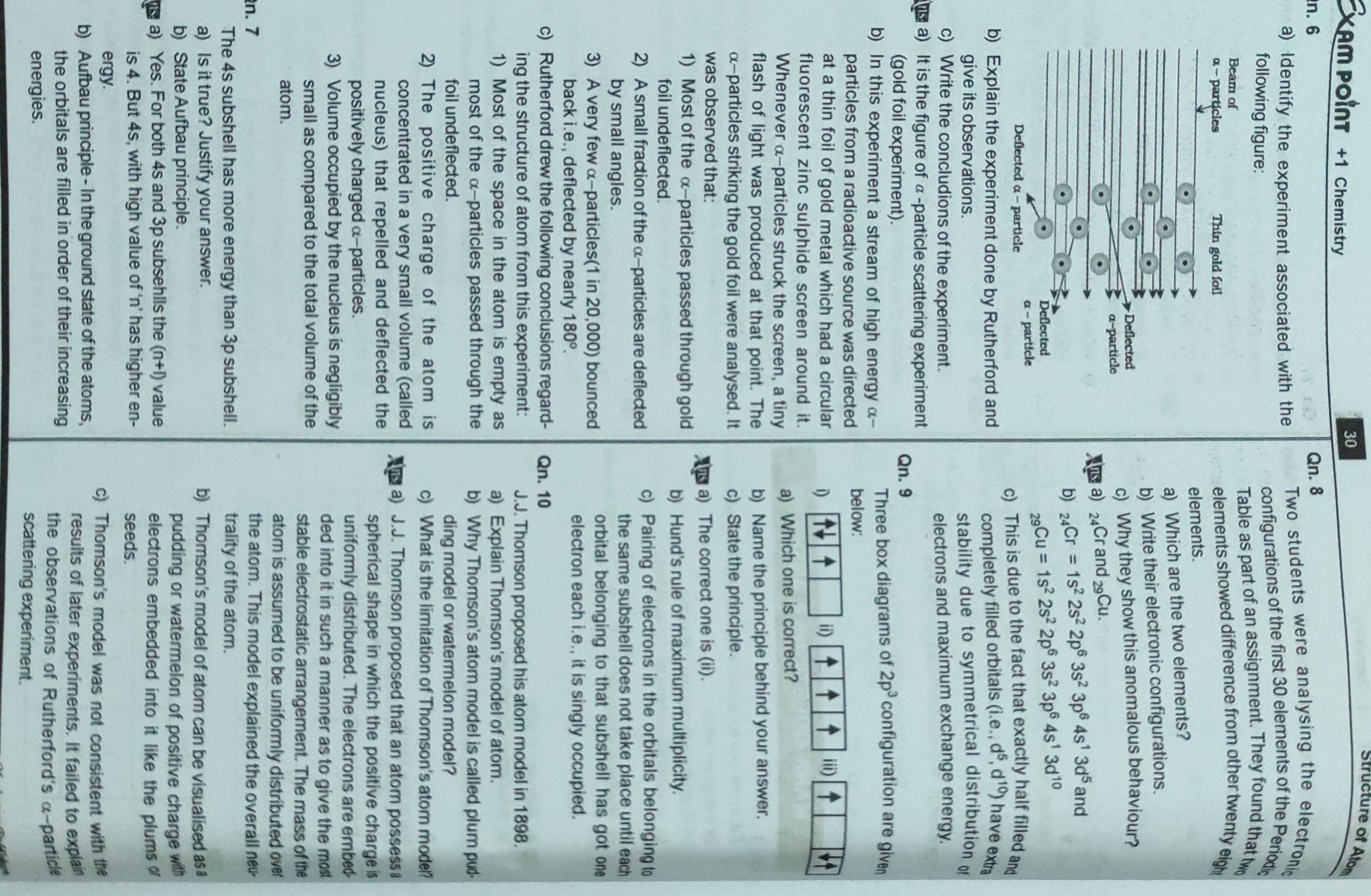
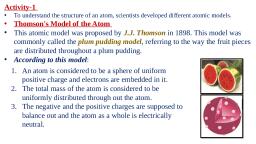
ay, «4, , Am Point +1 Chemistry, In. 6, , a) Identify the experiment associated with the, following figure:, , , , b, , 4, , Explain the experiment done by Rutherford and, , Give its observations., , C) Write the concludions of the experiment., , BS a) Itisthe figure of a -particle scattering experiment, , (gold foil experiment)., , b) In this experiment a stream of high energy a—, particles from a radioactive source was directed, at a thin foil of gold metal which had a circular, fluorescent zinc sulphide screen around it., Whenever «-—particles struck the screen, a tiny, flash of light was produced at that point. The, a—particles striking the gold foil were analysed. It, was observed that:, , 1) Most of the a—particles passed through gold, foil undeflected., , 2) Asmall fraction of the a—particles are deflected, by small angles., , 3) Avery few a—particles(1 in 20,000) bounced, back i.e., deflected by nearly 180°., , c) Rutherford drew the following conclusions regarding the structure of atom from this experiment:, 1) Most of the space in the atom is empty as, , most of the a—particles passed through the, , foil undeflected., , 2) The positive charge of the atom is, concentrated in a very small volume (called, nucleus) that repelled and deflected the, positively charged a—particles., , 3) Volume occupied by the nucleus is negligibly, small as compared to the total volume of the, atom., , in. 7, The 4s subshell has more energy than 3p subshell., a) lsit true? Justify your answer., b) State Aufbau principle., , w 3) Yes. For both 4s and 3p subsehils the (n+!) value, is 4. But 4s, with high value of ‘n’ has higher energy., , b) Aufbau principle - In the ground state of the atoms,, the orbitals are filled in order of their increasing, energies., , Ea, , OUUCTUTES of, , , , 8 ; a, on Two students were analysing the electron,, , configurations of the first 30 elements of the Re a, Table as part of an assignment. They found thaty,, elements showed difference from other twenty ie, elements. ss, a) Which are the two elements? !, b) Write their electronic configurations. ’, c) Why they show this anomalous behaviour? 4, a) 24Crand a9CU. j, _ b) 24cr = 187 2s? 2p® 3s? 3p® 4s! 3d° and, agCu = 1S" 2s? 2p® 3s? 3p° 4s' 3d"°, ¢) This is due to the fact that exactly half fill, completely filled orbitals (i.e., d°, d'°) have, stability due to sym metrical distributi, electrons and maximum exchange energy,, , , , Qn. 9, Three box diagrams of 2p* configuration are, , below: ’, , » RAL J LAL Lt) te), , a) Which one is correct? |, , b) Name the principle behind your answer., , c) State the principle., , 1D a) The correct one is (ii)., , b) Hund’s rule of maximum multiplicity. BS, , c) Pairing of electrons in the orbitals belonging|, the same subshell does not take place until e, , orbital belonging to that subshell has got ¢, electron each i.e., it is singly occupied., , Qn. 10 e, J.J. Thomson proposed his atom model in 1898,, a) Expiain Thomson's model of atom. 4, , b) Why Thomson's atom model is called plum pu, ding model or watermelon model? 7, c) Whatis the limitation of Thomson's atom mode, 1D a) J.J. Thomson proposed that an atom poss, spherical shape in which the positive charg, uniformly distributed. The electrons are emb, ded into it in such a manner as to give the m, atom is assumed to be uniformly distributed 01, , the atom. This model explained the overall n, trality of the atom. ;, b) Thomson’s model of atom can be visual!, pudding or watermelon of positive charg, electrons embedded into it like the plt, seeds. ", ¢) Thomson's model was not consistent with!, results of later experiments. it failed to exp, the observations of Rutherford’s a-parll, Scattering experiment.