Notes of 12 th Sci., Chemistry Equilirium - Study Material
Page 1 :
7. EQUILIBRIUM, , HAIZEL G. ROY, H.S.S.T. (HG) CHEMISTRY, GOVT. H.S.S. KALAMASSERY, ERNAKULAM
Page 3 :
PHYSICAL EQUILIBRIUM, , Equilibrium which involves only physical, changes is called physical equilibrium.
Page 4 :
GENERAL CHARACTERISTICS OF PHYSICAL EQUILIBRIUM, , Equilibrium can be established only in case of closed system., The equilibrium is always dynamic in nature., The measurable properties of the system become constant at equilibrium., At equilibrium, there exists an expression involving the concentration of, reacting substances which become constant at a given temperature.
Page 5 :
HENRY’S LAW, , The, , mass of gas dissolved in a given mass of a solvent at a particular, , temperature is proportional to the pressure of the gas above the solvent., OR, Henry’s law states that, the solubility of a gas is proportional to the pressure.
Page 6 :
EXAMPLE, , In, , soda water bottles, the dissolved and un dissolved molecules of CO 2, , exist in equilibrium., When, , the bottle is opened, the CO2 dissolved in it escapes out rapidly, , with a fizz., This, , fizzing out of soda bottle can be easily understood in terms of, , Henry’s law.
Page 7 :
FIZZING OF CARBONATED DRINKS
Page 8 :
REVERSIBLE REACTIONS, , Reactions in which the products of, the reaction can react with one, another under suitable conditions to, give back the original reactants.
Page 9 :
IRREVERSIBLE REACTIONS, , Reactions in which the products, of the reaction do not react back, to give the reactants.
Page 10 :
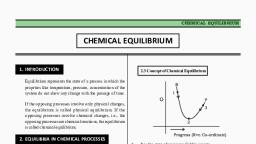
CHEMICAL EQUILIBRIUM
Page 11 :
CHEMICAL EQUILIBRIUM, , The state of reversible reaction at, which the rate of forward reaction is, equal to the rate of backward, reaction and the composition of the, system remains constant.
Page 12 :
CHEMICAL EQUILIBRIUM IS DYNAMIC IN NATURE, , In, , a chemical reaction, both forward and backward reactions do not stop, , but proceed at equal rates., The concentration of reactants and products remain constant., Therefore, the equilibrium is called dynamic equilibrium.
Page 14 :
CHARACTERISTICS OF CHEMICAL EQUILIBRIUM, , Chemical equilibrium is dynamic in nature., The, , observable properties of the system become constant at equilibrium and remain, , unchanged., The equilibrium can be approached from either direction., The equilibrium can be attained only if the system is a closed one., A catalyst cannot alter the position of equilibrium., The free energy change at constant temperature and pressure is zero.
Page 15 :
LAW OF MASS ACTION, , The law states that, “the rate of a reaction is directly proportional to the, product of the molar concentrations of the reacting substances at, constant temperature”.
Page 16 :
LAW OF MASS ACTION, , where [A] and [B] are the molar, concentrations of the reactants A, and B respectively., K is a constant known as rate, constant.
Page 17 :
RATE CONSTANT, , According to law of mass action,, , The rate constant of a reaction at a, , r = K[A][B], , given temperature may be defined, , If the concentration of each of the, , as the rate of the reaction when the, , reactants is unity,, , concentration, , i.e., [A] = [B] = 1, then r = K., , reactants is unity., , of, , each, , of, , the
Page 18 :
EQUILIBRIUM CONSTANT
Page 20 :
EQUILIBRIUM CONSTANT, , Equilibrium constant is defined as the ratio of the product of the molar, concentrations of the products to that of the reactants with each, concentration term raised to the power equal to its stoichiometric, coefficient in the balanced chemical equation.
Page 21 :
EQUILIBRIUM CONSTANT IN TERMS OF PRESSURE, , For, , reactions involving gases, the partial pressure of the reactants and, , products are proportional to the concentrations., Therefore, the law of chemical equilibrium can be expressed in terms of, , partial pressures instead of concentrations.
Page 22 :
Where PA , PB , PC , PD are the partial pressures of A, B, C and D respectively., KP is the equilibrium constant in terms of partial pressures.
Page 23 :
RELATION BETWEEN KP AND KC
Page 24 :
RELATION BETWEEN KP AND KC, , Where ∆n = [No. of moles of gaseous products ─ No. of moles of gaseous reactants], ∆n = (c + d) ─ (a + b)
Page 25 :
UNITS OF EQUILIBRIUM CONSTANT, , If the total number of moles of the reactants is exactly equal to the total, number of moles of products, ‘K’ has no units., If, , the total number of moles of products and reactants are not equal, ‘K’ will have, , units., Unit of Kc = (mol L ─1 ) ∆n, Unit of Kp = (atm) ∆n
Page 26 :
HOMOGENEOUS EQUILIBRIA, , The equilibria in which the substances involved are present in same, phases are called homogeneous equilibria.
Page 27 :
HETEROGENEOUS EQUILIBRIA, , The equilibria in which the substances involved are present in different, phases are called heterogeneous equilibria.
Page 28 :
APPLICATIONS OF, EQUILIBRIUM CONSTANT
Page 29 :
PREDICTION OF THE EXTENT OF A REACTION, Greater, , the value of equilibrium constant, greater will be the concentration of, , products., In general,, If Kc > 103 (i.e. Kc is very large), the reaction proceeds nearly to completion., If Kc < 10–3 (i.e. if Kc is very small), the reaction proceeds rarely., If, , the value of Kc is in between 103 and 10–3 appreciable concentrations of both, , reactants and products are present.
Page 30 :
PREDICTION OF THE DIRECTION OF THE REACTION, , i.e., Forward Reaction will proceed., If Qc = Kc, the reaction mixture is at equilibrium.
Page 31 :
CALCULATION OF EQUILIBRIUM CONCENTRATIONS, , By knowing the value of equilibrium constant, we can calculate the, equilibrium concentrations of reactants and products.
Page 32 :
RELATIONSHIP BETWEEN EQUILIBRIUM CONSTANT (Kc),, REACTION QUOTIENT (Qc) AND GIBBS ENERGY (G)
Page 33 :
FACTORS INFLUENCING, EQUILIBRIUM
Page 34 :
LE-CHATLIER’S PRINCIPLE, , According to Le-Chatlier Principle, whenever there is a change in, pressure, temperature or concentration of a system at equilibrium, the, system will try to adjust itself in such a way so as to nullify the effect of, that change.
Page 35 :
APPLICATIONS OF, LE-CHATLIER’S PRINCIPLE
Page 37 :
EFFECT OF TEMPERATURE, Formation of NH, An, , 3, , is favoured at low temperature as it is an exothermic reaction., , increase in temperature will shift the equilibrium in the backward direction as it is, , endothermic., A decrease in temperature favours the forward reaction as it is exothermic., So the manufacture of ammonia should be carried out at a lowest possible temperature., If, , the temperature is too low, the kinetic energy of the molecules will be too low and, , hence the reaction will be extremely slow., Therefore, an optimum temperature of about 773K is employed.
Page 38 :
EFFECT OF PRESSURE, , Increase, , in pressure will favour the formation of ammonia because its, , formation is accompanied by a decrease in the number of moles., On the other hand, a decrease in pressure will favour its dissociation.
Page 42 :
EFFECT OF TEMPERATURE, , The formation of SO, , 3, , is exothermic., , Therefore, a decrease in temperature will favour the formation of SO, An increase in temperature will favour the backward direction., , 3, , .
Page 43 :
EFFECT OF PRESSURE, , Increase, , in pressure will favour the formation of SO 3 as it is, , accompanied by a decrease in the number of moles., A decrease in pressure will favour its decomposition.
Page 44 :
EFFECT OF CONCENTRATION, , Addition of SO2 or O2 or removal of SO3 will shift the equilibrium in the, forward direction., , TO SUM UP, Low temperature, high pressure and high concentration of SO2 and O2 will, favour the formation of SO3 .
Page 46 :
EFFECT OF TEMPERATURE, , The dissociation of PCl, , 5, , is endothermic., , Therefore, an increase in temperature will favour its decomposition., On the other hand, a decrease in temperature will shift the equilibrium, , in the backward direction.
Page 47 :
EFFECT OF PRESSURE, , Decrease, , in pressure will favour the decomposition of PCl 5 as it is, , accompanied by an increase in the number of moles., On, , the other hand, an increase in pressure will shift the equilibrium in, , the backward direction.
Page 48 :
EFFECT OF CONCENTRATION, Addition of PCl5 increases the rate of decomposition of PCl5., , TO SUM UP, High temperature, low pressure and high concentration of PCl 5 will favour, the dissociation of PCl5.
Page 49 :
IONIC EQUILIBRIUM
Page 50 :
IONIC EQUILIBRIUM, , When an electrolyte is dissolved in water, it splits up into the ions., The process of ionisation is reversible in nature., Thus, , there is a state of dynamic equilibrium between the ions and the, , unionized molecules., Ionic, , equilibrium is the equilibrium which is established between the, , unionized molecules and the ions in solution of weak electrolytes.
Page 51 :
CONCEPTS OF ACIDS, BASES AND SALTS
Page 52 :
1. ARRHENIUS CONCEPT
Page 54 :
BASE, , Base is a substance which gives OH ─ ions in aqueous solutions., Eg:- NaOH, KOH, Ca(OH)2 etc.
Page 55 :
STRONG AND WEAK ACIDS, , Acids, , which are almost completely ionized in aqueous solutions are, , called strong acids., Eg:- HCl, HNO, Acids, , 3, , etc., , which are only slightly ionized in aqueous solutions are called, , weak acids. Eg:- CH3COOH, HCOOH etc.
Page 56 :
STRONG AND WEAK BASES, , Bases, , which are almost completely ionized in aqueous solutions are, , called strong base. Eg:- NaOH, KOH etc., Bases, , which are only weakly ionized in aqueous solutions are called, , weak bases. Eg:- NH4OH, Ca(OH)2 etc.
Page 57 :
2. BROSTED AND LOWRY CONCEPT, , This concept was put forward by Bronsted and Lowry in 1923., An acid is a substance which can donate a proton., Base is a substance which can accept a proton., In other words, an acid is a proton donor and base is a proton acceptor.
Page 59 :
AMPHOTERIC SUBSTANCES, , Substances, , which are capable of donating as well as accepting protons, , are called amphoteric substances., Eg:- H, , 2, , O behaves as an acid as well as a base.
Page 60 :
CONJUGATE ACID BASE PAIRS, , Consider an acid base reaction,, Here acid donates a proton and becomes a base., The base accepts a proton and becomes an acid., The base formed from an acid is called conjugate base of the acid, The acid formed from a base is called the conjugate acid of the base.
Page 61 :
In, , the above example, Cl ─ is the conjugate base of HCl and NH4+ is the, , conjugate acid of NH3 ., The, , pairs of acids and bases which are formed from each other by the, , gain or loss of a proton are called conjugate acid base pairs.
Page 62 :
RELATIVE STRENGTH OF CONJUGATE ACIDS AND BASES, , According, , to Bronsted Lowry Concept, the strength of an acid depends, , upon its tendency to denote a proton., The strength of a base depends up on its tendency to accept a proton.
Page 63 :
HCl has a strong tendency to donate proton, therefore it is a strong acid., But Cl ─ ion has very little tendency to accept a proton., Therefore, Cl ─ ion is a weak base., The conjugate base of a strong acid is a weak base., The conjugate base of a weak acid is a strong base.
Page 64 :
3. LEWIS CONCEPT, , An acid is a substance which can accept a pair of electrons., A base is a substance which can donate a pair of electrons., In other words, an acid is an electron pair acceptor and base is an electron pair donor., Eg:- BF, , +, ,, AlCl, ,, H, etc are Lewis acids., 3, 3, , Eg:-─NH, , ─, ─, ─, ,, R, ─, O, ─, H,, CN, ,, I, ,, OH, etc are Lewis bases., 3
Page 65 :
IONIC PRODUCT OF WATER
Page 66 :
pH SCALE, , The term pH was introduced by Sorenson., It is the short form of the Danish words Potenz Hydrogen, meaning power of, , hydrogen., It measures the concentrations of H+ ions., pH is defined as the negative logarithm of hydrogen ion concentration in moles, , per litre.
Page 69 :
pOH, , pOH is defined as the negative logarithm of the hydroxyl ion, concentration in moles per litre., P OH = - log[OH - ]
Page 70 :
Pkb, , Pkw, , It is the negative logarithm of Kb ., Pkb = logkb, , It is the negative logarithm of K w ., , Lower the value of Pkb , stronger will be, , P Kw = log Kw, , the base.
Page 72 :
IONISATION CONSTANTS OF WEAK ACIDS AND WEAK BASES
Page 74 :
INDICATORS, , A, , substance which indicates the completion of a chemical reaction by a sharp colour, , change., An, , acid base indicator is a substance which changes colour according to the hydrogen, , ion concentration or pH of the solution to which it is added., An acid base indicator is either a weak organic acid or a weak base., They possess different colours in ionized and unionized state.
Page 77 :
SOLUBILITY PRODUCT, , Consider a saturated solution of a sparingly soluble salt., In, , the saturated solution of a sparingly soluble salt, a dynamic, , equilibrium is established between un dissolved molecules and the, dissociated ions.
Page 79 :
Where Ksp is known as solubility product., Solubility product of an electrolyte at a fixed temperature is the product, , of the concentrations of the ions in a saturated solution of an electrolyte.
Page 80 :
COMMON ION EFFECT, In a solution of a weak electrolyte, a dynamic equilibrium is established, between the un dissociated molecules and the dissociated ions.
Page 81 :
To this solution, another electrolyte which can supply the common ion A+ or B ─ is added., In order to keep the K value constant, AB must suppress its ionisation., Therefore,, , the ionisation of a weak electrolyte can be suppressed by the addition of, , another electrolyte containing a common ion., This effect is known as common Ion effect., The, , suppression of the dissociation of the weak acid or a weak base by the addition of a, , strong electrolyte containing a common ion is called common ion effect.
Page 82 :
Eg:-Consider the dissociation of the weak base NH, , The, , 4, , OH., , dissociation of NH4OH will be suppressed by the addition of an, , electrolyte like NH4Cl which can supply the common ion, NH4+ .
Page 83 :
BUFFER SOLUTION, , A solution which maintains its pH fairly constant even on the addition of a, , small amount of an acid or a base., A, , buffer solution is a solution which resists the change in pH value on the, , addition of small amount of acid or base., Buffers are of two types.
Page 84 :
ACIDIC AND BASIC BUFFER, , A mixture of a weak acid and its, , A mixture of weak base and its salt, , salt with a strong base is called an, , with a strong acid are called basic, , acid buffer., , buffer., , Eg:- A mixture of CH3COOH and, , Eg:- A mixture of NH4OH and NH4Cl, , CH3COONa
Page 85 :
BUFFER ACTION, , The ability of the buffer solution to resist the change in pH value on the, addition of small amount of an acid or a base is called buffer action.
Page 86 :
pH OF A BUFFER SOLUTION, HENDERSON - HASSELBALCH EQUATION
Page 90 :
HYDROLYSIS OF SALTS, The phenomenon of interaction of anions and cations of the salt with H+ or OH─ ions, furnished by water to give alkaline or acidic solutions is known as, salt hydrolysis., The cations of strong bases and anions of strong acids do not get hydrolyse., So the solutions of salts formed from strong acids and bases are neutral i.e., their pH is, 7., Eg. NaCl, KCl, NaNO3 , KNO3 , Na2SO4 , K2SO4 etc.
Page 91 :
HYDROLYSIS OF SALT OF STRONG BASE AND WEAK ACID, , Sodium acetate (CH, , COONa), sodium carbonate (Na2CO3 ), potassium, , 3, , cyanide (KCN) etc. are examples for such type of salts., Here, , only the anion of the weak base undergoes hydrolysis (since cation of the strong, , base does not hydrolyse)., So the solution of such salts will be basic. i.e. pH > 7., pH of such salt solution is given by pH = 7 + 1⁄2 (pKa + log C), Where C is the concentration of salt.
Page 92 :
HYDROLYSIS OF SALT OF WEAK BASE AND STRONG ACID, , NH, , Cl, NH4NO3 , CuSO4 etc are examples for such type of solutions., , 4, , Here only cation of weak base undergoes hydrolysis., So the solution is acidic., pH of such a solution is given by pH = 7 + 1⁄2 (pKb + log C).
Page 93 :
HYDROLYSIS OF SALT OF WEAK BASE AND WEAK ACID, Ammonium acetate (CH, , COONH4 ), ammonium carbonate [(NH4)2CO3 ] etc., , 3, , are examples for such type of salts., Here both cation and anion undergo hydrolysis., Hence weak acid and weak base are produced in solution., So the solution may be neutral, acidic or basic depending upon the relative, strength of acid and base formed., pH of such a solution is given by pH = 7 + 1⁄2 (pKa + pKb).



 Learn better on this topic