Notes of B.Sc. First Year, Botany puccinia.pdf - Study Material
Page 4 :
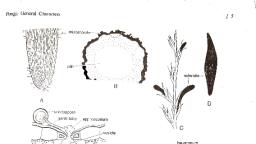
Uredinales: Puccinia, , ]34], , teleutosorus, ruptured host, epidermis, , ,, , exine----=r /."'i, 6, , intlne, dlkaryon, body----..., , stalk----,, d, , mycelium, , A, , C, , B, , Fig. 2 A-C. Puccinia graminis: Teleutospore stage; A. Teleutosori on wheat leaf, B. Vertical section, of wheat leaf passing through a teleutosorus, C. Teleutospore., , infection of uredospores. The teleutosori appear as, black raised streaks along leaf sheaths and stems of, infected plants (Fig. 2 A). Groups of binucleate cells, ,~'hich gjye nse to teleutospores are known as telia., The~ teleutospore is stalked. bi-celled, spindle, shaped structure. constrictedslightly at the septum, 'Fig. 2 RC). The wall of the teleutospore is thick, and smooth. and the tip is usually pointed or round., Each cell of the teleutospore is binucleate and is, proFided v.ith a germ pore. The germ pore is at the, apex in the upper cell. whereas it is just below the, septum in the lower cell. As the teleutospore, matures. the two nuclei in a cell fuse to form a, diploid nucleus (Fig. 2 C)., Like uredospores, the teleutospores also exert, pressure on the overlying epidermis. The epidermis, is thus ruptured and the spores are exposed. The, teleutospores act as resting spores and may survive, most unfavourable conditions. They are incapable, of reinfecting wheat plants. They do not germinate, until the next spring. Under favourable conditions, of high atmospheric humidity and low temperature,, they germinate in soil as no host is required for, their germination., , -, , [ill] Basidiospore stage, On return of ,favourable, conditions in spring, the, --teleutospore germinates. It produces one germ tube, from each cell. The germ tube has lim ited growth, and is known as ~mycelium or epibasidium, (Fig.· 3 A, B). The dip1oia'7iiicieiTs moves Jli'to"" the, promy.cetium and divides meiotically to fot~m four, , haploid nuclei, two of (+) and two of (-) strain., The promycelium now divides into four cells by, the formation of transverse septa. Each cell produces, a single basidiospore which is borne asymmetrically, on a fine sterigma. The four basidiospores are thus, formed on each promycelium, two of (+) and__JW., of (-) strain. Basidiospores are small, unicellular, and thin walied structures, each with a haploid, nucleus. They are discharged by an explosive, mechanism and are disseminated by wind. They can, germinate only on the leaves of alternate host,, barberry bushes. Basidios.pores can survive only for, few days and they perish in the absence of alternate, host., -, , ---~-teloutos pores, , A, , B, , Fig. 3 A-B. Puccinin grnminis: Ge1mination of teleutospore, and formation of bas idia.



 Learn better on this topic