Notes of SYBA, Indian Economy INDIAN ECONOMY- intro.pptx - Study Material
Page 2 :
Meaning and Definition, The Indian economy is a developing economy, and this is owed to the fact that there are extremely high levels of poverty, unemployment, illiteracy, etc. in India. With a suddenly diminishing Gross Domestic Product (GDP) to add to the various problems faced by the Indian economy, there are a lot of factors which contribute to the nature and characteristics of Indian economy being a developing economy. , The meaning of the economic system refers to the role or model of distribution and production which take place in the society.

Page 3 :
SOME BASIC CONCEPT OF INDIAN ECONOMY, ECONOMIC GROWTH, ECONOMIC DEVELOPMENT, Let’s understand the characteristic features of developing economies and then understand how these features apply to the Indian economic realm
Page 4 :
FEATURES/CHARACTRISTICS OF INDIAN ECONOMY, Excessive dependence on agriculture, Low per capita income, Population growth, Unemployment and underunemployment, Inequality in wealth distribution, Low level of technology, Lack of infrastructure, Poor quality of human capital, Under utilization of resources, Private and public sector
Page 5 :
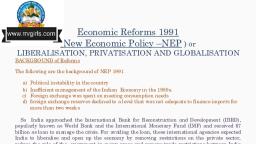
MODULE 1NEW ECONOMIC POLICY 1991, New Economic Policy of India was launched in the year 1991 under the leadership of P. V. Narasimha Rao. ... Narasimha Rao government reduced the import duties, opened reserved sector for the private players, devalued the Indian currency to increase the export. This is also known as the LPG Model of growth., New Economic Policy refers to economic liberalisation or relaxation in the import tariffs, deregulation of markets or opening the markets for private and foreign players, and reduction of taxes to expand the economic wings of the country.
Page 6 :
The main objectives behind the launching of the New Economic policy (NEP) in 1991 by the union Finance Minister Dr. Manmohan Singh are stated as follows., 1. The main objective was to plunge Indian Economy in to the arena of ‘Globalization and to give it a new thrust on market orientation., 2. The NEP intended to bring down the rate of inflation, 3. It intended to move towards higher economic growth rate and to build sufficient foreign exchange reserves., 4. It wanted to achieve economic stabilization and to convert the economy into a market economy by removing all kinds of un-necessary restrictions., 5. It wanted to permit the international flow of goods, services, capital, human resources and technology, without many restrictions., 6. It wanted to increase the participation of private players in the all sectors of the economy. That is why the reserved numbers of sectors for government were reduced. As of now this number is just 2.
Page 8 :
Following steps were taken under the Liberaliation measure:, (i) Free determination of interest rate by the commercial Banks:, (ii) Increase in the investment limit for the Small Scale Industries (SSIs):, (iii) Freedom to import capital goods:, (v) Freedom for expansion and production to Industries:, (vi) Abolition of Restrictive Trade Practices:
Page 9 :
1. LIBERALISATION, Removal of Industrial Licensing and Registration:, Previously private sector had to obtain license from Govt. for starting a new venture. In this policy private sector has been freed from licensing and other restrictions., Industries licensing is necessary for following industries:, (i) Liquor, (ii) Cigarette, (iii) Defence equipment, (iv) Industrial explosives, (v) Drugs, (vi) Hazardous chemicals
Page 10 :
2. PRIVATISATION:, , privatisation means permitting the private sector to set up industries which were previously reserved for the public sector. Under this policy many PSU’s were sold to private sector. Literally speaking, privatisation is the process of involving the private sector-in the ownership of Public Sector Units (PSU’s)., The main reason for privatisation was in currency of PSU’s are running in losses due to political interference. The managers cannot work independently. Production capacity remained under-utilized. To increase competition and efficiency privatisation of PSUs was inevitable., , The following steps are taken for privatisation:, 1. Sale of shares of PSUs:, 2. Disinvestment in PSU’s:, 3. Minimisation of Public Sector:, (a) Railway operations, (b) Atomic energy
Page 11 :
3. GLOBALIZATION:, Globalisation means to make Global or worldwide, otherwise taking into consideration the whole world. Broadly speaking, Globalisation means the interaction of the domestic economy with the rest of the world with regard to foreign investment, trade, production and financial matters., Following steps are taken for Globalisation:, (i) Reduction in tariffs:, Custom duties and tariffs imposed on imports and exports are reduced gradually just to make India economy attractive to the global investors., (ii) Long term Trade Policy:, Forcing trade policy was enforced for longer duration.
Page 12 :
Main features of the policy are:, (a) Liberal policy, (b) All controls on foreign trade have been removed, (c) Open competition has been encouraged., (iii) Partial Convertibility of Indian currency:, Partial convertibility can be defined as to convert Indian currency (up to specific extent) in the currency of other countries. So that the flow of foreign investment in terms of Foreign Institutional Investment (FII) and foreign Direct Investment (FDI)., This convertibility stood valid for following transaction:, (a) Remittances to meet family expenses, (b) Payment of interest, (c) Import and export of goods and services., (iv) Increase in Equity Limit of Foreign Investment:
Page 13 :
REVIEW OF FIVE YEAR PLAN, 1ST FYP 1951-56 – Agriculture Devp, 2ND FYP 1956-61 – Industrial Devp, 3RD FYP 1961-66 – Make economy independent and self active position, PLAN HOLIDY 1966-69 – Indo-Pak war, 4TH FYP 1969-74 – Growth with stability and family programme (garibi hatao), 5TH FYP 1974- 79 – Remove poverty, self reliance, top priority to agri next came to industry and mining, ROLLING PLAN 1978-79 – Annual plan, 6TH FYP 1980-85 – poverty eradication, tech self reliance, infrastructure devp
Page 14 :
7TH FYP 1985-90 - Self sufficient economy, opportunity of employment, 1st time private sector got priority over public sector, ANNUAL PLAN 1990-92 - Violate political situation, 8TH FYP 1992-97 - Narsima rao govt. launched new economic policy in India, Devp of human resources i.e. Employment, Education, Public health, 9TH FYP 1997-02 - Growth with justice & equality, focus on govt. sector FDI, 10TH FYP 2002-07 - More focus on govt. panchayati raj, 11TH FYP 2007-12 - Aim on increase saving and investment, 12TH FYP2012-17 - More inclusive & sustainable growth, INTEGRATED DEVELOPMENT PROGRAMME (IDP) 2017-20 – Defence and security & development of monetary sector.