Notes of XI Commerce, English silk road.pdf - Study Material
Page 1 :
Shrikanwartara Public Higher Secondary School, Mandleshwar, Class:11th, Sub: English, Topic: Silk Road, , Word-Meaning, • Ducking back → Going back, • Manoeuvres → Movements – usually predetermined or predefined, • Billowed → Appeared, • Swathe → A narrow strip, • Cairn of rocks → Heap of stone made as a monument, landmark etc, • Careered down → Climbed down, • Salt flats → Area where salt has been deposited, • Flawless → Without defects, Perfect, Clear, • French loaves → Pieces of French bread, • Glow → Shine, • Splash → Spread,, • Tint → Colour, • Blush → Shade, Tinge, • Farewell present → A gift given when someone is leaving, • Heading → Going, • Kailash Kora → Pilgrimage of Kailash, • Ought → Must, Should, • Ducking back → Going back
Page 2 :
• Emerged → Appeared, • Sized up → Looked carefully, • Clambering → Walked with difficulty, • Drokba → Shepherd, • Get off → Bypass, • Involved → Included, • Mountain passes → Roads made along mountains, • Likelihood → Possibility, • Gazelles → Type of animal, • Nibbling → Eating, • Arid → Dry, • Frown → Slightly distort the face or eyebrows, • Bounding away → Running away, • Void → Open space, Place where nobody lives, • Kyang → Wild ass of Tibet region, • Pall of dust → Cloud or layer of dust in the sky, • Galloping → Running quickly, • En masse → Together, Every body, • Manoeuvres → Movements, • Plume of dust → Cloud of dust, • Billowed → Appeared, • Wilderness → From nowhere, Suddenly, • Solitary → Alone. Lonely
Page 3 :
• Tending →Taking care of , Rearing, • Well-wrapped → Fully covered, • Waving → Signaling, • Track → Path, • Evasive → Try to avoid, • Veering → Change direction, Move to other direction, • Nomad → Person moving from one place another,, • Pitched → Made, • Splendid → Amazing,, • Isolation → Alone, • Mastiff → Type of dog, • Cock →Tilt, Bend, • Fix us in their sight → Continue to stare, • Exploded into action → Suddenly started taking action, • Shaggy → Full of long hair, • Furious → Frightening, Violent, Fierce, • Massive → Very big, • Shooting → Moving quickly, • Swerve → Abruptly change direction, • Chase → Follow, • Easing off → Stop or reduce the speed, • Imperial courts → Kingdom, • Snow capped mountains → Mountains that had snow at their top
Page 4 :
• Clogged → Full of, • Glinting → Shining, • Trail → Path, • Hugged → Very very close, • Meanders → Twisting path of river, Having many curves, • Closed in → Came nearer, • Bumpier → More jumping, • Track → Path, • Labour → To make large efforts, • Sported → Showed, • Daubed → Splashed, Stained, • Lichen → Type of plant, • Hunks → Lump, Chunk, Piece, • Cling →To stick, • Tight bend → Sharp bend, • Swathe → A narrow strip, • Petered out → Decreased, Ended, • Trail → Path, • Stepped on to → To walk on, To stand on, • Encrusted → Gathered in a heap, Became hard, • Slither → Move smoothly, • Stamping → Putting foot on ground with force, • Ascertain → Assess, Understand
Page 5 :
• Sturdy → Strong, • Fling →Throw, Spread, • Pitched in → Helped, • Apparent → Visible, Evident, Obvious, • Blockage → Obstruction, • Survey → Examine, • Studded with → Full of, • Negotiated → Passed through, • Lurching → Swaying, Jumping over, • Hairpin bend →Very sharp curve, • Drifted → Spread,, • Crept past → Moved ahead slowly, • Throb → A fluctuating pain, • Horribly → Very painfully, • Gulps → Swigs, To drink in small quantity, • Rapid → Quick, • Ascent → Upward climb, • Cairn of rocks → Heap of stone made as a monument, landmark etc, • Festooned → Decorated, • Ragged → Old and torn, • Unscrewed → Opened by rotating, • Emitted →Gave, Generated, Created, • Hiss → A sound when air or vapours comes out of a container
Page 6 :
• Careered → Moved quickly, • Plateau → A flat are between hills, • Salt Flats → Area where salt has been deposited, • Pockmarked → Spread across, Exisiting at many places, • Brackish → Salty, Saline, • Vestiges → Reminders, Sign, indication, • Great collision → A very big change that occurred on earth, • Cosmology → The science of origin of this world, • Pinpoints → Indicates precisely, • Headwaters → Source, • Flanks → Sides, • Striking distance → Very close, • Forge ahead → Move ahead, • Draught → Flow of air, • Compensate → Reduce the effect, • Filthy → Dirty, • Rag → Torn cloth, • Relieved → Released, • Solitary confinement →Alone in a room, • Rubbish → Refuse, Waste, • Stark contrast → Exactly opposite, • Accounts → Description, • First encounters → First visit
Page 7 :
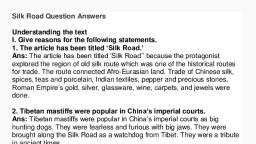
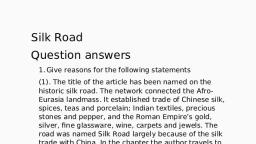
• Sanctity →Purity, Holiness, • Burst into tears → Started crying, • Hallowed → Holy, • Prone → Vulnerable, To easily get affected, • Sentimental → Emotional, • Outbursts → Expression, • Drew up → Stopped, Understanding the text, I. Give reasons for the following statements., 1. The article has been titled ‘Silk Road.’, Ans: The article has been titled ‘Silk Road’’ because the protagonist explored the region of old, silk route which was one of the historical routes for trade. The route connected Afro-Eurasian, land. Trade of Chinese silk, spices, teas and porcelain, Indian textiles, pepper and precious, stones, Roman Empire’s gold, silver, glassware, wine, carpets, and jewels were done., 2. Tibetan mastiffs were popular in China’s imperial courts., Ans: Tibetan mastiffs were popular in China’s imperial courts as big hunting dogs. They were, fearless and furious with big jaws. They were brought along the Silk Road as a watchdog from, Tibet. They were a tribute in ancient times., 3. The author’s experience at Hor was in stark contrast to earlier accounts of the place., Ans: Hor was an ugly and miserable place which had no vegetation and just dust and rocks. It, was scattered with gathered refuse and it is luckless that it was on the shore of Lake, Mansarovar which is Tibet’s most respected water. Ekai Kawaguchi was a Japanese monk who, arrived in the town in 1900, he was so moved with the purity of the lake that he cried. After a, few years, similar effect was on Sven Hedin a Swedish who didn’t have such an emotional, outburst., The protagonist’s car suffered from two punctures in that place. When he reached that place’s, only café to have some tea, the place was filled with badly painted concrete and three broken, windows., 4. The author was disappointed with Darchen., Ans: He was disappointed with Darchen because he was having health issues due to change in, altitude. He had a cold and was unable to sleep at night. The place had no pilgrims and it was, filled with loads of remains and trash., 5. The author thought that his positive thinking strategy worked well after all., Ans: The author thought that his positive thinking strategy worked well after all because he, finally met someone who understood his language and was there to complete the kora just like, him. He met Norbu at Darchen’s only café. Earlier, he got ill as soon as he reached the place. No, one understood English well. He felt lonely as there were no pilgrims around.
Page 8 :
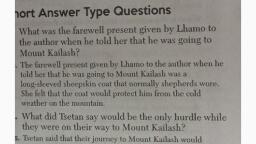
He decided to team up with him to complete his journey. He was glad he maintained his, positive thinking approach in life., , Extra Questions:, 1. Write about a place that you had visited recently in about 100-120 words., 2. Write a travelogue on “A Visit to Agra”., , EB 1. A flawless half-moon floated in a perfect blue sky on the morning we said our goodbyes., Extended banks of cloud like long French loaves glowed pink as the sun emerged to splash the, distant mountain tops with a rose-tinted blush. Now that we were leaving Ravu, Lhamo said she, wanted to give me a farewell present. One evening I’d told her through Daniel that I was heading, towards Mount Kailash to complete the kora, and she’d said that I ought to get some warmer, clothes., (i) Where was author going to?, (a) Ravu, (b) Lhamo, (c) Mount Kailash, (d) None of the above, (ii) Which figure of speech has been used in the phrase ‘banks of cloud like long French loaves’, (a) Metaphor, (b) Alliteration, (c) Oxymoron, (d) Simile, (iii) Which of the following objects could be seen in the sky on that day, 1. Moon, 2. Sun, 3. Bread
Page 9 :
4. Trees, 5. Clouds, 6. Mountains, (a) 1, 2 and 3, (b) 1,2 ,5 and 6, (c) 2,5 and 6, (d) 2,3 and 6, (v) Based on above extract classify following as facts or opinion., 1. Author was going to Mount Kailsah to complete kora, 2. Author did not have any warm clothes, 3. I can assume that Lhamo did not understand any word of author, 4. Mountains must have been capped with snow, 5. Moon and Sun both were visible in the sky, 6. Daniel was the translator for the author, (a) F – 1,5, 6 and O- 2, 3 ,4, (b) F – 1,2, 4, and O – 3, 5, (c) F – 1,4,5 and O – 2,3, (d) F – 4, 5 and O -1,2,3



 Learn better on this topic