Notes of B.Com I Sem Nep, Digital Fluency & Digital Fluency & Digital Fluency IMG_20220105_090232.jpg - Study Material
Page 1 :
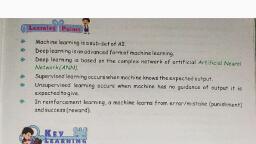
AI stands for Artificial Intelligence,, and is basically the study/process, which enables machines to mimic, human behaviour through particular, algorithm., , , , , , , , , , , , , , , , Machine Learning _, , ML stands for Machine leila,, and is the study that uses statistical, methods enabling machines to, improve with experience., , “|IDL stands for Deep Learning, eep Learning, and is, the study that makes use of Neural, Networks(similar to neurons present, in human brain) to imitate, , , , , , , functionality just like a human brain., , , , , , , , , , , , , , , , , , , , , , , , , , AI is the broader family cons: ling, of ML and DL as it’s components., , —o, , Al is a computer algorithm wich, exhibits intelligence throug!, decision making., , , , , , , , , , , , , Search Trees and much complex, math is involved in Al., , The aim is to basically inc:, chances of success and no!, accuracy., , Three broad categories/types Of AI, are: Artificial Narrow Inte!’ ., (ANI), Artificial General, Intelligence (AGI) and Arti c/a!, Super Intelligence (ASI), , , , , , , The efficiency Of Al is bas:, the efficiency provided by, DL respectively., , , , If you have a clear idea about the, , , , } {L is the subset of AI., , [pu is the subset of ML., , , , , , IML is an AI algorithm which, , |, , allows system to learn from data., , , , IDL is a ML algorithm that uses, , deep(more than one layer) neural, networks to analyze data and provide, output accordingly., , , , ——, , —=—, , logic(math) involved in behind and, you can visualize the complex, Lunctionalities like K-Mean,, Support Vector Machines, etc., then, it defines the ML aspect., , , , ||the DL aspect., , ata you are clear about the math, , involved in it but don’t have idea, about the features, so you break the, complex functionalities into, linear/lower dimension features by, adding more layers, then it defines, , , , , , [he aim is to increase accuracy not, caring much about the success ratio., , a, , It attains the highest rank in terms of, accuracy when it is trained with large, amount of data., , , , , , Three broad categories/types Of, VIL are: Supervised Learning,, Unsupervised Learning and, \einforcement Learning, , Less efficient than DL as it can’t, vork for longer dimensions or, nigher amount of data., , \Networks and Recursive Neural, Networks, , |More powerful than ML as it can, , , , - :, , DL can be considered as neural, networks with a large number of, \parameters layers lying in one of the, , (four fundamental network, , architectures: Unsupervised Pretrained Networks, Convolutional, Neural Networks, Recurrent Neural, , eeerinuireeteiie a tase, , easily work for larger sets of data., , , , , , , , Examples of AI application, , include: Google’s Al-Powe: ci, Predictions, Ridesharing Aj os Like, Uber and Lyft, Commercia! !°li:, Use an AI Autopilot, etc., , , , , , |, ifyfa, LVS, , , , I:xamples of ML applications, include: Virtual Personal Assistants:, Siri, Alexa, Google; etc., Email, pain and Malware Filtering., , |., , Examples of DL applications, , , , include: Sentiment based news, aggregation, Image analysis and, caption generation, etc.



 Learn better on this topic