Notes of FYBCOM- DIV 1&3, Business Economics FYBCOM-B.ECO.pptx - Study Material
Page 2 :
MODULE/UNIT 4, COST OF PRODUCTION, , COST CONCEPTS: The concept of cost is a key concept in Economics. It refers to the amount of payment made to acquire any goods and services. In a simpler way, the concept of cost is a financial valuation of resources, materials, undergone risks, time and utilities consumed to purchase goods and services. From an economist's point of view, the cost of manufacturing any goods and services is often said to be the concept of opportunity cost. , With heightened competition in today's world, companies urge to make maximum profits. The company's decision to maximize earnings relies on the behaviour of its costs and revenues. Besides the concept of opportunity cost, there are several other concepts of cost namely fixed costs, explicit costs, social costs, implicit costs, social costs, and replacement costs.
Page 3 :
TYPES/KINDS OF COST, ACCOUNTING OR INTELLECTUAL COST, OPPORTUNITY COST, INCREMENTAL COST, SUNK COST, REPLACEMENT COST, SHUTDOWN COST, ABANDOMENT COST, SHORT RUN AND LONG RUN COST , FIXED AND VARIABLE COST
Page 4 :
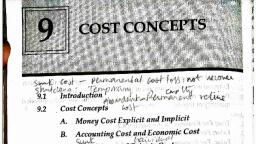
COST CONCEPT, IMPLICIT COST = Imputed cost of resources owned by the entrepreneur = opportunity cost of resources owned by the entrepreneur = indirect cost, EXPLICIT COST = Expenditure on hiring or purchasing inputs = output pocket cost = direct cost, ACCOUNTING PROFIT = Total revenue – explicit cost, ECONONOMIC PROFIT = Total revenue – total cost (Implicit + Explicit cost), TOTAL COST = TC = f (q), TC = TFC + TVC