Notes of 11 COMMERCE, Business bst 11 chapter 7 (2).pdf - Study Material
Page 1 :
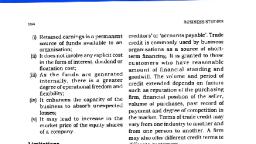
Retained Earnings, , A portion of the net earnings retained in the business for use, in the future is known as retained earnings. This is also, referred to as ‘ploughing back of profits’., , Merits of Retained Earnings, , * Retained earnings is a permanent source of funds., , * It does not involve any explicit cost in the form of interest,, dividend or floatation cost., , e¢ There is a greater degree of operational freedom and, flexibility., , ¢ It enhances the capacity of the business to absorb, unexpected losses., , + It may lead to increase in the market price of the equity, shares., , Demerits of Retained Earnings, Dissatisfaction amongst the shareholders as they would get, , lower dividends., ¢ Itis an uncertain source of funds as the profits of business, , are fluctuating., ¢ The opportunity cost associated with these funds is not, recognised by many firms., , Global Depository Receipts (GDRs)/, International Depository Receipts (IDRs), , The local currency shares of a company are delivered to the, depository bank. The depository bank issues depository, receipts against these shares. Such depository receipts, denominated in US dollars are known as Global Depository, Receipts (GDR).
Page 2 :
GDR is an instrument issued abroad by an Indian company, to raise funds in some foreign currency and is listed and, traded on a foreign stock exchange., , American Depository Receipts (ADRs), ipts issued by a company in the USA are, , Depository Receipts. It is similar to a, be issued only to American citizens, , ded on a stock exchange of USA., , The depository rece, known as American, GDR except that it can, and can be listed and tra
Page 3 :
4.6 International Depository Receipt [(IDR), (Owners' Fund-Long-term Finance)], , ——, , An IDR is also like GDR except that it is issued to citizen of India. Through IDR, foreign, companies raise funds from Indian market., , The foreign company IDRs will deposit shares to an Indian Depository. The depository, issues receipts to investors in India against these shares. Standard Chartered Bank was the first, , global company to file for an issue of IDR in India. ‘ . ‘, pany dint Gd Yat ov, , <I
Page 4 :
Trade Credit, , Trade credit is the credit extended by one trader to another for, the purchase of goods and services. Such credit appears in the, records of the buyer of goods as ‘sundry creditors’ or ‘accounts, payable’. Trade credit is commonly used by business, organisations as a source of short-term financing., , Merits of Trade Credit, , @, , Trade credit is a convenient and continuous source of funds., Trade credit may be readily available in case the credit, worthiness of the customers is known to the seller., , Trade credit helps to promote the sales of an organisation., Trade credit can be availed in situation when any firm wants, to increase its existing inventory levels to a higher level., , It does not create any charge on the assets of the firm while, providing funds., , Demerits of Trade Credit, , 6, , Availability of easy and flexible trade credit facilities may, induce a firm to indulge in overtrading., Only limited amount of funds can be generated through, , trade credit., It is generally a costly source of funds.
Page 5 :
Public Deposits, , The deposits that are raised by organisations directly from, the public are known as public deposits. Rates of interest, offered on public deposits are usually higher than that, offered on bank deposits. Public deposits can take care of, both medium and short-term financial requirements of a, , business. The acceptance of public deposits is regulated by, the Reserve Bank of India., , Merits of Public Deposits, , ¢ The procedure of obtaining deposits is simple., , © Cost of public deposits is generally lower than the cost of, borrowings from banks and financial institutions., , ¢ Public deposits do not usually create any charge on the, assets of the company., , « The control of the company is not diluted as the, depositors do not have voting rights.