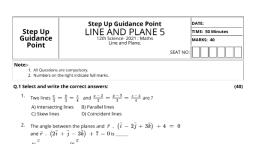
MCQ Test of Class 12, Maths Line and Plane - Study Material
Question 2 :
Find vector equation for the line passing through the points $3\overline i+4\overline j-7\overline k,\overline i-\overline j+6\overline k$.<p></p><p></p><p></p><p></p><p></p><p></p>
Question 3 :
Equation to a line parallel to the vector $2\hat{i}-\hat{j}{+}\hat{k}$ and passing through the point $\hat{i}+\hat{j}{+\hat{k}}$<br/>
Question 4 :
The position vector of point $A$ is $(4, 2, -3)$. If $p_{1}$ is perpendicular distance of $A$ from $XY-plane$ and $p_{2}$ is perpendicular distance from Y-axis, then $p_{1} + p_{2} =$ _______.
Question 5 :
$L$ and $M$ are two points with position vectors $2\overline { a } -\overline { b } $ and $a+2\overline { b } $ respectively. The position vector of the point $N$ which divides the line segment $LM$ in the ratio $2:1$ externally is
Question 6 :
The length of the perpendicular drawn from the points $(5,4,-1)$ to the line $\overline r = \widehat i + \lambda \left( {2\widehat i + 9\widehat i + 5\widehat k} \right)$ is
Question 7 :
A square $ABCD$ of diagonal $2a$ is folded along the diagonal $AC$ so that the planes $DAC$ and $BAC$ are at right angle. The shortest distance between $DC$ and $AB$ is
Question 8 :
Find the shortest distance between two lines : $\dfrac{x-1}{2}=\dfrac{y-2}{3}=\dfrac{z-3}{4}$ and $\dfrac{x-2}{3}=\dfrac{y-4}{4}=\dfrac{z-5}{5}$ is
Question 9 :
The shortest distance between the skew lines $\frac { x - 3 } { - 1 } = \frac { y - 4 } { 2 } = \frac { z + 2 } { 1 } , \frac { x - 1 } { 1 } = \frac { y + 7 } { 3 } = \frac { z + 2 } { 2 }$ is
Question 10 :
Find shortest distance between the sides of parrallelogram $\overline r=2\overline i-\overline j+\lambda (2\overline i+\overline j-3\overline k)$ and $\overline r=\overline i- \overline j+2\overline k+\mu (2\overline i+\overline j-5\overline k)$<p></p><p></p><p></p><p></p><p></p><p></p><p></p><p></p><p></p><p></p><p></p><p></p><p></p>
Question 11 :
If O is the origin and A is the point $(a, b, c)$, then the equation of the plane through A and at right angles to OA is
Question 13 :
<span>Perpendiculars AP, AQ and AR are drawn to the $x-,y-$ and $z-$axes, respectively, from the point $A\left ( 1,-1,2 \right )$. </span><span>The A.M. of $AP^2,$ $AQ^2$ and $AR^2$ is</span>
Question 14 :
Vector equation of the plane $\vec{r}=\widehat{i}-\widehat{j}+\lambda (\widehat{i}+\widehat{j}+\widehat{k})+ \mu (\widehat{i}-2\widehat{j}+3\widehat{k})$ in the scalar dot product form is<br>
Question 15 :
The shortest distance between the lines $x+\alpha =2y=12z$ and $x=y+29=6\left ( z-\alpha \right )$
Question 16 :
The distance from the point $\displaystyle -\hat i + 2\hat j + 6\hat k$ to the straight line passing through the point with position vector $\displaystyle 2\hat i + 3\hat j - 4\hat k$ and parallel to the vectors $\displaystyle 6\hat i + 3\hat j - 4\hat k$ is<br>
Question 17 :
If $(2, 3, -1)$ is the foot of the perpendicular from $(4, 2, 1)$ to a plane, then the equation of that plane is $ax+by+cz=d$. Then $a+d$ is<br/>
Question 19 :
The distance of point $A(-2, 3, 1)$ from the PQ through $P(-3, 5, 2)$, which makes equal angles with the axes is-
Question 20 :
let $P(4,1,\lambda)$ and $Q(2,-1,\lambda)$ be two points. A line having direction ratios $1,-1,6$ is perpendicular to the plane passing through the origin, $P$ and $Q$, then $\lambda$ equals
Question 21 :
The distance between a point $P$ whose position vector is $5\hat{i}+\hat{j}+3\hat{k}$ and the line $\vec{r}=(3\hat{i}+7\hat{j}+\hat{k})+\lambda(\hat{j}+\hat{k})$ is<span><br/></span>
Question 22 :
The vector equation of the plane which is at a distance of $\cfrac { 3 }{ \sqrt { 14 } } $ from the origin and the normal from the origin is $2\hat { i } -3\hat { j } +\hat { k } $ is
Question 23 :
The point on the line $\displaystyle\frac{x-2}{1}=\frac{y+3}{-2}=\frac{z+5}{2}$ at a distance of $6$ from the point $(2, -3, -5)$ is
Question 24 :
The vector equations of two lines $\displaystyle L_{1}$ and $\displaystyle L_{2}$ are respectivly<br><span>$\displaystyle \vec{r}=17\hat{i}-9\hat{j}+9\hat{k}+\lambda \left ( 3\hat{i}+\hat{j}+5\hat{k} \right )$ and $\displaystyle \vec{r}=15\hat{i}-8\hat{j}-\hat{k}+\mu \left ( 4\hat{i}+3\hat{j} \right )$<br>I </span>$\displaystyle L_{1}$ and $\displaystyle L_{2}$ are skew lines<br>II $\displaystyle \left ( 11, -11, -1 \right )$ is the point of intersection of $\displaystyle L_{1}$ and $\displaystyle L_{2}$<br>III $\displaystyle \left ( -11, -11, 1 \right )$ is the point of intersection of $\displaystyle L_{1}$ and $\displaystyle L_{2}$<br>IV $\displaystyle cos^{-1} \left ( 3/\sqrt{35} \right )$ is the acute angle between $\displaystyle L_{1}$ and $\displaystyle L_{2}$<br>then, which of the following is true ?
Question 25 :
Distance between the two planes : $2x + 3y + 4z = 4$ and $4x + 6y + 8z = 12$ is
Question 27 :
If the sum of the squares of the perpendicular distances of $P(x,y,z)$ from the coordinate axes is $12$, then the locus of $P$ is:<br/>
Question 28 :
Equation of the plane passing through a point with position vector $\displaystyle 3\hat{i}-3\hat{j}+\hat{k} $ & normal to the line joining the points with position vectors $\displaystyle 3\hat{i}+4\hat{j}-\hat{k} $ & $\displaystyle 2\hat{i}-\hat{j}=5\hat{k} $ is<br>
Question 29 :
The direction ratios of two lines AB, AC are 1, -1, -1 and 2, -1, 1. The direction ratios of the normal to the plane ABC are
Question 30 :
A line is perpendicular to the plane $x+2y+2z=0$ and passes through $(0, 1, 0)$. The perpendicular distance of this line from the origin is
Question 31 :
If a plane passes through the point $(1, 1, 1)$ and is perpendicular to the line $\dfrac{x-1}{3}=\dfrac{y-1}{0}=\dfrac{z-1}{4}$ then its perpendicular distance from the origin is
Question 32 :
The perpendicular distance of the point $\left ( x,\, y,\, z \right )$ from the x-axis is <br>
Question 33 :
Distance of the point $P(\vec p)$ from the line $\vec r=\vec a+\lambda \vec b$ is-
Question 34 :
If the length of the perpendicular from the point $(\beta, 0, \beta) (\beta \neq 0)$ to the line, $\dfrac{x}{1} = \dfrac{y - 1}{0} = \dfrac{z + 1}{-1}$ is $\sqrt{\dfrac{3}{2}}$, then $\beta$ is equal to:
Question 35 :
If distance between two lines $\dfrac{x-5}{7}=\dfrac{y-7}{1}=\dfrac{z+3}{c}$ and $\dfrac{x-8}{7}=\dfrac{y-7}{1}=\dfrac{z-5}{c}$ is $65.5 $, find $c$.
Question 36 :
The $\perp $ distance of a corner of a unit cube on a diagonal not passing through is
Question 37 :
The distance from the point $(1,6,3)$ to the line $\bar{r}=(\hat{j}+2\hat{k})+\lambda(\hat{i}+2\hat{j}+3\hat{k})$ is
Question 38 :
If the shortest distance between the lines $\displaystyle \frac{x-1}{\alpha} = \frac{y+1}{-1} = \frac{z}{1}, \,\,\, (\alpha \neq -1)$ and <div><br/></div><div>$x + y + z + 1 = 0 = 2x - y + z + 3$ is $\displaystyle \frac{1}{\sqrt{3}}$, then a value of $\alpha$ is :</div>
Question 39 :
<div>Consider the line</div>$\displaystyle {L}_{1}:\dfrac{{x}+1}{3}=\dfrac{{y}+2}{1}=\dfrac{{z}+1}{2},\ \displaystyle {L}_{2}:\dfrac{{x}-2}{1}=\dfrac{{y}+2}{2}=\dfrac{{z}-3}{3}$<div>The shortest distance between $L_1$ and $L_2$ is<br/></div>
Question 40 :
Find the shortest distance between the line whose equations are $\vec { r } =\hat { i } +2\hat { j } +3\hat { k } +\lambda \left( 2\hat { i } +3\hat { j } +4\hat { k } \right) $ and $\vec { r } =2\hat { i } +4 \hat {j} +5\hat { k } +\mu \left(4\hat { i } +6\hat { j } +8\hat { k } \right) $<br><br>
Question 41 :
Consider two lines $\dfrac{x +3}{-4}=\dfrac{y - 6}{3}=\dfrac{z}{2}\: $and$\: \dfrac{x - 2}{-4}=\dfrac{y+1}{1}=\dfrac{z - 6}{1}$. Which of the following are <b></b>correct?<br>
Question 42 :
The cartesian from of equation a line passing through the point position vector $2\hat{i}-\hat{j}+2\hat{k}$ and is in the direction of $-2\hat{i}+\hat{j}+\hat{k}$, is
Question 43 :
The shortest distance between the lines $\displaystyle x - y = 0 = 2x + z$ and $\displaystyle x + y - 2 = 0 = 3x - y + z - 1$ is
Question 45 :
Find the shortest distance between line $l_1$ and $l_2$ whose vector equations are<br/>$\vec r=\hat i+\hat j+\mu (2\hat i -\hat j+\hat k)$ ................ (i)<br/>and $\vec r=2\hat i+\hat i-\hat k+\mu (3\hat i-5\hat j+2\hat k)$ ............. (ii)<br/>
Question 46 :
The point $P$ is the intersection of the straight line joining the points $Q\ (2,3,5)$ and $R\ (1, - 1, 4)$ with the plane $5x- 4y - z = 1$. If $S$ is the foot of the perpendicular drawn from the point $T\ (2, 1, 4)$ to $QR$, then the length of the line segment $PS$ is<br>
Question 47 :
If $(2, -1, 3)$ is the foot of the perpendicular drawn from the origin to the plane, then the equation of the plane is
Question 48 :
If a = 4i + 3j and b be two vectors perpendicular to each other on the xy- plane. Then, a vector in the same plane having projections 1 and 2 along a and b respectively, is
Question 49 :
Equation of the line which passes through the point with p.v. (2, 1, 0) and perpendicular to the plane containing the vectors $\widehat{i}+\widehat{j}\:and\: \widehat{j}+\widehat{k}$ is<br>
Question 50 :
If a line $l$ passes through $(k, 2k), (3k, 3k)$ and $(3, 1)$, $k \neq 0$, then the distance from the origin to the line $l$ is <br/>
Question 51 :
Statement-$1$: The perpendicular distance from $(1, 4, -2)$ to the line joining $(2, 1, -2)$ , $(0, -5,1)$ is $\displaystyle \dfrac{5\sqrt{26}}{7}$<div><span><br/>Statement-$2$: The perpendicular distance from a point $P$ to the line joining the points $A$, $B$ is $\displaystyle \dfrac{|\overline{AP}\times\overline{AB}|}{|\overline{AB}|}$<span><br/></span></span></div>
Question 52 :
Find the shortest distance between the pair of parallel lines<br/> $\vec{r}\, = \vec{i} + 2\vec{j} + 3\vec{k} + \lambda\, (\vec{i}\, -\vec{j}\, + \vec{k}) \,and\, \vec{r}\,= 2\vec{i}\,- \vec{j}\, - \vec{k}\, + \mu\, (\vec{-i}\, +\vec{j}\, - \vec{k}) \,is$<br/>
Question 53 :
If the lines $\dfrac{x-2}{1}=\dfrac{y-3}{1}=\dfrac{z-4}{-k}$ and $\dfrac{x-1}{k}=\dfrac{y-4}{2}=\dfrac{z-5}{1}$ are coplanar, then $k$ can have <br/>
Question 54 :
The equation of the line parallel to $\cfrac { x-3 }{ 1 } =\cfrac { y+3 }{ 5 } =\cfrac { 2z-5 }{ 3 } $ and passing through the point $(1,3,5)$ in vector form, is:
Question 55 :
Find the length of perpendicular from $ P(2, -3, 1)$ to the line $\displaystyle \frac{x- 1}{2} = \frac{y - 3}{3} = \frac{z + 2}{-1}$



 Learn better on this topic