MCQ Test of JUDICIAL SERVICE BATCH EM, LAW HINDU MARRIAGE ACT 1955 - Study Material
Page 1 :
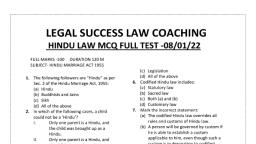
L, , LEGAL SUCCESS LAW COACHING, HINDU LAW MCQ FULL TEST -08/01/22, , FULL MARKS -100 DURATION 120M, SUBJECT- HINDU MARRIAGE ACT 1955,, , The following followers are “Hindu” as per, , Sec. 2 of the Hindu Marriage Act, 1955:, , (a) Hindu, , (b) Buddhists and Jains, , (c) Sikh, , (d) All of the above, , In which of the following cases, a child, , could not be a ‘Hindu’?, , I, Only one parent is a Hindu, and, the child was brought up as a, Hindu., , I. Only one parent is a Hindu, and, , the child was not brought up asa, , Hindu., , If after the birth of a child, one of, , the parents become convert to, , another religion,, , IV. If after the birth of a child, one or, both of the parents become, convert to another religion and in, the exercise of parental right the, child is also converted into the, religion in which the parent or, parents have converted., , Codes:, , (a) |, IIland Iv, , (b) land iv, , (c) landiv, , (d) Nand tt, , The Hindu Marriage Act does not apply to:, , (a) Scheduled Tribes (even if Hindus), , (b) Scheduled Tribes (even if Hindus), unless the Central Government by, notification in the Official Gazette, directs so., , (c) Buddhists, , (d) Sikhs, , The ancient sources of Hindu law include:, , (a) Shruti and Smriti, , (b) Digests, , (c) Commentaries and Customs, , (d) All of the above, , The modern sources of Hindu law include:, , (a) Equity, justice and good conscience, , (b) Precedents (judicial decisions), , », , (c) Legislation, , (d) All of the above, , Codified Hindu law includes:, , (a) Statutory law, , (b) Sacred law, , (c) Both (a) and (b), , (d) Customary law, , Mark the incorrect statement:, , (a) The codified Hindu law overrides all, rules and customs of Hindu law., , (b) A person will be governed by custom if, , he is able to establish a custom, , applicable to him, even though such a, , custom fs in derogation to codified, , Hindu law., , In matters of prohibitions on marriage, , on the ground of blood relationship of, , affinity, ceremonies of marriage, and,, , divorce, customs are not allowed to, , override the statutory law., , It has been an established rule of, , Hindu law that custom override sacred, , law., , As per Sec, 3 of the Hindu Marriage Act,, , “custom” and “usage” signify any rule:, , {a} Which having been continuously and, uniformly observed for a long time,, has obtained the force of law among, Hindus in any local area, tribe,, community, group or family., , (b) Which is certain and not, unreasonable., , {c) Which is not opposed to public, policy., , ({d) All of the above, , Hindu law has two main schools:, , {a} Mitakshara school and Dayabhaga, school, , (b) Mitakshara school and Mithila school, , {c) Dayabhaga school and Benaras, school, , (d) Dayabhaga school and Dravida school, , {c), , (9), , 10, Mark the incorrect statement:, , (a) The Dayabhaga prevails in Bengal and, North-East States and the Mitakshara, prevails in rest of India., , , , mz KAMLA COMPLEX, OPP. R.G. INTER COLLEGE, CHIPP| TANK, MEERUT. 7982730859
Page 2 :
(b) The Mitakhshara school has four sub- 15. Performance of certain shashtric !, , schools, the Benaras, the Bombay, ceremonies is still necessary for a valid |, the Mithila and the Dravida or South Hindu marriage. The ceremonies i, India. specifically recognized by the H.M. Act I, (c) In the modern Hindu law, schools is/are:, have relevance only in the respect of {i) Saptapadi and invocation before, the uncodified Hindu law; they have the sacred fire., lost all their relevance in regard to {ii) Kanyadan, the codified Hindu law (iii) Panigrahan, (d) None of the above. {iv) Vivaha-homan, 11, In modern Hindu law, marriage has Codes : t, become: {a} |, land iv !, (a) Monogamous (b) 1, Mand Iv, (b) Indissoluble union {c) land IV only, (c} Sacramental union (d) lonly i, (d) Contract 16. Section 7 of the H.M. Act lays down that a, 12. Mark the incorrect statement. Hindu marriage may be solemnized in, (a) A marriage has a semblance of a accordance with the:, contract as consent is of some {a} Customary rites and ceremonies of, importance. either party thereto., (b) Consent is an essential aspect of (b) Customary rites and ceremonies of, Hindu marriage, thus if consent both parties thereto,, obtained by force or fraud the {c) New and innovated ceremonies and t, marriage is void. rites, |, (c} A child marriage is a valid marriage (d) Both (a) and (b), under Hindu law while under the 17. A customary ceremony:, Contract Act, the contract of a minor (a) May not include any one of the i, is void. shastric ceremonies including, (d) A marriage has a semblance of a Saptapadi., sacrament as in most marriages 2 (b) May be totally non-religious, sacramental ceremony is still ceremony or simple ceremony., necessary. ({c) Should be an essential ceremony in, 13. The Hindu Marriage Act, 1995: the community of the parties., (a) Recognizes Brahma (bride given in {d) All of the above. |, gift by father) form of marriage. 18. Which of the following is a valid i, (b) Recognizes Gandharva (mutual customary marriage? |, agreement of bride and bridegroom). {a) Smearing of vermillion by the i, (c} Does not specifically provide for any bridegroom on the forehead of the i, form of marriage. bride. t, (d) Recognizes only court marriages. (b) Tying of the mangla sutra around the, 14, The H.M. Act calls marriage solemnized bride’s neck., under the Act as “Hindu marriage”: (c) Exchange of garland between the, (a) Which may be performed in bride and bridegroom. ', accordance with the shashtric rites {d) All of the above ', and ceremonies. 19. Among the Jats and same lower caste, (b) Which may be performed in Hindus in Northern India which for, of the, accordance with the customary marriage is prevalent? i, ceremonies. (a) Kareva |, (c) Which can be entered into any one of (b) Chadar andazi i, the three forms (viz. Brahma, {c) Both (a) and (b) |, Gandharva or Asura) by performing ({d) Pratiloma, necessary ceremonies and rites 20. Anand karaj is a:, required under the Act. {a} Buddhist ceremony, (d) All of the above. (b) Sikh ceremony, , {c) Jain ceremony, , , , iz KAMLA COMPLEX, OPP. R.G. INTER COLLEGE, CHIPPI TANK, MEERUT. 7982730859
Page 3 :
(d) Jat ceremony, , 21. A marriage without requisite ceremonies, , under the H.M. Act is:, (a) Null and void, , (b) Voidable, , (c) Void or voidable, (d) Irregular, , 22. A marriage between two Hindus by the, , Buddhist rites is:, (a) Void, , (b) Voidable, , (c) Valid, , (d) Invalid, , 23. Under the Hindu Marriage Act, 1955:, , (i) Any two Hindus domiciled in, Indian can perform their, marriage., , (ii) Any two Hindus whether, domiciled in India or not,, whether Indian nationals or, foreigners (i.e., a Hindu living in a, foreign country), can perform, their marriage., , (iii) Marriages between the persons, belonging to Hinduism, Jainism,, Sikhism and Buddhism are valid., , (iv) Marriages between a Hindu and, non-Hindu or outside the four, main religious communities of, Hindus are not possible in India., But in a foreign country it will be, valid marriage. Such a marriage, could be performed in India, under the Special Marriage Act,, 1954., , Codes:, , (a) I tandiv, , (b) 1, and iv, , (c) Handiv, , (d) 1, Mandiv, , 24. As per Sec. 5 of the H.M. Act, the, , essential conditions of a valid Hindu, , marriage are :, , (i) Neither party has a spouse living, at the time of marriage., , (ii) At the time of marriage, neither, party Is incapable of giving a valid, consent owing to unsoundness of, mind., , (iii) At the time of marriage, neither, party is suffering from mental, disorder of such a kind as to be, unfit for marriage and the, procreation of children, , 26., , 27., , 28., , 29., , {iv) The bridegroom has completed, the age of 21 years and the bride, age of 18 years., , {v) The parties are not within the, degrees of prohibited, relationship, unless the custom, or usage permits such marriage., , (vi) The parties are not sapindas of, each other, unless the custom or, usage permits such marriage., , {a) LI, Wand Vv, , (b) 1, Ill, IV, Vand VI, , (c) | WiVand vi, , (d) All of the above, , The offence of bigamy is committed by a, , person who marries during the lifetime of, , his or her spouse provided:, , (a) The first marriage is not null and void., , (b) The first marriage is null and void., , ({c) The first marriage is voidable and no, court’s decree annulling first, marriage has been obtained,, , {d) Both (a) and (b), , Which of the following is not a case, , coming under ‘bigamy’:, , {a} Bhaurao v State of Maharashtra, , (b) Dr. N.A. Mukerj v State, , {c) Sarla Mudgal v Union of India, , (d) P.V. Venkataramana v State, , Section 11 of the H.M. Act makes a, , bigamous marriage:, , {a} Void, , (b) Voidable, , {c) Void and voidable, , (d) Invalid, , Section 17 of the H.M. Act makes bigamy, , a penal offence under :, , {a) Secs. 494 and 495, Indian Penal Code, , (b) Secs. 493 and 495, Indian Penal Code, , ({c) Sees. 492 and 494, Indian Penal Code, , (d) Secs. 496 and 497, Indian Penal Code, , Mark the incorrect statement :, , {a} The persons who perform bigamous, marriage can’t be guilty if they omit,, deliberately or inadvertently (by, mistake), to perform the essential, ceremonies of marriage., , (b) A married person cannot keep a, concubine., , (c) A marriage, which is in violation of, “any provisions of law”, would be, void under Sec, 494, IPC., , {d) In Sarla Mudgal v Union of India, the, Supreme Court put a check on the, practice of Hindus to embrace Islam, , , , m=z KAMLA COMPLEX, OPP. R.G. INTER COLLEGE, CHIPPI TANK, MEERUT. 7982730859
Page 4 :
in order to contract a second, marriage., , 34. G, a Hindu girl, aged 14 years, marries B,, a Hindu boy, by exchanging garlands in a, , temple. Later on, G finds that B is i, , impotent. G leaves the matrimonial home I, , and marries A:, , {a} Gcan be punished for bigamy., , {b) G cannot be punished for bigamy., , {c) G cannot be punished for bigamy, because his first marriage was not, valid on account of improper, , 30. In 1965, Ramesh aged 7 years got, married to Vibha, a 2-year old girl in, accordance with religious rites and, ceremonies. In 1985, Ramesh got married, to Sudha in a temple by exchange of, garlands, and applying a tilak of his blood, to Sudha’s forehead in presence of the, priest of the temple and the parents of, , Sudha : solemnization of marriage. t, (a) Ramesh can be prosecuted for (d) G cannot be punished for bigamy ', committing bigamy. because his first marriage was not f, (b) Ramesh cannot be prosecuted for valid on account of impotency of B. |, committing bigamy. 35. B, A Hindu boy aged 20 years, loves G, a i, , (c} Ramesh cannot be prosecuted for, committing bigamy because his, , Hindu girl, aged 16 years. They go toa |, , temple and take a vow that they are now, , second marriage was not valid. husband and wife. B does not disclase, , (d) Ramesh cannot be prosecuted for this fact to his parents. Subsequently, his, committing bigamy because his first father duly solemnizes 8's marriage with, marriage was not valid. Ww:, , 31, In 1990, Karan aged 18 years married {a} B can be punished for bigamy., Maneka aged 16 years in accordance with (b) B cannot be punished for bigamy. t, religious rites and ceremonies, In 1994, {c) B cannot be punished for bigamy t, Karan married Urvashi in Gandharva form because his first marriage was not, of marriage by exchange of garlands : valid on account of improper, (a) Karan can be prosecuted for solemnization of marriage. i, , committing bigamy. (d) B cannot be punished for bigamy, (b) Karan cannot be prosecuted for because his first marriage was not, committing bigamy valid on account of non-disclosure to, (c) Karan cannot be prosecuted for parents., committing bigamy his second 36. In case of bigamy, the aggrieved spouse, marriage was not valid. can:, , (d) Karan cannot be prosecuted for, committing bigamy because his first, marriage was not valid., , 32. A marries 8; later A started living with C, , and a child was born between them. B, , {a} Initiate criminal proceedings, , (b) Claim divorce and file a petition for, maintenance allowance. |, , {c) Seek an injunction, to restrain erring I, spouse from remarrying, from the i, , prosecutes A: court under the Code of Civil, , (a) A cannot be prosecuted for Procedure., committing bigamy. ({d) All of the above, , (b) Acan be prosecuted for committing 37. Mark the incorrect statement :, bigamy. {a) The first wife cannot petition for, , nullity under Sec. 11, only second ', wife could do so., , (b) The first wife may file a declaratory |, suit under the Specific Relief Act. i, , (c)_ In the case of bigamous marriage, the t, “second wife” has no status of wife, i, but she can start criminal |, proceedings against the erring spouse, if she was not aware of the existence, of the first marriage of the erring, spouse., , (c) A has committed no offence., (d) None of the above, , 33. A marries 8; later A, after conversion to, Islam, marries a Muslim girl. 8 prosecutes, A:, , (a) A cannot be prosecuted for, committing bigamy., , (b) A can be prosecuted for committing, bigamy., , (c) A has committed no offence, , (d) None of the above, , , , mz KAMLA COMPLEX, OPP. R.G. INTER COLLEGE, CHIPPI TANK, MEERUT. 7982730859
Page 5 :
41., , 42., , 43., , (d) In bigamy the solemnization of, marriage as a fact has not to be, proved., , To make a marriage voidable on account, , of lack of mental capacity, the mental, , capacity should relate to :, , (a) Pre-marriage mental conditions, , (b) Post marriage mental conditions, , (c) Both (a) an (b), , (d) Either (a) or (b), , Achild marriage is prohibited under, , Hindu law but if it is solemnized, what, , will be the status of such marriage :, , (a) Valid, , (b) Void, , (c} Voidable, , (d) None of the above, , . Mark the correct statement :, , (a) Hindu Marriage Act provides for, some punishment for child marriage, under Sec. 18., , (b) A child marriage Is void under the, Special Marriage Act, 1954., , (c}) The Child Marriage Restraint Act,, 1929 (as amended in 1978), applies, to all communities in India and, prohibits child marriages. But the Act, does not affect the validity of child, marriage, which is governed by the, personal law of the parties to, marriage., , (d) The court has no power to Issue an, injunction to prohibit a child marriage, from being performed,, , If a minor marries without the consent of, , the parents/guardians, the marriage, , would be :, , (a) Invalid, , (b) Valid, , (c} Void, , (d) Voidable, , Void marriage under Sec. 11 of the H.M., , Act includes marriage with respect to :, , (a) Sapinda relationship, , (b) Degree of prohibited relationship, , (c) Both (a) and (b), , (d) None of the above, , Sapinda relationship is created :, , (a) Up to 3 generations inclusive in line, of ascent through mother., , (b) Up to 5 generations inclusive in line, of ascent through father., , (c) Up to 5 generations inclusive in line, of ascent through father., , (d) Both (a) and (b), , 44, As per Sec. 3(g), of the Act two persons, cannot marry if they are related to each, other within the ‘degrees of prohibited, relationship’, viz:, , {a) If one is a lineal ascendant of the, other., , (b) If one was the wife of husband of a, lineal ascendant or descendants of, the other., , {c) If one was the wife of the brother, or, , the father’s brother's wife, or, grandmother's brother's wife., (d) All of the above., 45. Which one of the following is/are within, the ‘degrees of prohibited relationship’ :, {a) Brother and sister, (b) Uncle and niece or aunt and nephew, (c) Cousins, (d) All of the above, 46. Mark the incorrect statement :, {a} When both the parents (father and, mother) of two persons are same, it, is ‘relationship by full blood’., , (b) When father is common and mothers, are different, it is ‘relationship by half, , blood’., , (c) When mother is same and fathers are, different, it is ‘relationship by uterine, , blood’., , Even if a custom permits, a marriage, between two Sapindas or between, two persons within the degrees of, prohibited relationship, will be, invalid., , (d), , 47. Which one of the following marriages is a, , valid Hindu marriage?, , {a) Marriage of maternal uncle and niece, , (b) Marriage with brother's widow, (c) Marriage with father’ brother, (d) A marriage a widow while she is, pregnant., 48. Which one of the following marriages is, not a valid Hindu marriage :, ' A marries his adopted sister,, , i Marriage of step-brother and, , sister., , WV. Marriage with wife's sister after, her death., , Vv. Marriage with deceased wife's, mother., , vi A marries with mother’s sister's, daughter's daughter., , Codes :, , {a) |, and tl, , I. A marries his stepmother’s sister., , , , iz KAMLA COMPLEX, OPP. R.G. INTER COLLEGE, CHIPPI TANK, MEERUT. 7982730859



 Learn better on this topic